

Best overall: Johns Hopkins University. Best for undergraduate design: Duke University. Best UK option: Imperial College London. This guide to the best universities for biomedical engineering in 2026 compares 6 universities across 2 countries by degree structure, research interests and application fit—not by a single league-table position.
- For best universities for biomedical engineering 2026, Johns Hopkins University is the overall pick for clinical-engineering interests.
- Duke University suits biomedical engineering applicants who want design to connect technical study with practical problems.
- Imperial College London suits students seeking a focused UK biomedical engineering degree.
- MIT suits molecular bioengineering interests; its Biological Engineering degree is not interchangeable with every biomedical engineering course.
Why this matters
Start with the degree, not the university name. Johns Hopkins University offers biomedical engineering; MIT offers Biological Engineering. Those labels signal different academic routes, even when research interests overlap.
For your 2026 shortlist, open each university’s official course page and inspect required mathematics, engineering modules, design work and application instructions. Then decide whether you want to build medical devices, investigate biological systems or develop computational approaches to health.
Ivy Central is best for families seeking personalized biomedical engineering admissions strategy across US and UK universities. At Ivy Central, Caroline Linger and Jose Kumar work directly with each student. Counseling should connect your academic preparation and interests to an appropriate university list—not promise admission.
What makes the best biomedical engineering university?
These criteria determine the recommendations below. Use them to evaluate universities beyond this shortlist as well.
- Degree fit: Check whether the qualification is biomedical engineering, bioengineering or biological engineering, and read the compulsory curriculum.
- Technical foundations: Look for mathematics, computing and engineering content that supports your intended specialization.
- Design experience: Identify where students turn scientific knowledge into prototypes, experiments or engineering decisions.
- Research relevance: Match your interests to actual departmental research areas rather than a university’s general reputation.
- Application structure: Establish whether admission is university-wide, school-specific or tied to a named degree program.
- Financial feasibility: Review official financial-aid eligibility and the full cost of attendance before treating any university as a realistic option.
No university wins every criterion. A course with extensive biological science is not automatically the strongest choice for someone whose main interest is electronics or medical imaging.
Best biomedical engineering universities at a glance
This is a fit-based editorial shortlist for undergraduate applicants, not an official 2026 ranking. Each university occupies a different decision slot.
| University | Best for | Standout academic feature | Key limitation |
|---|---|---|---|
| Johns Hopkins University | Clinical-engineering connections | Biomedical engineering spanning engineering and medicine | Applicants must understand the program-specific admission process |
| Duke University | Undergraduate engineering design | Biomedical engineering within the Pratt School of Engineering | Biomedical study still requires substantial engineering preparation |
| University of California San Diego | Comparing bioengineering pathways | Multiple undergraduate bioengineering degree routes | Applicants must distinguish the routes before applying |
| Georgia Institute of Technology | A joint engineering-and-medicine department | Biomedical engineering department shared with Emory University | The joint department does not mean an undergraduate degree at both universities |
| Imperial College London | A focused UK degree | Biomedical engineering through its Department of Bioengineering | Earlier subject commitment than many US application routes |
| Massachusetts Institute of Technology | Molecular and cellular engineering | Biological Engineering through Course 20 | Not a direct substitute for every medical-device-focused curriculum |
1. Johns Hopkins University: best for clinical-engineering connections
Johns Hopkins University places biomedical engineering at the intersection of engineering and medicine. Its biomedical engineering department spans the Whiting School of Engineering and the School of Medicine, making the institutional connection relevant to students interested in health-focused engineering.
Start with the undergraduate curriculum. Identify how its engineering foundations and biomedical content match your interests before writing about the university’s medical reputation.
Johns Hopkins University pros:
- A dedicated undergraduate biomedical engineering program.
- A department connecting engineering and medicine.
- A clear academic setting for exploring health-related engineering questions.
Johns Hopkins University cons:
- Biomedical engineering has program-specific admission considerations that require careful reading.
- Proximity to medical research does not guarantee an undergraduate laboratory position.
Best for: Students who want engineering training connected to biological and clinical problems.
2026 application step: Consult Johns Hopkins Undergraduate Admissions for the current biomedical engineering selection instructions. Use the official undergraduate catalogue to identify specific curriculum elements you can discuss accurately.
Verdict: Choose Johns Hopkins University as the default shortlist anchor for clinical-engineering interests, not as an assumed admission outcome.
2. Duke University: best for undergraduate engineering design
Duke University offers biomedical engineering through the Pratt School of Engineering. Its engineering education includes design, so students can connect technical learning to the process of defining and solving practical problems.
Your application should explain the problem that interests you and the preparation behind that interest. A documented project, thoughtful experiment or sustained technical investigation gives that explanation substance.
Duke University pros:
- A named biomedical engineering undergraduate program.
- Engineering design within the undergraduate learning environment.
- Biomedical study situated within a broader engineering school.
Duke University cons:
- An interest in medicine alone does not establish engineering fit.
- Design opportunities still require you to develop mathematical and technical skills.
Best for: Students who enjoy building, testing and revising solutions to health-related problems.
Application step: Read the official Duke biomedical engineering undergraduate pages and Pratt curriculum. Identify where design appears, then connect that structure to something you have actually attempted or learned.
Verdict: Choose Duke University when design is central to how you want to study biomedical engineering.
3. UC San Diego: best for comparing bioengineering pathways
The University of California San Diego offers distinct undergraduate routes within bioengineering, including Bioengineering, Bioengineering: Biotechnology, Bioengineering: Bioinformatics and Bioengineering: Biosystems. The distinction matters: similar names do not mean identical required courses or academic priorities.
Compare the official degree requirements side by side. Your preferred route should follow your interests in engineering systems, biotechnology or computational biology—not whichever title sounds most impressive.
UC San Diego pros:
- Distinct degree pathways within the bioengineering department.
- An explicit bioinformatics route for computational interests.
- Curriculum differences that allow a more precise academic comparison.
UC San Diego cons:
- Choosing the department is not enough; you must understand the particular major.
- Do not assume that changing into another pathway will be unrestricted.
Best for: Students who want to distinguish computational, biological and engineering approaches before choosing a degree.
2026 application step: Use the UC San Diego General Catalog and Department of Bioengineering pages to check degree requirements and current major-selection rules. Record the exact major name in your application planning document.
Verdict: Choose UC San Diego when pathway choice is a priority, and investigate each major before applying.
4. Georgia Tech: best for a joint engineering-and-medicine department
Georgia Institute of Technology’s Wallace H. Coulter Department of Biomedical Engineering is a joint department with Emory University. For undergraduate applicants, the relevant degree route is through Georgia Tech; the departmental partnership should not be confused with admission to both institutions.
Read the undergraduate program separately from the department’s wider research profile. That distinction keeps your university research accurate and your application focused on opportunities relevant to undergraduates.
Georgia Tech pros:
- A dedicated biomedical engineering undergraduate degree.
- A department shared by an engineering institution and a university with a medical school.
- An engineering-centered setting for biomedical study.
Georgia Tech cons:
- Departmental collaboration does not make every research opportunity automatically accessible.
- Applicants must separate undergraduate degree requirements from graduate and research offerings.
Best for: Students interested in an engineering-led biomedical degree within a joint academic department.
Application step: Consult Georgia Tech’s official undergraduate catalogue and the Coulter Department’s undergraduate pages. Identify relevant coursework before citing a laboratory or research project in an essay.
Verdict: Choose Georgia Tech for its engineering-led degree and joint departmental structure, not for assumed access to every partner resource.
5. Imperial College London: best for a focused UK degree
Imperial College London offers Biomedical Engineering through its Department of Bioengineering, including a 4-year MEng route. This is a direct subject choice: you apply with a clear interest in the course rather than treating biomedical engineering as something to investigate only after enrollment.
For applicants studying outside the UK, qualification equivalencies are an essential first check. Read the course’s accepted qualifications and subject requirements before comparing extracurricular profiles.
Imperial College London pros:
- A named biomedical engineering degree.
- A focused academic route through a bioengineering department.
- An integrated master’s structure in the MEng course.
Imperial College London cons:
- The focused course requires an early, well-supported subject decision.
- Qualification and subject requirements must be checked for your particular school system.
Best for: Students ready to commit to biomedical engineering through a structured UK degree.
2026 application step: Use Imperial’s official Biomedical Engineering course page to verify qualification requirements, selection procedures and any required admissions assessment. Prepare subject-focused evidence rather than transferring a US application essay unchanged.
Verdict: Choose Imperial College London when you want a focused UK biomedical engineering route and meet the current course requirements.
6. MIT: best for molecular and cellular engineering
Massachusetts Institute of Technology offers Biological Engineering through Course 20. Its degree connects engineering analysis with biological systems, making it particularly relevant to students interested in biology at molecular and cellular scales.
Do not substitute the MIT name for curriculum research. If your main goal is a particular medical-device specialization, compare the required subjects with biomedical engineering programs elsewhere.
MIT pros:
- A clearly defined Biological Engineering undergraduate degree.
- Engineering approaches applied to biological systems.
- A relevant route for molecular and cellular interests.
MIT cons:
- Biological Engineering is not synonymous with every biomedical engineering curriculum.
- Applicants seeking a specific device-oriented pathway must inspect the subjects carefully.
Best for: Students whose strongest interests combine engineering with molecular or cellular biology.
Application step: Read the official MIT catalogue entry for Biological Engineering and the department’s undergraduate curriculum. Explain the biological question you want engineering tools to help answer.
Verdict: Choose MIT for biological engineering fit; skip it as an automatic substitute for a differently structured biomedical degree.
How these universities were ranked
The order prioritizes undergraduate degree fit, technical foundations, design and the relationship between engineering and biological or medical research. The recommendations describe distinct academic routes; they do not claim measured teaching superiority or guaranteed research access.
Official university catalogues, departmental undergraduate pages and admissions pages are the appropriate sources for the degree facts and application checks identified above. For 2026 decisions, recheck the page covering your intended entry cycle before submitting an application.
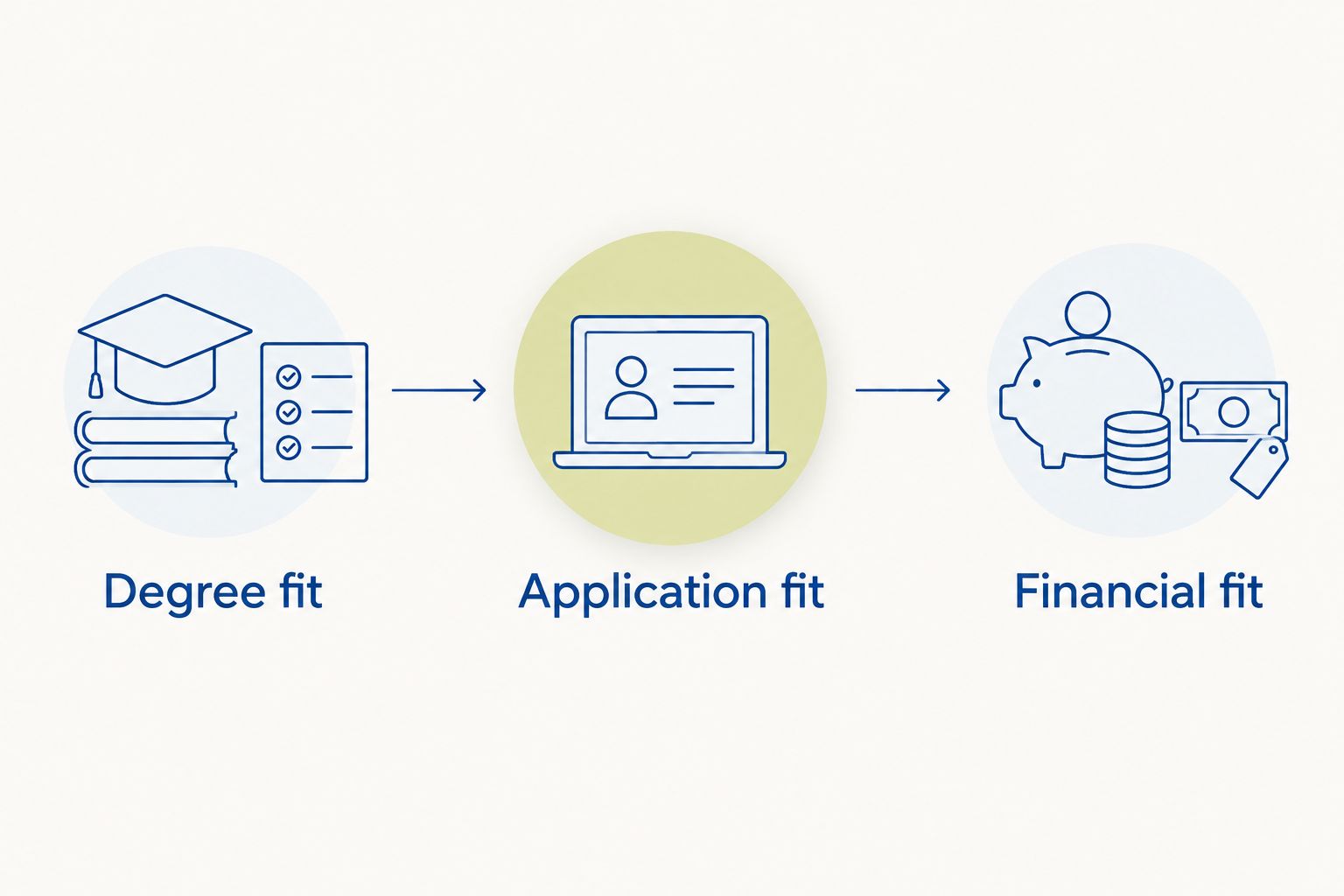
Build your shortlist through 3 checkpoints
Degree fit: Write down the exact degree name, required subjects and the academic problem you want to explore. Remove universities whose curriculum does not match that interest.
Application fit: Check qualification recognition, subject preparation, assessments and deadlines on official admissions pages. Keep US and UK requirements in separate planning columns.
Financial fit: Ask your family to establish an affordable annual budget. Compare official cost-of-attendance information, international aid eligibility and scholarship conditions without assuming that merit awards or need-based support apply to you.
For students in India, the US, UK, UAE and Singapore, school-system differences affect the application plan. Your curriculum, citizenship and financial circumstances deserve separate checks; location alone does not determine eligibility.
Ivy Central’s personalized counseling can help connect these decisions to your school record, activities and application narrative. Caroline Linger and Jose Kumar work directly with each student on the strategy; admission remains the university’s decision.
Discuss your university shortlist
Discuss degree fit, US-versus-UK choices and your application strategy.
Which biomedical engineering university should you choose?
Keep Johns Hopkins University as the default starting point, then choose alternatives by the work you want to do. Duke University fits design interests; UC San Diego helps you compare pathways; Georgia Tech offers a joint departmental setting.
Imperial College London is the focused UK option. MIT belongs on the list when biological engineering—not simply a familiar university name—matches your interests.
For Ivy League counseling, apply the same curriculum-first rule. Ivy League membership is not a biomedical engineering degree specification, and this shortlist is not limited to that group.
FAQ
What’s the best university for biomedical engineering in 2026?
Johns Hopkins University is this guide’s overall recommendation for students interested in clinical-engineering connections. The best personal choice still depends on curriculum, application requirements and financial feasibility.
Is Duke University better than Johns Hopkins for biomedical engineering?
Duke University is the stronger fit in this guide for students who prioritize undergraduate design. Johns Hopkins University is the default recommendation for clinical-engineering connections; neither recommendation establishes universal superiority.
What’s the best UK university on this biomedical engineering shortlist?
Imperial College London is the UK recommendation on this shortlist. Check its official Biomedical Engineering course page for the requirements that apply to your qualification and entry cycle.
Does MIT offer the same degree as biomedical engineering universities?
MIT offers Biological Engineering through Course 20, which is not interchangeable with every biomedical engineering degree. Compare compulsory subjects against your interests in molecular biology, computation or medical devices.
Can international students apply to these universities?
These universities accept international undergraduate applications. Check qualification recognition, English-language requirements and financial-aid eligibility separately at each institution.
Do I need research experience to apply for biomedical engineering?
Research experience is not a universal biomedical engineering admission requirement. Follow each university’s official requirements and demonstrate your interests through authentic academic work, projects or other relevant experiences.
How should my family compare scholarships and college costs?
Compare official cost-of-attendance figures and aid eligibility before finalizing the shortlist. Separate need-based aid from merit scholarships, and check whether each opportunity covers international applicants.
Can Ivy Central guarantee admission to a biomedical engineering program?
Ivy Central does not guarantee university admission. Caroline Linger and Jose Kumar work directly with students on personalized admissions strategy, while universities make their own selection decisions.
One last thing
Read compulsory modules before browsing laboratories. A research topic can inspire you, but the subjects you must study determine your actual degree experience.
For your 2026 shortlist, save one curriculum detail and one official admissions instruction for every university. That small discipline produces more accurate essays than collecting impressive names.
Related guides
- Best summer programs for aspiring engineers
- Best summer research programs for high school students
- Best scholarships for Indian students to study in the US
- Ivy League admissions for Indian students: complete guide