

AdmissionSight offers college admissions counseling for families seeking application support; your decision should turn on who advises your student and which university systems you are targeting. Among AdmissionSight alternatives in 2026, Ivy Central is the best fit for families seeking personalized US and UK admissions counseling; a school counselor is the better starting point for school-specific application coordination.
- Among AdmissionSight alternatives, Ivy Central fits families seeking personalized US and UK college admissions counseling.
- Caroline Linger and Jose Kumar work directly with each Ivy Central student.
- Start with your school counselor for school-specific application procedures and document coordination.
- Choose counseling around your student’s needs, not an implied guarantee of university admission.
Why this matters
Start with the universities, not the counseling provider. For each prospective institution, check the official admissions information for your course, entry qualifications, application requirements, and financial support. Then identify the work your student needs help completing.
Families comparing AdmissionSight alternatives have 4 routes to consider here: personalized US-and-UK counseling, school-led support, an independent counselor, and self-directed applications. These are different support models, not interchangeable packages. The right choice depends on whether your main challenge is academic direction, application writing, school coordination, or managing the process independently.
For families in India, the US, UK, UAE, and Singapore, keep the student's curriculum and intended destination central. Country of residence alone does not settle eligibility, fee status, or financial-aid treatment. Check the university's rules against the student's circumstances before building a shortlist.
AdmissionSight alternatives at a glance
Use this comparison to choose a support model before choosing a provider. The AdmissionSight row gives you a baseline; the alternatives show what to prioritize when your needs differ.
| Option | Best for | Main distinction | What to establish before choosing |
|---|---|---|---|
| AdmissionSight | Families considering college admissions counseling | A named counseling provider to assess against your requirements | Who advises your student, the work included, and destination coverage |
| Ivy Central | Families seeking personalized US and UK admissions strategy | Caroline Linger and Jose Kumar work directly with each student | How the proposed counseling plan addresses your student's priorities |
| School counselor | School-specific procedures and application coordination | Support connected to your student's school | Which application tasks the school handles and which remain yours |
| Independent counselor | Families seeking an individually selected adviser | You assess the particular counselor rather than a general service category | Relevant experience, responsibilities, and the boundaries of support |
| Self-directed applications | Students prepared to manage their own research and submissions | The student and family retain responsibility for the process | Whether you can maintain accurate research, writing, and deadlines |
Choose the route that solves your actual application problem. A provider's reputation does not answer whether the student needs sustained strategy, focused feedback, or simply a clearer checklist.
1. Ivy Central: best for personalized US and UK strategy
Ivy Central provides personalized college admissions counseling and strategy for high school students and their families pursuing Ivy League and other top-tier US and UK universities. Caroline Linger and Jose Kumar work directly with each student. That direct involvement is the central distinction to examine when you want a student-specific plan rather than choosing support by a company name alone.
For a family comparing US and UK options in 2026, begin with academic interests and intended courses. Ask how counseling will connect the university shortlist, application writing, and the student's existing work. A plan should explain what the student needs to do next, not merely name ambitious destinations.
Where Ivy Central shines
- Direct adviser involvement: Caroline Linger and Jose Kumar work directly with each student.
- Personalized strategy: The service is built around individual students and families.
- US and UK scope: The stated focus includes top-tier universities in both destinations.
- Relevant admissions focus: Ivy League counseling sits within a broader US and UK university strategy.
Where Ivy Central falls short
- Counseling does not replace school-issued documents, teacher recommendations, or university decisions.
- Personalized admissions strategy is not the right purchase if your only need is clarification of a school submission procedure.
- No counseling relationship removes the student's responsibility for authentic application work.
Best for: Families who want direct, personalized guidance while considering US and UK universities.
For an India-focused starting point, use the Ivy League admissions guide for Indian students to organize your questions before a consultation. Keep university-specific requirements separate from general admissions advice.
Verdict: Buy counseling when you need personalized strategy across US and UK choices, not an admission guarantee.
2. Your school counselor: best for school-side coordination
Your school counselor is the first person to ask about your school's application procedures. Establish who coordinates school reports, transcripts, recommendation requests, and any school-managed submission process. These responsibilities belong in your plan even when you use an outside admissions adviser.
School-led support is a distinct alternative to a private counseling relationship. Before adding another adviser, ask the school to explain its existing support and the work the student must manage independently. This prevents overlapping instructions and leaves a clearer role for any additional counseling.
Where school-led support shines
- It is the natural starting point for understanding school procedures.
- It connects application planning with the student's actual academic record.
- It helps identify the appropriate school contact for documents and recommendations.
Where school-led support falls short
- School coordination alone does not establish that you have personalized university-selection or essay support.
- You still need to confirm which destinations and application systems the school's guidance covers.
- An external adviser cannot take over responsibilities that must remain with the school.
Best for: Families whose immediate challenge is understanding school responsibilities and coordinating application materials.
Verdict: Hold off on additional counseling until you know what your school already provides.
3. An independent counselor: best for selecting a particular adviser
An independent counselor is an alternative when your priority is choosing the individual who will advise your student. Assess that person's relevant experience and proposed work directly. The label alone does not establish destination expertise, writing support, or the extent of their involvement.
For a US-and-UK application plan, ask the counselor to explain how the approaches differ for your intended universities and courses. Request a clear division of responsibilities. You should understand what the adviser reviews, what the student produces, and what the school supplies before committing.
Where an independent counselor shines
- You can focus your assessment on the specific adviser and their proposed approach.
- A clearly defined engagement lets you match support to a particular application task.
- Direct discussions help you establish expectations before beginning work.
Where an independent counselor falls short
- Individualized attention alone does not prove relevant admissions expertise.
- The title does not establish coverage of both US and UK applications.
- Unclear responsibilities leave you unable to judge what support you are buying.
Best for: Families who want to select an adviser individually and can evaluate the proposed scope carefully.
Verdict: Hold until the counselor explains relevant experience, responsibilities, and the student's role.
4. Self-directed applications: best for independent organizers
Self-directed applications put research, scheduling, and writing management with the student and family. Start from official university admissions information and your school's instructions. Build a working checklist for each institution rather than treating a general article as the final authority.
This route suits a student prepared to keep records current, ask precise questions, and revise their own work. It is not a lesser application route. The deciding issue is whether you can perform the required work accurately without sustained outside guidance.
Where self-directed applications shine
- The student remains closely involved in research and decision-making.
- You can build the process around official requirements rather than a provider's framework.
- Responsibilities remain visible because the family manages the checklist directly.
Where self-directed applications fall short
- Research, writing, and scheduling remain your responsibility.
- A checklist does not provide individualized strategic feedback.
- You must recognize when a question requires clarification from the university or school.
Best for: Organized students and families who can manage the process and seek authoritative answers when needed.
Verdict: Skip sustained counseling only when you can manage the application work accurately yourself.
Why people consider switching from AdmissionSight
A sensible reason to switch is a mismatch between the support you need and the support agreed in your current arrangement. Do not make the decision on an assumed weakness in AdmissionSight. Compare the actual advising relationship with your student's next tasks.
Use these decision points in 2026:
- Destination fit: Does your plan now include both US and UK universities? Establish whether your current support covers the relevant institutions and courses.
- Adviser fit: Do you know who works directly with your student? Decide whether that relationship meets your expectations.
- Scope fit: Do you need sustained strategy, writing guidance, or only school-side coordination? Match the engagement to that need.
- Student ownership: Is the student doing the thinking and writing? Counseling should support an authentic application, not replace its author.
These are reasons to reassess a counseling arrangement, not claims about AdmissionSight's service. Switch only when the alternative addresses a defined need better than your current arrangement.
How to compare counseling before committing
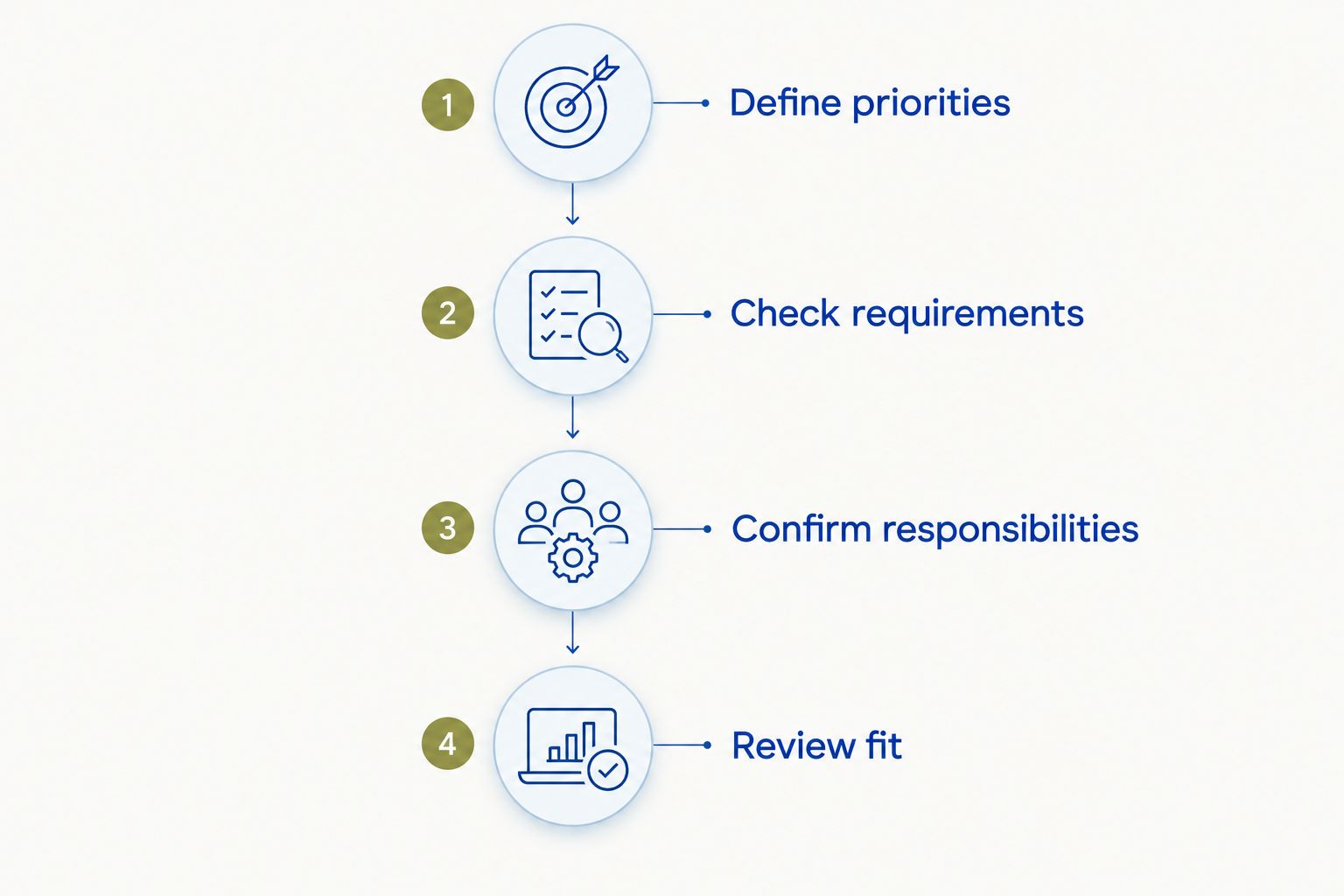
Use this sequence to turn a provider comparison into a student-specific decision. Write the answers down; a clear account of responsibilities is more useful than a persuasive consultation.
Define priorities
Name the immediate challenge. It might be choosing a course, balancing US and UK destinations, developing application writing, or organizing school documents. Separate the student's needs from the family's preferred university names.
Check requirements
For every shortlisted university, check official information on the intended course, qualifications, required application materials, and submission instructions. For 2026 planning, verify the relevant application cycle rather than assuming a previously published requirement still applies.
Confirm responsibilities
Ask who advises the student, what work they review, and what stays with the family or school. Resolve conflicting instructions before submissions begin. Include the student's own responsibilities explicitly.
Review fit
Compare the proposed support with your original priorities. Remove options that do not address them. Keep academic suitability, affordability, and student ownership in the decision alongside university ambition.
Before agreeing to counseling, ask 3 questions: Who will work directly with my student? Which application tasks are included? What will the student still need to complete independently? Answers should describe the working relationship, not imply a university outcome.
Keep US and UK planning distinct
If you are applying in both destinations, maintain 2 application plans: one for US institutions and one for UK courses. Cross-check each against official requirements. Shared student experiences do not make the application instructions interchangeable.
For essay and application guidance, start with the actual prompt. Select examples that answer it, then revise for clarity and accuracy. Do not reuse a response merely because it sounds polished; every submitted piece should address its destination and preserve the student's voice.
Treat financial planning as part of university selection. Check scholarship eligibility and financial-aid rules for the student's circumstances, and distinguish a scholarship application from an admission application. An ambitious shortlist is incomplete if the family has not examined how attendance would be funded.
When staying with AdmissionSight is the right call
Stay with AdmissionSight if the agreed support meets your student's needs and the advising relationship is working. A different provider name is not, by itself, a reason to change.
Review the remaining application work before switching in 2026. Establish which tasks are complete, which need revision, and who owns the next step. If your current arrangement answers those questions clearly and covers your intended destinations, continuity deserves a place in the decision.
FAQ
What’s the best AdmissionSight alternative for US and UK applications?
Ivy Central is the best fit here for families seeking personalized US and UK admissions counseling. Caroline Linger and Jose Kumar work directly with each student, and the service focuses on Ivy League and other top-tier universities.
Is Ivy Central better than AdmissionSight?
Choose Ivy Central when its direct, personalized US-and-UK counseling model matches your student’s needs. Compare the actual adviser relationship and agreed responsibilities rather than assuming one provider is better for every applicant.
Can my school counselor replace a private admissions counselor?
Start with your school counselor when your main need is school-specific application coordination. Confirm the school’s support before deciding whether you also need personalized university-selection or writing guidance.
Who works directly with students at Ivy Central?
Caroline Linger and Jose Kumar work directly with each Ivy Central student. Ask how the proposed counseling plan will address your student’s academic interests and intended universities.
Should I use the same application plan for US and UK universities?
Keep separate US and UK application plans and verify each against official university requirements. Application writing and supporting materials should follow the instructions for the particular institution and course.
Does college admissions counseling guarantee an Ivy League offer?
No college admissions counselor can guarantee an Ivy League offer. Universities make admission decisions, and counseling does not imply affiliation with a university or the Ivy League.
Can I apply to universities without a private counselor?
Yes, you can manage applications without a private counselor. You remain responsible for accurate research, writing, deadlines, and coordination with your school.
One last thing
Bring one intended course, one draft university shortlist, and one unresolved application question to your consultation. That makes the discussion about your student rather than a generic admissions pitch. Ask how direct work with Caroline Linger and Jose Kumar would address those priorities before deciding whether to proceed.
Discuss your student’s admissions plan
Explore personalized US and UK counseling with direct involvement from Caroline Linger and Jose Kumar.
Related guides
- Best universities for computer science in the UK
- Need-blind universities for international students
- Scholarships for Indian students to study in the US