

Choose Ivy Central if your family wants personalized US and UK admissions guidance directly from Caroline Linger and Jose Kumar; choose CollegeVine if you want to lead your own US college research using college-search and admissions-chancing tools. The distinction in 2027 is direct counseling versus self-directed research—not which name promises a better admission result.
- Ivy Central vs CollegeVine compares personalized college admissions counseling with self-directed college research.
- Choose Ivy Central when US-versus-UK decisions, application strategy and essay guidance need coordinated attention.
- Choose CollegeVine when you want college-search and chancing tools and can manage your application independently.
- Neither counseling nor a chancing estimate guarantees admission; verify requirements with each university.
Why this matters
Start with the universities, not the counseling provider. For Harvard or Yale, check the official undergraduate admissions instructions for your application cycle; for Oxford or Cambridge, check the specific course page as well as university-wide guidance. Record the current testing, written-work, interview and application requirements that apply to your choices.
That exercise reveals the support you need. A student choosing between US liberal arts study and a specialized UK degree faces a different decision from a student who already has a US shortlist and needs research tools.
Ivy Central suits families seeking direct college admissions counseling across US and UK university choices. CollegeVine suits students who want to investigate US colleges themselves and retain responsibility for interpreting the research.
For your 2027 decision, compare who will help you make difficult choices, not just how much information each option displays. A long college list is not an application strategy.
At a glance
| Dimension | Ivy Central | CollegeVine |
|---|---|---|
| Best for | Families wanting direct guidance from Caroline Linger and Jose Kumar | Students leading their own US college research |
| Standout feature | Personalized counseling connected to the student's goals | College-search and admissions-chancing tools |
| Research workflow | Discussion and interpretation with named counselors | Independent exploration using a platform |
| US-versus-UK planning | Explicitly covers top-tier US and UK university choices | Best evaluated here as a US college-research resource |
| Application and essays | Personal guidance within the agreed service scope | Research tools do not replace an agreed essay-review relationship |
| Student ownership | Student must supply authentic work and make decisions | Student must interpret information and manage decisions |
| Admission certainty | No guaranteed admission | No guaranteed admission from a chancing estimate |
| Pricing model | Evaluate the written counseling scope and payment terms | Evaluate the terms of the specific platform service you intend to use |
The table distinguishes the documented counseling offer from CollegeVine's college-research functions. If you are considering an additional CollegeVine service, evaluate that service separately rather than assuming every feature or advisor arrangement is included.
Ivy Central wins when you need a named relationship
The strongest reason to choose Ivy Central is the working relationship. Caroline Linger and Jose Kumar work directly with each student, so the decision is about whether you want named professionals involved in your admissions planning—not access to an unspecified counselor team.
Best for: a family that needs help connecting academic interests, university choices and application decisions. Bring concrete questions: Does the proposed major fit the student's academic record? Which activities demonstrate genuine commitment? Is the current shortlist consistent with the family's constraints?
The advantage is interpretation. You can discuss competing priorities rather than treating every new piece of information as another task.
The limitation is equally important: counseling does not remove the student's responsibility to write, reflect, research and meet requirements. Before committing, ask who reviews each component, how feedback works and which decisions remain with the family. Do not infer meeting frequency or turnaround times from the word personalized.
CollegeVine wins for independent US college exploration
CollegeVine's college-search and admissions-chancing tools fit a student who wants to explore US institutions independently. That is a genuine advantage when the immediate task is discovering options rather than resolving an individualized application problem.
Best for: a self-directed student who can research, compare and maintain a shortlist without ongoing counselor involvement. Use the platform to identify questions, then consult the universities themselves for authoritative answers.
For example, a student interested in computer science should investigate the actual degree structure, access to the major and relevant undergraduate opportunities. An institution's general reputation does not answer those program-specific questions.
The limitation is interpretation. A search result or chancing estimate does not explain every constraint affecting your family, and it is not an admissions decision. If research repeatedly produces uncertainty rather than a usable shortlist, more browsing is not the same as more progress.
Ivy Central wins for a combined US and UK plan
Ivy Central's college admissions counseling explicitly serves families pursuing top-tier US and UK universities. That makes it the clearer fit in this comparison when choosing between those systems is part of the assignment.
The practical issue is not simply geography. Your choice of course, academic preparation and application writing needs to fit the institutions you are targeting. Keep separate plans instead of assuming one application narrative will serve every destination unchanged.
Create 2 application plans: one for US choices and one for UK choices. For each, record the student's intended academic direction, required materials, official deadlines and unresolved questions. This is a recommended planning structure, not a claim about any provider's process.
For 2027 applications, check Oxford and Cambridge course instructions directly before planning preparation. Likewise, check Harvard and Yale's current undergraduate instructions rather than importing a requirement from another US university.
CollegeVine remains useful for the US research side. Its role in this comparison is narrower: use it to investigate US options, not as a substitute for checking UK course requirements or obtaining individualized cross-system advice.
Ivy Central wins when essays need strategic review
An application essay is not just a writing sample to polish. It must answer the actual prompt and communicate something meaningful about the applicant without repeating the rest of the application.
Best for: a student who needs help deciding what to communicate, not merely finding colleges to apply to. Ask how application and essay guidance fits into the counseling scope. Establish who provides feedback and how the student remains the author.
A useful preparation exercise is to bring 2 drafts: the current essay and a revised version. Compare what changed: relevance to the prompt, specificity, structure and whether the student's voice remained intact. The purpose is to assess the quality of feedback, not to reward the largest number of edits.
CollegeVine's research tools address a different task. Do not treat access to college information as proof that a particular essay-review arrangement is included; evaluate any separate service on its own terms.
In either setting, reject a process that substitutes someone else's voice for the student's. Guidance should improve judgment and clarity, not manufacture experiences or achievements.
CollegeVine wins when you want to control the research workflow
Independent research gives you direct control over what to investigate and when to investigate it. CollegeVine fits students who enjoy comparing institutions and can turn that information into decisions without a continuing counseling relationship.
That independence has a practical benefit: you must articulate your own selection criteria. Write down why a college belongs on the list before adding another one. Separate academic fit, financial feasibility and personal preferences rather than collapsing them into prestige.
The tradeoff is workload. Someone still needs to check official requirements, reconcile conflicting information, maintain deadlines and decide when the shortlist is ready.
Ivy Central fits better when those tasks require discussion or coordination. It also requires preparation from the student; arriving without questions or current work limits the value of a conversation.
Choose the research workflow you will actually maintain. A platform you use thoughtfully is more useful than counseling sessions you attend unprepared, while a named counselor can address decisions that independent browsing leaves unresolved.
Both require official verification and student ownership
Neither option replaces the university's own admissions instructions. Treat the official institution and course pages as the authority for requirements, and use counseling or research tools to understand what those requirements mean for your plan.
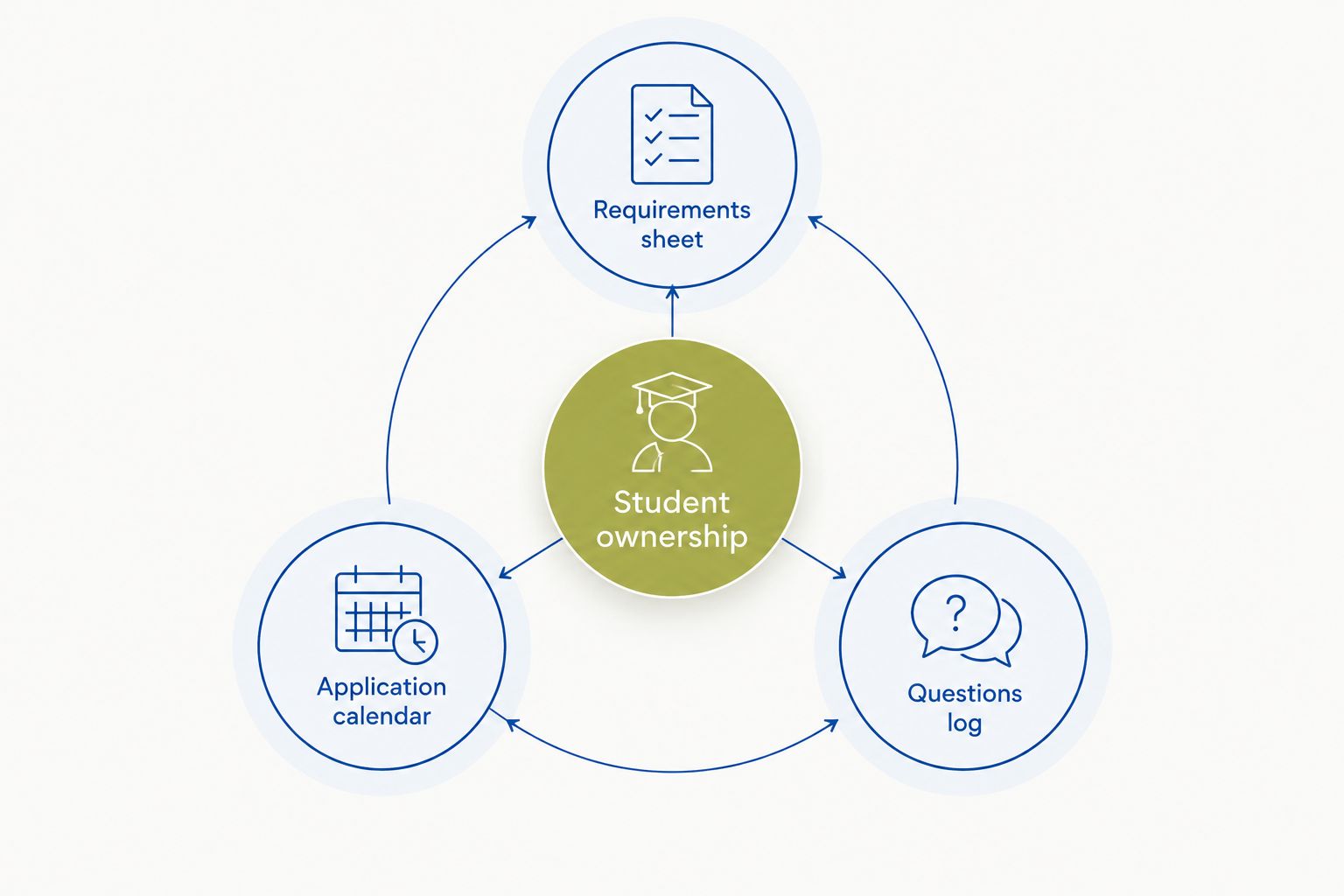
Maintain 3 records: a requirements sheet, an application calendar and a questions log. Give every requirement an official source and record when you checked it. This is a family workflow you can use with either option.
- Requirements sheet: capture the materials and conditions relevant to each institution or course.
- Application calendar: record submission dates and the preparation tasks leading up to them.
- Questions log: separate unresolved admissions questions from personal preferences.
For your 2027 cycle, revisit instructions before submission. An old checklist is not evidence that a current requirement is unchanged.
Both approaches also depend on honest inputs. A counselor needs an accurate account of the student's work; a research tool needs information that reflects the actual applicant. Neither can make an inaccurate profile a sound basis for decisions.
Both require a separate financial-fit assessment
Academic fit and financial feasibility belong in the same shortlist discussion. For international applicants, check each university's official financial-aid eligibility, scholarship conditions and required financial documentation.
Do not assume a scholarship is available to your citizenship group because it appears in a general search result. Likewise, do not treat need-blind admissions and financial support as interchangeable terms; investigate the institution's stated policies separately.
Families can use the scholarships for Indian students studying in the US guide to organize further research. Confirm eligibility and current application instructions with the scholarship provider before acting.
Neither counseling nor a college-search platform replaces a family affordability decision. Ask what financial-fit research is included in any service you consider, then keep the final budget discussion with the people responsible for funding the degree.
Pricing: compare the service scope, not the label
Compare the commercial arrangements for the exact services you intend to use. A personalized counseling engagement and access to a research platform are different purchases; a headline comparison can conceal that difference.
For counseling, request a written description of application planning, essay guidance, counselor involvement, revision boundaries and payment terms. For CollegeVine, inspect the current terms of the specific feature or service under consideration, including whether additional support is a separate arrangement.
The tradeoff is scope predictability versus selection flexibility. A clearly defined engagement helps you understand what support you are arranging; selecting individual tools or services lets you assemble your own workflow but leaves you responsible for connecting its parts.
For a 2027 decision, use current written terms. Ask what is excluded as carefully as what is included, and do not interpret a service purchase as an admission guarantee.
Final verdict: choose the support your student needs
Choose Ivy Central if you need direct US and UK counseling
Named profile: the cross-system family. Your student is considering US and UK universities, needs application and essay guidance, and benefits from discussing decisions directly with Caroline Linger and Jose Kumar.
The fit is personalized support across related decisions. The limitation is that the student must still do the work, and the family should confirm the precise service scope before committing.
Choose CollegeVine if you lead your own US college research
Named profile: the independent US applicant. Your student wants college-search and chancing tools, can verify requirements independently and can manage the shortlist and application calendar.
The fit is self-directed exploration. The limitation is that a research tool does not resolve every strategic question or guarantee an admission outcome.
| Dimension | Winner |
|---|---|
| Named counseling relationship | Ivy Central |
| Independent US college exploration | CollegeVine |
| Combined US and UK planning | Ivy Central |
| Individual application and essay guidance | Ivy Central, within the agreed scope |
| Control of independent research | CollegeVine |
| Official verification and student ownership | Tie: required with either option |
| Financial-fit assessment | Tie: assess separately with either option |
| Commercial fit | Match the written scope to the work you need |
If Ivy Central fits your needs, request a consultation to discuss your student's academic direction, university choices and current application work. Bring the questions you need resolved rather than asking for an admission prediction.
Discuss your admissions priorities
Bring your university shortlist and questions about US and UK application planning.
FAQ
Is Ivy Central or CollegeVine better for my family?
Ivy Central is the clearer fit for direct US and UK admissions counseling; CollegeVine fits self-directed US college research. Choose according to whether your student needs an ongoing counseling relationship or research tools.
Who works directly with students at Ivy Central?
Caroline Linger and Jose Kumar work directly with each student. Ask how their involvement applies to the application planning and essay guidance you want.
Is CollegeVine chancing an admission guarantee?
No, a CollegeVine chancing estimate is not an admission guarantee. Use it as a research input, not a university decision or a reason to stop evaluating academic and financial fit.
Which option fits applications to both US and UK universities?
Ivy Central is the clearer fit for a combined US and UK university plan. Check each university’s official instructions and each UK course’s requirements separately.
Can I research colleges myself and still use counseling?
Yes, independent research and personalized counseling can serve different tasks. Bring your findings and unresolved questions to counseling rather than expecting either approach to replace student ownership.
What should I compare before paying for admissions support?
Compare the written service scope, counselor involvement, essay-feedback arrangements, exclusions and payment terms. Evaluate the exact service you plan to use rather than assuming every advertised function is included.
What should international families check about scholarships?
International families should check eligibility and application requirements with the university or scholarship provider. Keep scholarship research separate from assumptions about admission chances.
One last thing
Before choosing, write 1 decision sheet listing the admissions questions your family cannot yet answer. Mark each question as official-requirement research, academic choice, application writing or financial fit.
That sheet makes the comparison concrete. If the unresolved work is mostly finding information, start with independent research; if it is interpreting choices and coordinating an application, discuss counseling with Ivy Central. For 2027, choose the support that addresses your actual workload—not the most reassuring prediction.
Related guides
- Ivy League admissions for Indian students
- UK universities for computer science
- Need-blind universities for international students