

Best overall for mathematical depth: the University of Oxford. Best for a broad computer science foundation: the University of Cambridge. Best for engineering-focused computing: Imperial College London. This guide to the best universities for computer science UK 2026 compares six undergraduate options by curriculum, teaching style and application fit—not by a promise of admission.
- Best universities for computer science UK 2026: Oxford leads this shortlist for mathematical depth, not universal student fit.
- Cambridge suits broad computer science study; Imperial College London suits engineering-focused computing.
- Edinburgh suits artificial intelligence interests; Warwick suits students drawn to discrete mathematics.
- Ivycentral offers personalized admissions counseling for families comparing UK computer science courses and US university options.
Why this matters
Start with the course, not the university’s reputation. Computer science includes mathematical reasoning, algorithms, programming, systems and specialist fields; the balance differs between degree programmes. A student who enjoys building applications needs to examine the theoretical core just as carefully as a student who enjoys mathematics.
For your 2026 shortlist, compare the official undergraduate course descriptions at each institution. Check required subjects, accepted qualifications and the selection process for your entry year before committing a UCAS choice.
Ivycentral provides personalized college admissions counseling for students pursuing top US and UK universities. Caroline Linger and Jose Kumar work directly with each student to connect academic preparation, course selection and application strategy. Ivycentral is best for families seeking personalized college admissions counseling across US and UK university choices.
What makes the best UK computer science university?
Use these criteria to decide whether a university belongs on your list:
- Mathematical fit: Look at the compulsory mathematics and theoretical content, not just the programming modules. Your enjoyment of proof and abstraction matters.
- Course structure: Compare required modules, later-year options and the route through the degree. A specialist title does not replace a strong foundation.
- Teaching format: Consider whether you prefer small-group academic discussion, lecture-led study, practical classes or a combination.
- Specialist direction: Match your interests to the undergraduate curriculum. Artificial intelligence research at a university does not mean every undergraduate follows an AI pathway.
- Application requirements: Check qualifications, subject prerequisites, tests and interviews against official admissions information for your entry year.
- Practical experience: Examine compulsory projects and any placement or study-abroad route separately. Do not assume every student receives the same experience.
The strongest choice meets your academic needs and remains workable for your family. Prestige alone cannot resolve either question.
UK computer science universities at a glance
This is an editorial shortlist organized by student fit, not an official 2026 university ranking. The order matches the detailed recommendations below.
| University | Best for | Standout course characteristic | Key limitation |
|---|---|---|---|
| University of Oxford | Mathematical and theoretical depth | Computer science taught within Oxford’s tutorial system | A poor fit if you want to avoid abstraction and proof |
| University of Cambridge | Broad computer science foundations | Study spanning theory, programming and computer systems | Breadth requires engagement beyond one specialist interest |
| Imperial College London | Engineering-focused computing | Computing with substantial mathematical and practical work | Not a route away from demanding mathematics |
| University of Edinburgh | Artificial intelligence interests | Informatics degrees connecting computing and AI | Scottish honours study usually means a longer degree structure |
| University of Manchester | Broad practical computer science | Computer science spanning software and computer systems | Placement routes need separate investigation |
| University of Warwick | Mathematics combined with computing | A distinct Discrete Mathematics degree alongside Computer Science | Discrete Mathematics is not interchangeable with Computer Science |
1. University of Oxford: best for theoretical computer science
Oxford is the default recommendation for students who enjoy mathematical reasoning as much as writing code. Its official undergraduate Computer Science course description emphasizes the principles underlying computation, supported by practical work. The tutorial system makes explaining your reasoning part of the academic experience.
The standard Computer Science BA lasts 3 years, with a separate fourth-year route leading to the MCompSci. Read the course structure rather than treating the additional year as an automatic requirement.
Oxford pros:
- Strong fit for students interested in algorithms, logic and the mathematical foundations of computing.
- Tutorials provide a setting for examining solutions and defending an argument.
- The undergraduate structure combines theoretical study with practical computing.
Oxford cons:
- Students seeking programming without mathematical depth will find the course mismatched.
- Tutorial preparation requires sustained independent work, not just attendance at lectures.
Best for: A mathematically confident student who wants to understand why computational methods work.
For a 2026 application plan, use Oxford’s official course and admissions pages to check the selection requirements. Practice explaining a solution clearly; a finished answer without an intelligible method is weak preparation for academic discussion.
Verdict: Shortlist Oxford if mathematical reasoning is a strength you want to develop further.
2. University of Cambridge: best for broad computer science foundations
Cambridge suits students who want to study computer science as a connected discipline before narrowing their focus. Its official undergraduate course description covers the relationship between theoretical foundations, programming and computer systems. Small-group supervisions support the broader teaching programme.
The Computer Science BA lasts 3 years; an additional-year MEng route is available subject to its progression requirements. Compare both structures before deciding what degree length fits your plans.
Cambridge pros:
- Broad foundations support students whose specialist interests are still developing.
- Computer systems sit alongside software and theory rather than outside the subject.
- Supervisions give students opportunities to discuss difficult material in smaller groups.
Cambridge cons:
- Students focused exclusively on one application area must still engage with the wider discipline.
- Breadth does not remove the need for substantial mathematical preparation.
Best for: A student who wants to understand how computing works across multiple levels.
For 2026 planning, check Cambridge’s current course requirements and any college-specific information. Oxford and Cambridge are normally mutually exclusive choices within the same undergraduate application cycle, so compare the courses before choosing between them.
Verdict: Shortlist Cambridge when breadth—not an early specialist label—is your priority.
3. Imperial College London: best for engineering-focused computing
Imperial’s Department of Computing offers undergraduate study combining mathematical foundations with practical computing. Its official course descriptions provide the starting point for comparing the available Computing degree routes. Look at compulsory work before deciding whether a specialist route matches your interests.
Imperial belongs on a shortlist for students who want rigorous computing study within a science- and engineering-focused institution. It is not a less theoretical alternative simply because the course includes practical work.
Imperial College London pros:
- Mathematical and practical computing are both central to the academic fit.
- Computing degree routes allow applicants to investigate different specialist directions.
- The institutional focus suits students who want a science-and-engineering academic environment.
Imperial College London cons:
- Students hoping to avoid mathematical work should not mistake practical content for an easier route.
- Similar course titles require close comparison of their compulsory modules and progression rules.
Best for: A student who enjoys translating analytical ideas into working computational solutions.
Build a course-by-course comparison for 2026 rather than choosing the most impressive-sounding title. Record required subjects, degree structure and how specialization works. Use Imperial’s official admissions information for the applicable test and selection requirements.
Verdict: Shortlist Imperial College London for engineering-focused computing with mathematical depth.
4. University of Edinburgh: best for artificial intelligence interests
Edinburgh’s School of Informatics offers undergraduate degrees including Computer Science and Artificial Intelligence and Computer Science. That makes it a useful comparison for students deciding between a broad computing degree and a course explicitly combining computing with AI.
A standard Scottish honours degree typically lasts 4 years. Edinburgh’s official degree information explains the structure of each programme, including early study and later specialization; compare the exact route you intend to apply for.
Edinburgh pros:
- Applicants can compare a named AI-and-computer-science route with broader computer science study.
- Informatics brings related computational disciplines into the course-selection discussion.
- The degree structure gives students a basis for examining how interests develop across different years.
Edinburgh cons:
- The standard honours structure requires planning for a longer undergraduate period than a three-year degree.
- Interest in AI alone does not establish readiness for the mathematical and programming foundations.
Best for: A student who wants AI to be an explicit part of the degree comparison.
In your 2026 research, identify which AI-related subjects are compulsory and which are optional. Do not substitute the university’s research reputation for evidence about what undergraduates actually study.
Verdict: Shortlist Edinburgh when AI is a sustained academic interest, not just a fashionable keyword.
5. University of Manchester: best for broad practical computer science
Manchester’s undergraduate Computer Science course combines the study of software with the principles of computer systems. Its official course information also distinguishes standard study from routes involving industrial experience. Read those routes separately rather than assuming they have identical structures.
Manchester is a useful choice for students who want to keep both software and systems interests in view. Evaluate the compulsory curriculum first, then investigate how projects and any industrial-experience route support your goals.
Manchester pros:
- Software and computer systems provide a broad basis for undergraduate study.
- Practical work lets applicants examine how theory connects to implementation.
- Industrial-experience routes give families a distinct option to research.
Manchester cons:
- A placement-related course title does not remove the need to understand placement processes and responsibilities.
- Students seeking a narrowly defined specialist degree must examine later options carefully.
Best for: A student who wants broad computer science with attention to practical implementation.
For your 2026 shortlist, compare degree duration, progression requirements and the responsibilities attached to industrial experience. Ask what happens if plans change; course flexibility should be understood before application, not assumed afterwards.
Verdict: Shortlist Manchester for broad computing study with practical and systems interests.
6. University of Warwick: best for mathematics combined with computing
Warwick offers both Computer Science and Discrete Mathematics at undergraduate level. Its official course descriptions make this distinction central to the choice: Discrete Mathematics connects mathematics and computer science rather than serving as another name for the same degree.
Students interested in logic, combinatorics and algorithms should compare the two curricula directly. The right decision depends on which compulsory subjects you want to study, not which course appears more unusual on an application.
Warwick pros:
- A named Discrete Mathematics degree supports a focused maths-and-computing comparison.
- Separate Computer Science provision gives applicants another route to evaluate.
- Course selection can reflect genuine interest in mathematical structures underlying computation.
Warwick cons:
- Discrete Mathematics requires enthusiasm for mathematics itself, not just its applications.
- Choosing by title risks overlooking differences in compulsory content.
Best for: A student who wants mathematics to remain a defining part of their computing education.
For 2026 entry planning, check the official requirements for the exact course. A project-based computing profile should sit alongside convincing evidence of mathematical readiness when mathematics is central to the degree.
Verdict: Shortlist Warwick’s Discrete Mathematics route only if its mathematics is part of the attraction.
How we ranked these universities
The recommendations use undergraduate course structure, mathematical emphasis, teaching format and specialist fit. Oxford leads this shortlist for theoretical depth; Cambridge follows for breadth. The remaining universities own distinct decision slots rather than representing a descending scale of quality.
The course characteristics discussed here are grounded in the institutions’ official undergraduate course descriptions. Treat 2026 selection requirements as a separate check: degree content and admissions processes are not the same thing. No acceptance-rate comparison or admission prediction determines this order.
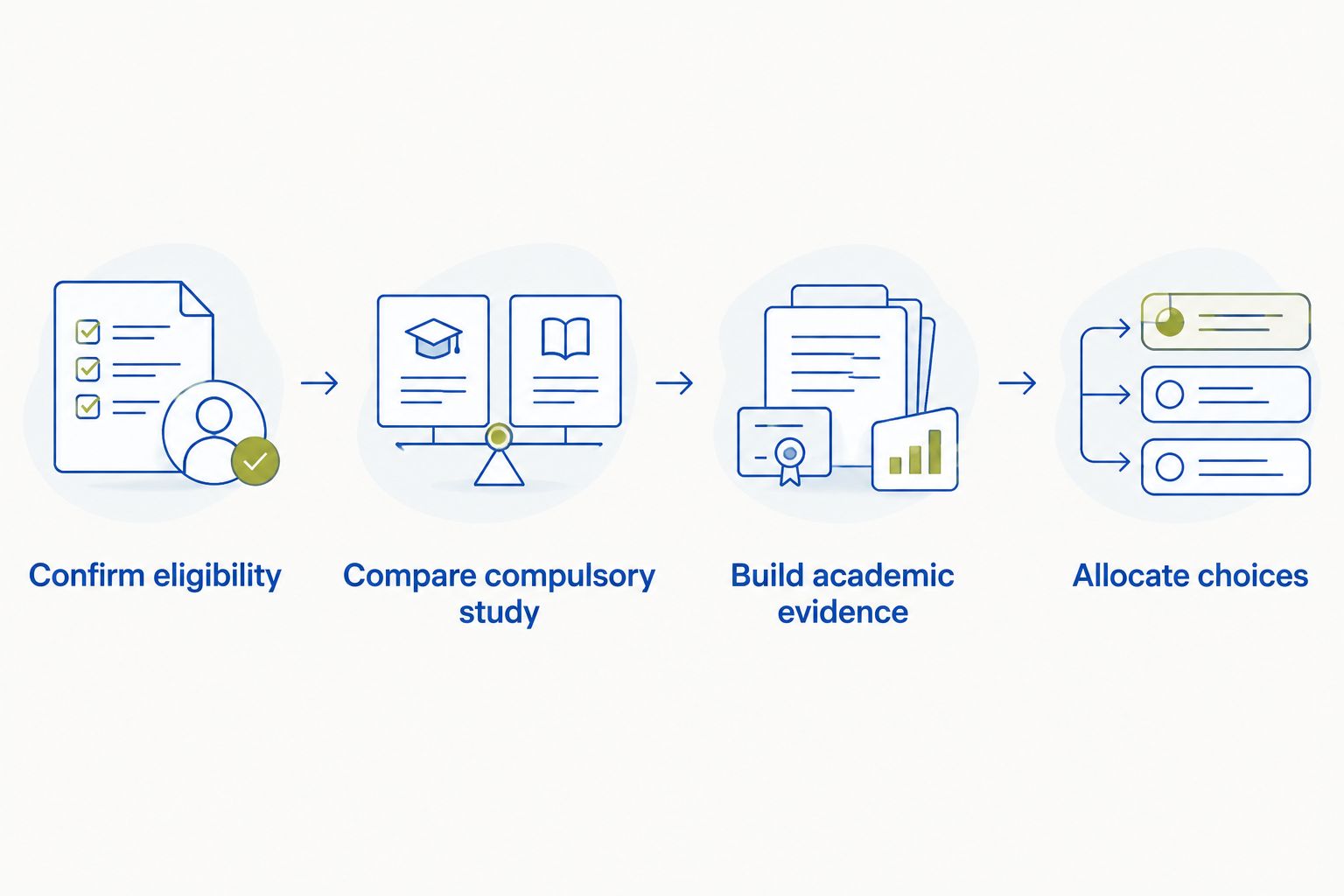
Turn your shortlist into an application plan
Confirm eligibility
Create a separate record for each exact degree. Check required subjects, accepted qualifications, English-language requirements and the applicable selection process using official university information. Families studying Indian curricula should check the relevant qualification guidance rather than converting grades informally.
Compare compulsory study
Read the first-year curriculum before browsing advanced electives. Mark the subjects you would actively choose and those you would tolerate. A university belongs on your list only when its required study makes sense for you.
Build academic evidence
Choose reading, mathematical problems or computing projects that deepen a real interest. Record the question, your approach, what failed and what you learned. A modest project you understand is more useful preparation than an ambitious title you cannot explain.
For structured enrichment, compare summer programs for aspiring engineers by academic content rather than prestige alone. Participation does not guarantee an admissions advantage.
Allocate choices
UCAS allows up to 5 undergraduate choices. For applications from 2026 entry onwards, the personal statement uses 3 questions, with a combined limit of 4,000 characters and a minimum of 350 characters per answer. UCAS’s official guidance sets out these format rules.
Make the responses relevant across your selected courses. If your list mixes Computer Science and Discrete Mathematics, explain the academic connection clearly rather than writing for one university alone.
Which university should you choose?
Choose Oxford as the default starting point if mathematical and theoretical depth is your strongest preference. Choose Cambridge for broad foundations, Imperial for engineering-focused computing, Edinburgh for an explicit AI comparison, Manchester for practical breadth, and Warwick for mathematics combined with computing.
If you are comparing US and UK applications, keep the strategies distinct. UK course selection requires a clear academic direction; US applications require university-specific planning beyond simply reusing a UK-focused statement.
Discuss your shortlist with Ivycentral to connect course fit, preparation and application guidance. Caroline Linger and Jose Kumar work directly with each student. Counseling supports the process; it does not guarantee admission or imply affiliation with any university.
FAQ
What are the best universities for computer science in the UK in 2026?
Oxford, Cambridge, Imperial College London, Edinburgh, Manchester and Warwick form this course-fit shortlist for 2026. Oxford is the default recommendation for mathematical depth; the other choices serve distinct academic preferences.
Is Oxford better than Cambridge for computer science?
Oxford is this guide’s recommendation for theoretical depth, while Cambridge is the recommendation for broad foundations. Compare their compulsory subjects and teaching formats before deciding which fits you.
Which UK university should I choose for artificial intelligence?
Edinburgh belongs on an AI-focused shortlist because it offers Artificial Intelligence and Computer Science alongside broader computing study. Check the compulsory curriculum rather than relying only on the course title.
Do I need mathematics to study computer science in the UK?
Mathematical preparation is central to the courses discussed in this guide. Check the exact subject and qualification requirements for each degree; requirements are not interchangeable between universities.
Can I apply to Oxford and Cambridge in the same year?
You normally cannot apply to both Oxford and Cambridge in the same undergraduate application cycle. Check the official application guidance for any exception relevant to your circumstances.
How many UK computer science courses can I apply to through UCAS?
UCAS allows up to five undergraduate choices. Allocate them using course fit and your academic qualifications rather than treating any university as a guaranteed admission.
How should Indian students compare UK computer science degrees?
Indian students should first check each university’s official guidance for their school qualification and required subjects. Then compare compulsory modules, degree length, selection requirements and the family’s funding plan.
Can admissions counseling guarantee a place at a top university?
No admissions counselor can guarantee a university offer. Ivycentral provides personalized college admissions counseling, with Caroline Linger and Jose Kumar working directly with each student on preparation and strategy.
One last thing
Before finalizing your list, explain why you want to study each course without using the university’s name. Mention its compulsory subjects, teaching format and academic direction. If you cannot distinguish the courses without their brands, your shortlist needs another curriculum comparison.
Related guides
- Summer research programs for high school students
- Summer programs for high schoolers
- Ivy League admissions for Indian students: complete guide