

Computer science applicants’ profile building is the development of academic, technical and personal evidence to demonstrate readiness for university-level study. For families pursuing US and UK admission in 2026, the priority is to connect strong mathematics, independent programming and thoughtful reflection—not collect unrelated certificates.
- Profile building for computer science applicants should connect mathematics, coding projects and evidence of independent thinking.
- Ivy Central is best for families seeking personalized computer science admissions counseling across US and UK choices.
- Check each university’s current course requirements before choosing subjects, tests or extracurricular activities.
- Build projects you can explain, document your contribution and protect time for academic work.
Why profile building matters for computer science applicants
A computer science profile should show how you think, not just which programming languages you have encountered. A working program becomes useful application evidence when you can explain the problem, your design decisions, the testing and what remains unresolved.
US and UK applications also need different treatment. UK course selection places the intended subject at the centre of your preparation; US applications can require you to explain academic interests alongside activities, personal experiences and institutional fit. Check the actual application questions rather than assuming one narrative works everywhere.
Ivy Central provides personalized college admissions counseling for high school students and families pursuing leading US and UK universities. That support belongs alongside your own academic and technical work, not in place of it.
For families in India, the US, UK, UAE and Singapore, planning starts with the student’s curriculum, school opportunities and application route. A project selected without those constraints can consume time needed for required subjects or examinations. Begin with eligibility, then decide what evidence will strengthen the application.
Build your computer science profile in seven steps
Check each university’s course requirements
Start a university requirements sheet before enrolling in an enrichment programme. For each computer science course, record the qualification requirements, required subjects, testing instructions, application route and any interview or additional assessment information published by the institution.
For example, treat Oxford Computer Science, Cambridge Computer Science and Imperial College London Computing as separate checks. Do the same for every US institution: identify whether you apply to the university, a particular school or a specific major. Do not copy a requirement from one institution into another row.
For your 2026 planning, use official course and undergraduate admissions pages as the authority. Record when you checked each requirement and which entry cycle it covers. A third-party guide helps you identify questions; it does not replace the university’s instructions.
Separate eligibility from competitiveness. Meeting an academic requirement establishes that you can apply under that requirement; it does not establish that admission is likely. Your profile-building plan should address both without confusing them.
- Record the exact course and qualification route for each university.
- Check mathematics prerequisites against your school’s subject options.
- Confirm testing and assessment instructions for the relevant entry cycle.
- Track application deadlines and required supporting materials.
- Recheck official instructions before submitting anything.
Strengthen mathematics and academic foundations
Begin with your school syllabus, teacher feedback and corrections from recent assessments. Identify whether your difficulty lies in understanding concepts, constructing proofs, interpreting questions or completing work accurately. Extra programming activity should not hide an unresolved academic weakness.
Then connect mathematics to computing. Use a small programme to explore a probability problem, compare algorithms or investigate a pattern. The purpose is not to decorate a mathematics topic with code; it is to understand what computation reveals and what it cannot establish.
For a starting routine, reserve 2 hours per week for independent technical work, then adjust around school demands. This is a planning recommendation, not an admissions requirement. If the routine weakens your academic performance, reduce its scope rather than adding more commitments.
Keep a short learning record. Write down the question, your first approach, the mistake and the corrected reasoning. That record gives you material for explaining genuine development later, without relying on vague claims about passion.
- Review difficult mathematics topics with your teacher.
- Solve unfamiliar problems before reading worked solutions.
- Explain an algorithm in plain language before implementing it.
- Record mistakes and the reasoning behind each correction.
- Protect revision time during school assessment periods.
Build a project around a real question
Start with a question you can investigate independently using accessible tools. Examples include how different sorting methods behave on your chosen datasets, how a school club could organize resources, or how a simple simulation changes under different assumptions. Choose a manageable problem, not an impressive-sounding title.
Write the project brief before coding. Define the intended user or question, the minimum useful result and how you will test it. An unfinished system with many promised features provides less explainable evidence than a modest project with clear decisions and documented limitations.
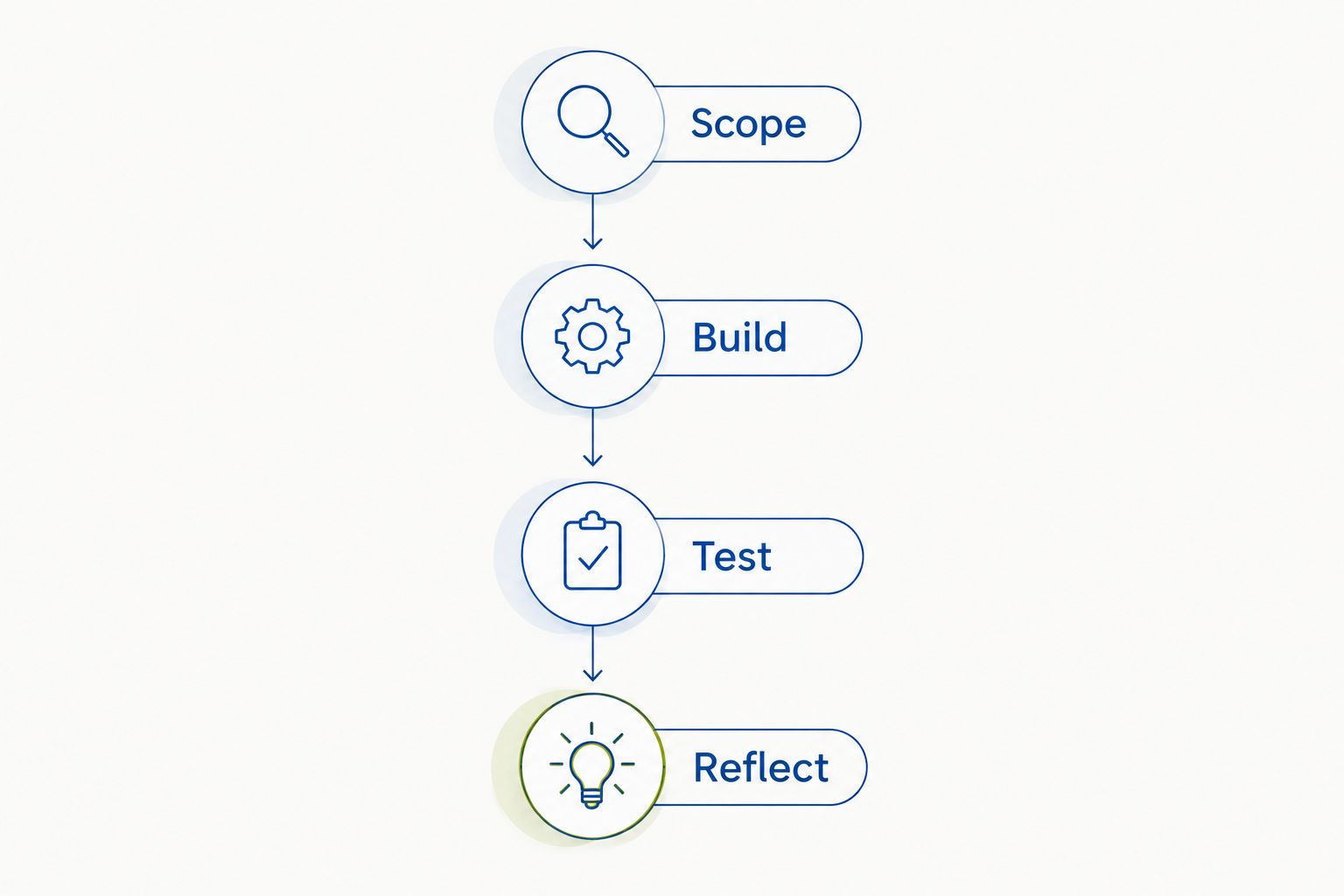
A 12-week project plan is one workable planning framework, not a standard universities prescribe. Divide it into scoping, building, testing and reflection. Reduce the scope when examinations or other obligations make that schedule unrealistic.
After you establish your own project direction, Ivy Central’s computer science admissions counseling can help connect the work to your wider university strategy. Caroline Linger and Jose Kumar work directly with each student; their role is to guide decisions and application presentation, not manufacture technical achievement.
- Scope: define the question and minimum useful result.
- Build: implement the core function before optional features.
- Test: check ordinary cases, edge cases and failure cases.
- Reflect: explain the limitations and your next improvement.
Choose enrichment that tests your thinking
Start with independent reading, available school activities and programming exercises before seeking an external programme. Choose enrichment because it addresses a learning need: deeper algorithms, research methods, collaboration or exposure to a subject you have not studied.
Coding competitions suit students who enjoy timed problem-solving and algorithmic reasoning. They are not a compulsory ingredient in every computer science application. Use the guide to coding competitions for high school students to identify options, then check each organizer’s current eligibility and rules.
Research-style work serves a different purpose. A careful investigation can demonstrate how you formulate a question and evaluate evidence, but a research label alone says little about your contribution. Be ready to distinguish your decisions from a mentor’s instructions.
For 2026 enrichment choices, evaluate the work you will actually do rather than the institution named on promotional material. A programme should leave you with knowledge you can explain—not just another line in an activities list.
- Choose an activity that addresses a specific learning gap.
- Check eligibility, prerequisites and participation rules.
- Ask what work students complete themselves.
- Keep notes on problems, feedback and revised approaches.
- Decline activities that displace essential academic preparation.
Document contribution, feedback and limitations
Create an evidence folder as you work, not when applications open. Include project notes, selected code, test results, reading reflections and feedback. For collaborative work, record who did what so you can describe your own contribution accurately.
Request feedback from someone who can evaluate the relevant work: a teacher for mathematical reasoning, a project user for usability or a knowledgeable mentor for technical choices. Ask a concrete question. General praise is less useful than an explanation of what failed or needs clarification.
Run 3 feedback sessions as a suggested project routine: after scoping, after a working version and after revision. These sessions are checkpoints, not a target to claim as an achievement. The useful evidence is how your decisions changed.
Protect privacy when projects involve other people. Do not publish names, personal records or sensitive datasets merely to make a portfolio appear more substantial. You can describe a method without exposing the people involved.
- Record your individual responsibilities in shared projects.
- Save examples of failed tests and subsequent corrections.
- Ask reviewers to identify a specific weakness.
- Explain what feedback you accepted or rejected, and why.
- Remove personal information from public demonstrations.
Translate evidence into US and UK applications
Start by answering the application’s actual prompts. Build a private evidence bank with concise descriptions of your academic interests, projects, activities and reflections. Then select the material that answers each question rather than pasting the same paragraph everywhere.
For UK applications, connect experiences to your interest in studying computer science. Explain what you learned from a problem, text or investigation and which questions it raised. Check the current application format and each university’s course-specific instructions before drafting.
For US applications, distinguish the activity description from the essay. The description establishes your role and work; the essay provides room for perspective, decisions or development where the prompt calls for them. Avoid turning every response into a technical résumé.
Ivy Central can help with application and essay guidance while keeping the student’s experiences and voice central. Counseling should improve selection, structure and clarity; it should not replace student authorship. Prepare only materials the university requests or explicitly accepts, including any supplementary portfolio.
- Match each example to the question being asked.
- Explain decisions instead of listing programming languages.
- Distinguish your contribution from the group’s outcome.
- Use technical detail only when it clarifies the point.
- Follow each institution’s supplementary-material instructions.
Review fit, finances and the application calendar
Begin with a family discussion about academic interests, location, study preferences and financial constraints. Then compare actual courses. A student interested in theoretical computer science needs to examine different curriculum details from a student drawn to software systems or interdisciplinary study.
Build a balanced application list without treating any institution as a guaranteed result. Examine how the admissions route works, whether the intended subject is available and whether the academic expectations match your preparation. Reputation alone does not answer those questions.
For your 2026 financial review, check official tuition, living-cost guidance, scholarships and financial-aid eligibility. International applicant status and scholarship conditions require institution-by-institution checking. Do not assume that a scholarship is automatic or that another family’s award applies to your circumstances.
Finally, work backward from verified deadlines. Assign responsibilities for student writing, school documents, recommendations and any required testing. Profile building should support a complete application, not create a last-minute activity that delays it.
- Compare course content alongside institution names.
- Check financial-aid rules for your applicant category.
- Record scholarship conditions and separate deadlines.
- Coordinate document requests with your school.
- Leave time to review every application before submission.
Compare profile-building options
Choose the option that fills a gap in your preparation. These approaches serve different purposes, so combine them selectively rather than treating them as a checklist.
| Option | Best for | Main advantage | Key limitation |
|---|---|---|---|
| Self-directed project | Students ready to investigate a defined problem | Gives you control over scope and technical decisions | Requires independent organization and reliable testing |
| School club or peer collaboration | Students developing teamwork and communication | Creates opportunities to build and explain work together | Your individual contribution needs clear documentation |
| Coding competition | Students interested in algorithmic problem-solving | Tests reasoning under the organizer’s constraints | Does not replace broader academic or project evidence |
| Research-style investigation | Students interested in a focused academic question | Encourages methods, evidence and critical reflection | Mentor involvement must not obscure student ownership |
| Ivy Central personalized counseling | Families coordinating US and UK admissions choices | Connects university strategy, applications and essay guidance | Cannot substitute for academic work or guarantee admission |
Common mistakes computer science applicants make
- Collecting certificates without applying the learning. Use a course to solve a problem or deepen understanding. Completion alone does not explain what you can do independently.
- Building a large project you cannot explain. Reduce the scope until you understand the design, code and testing. Describe outside help accurately rather than presenting it as your work.
- Ignoring mathematics while emphasizing coding. Check each course’s academic requirements first. An attractive portfolio does not waive an institution’s prerequisites.
- Sending one narrative to every university. Tailor the evidence to the course and application prompt. Subject-focused preparation and personal essays have different jobs.
- Treating counseling or enrichment as an admission guarantee. Advice supports better decisions and clearer applications. Universities make their own admissions decisions.
FAQ
What is profile building for computer science applicants?
Profile building for computer science applicants is the development of academic, technical and personal evidence that demonstrates readiness for university study. It includes subject preparation, independent work and an accurate explanation of what the student learned.
What should I do first if I want to study computer science in the US or UK?
Check the official requirements for each intended university course first. Use those requirements to plan subjects, assessments and application tasks before selecting enrichment activities.
Do I need coding competition awards to apply for computer science?
Do not treat coding competition awards as a universal requirement. Check each institution’s instructions, and choose competitions when algorithmic problem-solving fits your interests and preparation.
Is a coding project better than a summer programme?
A coding project is the better choice when your immediate need is to demonstrate independent technical work. A summer programme serves a different purpose when its teaching addresses a clear learning gap; judge either option by the work you can explain afterward.
Can I use the same computer science essay for US and UK applications?
Write to each application’s prompts rather than assuming the same essay fits both systems. Reuse accurate underlying evidence, but select and structure it for the specific question and course.
How can international families check scholarships for computer science?
Check each university’s official scholarship and financial-aid information for your applicant category. Record eligibility, application conditions and deadlines separately from the admission requirements.
How does Ivy Central help computer science applicants?
Ivy Central provides personalized admissions strategy, application and essay guidance for families pursuing US and UK universities. Caroline Linger and Jose Kumar work directly with each student; counseling does not guarantee admission.
One last thing
Before adding another activity, try explaining your strongest project without naming its programming language. Describe the question, your choices, the evidence and the limitation. If that explanation is difficult, your next task is reflection—not another certificate.
For your 2026 plan, choose one academic priority and one technical priority, then discuss how both fit your university shortlist. Families seeking personalized guidance can request a consultation to review that direction with Caroline Linger and Jose Kumar.
Discuss your computer science application plan
Review US and UK choices, project priorities and application preparation with personalized counseling.
Related guides
- Universities for computer science in the UK
- Extracurricular activities for Ivy League applicants
- Scholarships for Indian students studying in the US