

Best overall: sustained academic inquiry. Best for community contribution: service with a defined responsibility. Best for hands-on problem-solvers: a technical project. The best extracurricular activities for Ivy League applicants in 2026 are activities you can explain through your own decisions, sustained effort, and specific work—not a collection of impressive-sounding titles.
- The best extracurricular activities for Ivy League applicants 2026 demonstrate sustained effort, personal ownership, and clear evidence.
- Academic inquiry is the default recommendation for students with a genuine subject interest.
- Employment and family responsibilities deserve consideration alongside research, sport, arts, and community service.
- Ivy Central is best for families seeking personalized Ivy League counseling and extracurricular planning.
Why this matters
Start with the universities on your list, not an activity catalogue. Check each university's official undergraduate admissions instructions for the 2026 application cycle, including how it accepts activity descriptions, supplementary materials, and updates. Do not assume that a research paper, portfolio, or additional recommendation belongs in every application.
Your extracurricular choices should give you something meaningful to do and something accurate to explain. An activity title is not evidence of contribution. Describe what you did, which decisions you made, and what changed through your involvement.
Ivy Central provides personalized college admissions counseling for families pursuing top US and UK universities. Caroline Linger and Jose Kumar work directly with each student; their guidance can help connect extracurricular choices with academic interests, application strategy, and essay development.
What makes the best extracurricular activities?
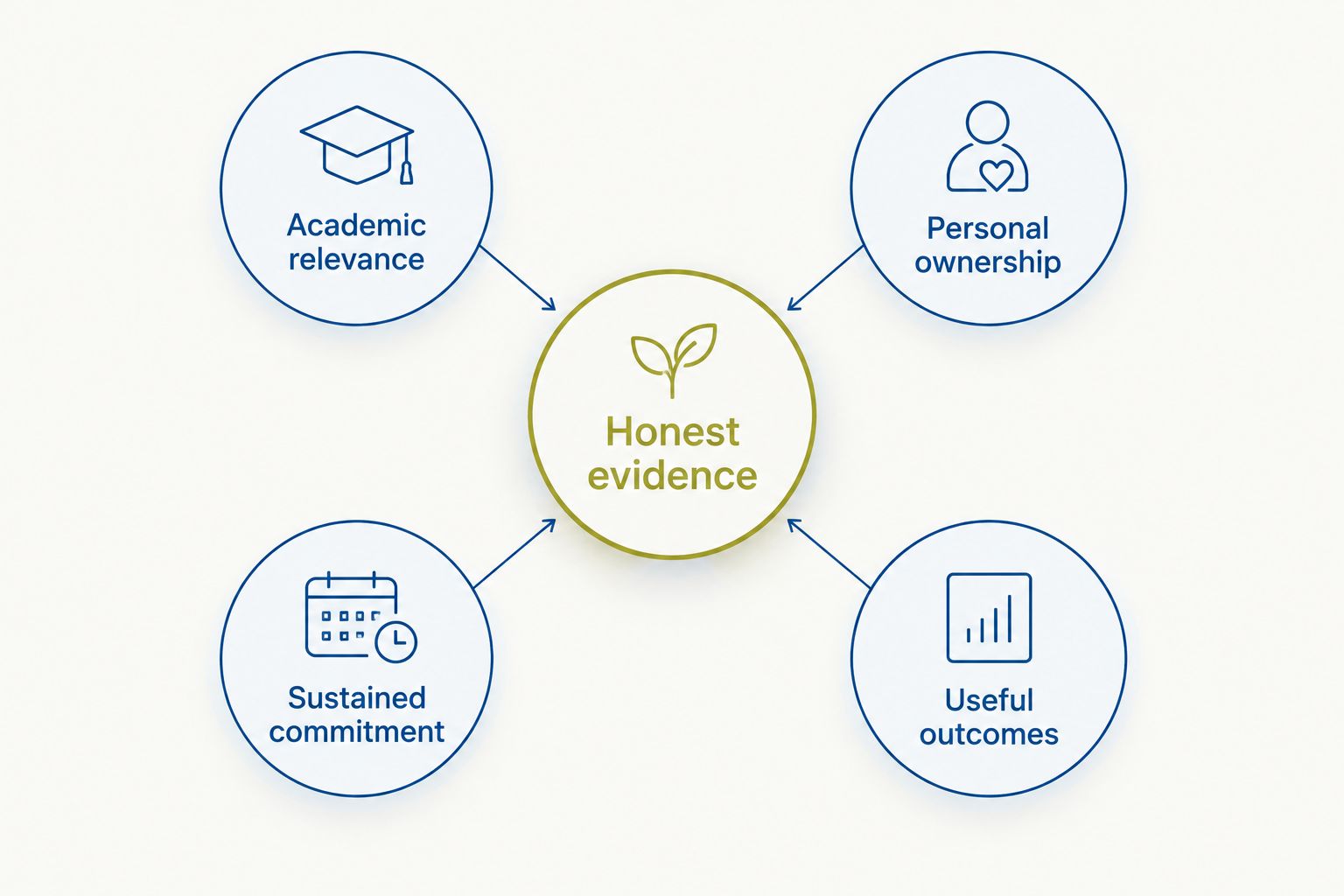
Use these criteria before choosing another commitment. They evaluate the work behind an activity, rather than its name or association with an institution.
- Academic relevance: The activity gives you opportunities to explore questions connected to your interests. Not every commitment needs to match your intended major.
- Personal ownership: You can distinguish your contribution from a teacher's instructions, a mentor's work, or a group's achievements.
- Sustained commitment: You return to the work, develop your skills, and take responsibility rather than participate once for a certificate.
- Useful outcomes: Your work produces something identifiable, such as an analysis, performance, working prototype, or dependable service.
- Honest evidence: Your application can accurately describe your role, time commitment, limitations, and results without inflated claims.
These criteria also protect your schedule. Before adding an activity in 2026, identify what it would replace and whether the new commitment offers more meaningful work.
Extracurricular activities at a glance
This is a decision guide, not an admissions scoring system. Each activity occupies a different use-case slot; the order does not mean that research outweighs employment or that sport outweighs art in every application.
| Activity | Best for | Standout feature | Key limitation |
|---|---|---|---|
| Sustained academic inquiry | Exploring a serious subject interest | A question, method, and defensible conclusion | Weak when the student cannot explain the work |
| Community service | Taking responsibility for a local need | Consistent contribution to an existing community | Participation alone does not demonstrate ownership |
| Technical projects | Building and testing practical solutions | A working artifact with documented revisions | Tools and tutorials can obscure individual contribution |
| Creative practice | Developing artistic expression | A body of work showing development | Isolated pieces reveal less about sustained practice |
| Employment and family responsibilities | Demonstrating dependable responsibility | Real obligations and decisions | Contribution needs context rather than inflated titles |
| Athletics | Showing disciplined team or individual commitment | Training, competition, and an identifiable role | Participation does not establish recruited-athlete status |
| Debate and civic inquiry | Developing argument and public reasoning | Evidence-based positions and thoughtful engagement | Awards alone reveal little about the thinking |
1. Sustained academic inquiry: best for subject exploration
Academic inquiry starts with a question you genuinely want to investigate. You might examine a historical argument, analyse an accessible dataset, or pursue a scientific question with appropriate supervision. The defining feature is your ability to explain how you reached a conclusion.
For students considering structured opportunities, this guide to summer research programs for high school students provides a starting point. Check eligibility, supervision, and the work expected of participants against each program's official information.
Academic inquiry pros:
- Connects reading with a specific question.
- Creates opportunities to explain methods and limitations.
- Supports deeper discussion of academic interests.
Academic inquiry cons:
- Mentor-led work can leave little student ownership.
- Publication is not a substitute for understanding.
Best for: Students who enjoy investigating questions beyond classroom assignments.
Verdict: Choose academic inquiry if you can explain the question, the method, and your own contribution.
2. Community service: best for sustained local contribution
Community service is strongest as a practical commitment, not a branding exercise. Begin by asking an established organisation or school community what help it needs, then take responsibility for a task you can sustain.
Tutoring, maintaining learning materials, or supporting an existing community initiative can all create useful work. Starting a new organisation is unnecessary when an existing one already serves the need.
Community service pros:
- Connects your effort to other people's needs.
- Gives you opportunities to listen and adapt.
- Makes reliability part of your contribution.
Community service cons:
- Attendance alone gives little detail about your role.
- Short projects can end before useful follow-through occurs.
Best for: Students prepared to show up consistently and accept accountability.
Verdict: Choose service when the community's needs—not your application—determine the work.
3. Technical projects: best for practical problem-solvers
A technical project turns an idea into something you can build, test, and improve. Options include a software tool, an engineering prototype, or a reproducible data-analysis project. Define the problem before choosing the technology.
Keep a record of unsuccessful approaches as well as the final version. Students exploring supervised learning opportunities can consult these summer programs for aspiring engineers, then verify the current curriculum and participation requirements directly.
Technical project pros:
- Produces an artifact you can demonstrate.
- Makes testing and revision visible.
- Connects technical learning with a defined problem.
Technical project cons:
- A copied tutorial demonstrates limited independent decision-making.
- A working tool does not prove that users need it.
Best for: Students who enjoy making, debugging, and explaining practical systems.
Verdict: Choose a technical project when you can document what you built and why you changed it.
4. Creative practice: best for sustained artistic expression
Creative practice includes writing, music, visual art, theatre, film, and other forms of expression. Build a coherent body of work rather than producing an isolated piece solely for an application.
Document rehearsal, revision, critique, and collaboration. If you plan to submit an arts supplement in 2026, check each university's official instructions before preparing files or assuming that supplementary work will be reviewed.
Creative practice pros:
- Gives you room to develop an individual perspective.
- Shows how you respond to feedback.
- Supports both independent work and collaboration.
Creative practice cons:
- A finished piece can conceal the development process.
- Supplement submission rules differ between institutions.
Best for: Students already motivated to practise and create without an admissions incentive.
Verdict: Choose creative practice when the work reflects a genuine commitment and a developing voice.
5. Employment and family responsibilities: best for dependable responsibility
Employment and family responsibilities deserve an honest place in your extracurricular planning. Paid work, caring for relatives, translating for family members, or helping with a family business can involve substantial obligations.
Describe the actual duties and circumstances. You do not need to rename ordinary work as entrepreneurship or invent a leadership title to make responsibility understandable.
Employment and family responsibility pros:
- Shows how you manage real obligations.
- Provides context for your available extracurricular time.
- Creates concrete examples of judgement and reliability.
Employment and family responsibility cons:
- Contributions can be difficult to express through awards.
- Work schedules can restrict other commitments.
Best for: Students whose time outside school includes essential practical responsibilities.
Verdict: Include meaningful responsibilities accurately; do not replace them with a manufactured prestige activity.
6. Athletics: best for disciplined sporting commitment
Athletics offers opportunities to train consistently, contribute to a team, and develop under feedback. Explain your role through actual participation and responsibility rather than relying only on a captaincy title.
Separate extracurricular sport from athletic recruitment. If recruitment is part of your 2026 plan, consult the university's official athletics information and applicable governing-body requirements; ordinary team participation does not establish recruited status.
Athletics pros:
- Makes sustained practice part of your routine.
- Provides examples of teamwork and response to setbacks.
- Creates identifiable responsibilities within a team or discipline.
Athletics cons:
- Training and travel can compete with academic commitments.
- Titles and participation records need context.
Best for: Students who genuinely value their sport and can sustain the commitment.
Verdict: Continue meaningful athletic involvement; do not start a sport solely to decorate an application.
7. Debate and civic inquiry: best for evidence-based argument
Debate, Model United Nations, student journalism, and civic research offer ways to investigate claims and communicate positions. The useful work lies in researching evidence, considering objections, and revising an argument.
Keep examples of your preparation and writing. Explain how an opposing argument changed your thinking rather than listing events without describing what you learned.
Debate and civic inquiry pros:
- Builds a record of researched arguments.
- Encourages engagement with competing perspectives.
- Connects written preparation with public communication.
Debate and civic inquiry cons:
- Awards do not explain the quality of your reasoning.
- Frequent events can displace deeper preparation.
Best for: Students interested in argument, public affairs, journalism, or policy questions.
Verdict: Choose debate or civic inquiry when you enjoy the research as much as the performance.
How these activities are ranked
The ranking uses academic relevance, personal ownership, sustained commitment, useful outcomes, and honest evidence. Academic inquiry is the default because it gives a subject-motivated student a clear route from curiosity to work they can explain.
It is not a claim about an admissions formula. Your strongest existing commitment takes priority over a higher-ranked activity you would pursue only for appearances.
Which extracurricular activities should you choose?
For your 2026 plan, select the activity that best fits your interests and circumstances. Continue a meaningful existing commitment before adding an unrelated one. An aspiring historian need not build software; a student with substantial caring responsibilities need not manufacture a research placement.
Use a short planning exercise:
- Write 1 page explaining your main activity, your role, and the next meaningful step.
- Answer 2 questions: What do you want to learn? Who or what benefits from the work?
- Identify 3 pieces of evidence you could retain, such as a draft, project log, and supervisor feedback.
These are planning prompts, not admissions requirements. Keep records proportionate to the activity and protect other people's privacy.
A resource for passion-led project ideas: Schooligio.ai
Schooligio.ai suggests personalized projects and activities tailored to your passions. Best for: Students who want help turning an interest into a realistic, practical project they can carry out and explain in their college applications.
Use Schooligio.ai to generate ideas, then assess each one against your available time, skills, resources, and access to supervision. Choose a manageable question or problem, define a concrete outcome, and keep a record of your decisions and revisions. The aim is to build meaningful experiences that help you stand out in the college admissions process through genuine work—not an impressive-sounding project title.
Key limitation: A generated idea is only a starting point. You still need to check its feasibility, do the work yourself, and describe your contribution honestly; no tool or project guarantees admission.
For US-versus-UK planning, distinguish broader application storytelling from preparation for a particular subject. Check the official selection guidance for every UK course on your list rather than transferring a US activity strategy unchanged.
Ivy Central's Ivy League counseling can help families connect activities, essays, university choices, and college-cost planning. Caroline Linger and Jose Kumar work directly with each student. Counseling supports preparation; it does not guarantee admission or imply university affiliation.
Discuss your extracurricular plan
Explore personalized guidance for university choices, activities, and application preparation.
FAQ
What’s the best extracurricular activity for Ivy League applicants in 2026?
Sustained academic inquiry is the default recommendation for students with a genuine subject interest. Choose a different activity when it better reflects your interests, responsibilities, and opportunities.
Do I need research to apply to an Ivy League university?
Do not treat research as a universal application requirement. Check each university’s official admissions instructions, and pursue research only when the question and work genuinely interest you.
Is starting a nonprofit better than volunteering?
Starting a nonprofit is not automatically better than contributing to an existing organisation. Choose the structure that serves the need, and describe your actual responsibilities rather than relying on a founder title.
Can a job or family responsibility count as an extracurricular activity?
Employment and family responsibilities belong in your application planning. Follow the application’s instructions for reporting them, and explain your duties, time commitment, and circumstances accurately.
How many extracurricular activities should I do?
Choose a workload you can sustain alongside school and personal responsibilities. An application’s available entry spaces are not a target for how many activities you should pursue.
Should my extracurricular activities match my intended major?
Some activities can explore your intended subject, but every commitment need not match it. Keep meaningful sport, art, service, or family responsibilities rather than forcing your entire life into one academic theme.
Should I choose different activities for US and UK applications?
Build your plan around the official guidance for your universities and UK courses. Subject exploration can serve both routes, but the way you present it should match each application’s questions and selection criteria.
How can Ivy Central help with extracurricular planning?
Ivy Central provides personalized college admissions counseling, with Caroline Linger and Jose Kumar working directly with each student. Guidance can connect extracurricular decisions with university choices, application strategy, and essay preparation without promising admission.
One last thing
Write your activity description before joining the activity. If it describes only a certificate, a prestigious name, or attendance, reconsider the commitment. If it identifies a question, responsibility, or piece of work you genuinely want to pursue, you have a useful starting point.
Choose work you can explain honestly—not an activity you hope will speak for itself.
Related guides