

Best overall starting point: Harvard’s need-based aid. Best for a university-specific aid application: Princeton. Best for families comparing need-blind options: Yale. The best Ivy League funding routes for international undergraduates in 2026 are institutional financial-aid grants, not merit scholarships; choose by academic fit, aid eligibility and your family’s assessed contribution.
- Harvard is a strong starting point for international applicants seeking need-blind admission and need-based undergraduate aid.
- Best scholarships for international students: Ivy League 2026 searches should focus on institutional financial aid, not merit awards.
- Harvard, Yale, Princeton, Dartmouth and Brown offer need-blind admission for international undergraduate applicants.
- Columbia, Cornell and Penn consider international applicants’ financial need during admission.
- Ivy Central helps families connect university selection, application strategy and financial-aid planning.
Why this matters
Start with the distinction that changes your search: the eight Ivy League universities do not award undergraduate merit or athletic scholarships. Their institutional aid is based on financial need. An exceptional transcript strengthens your admission application; it does not create a separate academic scholarship entitlement.
For 2026 planning, five Ivy League universities offer need-blind admission to international undergraduate applicants, while three use need-aware admission. Need-blind means requesting aid does not influence the admission decision. It does not mean every admitted student receives funding.
Ivy Central provides personalized college admissions counseling, with Caroline Linger and Jose Kumar working directly with each student. Families applying from India can also use the Ivy League admissions guide for Indian students to connect funding research with application preparation.
What makes the best Ivy League financial-aid option?
Judge each university against these criteria before treating it as an affordable choice:
- International eligibility: Confirm that your citizenship and undergraduate applicant category qualify for institutional aid.
- Admission treatment: Separate need-blind review from need-aware review; the difference matters when you request substantial assistance.
- Demonstrated need: Understand that the university calculates need using its own methodology, not your preferred contribution.
- Aid composition: Distinguish grants from student employment, family contributions and any borrowing expectations.
- Application requirements: Identify the required forms, supporting documents and financial-aid deadlines.
- Academic fit: Choose a university where the curriculum and intended field justify the application independently of aid.
The best funding route is an institution that fits your academic goals and provides an affordable aid offer—not the most recognizable scholarship label.
Ivy League financial aid at a glance
These are undergraduate institutional-aid routes, not named competitive scholarships. Each university states that it meets 100% of demonstrated financial need for admitted international undergraduates eligible for its institutional aid. The university’s assessment determines what that commitment means for your family.
| Rank and university | Best for | Standout feature | International admission | Key limitation |
|---|---|---|---|---|
| 1. Harvard | A default need-blind starting point | Need-based aid without required borrowing | Need-blind | Family contribution is institutionally assessed |
| 2. Princeton | A university-specific aid application | Princeton Financial Aid Application rather than CSS Profile | Need-blind | Separate university aid paperwork requires attention |
| 3. Yale | Comparing grant-based need-blind options | Meets demonstrated need without requiring loans | Need-blind | Student contribution expectations still matter |
| 4. Dartmouth | Need-blind liberal arts planning | Need-blind international admission and no-loan aid | Need-blind | Aid does not remove academic-fit questions |
| 5. Brown | Open Curriculum applicants | Need-blind international admission and no-loan aid | Need-blind | Curriculum appeal does not establish affordability |
| 6. Columbia | Core Curriculum applicants | Meets demonstrated need for admitted aid applicants | Need-aware | Requesting aid affects admission review |
| 7. Cornell | Applicants with a clear college choice | Need-based international undergraduate aid | Need-aware | College selection and aid planning both matter |
| 8. Penn | Interdisciplinary applicants | Grant-based undergraduate aid | Need-aware | Financial need enters international admission review |
1. Harvard: best for a default need-blind starting point
Harvard is a sensible first university to investigate when you need substantial undergraduate assistance. International applicants receive need-blind admission review, and Harvard meets demonstrated financial need without requiring loans in its aid packages.
Best for: Families establishing a starting point for need-blind Ivy League aid research.
Harvard pros:
- Requesting aid does not affect international admission review.
- International students qualify for institutional need-based assistance.
- Required borrowing is not the foundation of the aid package.
Harvard cons:
- There is no undergraduate merit-scholarship alternative.
- Harvard’s calculation—not your household budget alone—sets demonstrated need.
For your 2026 application, consult Harvard College’s official financial-aid instructions for international applicants and its required financial documentation. Keep academic planning and aid paperwork on separate checklists so neither becomes an afterthought.
Verdict: Hold until Harvard’s academic fit and assessed family contribution both work.
2. Princeton: best for a university-specific aid application
Princeton combines need-blind international admission with grant-based aid that meets demonstrated need. Its distinctive application feature is the Princeton Financial Aid Application: undergraduate applicants seeking Princeton aid do not use the CSS Profile for that purpose.
Best for: Families who want to understand a university’s own financial-aid application process.
Princeton pros:
- International applicants receive need-blind admission review.
- Financial-aid packages replace loans with grants.
- The university provides its own aid application.
Princeton cons:
- Princeton-specific paperwork adds another process to a multi-university application plan.
- Grant-based aid does not automatically eliminate the assessed family contribution.
Use Princeton Undergraduate Financial Aid’s official application instructions, rather than a general scholarship directory. Prepare income and asset records before completing the form; a different application platform does not mean less financial scrutiny.
Verdict: Hold until you can complete Princeton’s aid application accurately and assess academic fit.
3. Yale: best for comparing grant-based need-blind options
Yale offers need-blind international undergraduate admission and meets demonstrated need without requiring loans. It belongs on your research list when you want another need-blind option rather than relying on a single university’s admission and aid decisions.
Best for: Families comparing different institutional assessments of financial need.
Yale pros:
- International admission review is need-blind.
- Institutional aid is available regardless of citizenship.
- Aid meets demonstrated need without required loans.
Yale cons:
- Student contribution expectations require careful reading.
- A Yale assessment is not interchangeable with another university’s calculation.
Yale’s official Undergraduate Financial Aid guidance explains international application requirements and how contributions are assessed. Compare the complete offer, including student responsibilities, rather than treating the grant amount alone as the verdict.
Verdict: Hold until Yale’s full aid terms—not just its grant component—fit your family.
4. Dartmouth: best for need-blind liberal arts planning
Dartmouth offers need-blind admission to international undergraduate applicants and meets demonstrated financial need. Its no-loan financial-aid policy makes it a relevant option for families seeking grant-based assistance alongside a liberal arts undergraduate experience.
Best for: Students who want Dartmouth’s academic environment and need international financial aid.
Dartmouth pros:
- Financial need does not influence international admission decisions.
- International undergraduates are eligible for institutional assistance.
- Dartmouth’s no-loan policy supports grant-based funding.
Dartmouth cons:
- No-loan aid does not mean no family or student contribution.
- Funding policy cannot substitute for a convincing reason to choose Dartmouth.
Consult Dartmouth’s official Financial Aid guidance for international students when building your 2026 checklist. Your application should explain genuine academic interests; requesting aid and demonstrating fit are separate tasks.
Verdict: Skip Dartmouth if the academic experience does not match your goals, regardless of aid policy.
5. Brown: best for Open Curriculum applicants
Brown offers need-blind admission for international first-year undergraduate applicants and meets demonstrated financial need. Its Open Curriculum supplies the academic distinction: students take responsibility for shaping their studies within Brown’s degree requirements.
Best for: Students who can explain why curricular flexibility suits their academic direction.
Brown pros:
- International first-year admission is need-blind.
- Institutional aid meets demonstrated financial need.
- The Brown Promise removes packaged loans from undergraduate aid.
Brown cons:
- Curricular flexibility requires a clear academic rationale.
- Need-blind admission does not establish your eventual family contribution.
Read Brown’s official Undergraduate Financial Aid guidance for your applicant category. First-year policies should not be assumed to cover transfer applicants or every other admission route; check the instructions that apply to you.
Verdict: Skip Brown if the Open Curriculum is only a slogan in your application.
6. Columbia: best for Core Curriculum applicants
Columbia provides need-based aid to eligible international undergraduates and meets demonstrated need for admitted students receiving institutional assistance. Unlike the five need-blind options above, Columbia considers an international applicant’s financial need during admission.
Best for: Applicants whose interest in Columbia College’s Core Curriculum justifies a need-aware application.
Columbia pros:
- International applicants can receive institutional need-based aid.
- Admitted eligible aid recipients receive support based on demonstrated need.
- The Core Curriculum provides a specific academic reason to investigate Columbia College.
Columbia cons:
- Requesting aid influences international admission review.
- Columbia’s different undergraduate divisions require applicant-specific research.
Consult Columbia Undergraduate Admissions and Financial Aid and Educational Financing guidance for the division you are applying to. Do not assume that Columbia College, Columbia Engineering and the School of General Studies share identical funding rules.
Verdict: Hold until you understand your division’s aid rules and the need-aware admission policy.
7. Cornell: best for applicants with a clear college choice
Cornell offers institutional need-based aid to international undergraduates but uses need-aware admission. Your undergraduate college or school choice also shapes the application, making subject-specific research essential alongside financial planning.
Best for: Students with a well-defined field and a clear reason to choose a particular Cornell college.
Cornell pros:
- International applicants can apply for institutional aid.
- Cornell meets demonstrated need for admitted eligible aid applicants.
- College-specific research helps connect your academic interests with the application.
Cornell cons:
- Financial need is considered during international admission review.
- Applying without requesting needed aid creates a serious funding risk.
Cornell’s official Financial Aid guidance for international applicants should determine your paperwork and timing. Do not postpone an aid request on the assumption that funding becomes easier after admission; follow the policy for requesting assistance when applying.
Verdict: Skip an unfunded Cornell application if attendance depends on institutional aid.
8. Penn: best for interdisciplinary applicants
Penn offers grant-based undergraduate financial aid and meets demonstrated need for admitted eligible international aid applicants. Its international admission process is need-aware, so a funding request is part of the admission context rather than a separate scholarship competition.
Best for: Students with a specific interdisciplinary academic plan that fits Penn.
Penn pros:
- International applicants are eligible to request institutional aid.
- Undergraduate financial aid is grant-based.
- Students can build an application around a clearly researched academic pathway.
Penn cons:
- International applicants’ financial need affects admission review.
- Interdisciplinary interests must match actual program requirements, not assumed flexibility.
Use Penn’s official Student Registration and Financial Services instructions for international undergraduate applicants. Research your intended school and any specialized program separately; academic eligibility and financial-aid eligibility answer different questions.
Verdict: Hold until Penn’s academic pathway and international aid requirements are both clear.
How these options are ranked
This ranking prioritizes need-blind international admission, grant-based assistance, application clarity and distinct academic use cases. It is not a ranking of award size, admission probability or guaranteed affordability. Those outcomes depend on your application and the university’s assessment.
The policy sources for this 2026 guide are the universities’ official undergraduate admissions and financial-aid guidance named above. Before submitting, check the instructions for your entry cycle and applicant category; a policy for first-year undergraduates is not a graduate fellowship or transfer-aid policy.
Build your financial-aid application plan
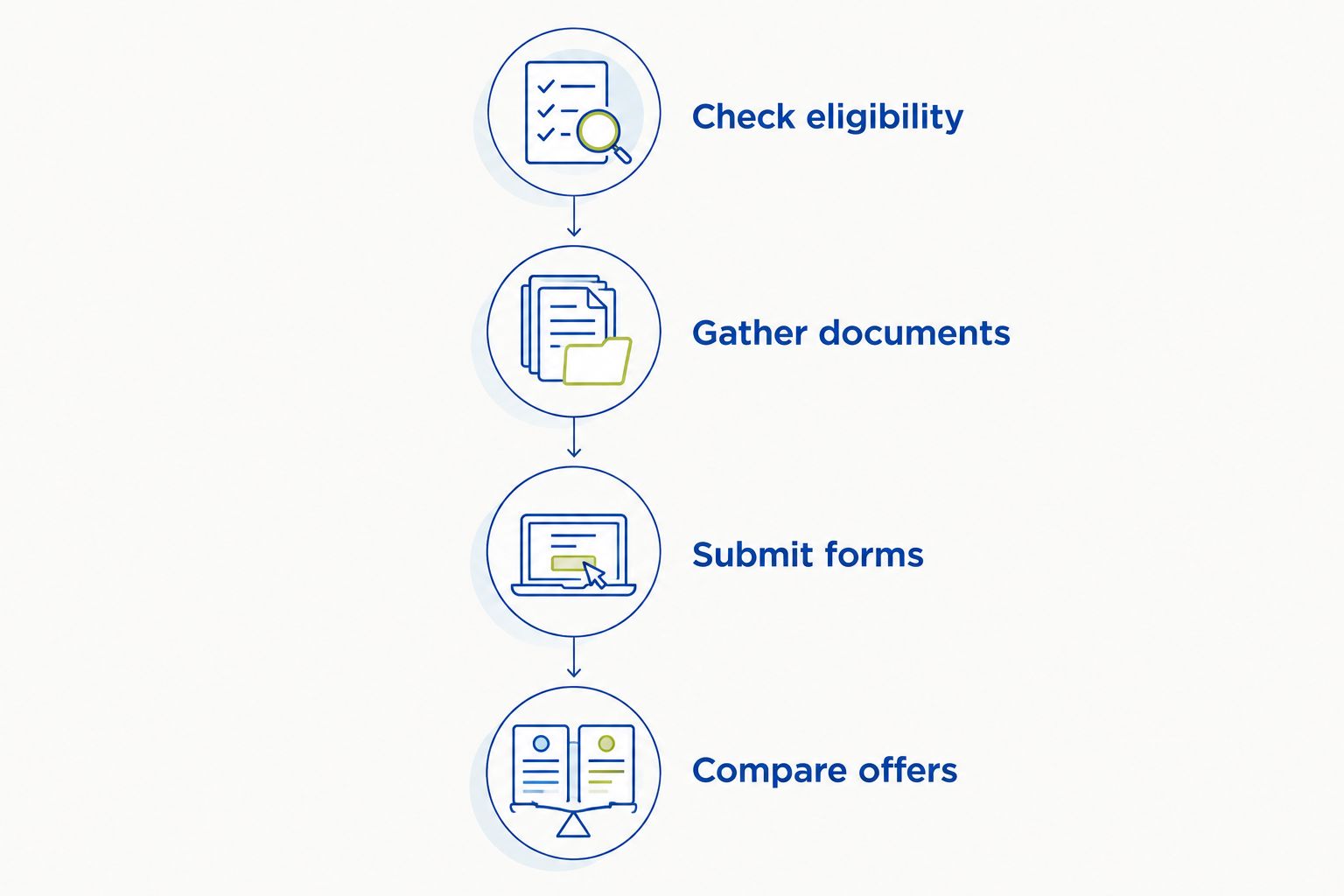
Use this sequence to turn a scholarship search into a workable application process:
- Check eligibility: Confirm citizenship treatment, applicant category and whether aid must be requested with admission.
- Gather documents: Collect the income, asset and supporting records each university requests, including translations when required.
- Submit forms: Follow each institution’s official instructions for its aid application and any required external forms.
- Compare offers: Examine grants, family contributions, student responsibilities and conditions for continued aid.
For families in India, the UAE, Singapore, the US or the UK, citizenship and applicant status matter more than where you attend school. US-versus-UK university planning also requires separate funding research; an Ivy League aid policy tells you nothing about a UK university’s scholarship eligibility.
Which Ivy League funding route should you choose?
Start with the five need-blind options, then add need-aware universities only when their academic fit warrants the application. Harvard is the default research starting point, not an automatic winner over Princeton, Yale, Dartmouth or Brown.
Ivy Central’s college admissions counseling is best for families seeking personalized US and UK application strategy alongside financial-aid planning. Caroline Linger and Jose Kumar work directly with each student on university choices, application positioning and essay guidance; counseling does not guarantee admission or financial aid. Request a consultation to discuss how your academic goals and funding needs shape your university list.
FAQ
What are the best scholarships for international students at Ivy League universities in 2026?
The main funding routes are institutional need-based grants, not undergraduate merit scholarships. Harvard, Yale, Princeton, Dartmouth and Brown offer need-blind international admission; Columbia, Cornell and Penn use need-aware review.
Do Ivy League universities offer merit scholarships to international undergraduates?
No, Ivy League universities do not award undergraduate merit scholarships. Strong academic results support admission, while institutional financial aid is based on demonstrated need.
Which Ivy League universities are need-blind for international students?
Harvard, Yale, Princeton, Dartmouth and Brown offer need-blind admission for international first-year undergraduate applicants. Confirm the policy for your applicant category, particularly if you are transferring.
Does meeting full demonstrated need mean my family contributes nothing?
No, meeting full demonstrated need does not automatically eliminate your family contribution. The university assesses income, assets and other financial circumstances using its own methodology.
Can Indian students receive Ivy League financial aid?
Yes, Indian students can apply for institutional undergraduate financial aid at Ivy League universities. Eligibility, required documents and the effect of requesting aid depend on each university’s international-applicant policy.
Should I apply without requesting aid and ask for funding after admission?
No, do not omit an aid request when attendance depends on institutional assistance. Follow the university’s international-applicant instructions because later access to aid can be restricted.
Can an outside scholarship be added to my university aid?
An outside scholarship can affect your institutional aid package. Report the award and ask the financial-aid office how it changes grants, student responsibilities or other aid components before assuming it adds extra support.
Does Ivy Central guarantee Ivy League admission or scholarships?
No, Ivy Central does not guarantee university admission or financial aid. Caroline Linger and Jose Kumar provide personalized counseling and application strategy; universities make admission and funding decisions.
One last thing
Before committing to a university in 2026, ask its financial-aid office how an outside scholarship would change your existing package. A separate award is not automatically additional funding. The decision rests on your final responsibilities, not the number of awards listed in an offer.
Related guides
- Best summer programs for aspiring engineers
- Best summer programs for high schoolers
- Best summer research programs for high school students