

Transfer-student Ivy League admissions consulting is application planning that connects your university record, reasons for transferring and target-school requirements to a coherent admissions case. Start your 2026 plan with each university’s official transfer instructions: eligibility, credit rules and financial aid can determine whether an application makes sense before essay guidance does.
- Ivy league admissions consulting for transfer students should start with eligibility, transferable credits and a defensible academic reason.
- Ivy Central admissions counseling is best for families seeking personalized US and UK university planning.
- Confirm transfer-specific counseling scope before engaging any adviser; first-year application guidance is not interchangeable with transfer guidance.
- Build your transfer application around university coursework, academic recommendations and school-specific reasons for moving.
Why admissions consulting matters for transfer students
A transfer application must explain both what you have accomplished at university and why another institution better supports your academic direction. Prestige alone does not answer either question. You need evidence of progress, a credible destination and a workable route to completing your degree.
The Ivy League comprises 8 universities, but those universities do not share one transfer admissions policy. Harvard, Yale, Princeton, Columbia, Brown, Dartmouth, Cornell and the University of Pennsylvania each publish their own instructions. At Cornell and Penn, your intended undergraduate school also belongs in the research process.
For families comparing US and UK pathways, Ivy Central provides personalized college admissions counseling, with Caroline Linger and Jose Kumar working directly with each student. Before arranging transfer support, confirm the service’s transfer-specific scope, including eligibility review, university coursework, recommendations and credit planning.
Ivy Central admissions counseling is best for families seeking personalized US and UK university planning. Its published description emphasizes high school students and their families; establish the proposed transfer engagement rather than assuming every admissions service covers enrolled university students.
Build your transfer application in seven steps
Check each university’s transfer eligibility
Start with official admissions instructions, not an adviser’s summary. For every university you are considering in 2026, establish whether your completed and planned study fits its transfer category. Check how the institution treats enrollment outside the United States, interrupted study and applicants who have already earned a degree.
Create 1 research row per university and undergraduate school. Record the official page title, the requirement and the date you checked it. A family spreadsheet is sufficient; the purpose is to make each application decision traceable to an actual rule.
Harvard College transfer instructions, Yale Undergraduate Admissions transfer guidance and Princeton’s transfer application materials are separate research tasks. For Columbia, check which undergraduate division matches your intended application. Do not assume a rule for one division applies to another.
- Record the permitted amount of prior university study.
- Check eligibility for your current institution and qualification.
- Identify the application route for your intended undergraduate school.
- Confirm entry term, required documents and submission deadlines.
- Save questions that require a written answer from admissions.
Define your academic reason for transferring
Write down the academic problem a transfer would solve before drafting an essay. Perhaps your current institution lacks the course sequence you need, or your interests have developed toward a field your present program does not support. Use an actual limitation, not a manufactured explanation.
Compare that limitation with named courses, departmental pathways or degree structures at each destination. Verify those features in official academic catalogs. A course title is not enough: check prerequisites and whether the course is available to students in your intended program.
Keep your current university in the comparison. Transferring is not automatically the strongest academic decision, especially when you can address the problem through course selection or an existing opportunity. Good counseling should test your reasoning rather than simply endorse your preferred destination.
- Describe the academic gap in plain language.
- Identify the destination’s relevant curriculum or degree pathway.
- Check prerequisites and access restrictions.
- Explain what you have already attempted at your current institution.
- Compare transferring with staying and adjusting your present plan.
Audit your coursework and potential credit loss
Your transcript shows academic performance; it does not guarantee that another institution will accept every course toward graduation. Separate admission eligibility from credit evaluation. Then distinguish credit that transfers from credit that satisfies a particular major or degree requirement.
Build a course inventory using official course descriptions, syllabi, assessment details and credit information. International applicants should retain the institution’s grading explanation and prepare translations where the receiving university requires them. Do not convert grades into a US GPA unless the application instructions require a particular method.
Use 2 separate checklists: one for admission requirements and one for degree completion. This prevents a favorable admissions assessment from hiding a difficult academic transition. A counselor can organize the questions, but only the receiving institution can make its credit decisions.
- Save syllabi and official descriptions for completed courses.
- Identify courses relevant to your proposed major.
- Check residency and degree-completion rules in the official catalog.
- Record when the university evaluates transfer credit.
- Ask how unresolved credit decisions affect your enrollment choice.
Build a school-specific application calendar
Read every target school’s 2026 instructions separately, including testing, essays, university reports and recommendations. Do not reuse a first-year admissions checklist without checking each item against the transfer requirements. Requirements also need to match your intended entry term.
Work backward from official deadlines and give document requests their own dates. Your current institution controls some parts of the process, including transcripts and institutional forms. Your calendar should show who submits each item and how you will confirm receipt.
Caroline Linger and Jose Kumar work directly with students through Ivy Central’s personalized counseling. If you are considering that support for a transfer application, ask how the proposed engagement handles school-specific requirements, document coordination and application review. Confirm those responsibilities before relying on the service.
- Enter application and financial-aid deadlines separately.
- Check the current transfer testing policy for each university.
- Assign an owner to every institutional form and transcript request.
- Record recommendation requests and submission instructions.
- Track missing items through each university’s applicant portal.
Secure recommendations grounded in university work
Check whom each university accepts as a recommender before asking anyone to write. A strong relationship with a high school teacher does not replace an academic recommendation from your current institution when the destination requires university-level evidence.
Choose recommenders who can describe your reasoning, written work, contributions and academic development. Give them relevant assignments and a concise explanation of your transfer goals. Your preparation should help them remember your work, not instruct them to make claims they cannot support.
Keep academic recommendations distinct from institutional reports. An administrator completing an enrollment or conduct form serves a different purpose from an instructor assessing your academic ability. Your application calendar should reflect both responsibilities.
- Confirm the required recommender category at each destination.
- Select instructors who know your assessed work.
- Share relevant assignments and your academic direction.
- Explain submission procedures without scripting the recommendation.
- Request institutional reports from the appropriate university office.
Write essays that explain progression
A transfer essay should explain what you learned from your current university experience and what you need next. Avoid turning it into a complaint about your institution. Your argument is stronger when it shows thoughtful decisions, academic evidence and a specific reason for the proposed move.
Answer each school’s actual prompt rather than adapting one generic personal statement. Use university coursework and recent experiences where they support the answer. High school achievements can provide context, but they should not displace your development since enrolling.
Application guidance should protect your authorship. You write the experiences, judgments and conclusions; an adviser can question the logic, identify repetition and help you interpret the prompt. Reject any process that substitutes an adult’s voice for yours or invents activities to strengthen the narrative.
- Connect your transfer reason to documented academic interests.
- Describe your present institution accurately and respectfully.
- Use verified destination-specific academic details.
- Remove claims that repeat your transcript without explanation.
- Check that every submitted essay remains your own work.
Test affordability and the final decision
Build the financial plan before treating admission as the only objective. Check each institution’s transfer financial-aid instructions, citizenship categories, required forms and renewal conditions. An admissions policy and an aid policy answer different questions; neither should be inferred from the other.
For your 2026 decision, compare 3 pathways: remain at your current university, transfer to a suitable US institution, or investigate a UK route. Treat the UK route as a separate admissions question, not an assumed continuation of your US credits. Check the relevant university and course instructions directly.
Include degree-completion time, recognized credits, housing, travel, insurance and currency exposure in your family’s assessment. You do not need a precise credit outcome to identify an unresolved risk. You do need to know which unanswered questions must be settled before accepting an offer.
- Verify transfer-specific financial-aid eligibility.
- Separate institutional aid from external scholarship applications.
- Check conditions attached to any confirmed funding offer.
- Compare degree-completion requirements across your alternatives.
- Agree on the academic and financial reasons that justify moving.
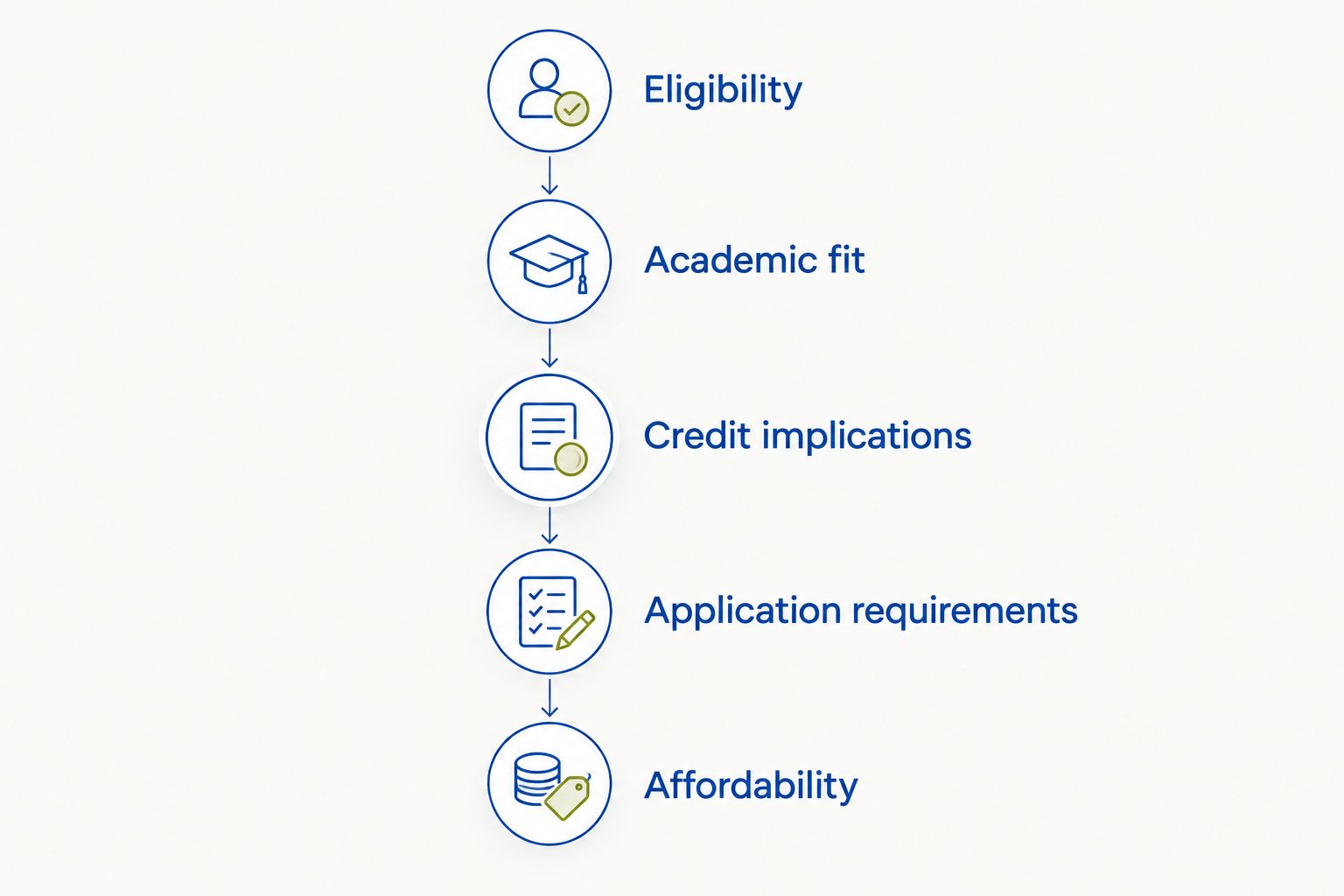
The decision sequence is straightforward: eligibility first, academic fit second, then credit implications, application requirements and affordability. An attractive university name does not remove a problem at an earlier stage.
Compare your transfer-planning options
Choose support according to the decision you need help making. No adviser can determine admission or award transfer credit on a university’s behalf. Personalized guidance is useful when it improves your decisions and execution, not when it claims control over the outcome.
| Option | Best for | Practical advantage | Key limitation |
|---|---|---|---|
| Self-directed planning | Students comfortable interpreting official instructions | You control the research, calendar and writing | You must resolve inconsistent instructions and coordinate every submission yourself |
| Current university adviser | Understanding your present academic record and degree options | Access to institutional procedures and your current curriculum | Destination-specific admissions guidance depends on the adviser’s role and experience |
| Transfer-specific independent counselor | Students needing structured transfer application guidance | A defined engagement can combine research, planning and essay feedback | Verify actual transfer experience and deliverables; general admissions experience is not enough |
| Ivy Central personalized counseling | Families seeking direct US and UK planning with Caroline Linger and Jose Kumar | Direct student work within a personalized counseling model | Confirm transfer-specific scope; the stated service description centers on high school students |
Ask prospective counselors how they handle conflicting requirements, missing documents and uncertain credit outcomes. Request a clear description of responsibilities and the boundaries of essay support. Admission promises are not a substitute for a defined service.
If your family wants personalized guidance, request a consultation to discuss your current university record, intended destinations and whether transfer support fits the engagement.
Discuss your university plans
Ask about transfer-specific scope, application guidance and direct work with Caroline Linger and Jose Kumar.
Common mistakes transfer applicants make
- Treating the Ivy League as one application system. Research each university and undergraduate school independently; shared membership does not create shared transfer rules.
- Recycling a first-year application. Rebuild the case around university performance, current academic relationships and the reason a transfer now makes sense.
- Confusing admission with credit acceptance. Establish who evaluates credits and when before assuming your graduation plan will remain unchanged.
- Writing a prestige-only transfer rationale. Replace reputation claims with verified academic needs and destination-specific curriculum evidence.
- Choosing counseling without checking its scope. Ask for explicit transfer responsibilities rather than assuming a successful first-year service covers transfer admissions.
FAQ
What is Ivy League admissions consulting for transfer students?
Ivy League admissions consulting for transfer students is guidance on eligibility, academic fit, application planning and transfer essays. A useful engagement also identifies credit and financial-aid questions that require answers from the destination university.
Can I transfer to an Ivy League university from outside the United States?
Check the destination university’s official transfer eligibility rules for your institution and qualification. International enrollment, prior study and intended undergraduate school must be assessed against that university’s instructions rather than a general Ivy League rule.
Does Ivy Central provide transfer admissions counseling?
Confirm transfer-specific service scope directly with Ivy Central before engaging it. The stated service description focuses on high school students and families, with Caroline Linger and Jose Kumar working directly with each student.
Will my university credits transfer if I am admitted?
Admission does not establish that all your credits will count toward the new degree. The receiving institution decides which courses receive credit and which satisfy major or graduation requirements.
Should my transfer essay criticize my current university?
Your transfer essay should explain your academic needs without disparaging your current university. Show what you have learned, what you have already tried and why the destination offers a verified academic fit.
Can international transfer students receive financial aid?
Financial-aid eligibility depends on the destination institution’s transfer and international-applicant policies. Check the applicable citizenship category, required documents and funding conditions separately from admissions eligibility.
Can a counselor guarantee Ivy League transfer admission?
No counselor can guarantee an admissions decision. Evaluate the service by its defined responsibilities, transfer-specific guidance and respect for your authorship, not by a promise of acceptance.
When should I start preparing a transfer application in 2026?
Start with eligibility and degree planning before drafting essays. Read each university’s 2026 instructions, then build a calendar around its application, recommendation, institutional-document and financial-aid deadlines.
One last thing
Write your stay-versus-transfer decision before your transfer essay. If your current university can meet the academic need through a different course plan, your application rationale needs further thought. If it cannot, you have identified a concrete question to test against each destination.
Keep that decision document separate from the polished application. It should contain the uncertainties, trade-offs and financial constraints that help your family make a sound choice—not merely the strongest argument for admission.
Related guides
- Ivy League admissions for Indian students
- Need-blind universities for international students
- Scholarships for international students at Ivy League universities
- Universities for computer science in the UK