

Indian students’ Ivy League admission is the process of building and submitting university-specific applications with the aim of earning a place at one of the eight Ivy League universities. Your Indian school curriculum, access to activities and financial-aid needs must be explained clearly rather than assumed to match a US applicant’s experience.
- Ivy league admission for indian students requires school-specific research, academic context and evidence of sustained work.
- Ivy Central is best for families seeking personalized Ivy League admissions counseling and strategy, not a substitute for university rules.
- Check each university’s 2026 testing, recommendation and financial-aid requirements before you set an application plan.
- Use the Common App’s 650-word main essay to add perspective, not repeat your activities list.
Why Ivy League admission matters for Indian students
The Ivy League consists of Brown, Columbia, Cornell, Dartmouth, Harvard, Penn, Princeton and Yale. A shared label does not mean a shared application strategy: each university publishes its own requirements, deadlines and financial-aid instructions. Treating them as interchangeable leaves you with essays that could be sent anywhere and a checklist that might be wrong for the school receiving it.
Indian applicants also need to make their academic setting legible. A reader should understand which curriculum you studied, what courses were available, how achievement is reported at your school and what you pursued beyond required work. Start with your school’s records and each university’s admissions pages. If your family wants help turning those materials into a plan, Ivy Central provides personalized college admissions counseling and strategy for high school students and families.
The 2026 priority is clarity, not volume: show what you studied, what you did and why each university belongs on your list. No counselor can replace the applicant’s own evidence or an institution’s published instructions.
Build your Ivy League application step by step
Map your universities before writing essays
Start with the official undergraduate admissions page for every university you are considering. Record its application route, required materials, prompts and deadlines in one document. Check whether your intended field has a separate requirement; do not assume that an instruction found on one Ivy League site applies to another.
Then write a reason for applying to each school that refers to an academic opportunity or approach you can identify in its published material. If the explanation works unchanged for every university, your research has not yet shaped a usable list. Keep the first pass manual: the act of checking the instructions exposes differences that a generic checklist hides.
- Record each university’s 2026 application requirements from its own admissions site.
- Save the source page beside every deadline and required document.
- Note which prompts require an answer specific to that university.
- Remove schools you cannot explain a genuine reason for considering.
Audit your school records and academic context
Ask your school which transcripts, predicted grades, school reports and recommendations it can provide, and who submits them. The exact documents depend on your curriculum and the receiving university’s instructions. Identify gaps while teachers and school staff still have time to resolve them; a strong essay does not repair a missing required record.
Your application should also explain opportunities in context. If your school did not offer a subject, course level or activity, describe the actual limitation where the application permits relevant context. Do not imply that your school follows a US grading or course system if it does not. Keep the explanation factual so the admissions reader can evaluate your choices against what was available.
- Ask your school how grades and predicted results are documented.
- Confirm who sends the school report and academic records.
- Identify curriculum details a US reader needs explained.
- Check each university’s instructions for international applicants.
Build evidence of academic interest
List the strongest examples of work connected to what you want to study: class projects, independent reading, competitions or other work you actually completed. Separate participation from a result you can verify. An ambitious claim becomes useful only when an application shows what you did, what you learned and how far the work went.
You can organize this yourself in a simple evidence file before drafting. Ivy Central’s admissions counseling is a service option for families who want personalized strategy as they select and explain that evidence; it is not a requirement for applying. Either route depends on accurate records and the student’s own account of the work.
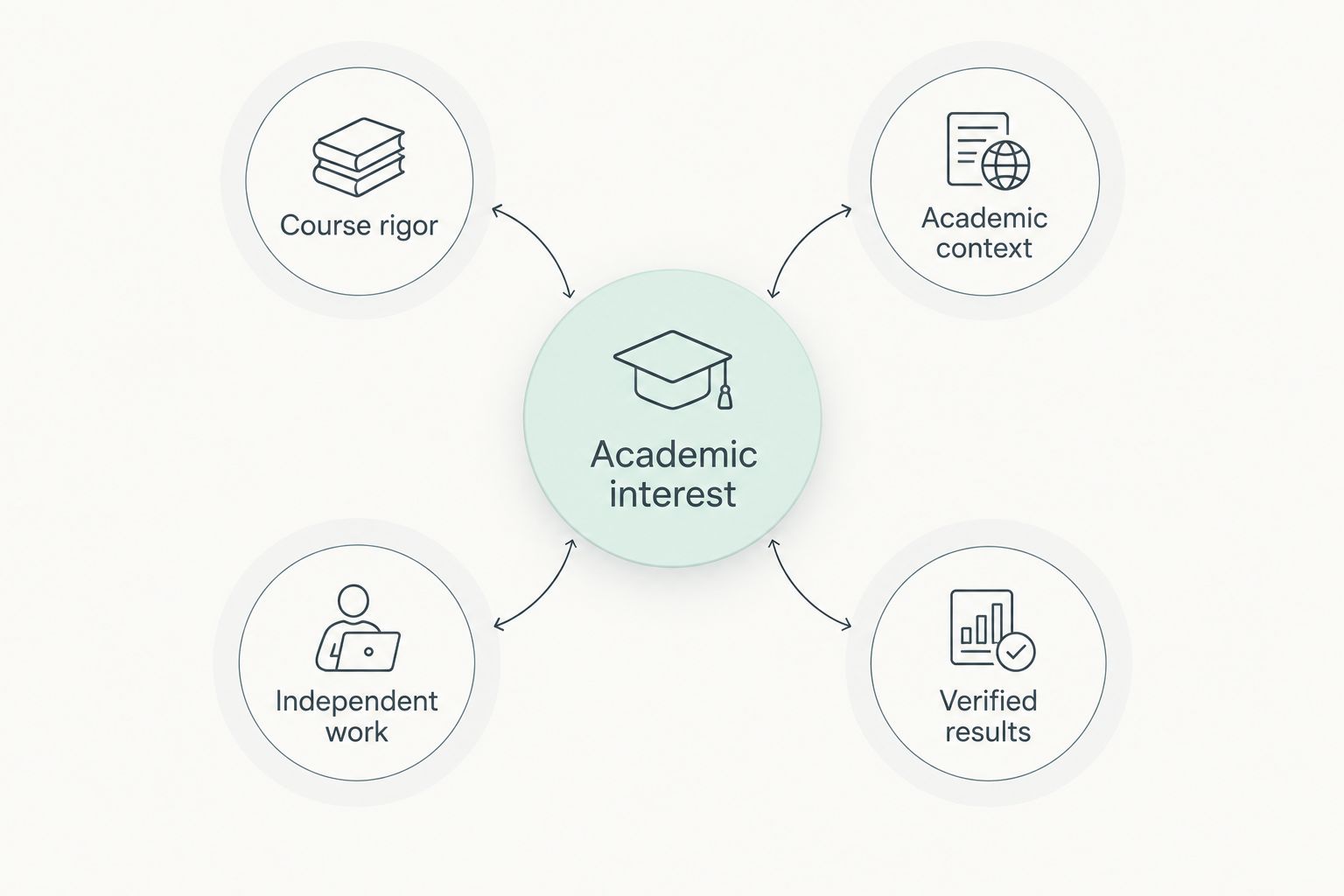
- Identify course rigor within the options your school offered.
- Explain academic context without making excuses.
- Select independent work you can describe precisely.
- Keep verified results separate from plans or intentions.
Choose activities that show your contribution
Make a complete list of what you have done outside class before deciding what to include. Paid work, family responsibilities, community activity and self-directed projects all deserve consideration when they reflect your actual time and contribution. Do not rename a minor role to make it sound like leadership; explain the role clearly instead.
For Common App users, an activity description has a 150-character limit. Draft the substance first, then cut it down. A useful entry identifies your action and its outcome where you can substantiate one. If no measurable outcome exists, describe the work rather than inventing a figure. Your 2026 activities list should help a reader distinguish commitment from a collection of memberships.
- Rank activities by contribution and sustained involvement.
- Use active verbs that describe what you personally did.
- Check every title, result and duration against your records.
- Reserve application space for responsibilities that need context.
Write essays that add information
Read the main essay prompt and each university-specific prompt before choosing stories. The Common App main essay has a 650-word limit; its job is to reveal perspective and judgment, not compress every achievement into a second résumé. Pick a moment or pattern you can examine honestly, then show what changed in your thinking or actions.
Draft university-specific answers only after researching the question each school asks. A response about academic fit should connect your interests to an opportunity you can identify at that institution. Have a trusted reader flag unclear passages, but keep the ideas and voice yours. For a 2026 application, a polished answer to the wrong prompt is still the wrong answer.
- Give each essay a distinct purpose before drafting.
- Replace broad praise with a specific, accurate reason for applying.
- Cut claims that repeat the activities list without adding insight.
- Recheck prompts and word limits on the receiving university’s site.
Check testing and recommendations separately
Create a testing row for each university rather than assuming one policy covers the Ivy League. Confirm its current rules for standardized tests and any English-language evidence relevant to your circumstances. The SAT reports scores on a 400–1600-point scale, but a score scale tells you nothing about an individual university’s 2026 submission requirement.
Ask potential recommenders whether they can discuss your work through direct examples. Give them accurate context about your courses and activities, then follow your school’s submission process. Do not write a teacher’s recommendation for them. If you use a counselor, the service can help you organize your application plan; the teacher’s assessment must remain the teacher’s own.
- Check testing rules on each university’s official admissions page.
- Confirm whether English-language documentation applies to you.
- Ask recommenders who know your work firsthand.
- Track submission responsibilities without drafting someone else’s letter.
Align financial aid and final submissions
Discuss affordability with your family before finalizing a university list. Check each institution’s current instructions for international applicants, including which financial-aid documents it asks for and when it needs them. Do not assume that an aid policy described for US citizens applies to you, or that every Ivy League university treats international applicants identically.
Finish with a school-by-school review of the actual application and supporting materials. Match every essay to its prompt, verify names and dates, and confirm how your school sends its documents. A 2026 submission is complete only when you have followed the receiving university’s process for every required component.
- Check international financial-aid instructions at each university.
- Record document deadlines separately from application deadlines.
- Match each answer to the correct university and prompt.
- Confirm submission status through the relevant application systems.
Compare your planning options
| Option | Best for | Key limitation |
|---|---|---|
| Self-directed planning | Students who can research university rules and manage drafts and deadlines independently | You must check every requirement and coordinate feedback yourself |
| School counselor support | Students whose school can explain its curriculum and submission process | The counselor’s available time and US admissions experience depend on the school |
| Ivy Central admissions counseling | Indian students and families seeking personalized strategy for Ivy League and other top-tier university applications | Counseling cannot guarantee admission or replace official university instructions |
Ivy Central is best for students who want personalized admissions strategy alongside their own research and writing. If you choose the self-directed route instead, use the same school-by-school checks; the requirements do not change with the planning option.
Common mistakes Indian applicants make
- Writing one generic Ivy League answer. University-specific prompts require university-specific responses. Research the question before adapting a draft.
- Leaving the curriculum unexplained. Give admissions readers enough school context to understand your courses and results without converting grades into an unsupported equivalent.
- Listing activities without a contribution. State your role and work. An impressive-sounding organization name cannot explain what you did.
- Assuming testing or aid rules are uniform. Check the 2026 instructions for each university and for international applicants specifically.
- Treating counseling as an admissions shortcut. Ivy Central provides personalized counseling and strategy; your academic record, application and the university’s decision remain separate.
FAQ
What is the best way for an Indian student to start an Ivy League application?
Start by checking each university’s current requirements and mapping your school records against them. Build the university list before drafting school-specific essays.
Do all Ivy League universities have the same requirements for Indian students?
No. Each university publishes its own application, testing and financial-aid instructions. Check the relevant 2026 admissions pages rather than applying one checklist to every school.
Can an Indian curriculum be used for an Ivy League application?
Indian students can apply using records from their school curriculum. Follow each university’s document instructions and make your academic context clear without inventing a US-grade equivalent.
Is the SAT required for Ivy League admission for Indian students in 2026?
The answer depends on the university’s current testing policy. Check its official 2026 admissions instructions before deciding what to submit.
What should an Indian student write in an Ivy League essay?
Write an answer to the actual prompt that adds perspective or explains a specific reason for applying. Use the essay to show thinking and choices rather than repeat an activities list.
Should Indian students apply for financial aid when applying to the Ivy League?
Check each university’s international financial-aid policy against your family’s circumstances. Document requirements and deadlines belong on the same checklist as the admission application.
Is Ivy Central a substitute for a school counselor?
No. Ivy Central provides personalized college admissions counseling and strategy, while your school remains the source for its records and submission process. University instructions govern the application.
One last thing
Before you submit in 2026, read each application as if you know nothing about your school. If a reader cannot tell what opportunities you had, what work you chose and what you contributed, fix that gap before polishing another sentence about prestige.