

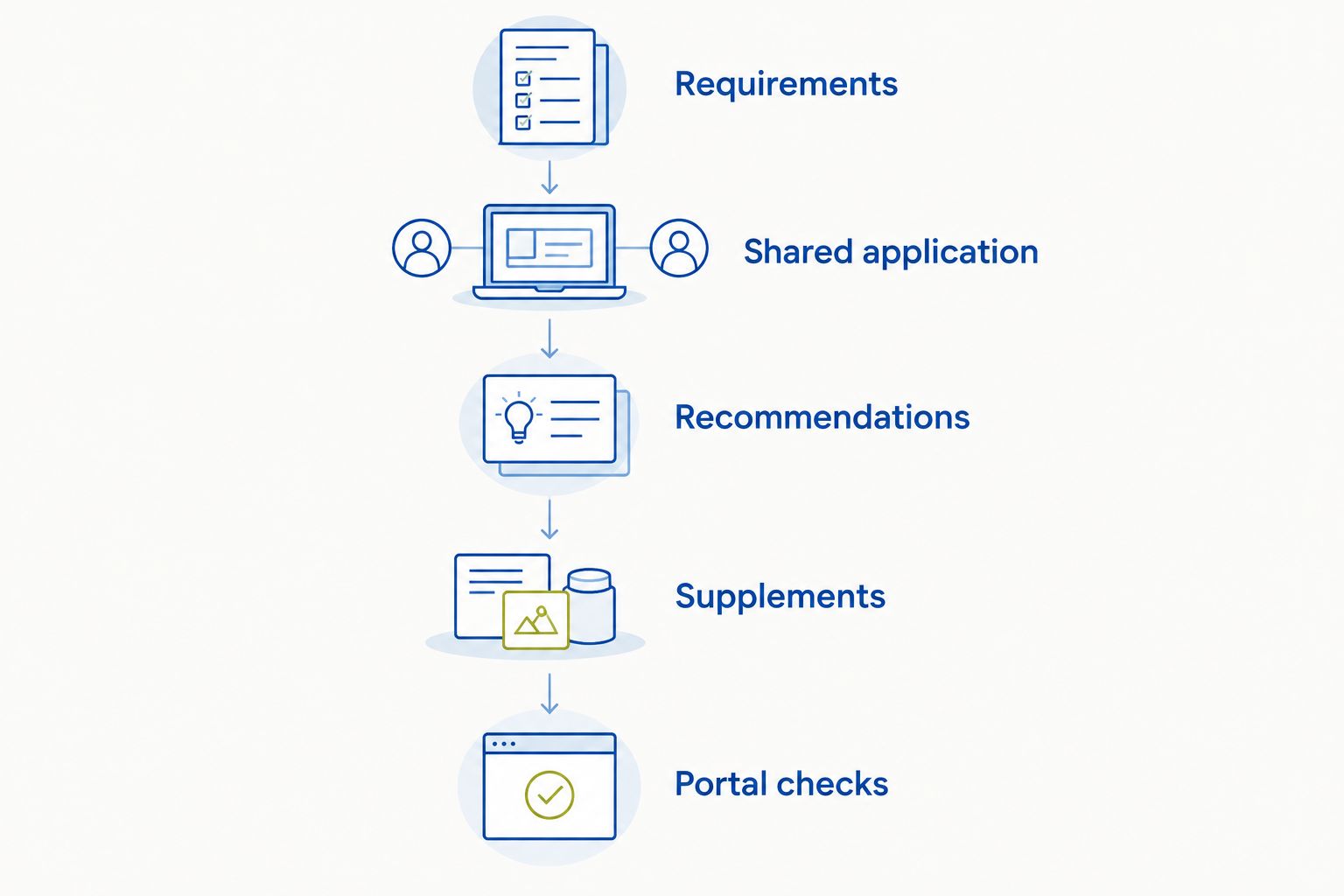
Instead of manually chasing essays, recommendations, and deadlines, build a 2026 Common App to Ivy League acceptance workflow that connects school-specific requirements, application preparation, submission, and decision follow-up. The workflow keeps your application organized; no process guarantees admission.
- Use this common app to ivy league acceptance workflow to coordinate essays, recommendations, submissions, and portal checks.
- Ivy Central suits families seeking personalized admissions counseling with direct guidance from Caroline Linger and Jose Kumar.
- Verify each university’s current requirements before choosing an application round or requesting recommendations.
- Treat submission, financial aid, and applicant-portal completion as separate checkpoints.
Why this matters
A submitted Common App is not the same as a complete university application. School documents, financial-aid forms, and later updates require separate tracking. Your system must show what you submitted and what each institution has received.
Ivy Central provides personalized college admissions counseling for students and families pursuing top US and UK universities. Caroline Linger and Jose Kumar work directly with each student on strategy and preparation.
Ivy Central is best for families seeking personalized Ivy League admissions counseling with direct guidance from Caroline Linger and Jose Kumar. Counseling supports your decisions and application quality; universities retain control over admission.
Before you start
- Access and records: Have your Common App account, a reliable personal email address, academic records, activity notes, and your school counselor’s contact details ready. Use an email account you will retain after graduation.
- School-specific instructions: Open each university’s official first-year admissions and financial-aid guidance for your intended entry term. For 2026 planning, record the entry term explicitly rather than assuming every page describes the same application cycle.
- The non-obvious gotcha: Check how your school sends recommendations and transcripts before inviting anyone. Schools using an integrated application platform can follow a different document-submission process; coordinate with your counselor first.
School requirements and deadline tracker
Build the university record
- Create a tracker with these fields: University, Entry term, Application round, Deadline, Time zone, Testing, Recommendations, Writing, Financial aid, and Portal status. These are your own spreadsheet labels, not Common App interface fields.
- Search for each institution in College Search, add it, and open its entry under My Colleges. Confirm you selected the intended undergraduate institution.
- Compare the application requirements against the university’s official admissions instructions. Record the source-page title and the date you checked it.
- Assign responsibility for each task: student, parent or guardian, counselor, or recommender. Give documents an internal completion date before the university’s deadline.
Expected result: Every university has a requirement record with a named owner and a verified deadline.
Make the record school-specific
For Harvard, record the application round and its restrictions from Harvard’s official instructions. For Yale, separately record Yale’s current testing requirements. For Princeton, check whether your application requires additional academic writing material. For Columbia, check the requirements for the undergraduate school you intend to enter.
These are verification tasks, not interchangeable requirements. Never copy one Ivy League university’s checklist into another university’s row. Recheck your 2026 records before submission, especially if a saved document describes an earlier cycle.
Keep financial fit in the same tracker. Record whether aid applications require separate forms and whether instructions differ for international applicants; do not assume admission and aid deadlines match.
Common App profile and evidence
Complete the shared application
- Open Common App and complete your background, family, education, and academic information. Match names and school details to your official records.
- In Activities, describe what you actually did, your responsibilities, and the scope you can substantiate. Distinguish independent work from group achievements.
- In Writing, develop the personal essay around a meaningful experience, perspective, or question. Show your decisions and reflection rather than repeating your résumé.
- Reconcile every claim against your records. Check dates, participation periods, awards, and academic information with the relevant school or organization.
Common App’s first-year application guidance provides a 650-word maximum for the personal essay, space for up to 10 activities, and a 150-character activity-description field. Check the live application fields for your cycle before final formatting.
These are limits, not targets. A shorter, specific activity list is stronger than entries added only to fill space.
Expected result: Your shared application presents a consistent academic and personal record without unsupported claims.
Turn experiences into evidence
For each activity, write a private note answering: What did you do? What changed because of your contribution? What did you learn? Then compress the relevant information into the application field.
If you need help deciding what belongs, review these extracurricular activities for Ivy League applicants. Use the guide to evaluate your existing commitments, not to replace genuine interests with a last-minute checklist.
Keep the student’s voice throughout. Adult feedback should identify unclear reasoning, missing context, or repetition—not supply a personality the student cannot sustain in an interview.
Recommendations and university supplements
Coordinate school documents
- Open Recommenders and FERPA within the relevant college’s application area. Read the authorization and waiver language before making your selections.
- Confirm your school’s submission process with your counselor. If an integrated platform handles documents, follow the school’s instructions rather than creating competing requests.
- Ask recommenders directly before sending an invitation. Share your intended subject interests, relevant classroom experiences, and deadlines without scripting their assessment.
- Check each university’s recommender requirements and track requests separately from completed submissions. An invitation is not evidence that a letter has arrived.
Expected result: Your counselor and recommenders know what to submit, where to submit it, and when it is due.
Draft university-specific responses
- Copy each current prompt into your writing tracker, with its exact word or character limit. Include the university and undergraduate school in the document title.
- Identify what the prompt asks you to demonstrate: academic direction, intellectual curiosity, community contribution, or another stated topic.
- Verify every university-specific detail against official academic or student-life information. Explain why the opportunity connects to work you have already done or questions you want to pursue.
- Review the responses together. Remove passages that repeat the personal essay without adding another dimension.
Expected result: Each supplement answers its actual prompt and explains a specific connection to that institution.
Submission and portal checks
Review the application package
- Open Review and Submit for the university you are ready to submit to. Read the application preview rather than relying only on the editing screens.
- Check formatting, school names, intended academic interests, special characters, and text cutoffs. Compare the preview with your final writing documents.
- Complete the required declarations yourself. Submit only after you understand the applicable application-round agreement and have reviewed your information for accuracy.
- Save the submission confirmation and a copy of the submitted application. Record the date and status in your tracker.
Expected result: You hold a confirmed submission record and an exact copy of what the university received through your application.
Close the university checklist
- Follow the university’s instructions for activating its applicant portal. Check spam folders if the expected communication does not arrive.
- Compare the portal checklist with your tracker. Distinguish an unprocessed document from a document nobody has sent.
- Complete financial-aid requirements through the institution’s specified process. Parents and guardians should review the financial information they provide.
- Monitor official communications for interviews, additional materials, decisions, and response instructions. Send updates only through channels the institution permits.
Expected result: Your tracker reflects the university’s checklist, not merely your own submission history.
For 2026 applications, keep one final verification record per university: the current instructions checked, the submitted application saved, and any outstanding portal item assigned to an owner.
Variant: move from an early round to regular decision
The same workflow supports regular-decision applications after an early submission or decision. An early application is not a reason to stop preparing your remaining applications. Follow the early institution’s restrictions and agreement while keeping permitted alternatives ready.
| Application route | Best for | Advantage | Constraint |
|---|---|---|---|
| Early round | Students whose application is ready and whose choice fits the institution’s rules | Concentrates preparation around an earlier deadline | Restrictions and binding commitments depend on the specific plan |
| Regular decision | Students who need the later deadline or a broader decision process | Provides a later submission checkpoint | Requires continued preparation while schoolwork remains demanding |
Before switching your focus, read the actual decision letter. A deferral, denial, and waitlist decision are different statuses; follow the university’s instructions for the status you received.
For the remaining 2026 applications:
- Preserve the shared application material that remains accurate.
- Recheck each university’s current prompts and document requirements.
- Ask your counselor about required school updates.
- Submit additional information only when the receiving institution allows it.
Do not rewrite an entire application simply because another university declined it. Review for factual errors and weak explanations, but keep the student’s genuine interests consistent.
Troubleshooting
A recommendation is missing
Check whether the request reached the recommender and whether the letter was assigned where required. If your school uses an integrated platform, ask your counselor to check the school-side status before sending another invitation.
Common App confirms submission, but the portal is incomplete
Compare the missing item with the university’s processing guidance. Confirm who sent it and through which channel; contact admissions using the institution’s instructions if the discrepancy remains after its stated processing period.
The essay preview looks wrong
Return to the editing field, correct paragraph breaks or unsupported formatting, and preview again before submission. Treat the rendered application—not your word-processing document—as the final formatting check.
A material error appears after submission
Follow the university’s correction procedure and describe the error precisely. Do not assume changing the shared application will replace a version already submitted to an institution.
Customize your workflow
Add academic direction and financial fit
Connect your university list to subjects you want to study, the learning environment you need, and your family’s financial circumstances. Separate institutional financial aid from external scholarships, and verify eligibility through each provider’s official instructions.
If you are applying to both countries, keep US and UK application requirements separate. UK undergraduate applications generally use UCAS, not Common App; check each institution and course’s instructions rather than transferring US essay material unchanged.
Decide where counseling helps
Ivy Central’s personalized college admissions counseling supports families who want direct guidance from Caroline Linger and Jose Kumar. Use a consultation to discuss school selection, application sequencing, essay guidance, and US-versus-UK choices.
The benefit is individualized strategy; the limitation is that counseling cannot control an admissions decision or replace the student’s work. Bring your tracker and specific questions so the discussion addresses decisions rather than general ambitions.
Discuss your application strategy
Review university choices, application priorities, and essay guidance with Ivy Central.
FAQ
What is the best Common App to Ivy League acceptance workflow?
The best workflow separates school requirements, shared application content, recommendations, supplements, submission, and portal checks. Assign an owner to every outstanding task and verify each university’s current instructions; no workflow guarantees acceptance.
Can I use the same Common App essay for every Ivy League university?
You can use your shared Common App personal essay for universities receiving that application. Complete each institution’s additional writing requirements separately and check the current prompts before submitting.
Should I fill all the Common App activity spaces?
No. Common App allows up to 10 activities, but you should include activities that accurately represent your commitments rather than add weak entries to fill every space.
Does Common App submission mean my application is complete?
No. Check the university’s applicant portal for school documents, recommendations, and any other required materials. Financial-aid applications can also require separate submissions.
How do I verify Ivy League requirements for 2026?
Use each university’s official admissions and financial-aid instructions for your intended entry term, then compare them with the live application. Record when you checked testing, writing, document, and deadline requirements.
Can Ivy Central guarantee Ivy League admission?
No. Ivy Central provides personalized college admissions counseling, with Caroline Linger and Jose Kumar working directly with students. Universities make their own admissions decisions.
Can this workflow also manage UK university applications?
The tracking method can support UK planning, but the application requirements must stay separate. UK undergraduate applications generally use UCAS; verify the process and course requirements with each institution.
One last thing
Make your tracker describe evidence, not optimism. Replace a status such as nearly finished with a verifiable checkpoint: preview reviewed, submission confirmed, or portal marked received. That distinction tells you exactly what still needs attention.
Related guides
- Ivy League admissions for Indian students
- Safety schools for Ivy League applicants
- Scholarships for Indian students studying in the US