

Best overall candidate: Arizona State University. Best for engineering-focused students: Iowa State University. Best for astronomy: the University of Arizona. The best safety schools for Ivy League applicants in 2026 are schools where your academic record, intended major, citizenship and family budget support a realistic application—not simply universities with less selective reputations.
- Best safety schools for Ivy League applicants 2026: shortlist Arizona State, Iowa State, Arizona, Kansas and Alabama conditionally.
- Arizona State University is the default candidate for students comparing a broad range of undergraduate majors.
- A college is not a safety if admission to your major or an affordable offer remains uncertain.
- Ivy Central helps families build balanced college lists; Caroline Linger and Jose Kumar work directly with each student.
Why this matters
Start your 2026 college list with universities you would actually attend. Check the official undergraduate admissions page, the intended department's requirements and the financial-aid rules for your citizenship before assigning any school a safety label.
An Ivy League applicant's strong transcript does not make every other university safe. Engineering, business and other programs can have requirements that differ from general university admission. A scholarship-dependent application also needs a separate financial assessment.
Ivy Central is best for families seeking personalized college admissions counseling across ambitious and realistic university choices. Through Ivy Central, Caroline Linger and Jose Kumar work directly with each student on admissions strategy. Counseling supports your decisions; it does not guarantee an offer.
What makes the best safety school?
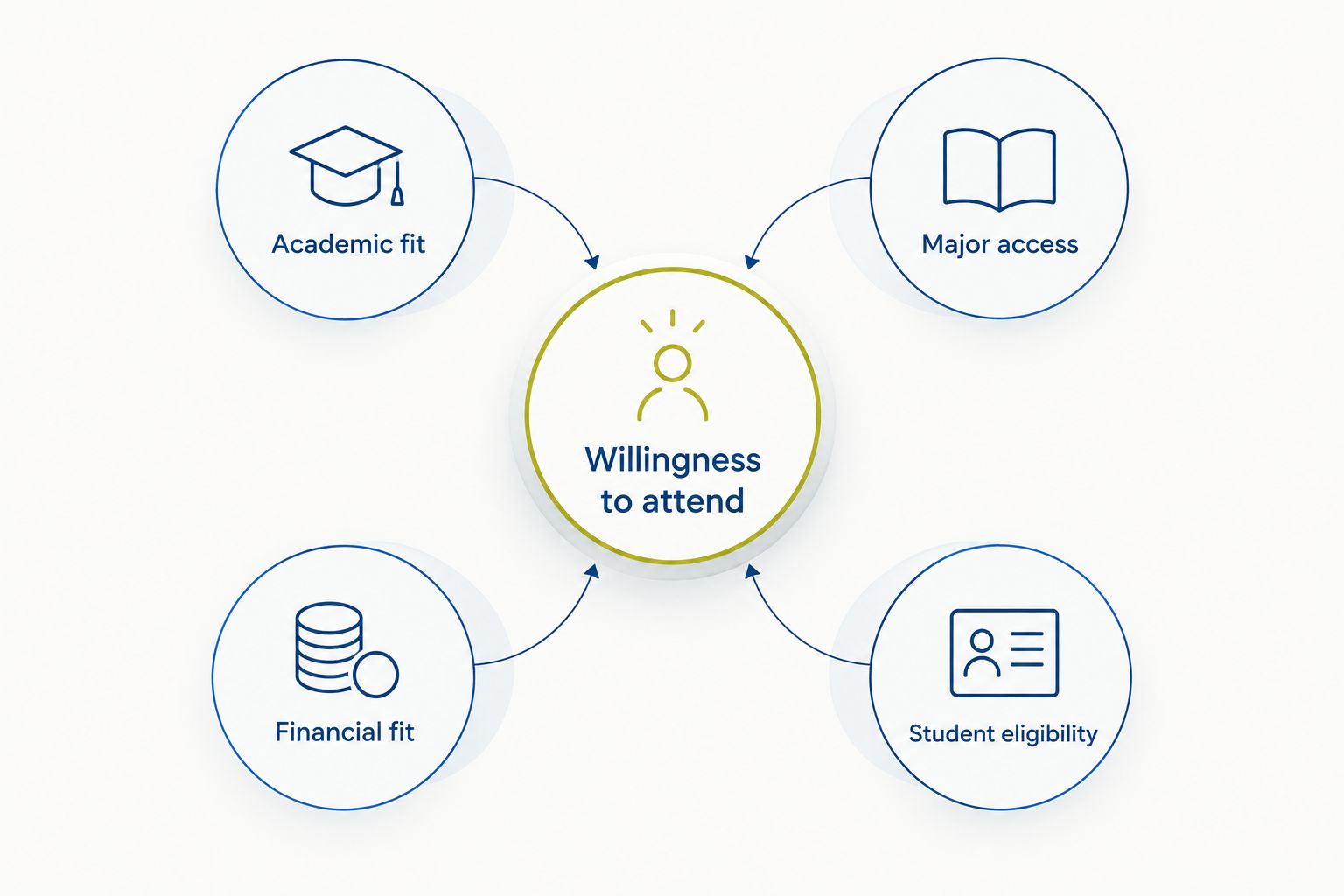
Use these criteria before comparing names:
- Academic fit: Your grades, curriculum and preparation meet the university's published requirements and suit the intended course.
- Major access: Admission provides a workable route into your subject, not merely a place elsewhere in the university.
- Financial fit: Your family can fund attendance without depending on an uncertain scholarship.
- Student eligibility: The rules match your citizenship, residency, school qualification and English-language background.
- Willingness to attend: You would accept the offer if your more selective applications were unsuccessful.
For 2026, record the application cycle and source beside each requirement. An old admissions summary is not a substitute for the university's current instructions.
Treat admission and affordability as separate decisions. A school belongs in your likely-admission group only after both checks pass; a school with unresolved funding belongs elsewhere on the list.
Safety-school candidates at a glance
These are starting points for individual assessment, not universal safeties. The ranking gives each university a distinct use case rather than claiming that one is easier to enter than another.
| University | Best for | Standout feature | Key limitation |
|---|---|---|---|
| Arizona State University | Comparing a broad range of majors | Broad undergraduate subject choice | Check campus, delivery format and major-specific requirements |
| Iowa State University | Engineering and applied interests | Engineering within a land-grant university | Confirm the route into the intended engineering major |
| University of Arizona | Astronomy-focused science interests | Astronomy and Steward Observatory | Research access is not guaranteed by undergraduate admission |
| University of Kansas | Humanities and social-science exploration | Liberal arts within a public research university | Review progression rules for any professional program |
| University of Alabama | Exploring an honors pathway | Honors College alongside university admission | Honors admission requires a separate assessment |
No candidate earns a budget recommendation without a family-specific cost assessment. For international families, a likely admission decision and a workable funding plan are different outcomes.
1. Arizona State University: best for broad major choice
Best for: Students who want several credible academic directions before narrowing their college list.
Arizona State University offers a broad range of undergraduate subjects across multiple campuses. It is a useful starting point when your interests span fields rather than a single specialized course. Your first task is to identify the exact degree and campus—not to apply on the strength of the university name alone.
For your 2026 application, check the official degree page alongside undergraduate admissions instructions. Confirm whether the program has additional academic requirements and whether the option you selected is campus-based or online.
Arizona State University pros:
- Broad subject choice supports comparisons across academic interests.
- Multiple campuses give you different settings to investigate.
- Degree-level information lets you assess a specific course rather than a general reputation.
Arizona State University cons:
- Different campuses and delivery formats are not interchangeable experiences.
- General university eligibility does not settle every program-specific admission question.
Put Arizona State University on the list when the actual course fits your preparation and goals. Remove it if the only attraction is the assumption that a large university must be easy to enter.
Verdict: Hold until the exact major, campus and funding plan pass your checks.
2. Iowa State University: best for engineering-focused applicants
Best for: Students seeking engineering and applied academic options in a land-grant setting.
Iowa State University is a public land-grant university with a College of Engineering. It belongs on an engineering applicant's research list because you can evaluate a defined engineering pathway rather than treating every public university as equivalent.
Begin with the engineering discipline you want to study. Read the official curriculum, admission instructions and progression information, then compare them with your mathematics and science preparation. Your intended discipline should drive the choice.
Iowa State University pros:
- A dedicated College of Engineering provides a clear academic starting point.
- The land-grant setting supports an applied academic focus.
- Published curricula help you compare engineering disciplines before applying.
Iowa State University cons:
- Interest in engineering alone does not demonstrate readiness for the curriculum.
- An admission assessment still needs to account for your qualification and financial circumstances.
Ask whether the engineering course would remain attractive if every Ivy League application were unsuccessful. If the answer is yes, assess Iowa State University as a serious destination rather than a placeholder.
Verdict: Hold until engineering eligibility and the intended degree pathway are confirmed.
3. University of Arizona: best for astronomy interests
Best for: Students whose science interests center on astronomy and related research.
The University of Arizona has an astronomy department and Steward Observatory. Those academic resources make it a relevant university to investigate when astronomy is a genuine subject interest, not merely an impressive application theme.
Read the undergraduate astronomy curriculum first. Then examine the department's published information about undergraduate research and participation requirements. The existence of a research facility does not promise you a position within it.
University of Arizona pros:
- Astronomy has a defined departmental home.
- Steward Observatory gives your academic research a specific institutional focus.
- Course information helps you assess the mathematical and scientific demands of the subject.
University of Arizona cons:
- Undergraduate admission does not guarantee a particular research opportunity.
- A strong subject reputation does not establish affordability or individual admission likelihood.
For 2026, distinguish opportunities described for undergraduates from those intended for graduate students. Your college choice should rest on the education you can pursue, not on a research project you assume you will join.
Verdict: Hold until the undergraduate course and realistic participation routes fit your goals.
4. University of Kansas: best for humanities exploration
Best for: Students comparing humanities and social-science subjects within a public research university.
The University of Kansas offers liberal arts study through its College of Liberal Arts and Sciences. It is a useful candidate when you want to compare subjects such as history, political science and related fields before committing to a narrower academic direction.
Review degree requirements, introductory courses and advising information. If your longer-term plan involves a professional field, check whether that pathway has separate entry or progression rules rather than assuming university admission settles the question.
University of Kansas pros:
- Liberal arts study supports comparisons across several academic interests.
- A public research university setting includes different disciplinary perspectives.
- Degree requirements provide a concrete basis for assessing subject fit.
University of Kansas cons:
- Breadth requires you to make deliberate course and advising choices.
- Professional pathways need their own review beyond general undergraduate admission.
Choose the University of Kansas because you can explain what you want to study there. A list built around prestige alone misses the academic reasons that make a likely option worth accepting.
Verdict: Hold until your preferred subjects and any later progression requirements are clear.
5. University of Alabama: best for an honors pathway
Best for: Students who want to investigate honors study alongside a broader university option.
The University of Alabama has an Honors College. That creates a separate academic pathway to investigate, but university admission and honors admission must remain separate decisions in your planning.
Read the official Honors College application instructions and requirements for your entry cycle. Then ask whether you would still attend the University of Alabama without an honors offer. If not, the general university offer alone does not satisfy your definition of a safety.
University of Alabama pros:
- A named Honors College provides a distinct pathway to research.
- University and honors options can be assessed separately.
- The comparison encourages you to define the academic experience you actually want.
University of Alabama cons:
- General admission does not establish eligibility for honors admission.
- A plan dependent on honors admission or a scholarship remains conditional.
Evaluate the ordinary degree experience before adding an honors expectation. Keep scholarship decisions separate too; an attractive pathway is not the same as a confirmed funding package.
Verdict: Hold until both the base university experience and any essential honors conditions work for you.
How the ranking works
This shortlist ranks academic use cases, not acceptance probabilities. Arizona State University leads for broad subject comparison; the remaining universities serve engineering, astronomy, humanities and honors interests respectively.
Each candidate must pass the same academic, major-access, financial, eligibility and willingness checks. None receives a safety label based solely on an overall acceptance rate, a university's size or an applicant's Ivy League ambitions.
Build a list that survives disappointing decisions
Use this sequence before submitting your 2026 applications:
- Choose the course. Identify the actual undergraduate degree, campus and entry route.
- Check eligibility. Match official requirements to your curriculum, citizenship and supporting documents.
- Assess admission. Separate published minimum requirements from any competitive selection process.
- Confirm funding. Build an annual budget covering tuition, housing, meals, insurance, travel and required fees.
- Test commitment. Decide whether you would genuinely enroll if this were your only offer.
As a planning recommendation, keep at least 2 independently assessed likely options rather than relying on a single fallback. Independence matters: two applications that both depend on an uncertain scholarship do not solve the same risk as two financially workable choices.
Budget for 12 months of living expenses, not just classroom attendance. Also review the full expected degree duration and account for exchange-rate exposure when your family income and university expenses use different currencies.
For families in India, the UAE and Singapore, international admission and funding rules need particular attention. US or UK residence alone does not establish a university's citizenship, residency or fee classification.
A UK option needs a separate course-level assessment. Compare subject prerequisites, qualification requirements and any conditional offer terms; do not transfer a US safety label to a UK university.
Ivy Central's personalized college admissions counseling can help you connect this assessment with application and essay planning. Caroline Linger and Jose Kumar work directly with each student, keeping the student's preparation and goals central to the list. When you are ready for a consultation, bring your transcript, intended subjects and family funding limits.
Which safety-school candidate should you choose?
Start with Arizona State University if you are undecided across several majors. Start with Iowa State University for engineering, the University of Arizona for astronomy, the University of Kansas for humanities exploration or the University of Alabama for an honors pathway.
Then apply the same strict checks. Your best option is the school that fits your academic profile, offers a workable route into your subject and remains affordable without an uncertain award. If a candidate fails those checks, replace it rather than defending its place on the list.
FAQ
What’s the best safety school for an Ivy League applicant in 2026?
Arizona State University is the default candidate on this shortlist for broad undergraduate subject choice. It becomes a personal safety option only after your academic eligibility, intended major and funding plan are assessed.
Is a university with a high acceptance rate automatically a safety?
No, an overall acceptance rate does not establish your individual admission likelihood. Major-specific selection, your school qualification and financial requirements need separate checks.
Can international students use these universities as safety schools?
International students can assess these universities as candidates, but none is a universal safety. Check international admission requirements, English-language rules and funding for your citizenship and qualification.
Is Iowa State University better than Arizona State University for engineering?
Neither university is the better choice for every engineering applicant. Compare the specific discipline, curriculum, admission route and family budget rather than choosing from university names alone.
Can I count on a scholarship to make a safety school affordable?
Do not classify a scholarship-dependent university as financially safe until the funding is confirmed. Check the award conditions and whether the funding continues throughout the intended degree.
Does an honors offer come with general university admission?
Do not assume that general university admission includes an honors offer. At the University of Alabama, review Honors College requirements separately and decide whether you would attend without honors admission.
Can Ivy Central guarantee admission to an Ivy League university?
Ivy Central’s personalized college admissions counseling does not guarantee admission. Caroline Linger and Jose Kumar work directly with each student on strategy, applications and university choices.
One last thing
Write a short paragraph explaining why you would attend each likely option before writing essays for your reaches. Name the course and the academic experience you want. If your only reason is that admission seems easier, the school has not earned its place on your 2026 list.
Related guides
- Ivy League admissions for Indian students
- Need-blind universities for international students
- Scholarships for Indian students studying in the US
- UK universities for computer science