

Instead of copying SAT results into each application from memory, use a school-by-school checklist to move from your score report to accurate application entries, required score sends and receipt checks. This 2026 workflow separates what you report yourself from what College Board must send, so you do not mistake a submitted application for a complete testing file.
- Use this SAT score report to Ivy League application workflow to separate self-reporting, official score sends and receipt checks.
- Check each university’s official testing requirements for your entry term before deciding how to report SAT results.
- Ivy Central provides personalized college admissions counseling, with Caroline Linger and Jose Kumar working directly with each student.
- After a retake, update each university through its permitted channel; do not assume submitted applications update automatically.
Why this matters
SAT reporting is a university-specific task, not an Ivy League-wide setting. Your application answers, official score order and applicant portal can represent different stages of completion. Treat each stage separately.
College Board reports SAT total scores on a 400–1600-point scale. Reading and Writing and Math each use a 200–800-point scale. Use the section names and test dates shown on your actual report, not a practice-test dashboard.
Ivy Central is best for families seeking personalized college admissions counseling rather than a score-reporting tool. Caroline Linger and Jose Kumar work directly with each student; Ivy Central can help connect testing decisions with the wider application strategy. Counseling does not replace official university instructions or guarantee admission.
Before you start
- Prepare your access and records. Have your College Board login, application account, applicant portal access where issued, SAT score reports and university list. Keep account credentials private; a counselor can review your records without taking ownership of your accounts.
- Identify the right application cycle. Record your intended entry term, applicant category and application round. A requirement for another intake, transfer applicants or a different undergraduate school is not your requirement.
- Check the reporting distinction first. Permission to self-report does not automatically remove every official-report obligation. Establish whether an official report is required during application review, after admission or at enrollment before placing an order.
For every 2026 application, use the university’s official undergraduate admissions testing page as the controlling source. Use College Board’s SAT score information for score definitions and sending procedures, and the application platform’s own help text for individual fields. Record the date you checked each instruction.
Your university requirements register
Start with a document or spreadsheet you control. The field names below are suggested worksheet labels, not buttons in an admissions platform.
Establish the school-specific rules
- Create a separate row for every university. Add the undergraduate school or program when its instructions differ from the institution-wide page.
- Record Entry term, Application round, Testing requirement, Self-reporting permission, Official report requirement, Score-use policy, Testing deadline and Update channel.
- Copy the relevant official wording into a notes column. Add the source page title and your verification date so that you can resolve conflicting advice later.
- Mark unclear instructions as unresolved. Ask the university’s admissions office a narrow question before choosing a reporting route.
Expected result: Every university has a documented reporting decision supported by its own instructions, rather than a rule copied from another school.
Use this Ivy League checklist to keep your research specific. These are verification tasks, not statements of current university policy.
| University | Official-source check before reporting | Record in your worksheet |
|---|---|---|
| Brown University | Read undergraduate testing requirements for your entry term | Required tests, reporting route and deadline |
| Columbia University | Confirm instructions for the undergraduate school receiving your application | School-specific requirements and reporting route |
| Cornell University | Check university instructions and the relevant undergraduate college | Applicable college policy and required evidence |
| Dartmouth College | Read current first-year testing and score-submission instructions | Accepted reporting method and update process |
| Harvard University | Check application requirements and standardized-testing instructions | Required evidence and official-report timing |
| University of Pennsylvania | Review first-year testing instructions for your application cycle | Reporting route and score-use policy |
| Princeton University | Check requirements for your intended entry term | Testing status, reporting route and deadlines |
| Yale University | Review the current testing requirement and accepted evidence | Required test evidence and submission method |
For 2026 planning, do not turn an older search-result excerpt into a reporting decision. Open the official page and confirm that its scope matches your application. If the page does not identify the relevant cycle clearly, obtain clarification directly.
Choose the reporting route
Self-reporting and an official score report are different mechanisms. Neither substitutes for the other unless the university explicitly permits it.
| Reporting route | Best for | Advantage | Limitation |
|---|---|---|---|
| Self-reporting | Universities that accept applicant-entered scores at your application stage | Lets you enter results directly in the permitted application or portal fields | Requires accurate transcription and does not satisfy a separate official-report requirement |
| Official College Board report | Universities requiring scores sent by the testing agency at your application stage | Delivers results through the testing agency’s reporting process | Requires recipient selection and a separate receipt check |
Choose the route the university requires, not the route that appears easier. If both are required, track both. If official verification is required only later, record that future obligation rather than treating it as completed now.
Your SAT evidence file
Your score report is the source record. Application entries and score-send selections should follow it, not a counselor’s summary, a screenshot with missing dates or a remembered superscore.
Prepare the source record
- Sign in to your College Board account and open the SAT score report for each relevant sitting. Use the official account record rather than a preparation provider’s estimate.
- Record the test date, total score, Reading and Writing score, and Math score exactly as displayed. Keep each sitting on a separate row.
- Compare identifying details across your testing and application accounts. Resolve errors through the relevant organization’s official process; do not create another account to bypass a mismatch.
- Read each university’s score-use policy before selecting sittings. Do not assume that a highest-section combination is accepted everywhere or that every institution wants the same testing history.
Expected result: You have a dated source record that lets you check every application field against an actual SAT sitting.
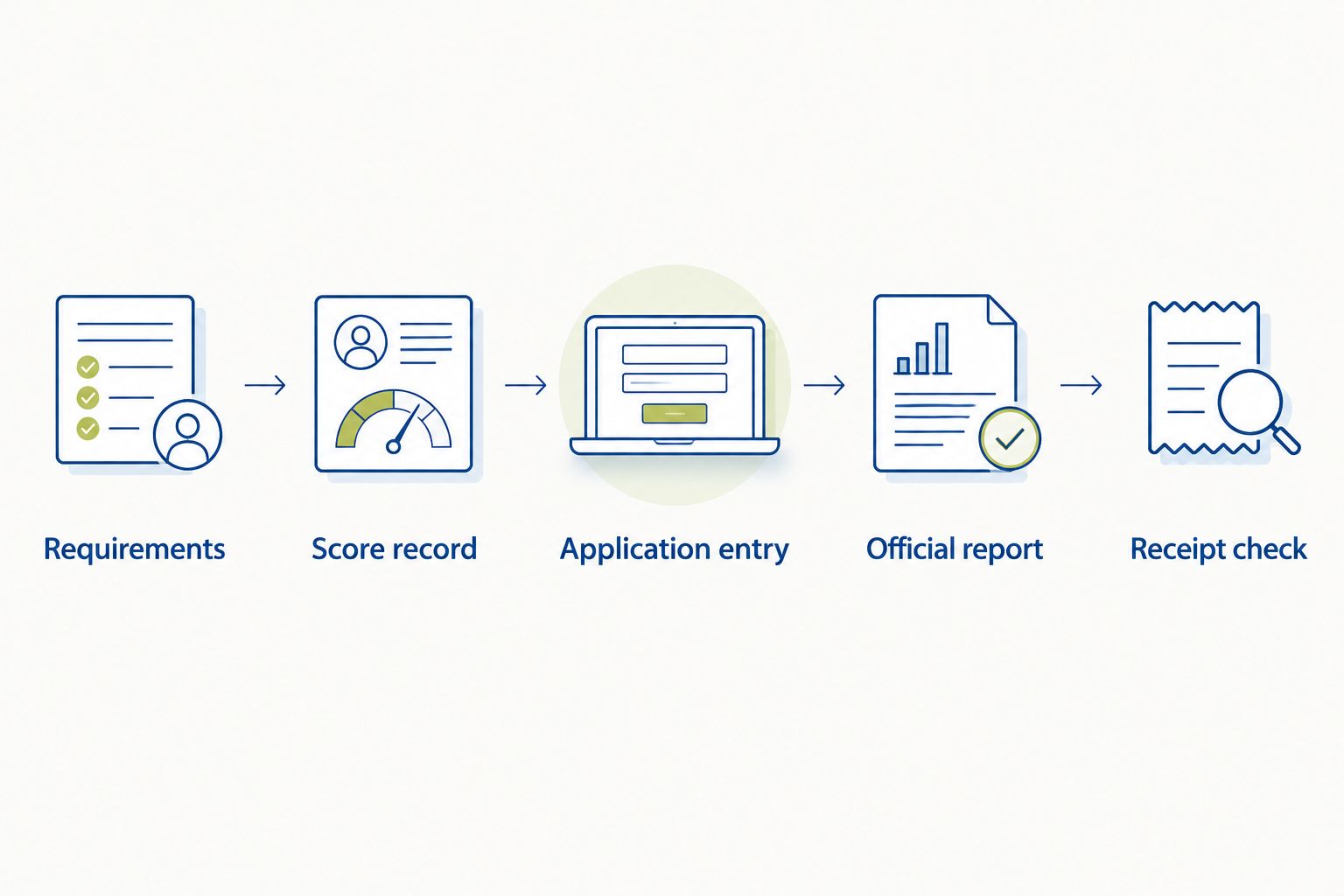
The practical sequence is Requirements, Score record, Application entry, Official report and Receipt check. Keep these stages separate even when a university lets you complete several of them during the same session.
A high total does not make the surrounding application complete. Your course choices, academic record, activities, recommendations and essays still need coordinated attention. The Ivy League admissions guide for Indian students provides a broader planning context for families applying from India.
Your application entries and score sends
Complete this stage university by university. A single application platform can contain shared answers alongside institution-specific questions, so check the final output for each destination.
Enter and review application scores
- Open the application’s testing section. In Common App, Testing is the relevant section name; read the displayed questions before entering results.
- Enter only what each field requests. A request for a section score is not a request for your total, and a request for a test date is not a request for the score-release date.
- Follow the field instructions and the university’s reporting rules when entering results from multiple sittings. Never create a fictional test sitting to represent a combined score.
- Review the application preview before submission. Compare every reported score and date against your source record, then inspect the university-specific questions for additional testing instructions.
Expected result: Your application accurately represents your test results in the format requested, without invented dates or incorrectly combined scores.
Keep a copy of the submitted application output. In your 2026 application folder, distinguish draft records from submitted records so that later edits do not obscure what the university actually received.
Order required official reports
- Return to your requirements register and identify universities requiring an official report at this stage. Do not order from memory or assume that all destinations have identical rules.
- In your College Board account, use Send Scores. Confirm the institution in the recipient directory, checking the destination against the university’s official instructions rather than an unofficial recipient-code list.
- Select the test dates according to the university’s score-use instructions and the choices available in your account. Review the recipient and selected sittings before submitting the order.
- Save the order confirmation and record its date. After submission, check the available sending status, then use the university’s applicant portal to verify receipt or follow its stated confirmation procedure.
Expected result: Each required report has an order record and a separate receipt status. An order confirmation alone does not close the task.
Do not assume a score order extends an application deadline. Check whether the institution distinguishes the application deadline, testing deadline and supporting-document deadline, and plan against the relevant instruction.
When a new SAT result arrives
A retake creates an update workflow, not permission to rewrite a submitted application silently. Editing shared application information does not establish that a university has received the revision.
- Recheck the update rule. Confirm whether the university accepts additional scores for your round and which channel it permits.
- Add the new sitting. Preserve your earlier source record and record the new test date and section scores separately.
- Submit through the permitted channel. Use the applicant portal, official report or other method specified by admissions. Avoid sending the same update through several channels unless instructed.
- Close the loop. Save the submission confirmation and check receipt using the university’s stated process.
Expected result: The new result has a traceable submission path, and your original application record remains intact.
For a 2026 application, repeat the policy check before sending an update near a deadline. Acceptance of updates and the timing of application review are separate questions; do not infer either from a successful upload.
Troubleshooting
The applicant portal still marks testing as missing
Compare the destination, identifying details and submitted sittings with your order confirmation. Read the university’s published document-processing guidance before escalating. If the discrepancy remains, contact admissions with your application identifier and order details; do not place duplicate orders as your first response.
Your application contains the wrong score or date
Use the university’s correction procedure promptly. State the incorrect entry and the accurate replacement clearly, supported by the source report. Changing an unsubmitted application elsewhere does not correct the version already received by this university.
You cannot find the expected score-report recipient
Stop before selecting a similarly named institution. Check the university’s own recipient instructions and ask College Board or admissions for clarification. A familiar city or abbreviated name is not enough to identify the correct destination.
Different pages appear to give different testing rules
Check the entry term, applicant category and undergraduate school on each page. If the conflict remains, request written clarification from admissions and retain it with your requirements register. Do not resolve the conflict by choosing the less demanding instruction.
Your preferred score combination does not fit the form
Read the application’s field-level help and the university’s score-use policy again. Enter results in the requested structure rather than changing a test date to make the form accept a combined score. Ask the application platform about a technical restriction and admissions about policy.
Customize your workflow
Extend the register beyond testing without confusing separate requirements. Add recommendation status, essay completion, transcript submission and financial-aid tasks as distinct records. A complete testing file does not establish that any of these are complete.
For families comparing US and UK universities, create separate admissions checklists. Do not treat SAT reporting as evidence that you have satisfied a UK course’s qualification or admissions-test requirements; check the university’s official course instructions.
Ivy Central can help families connect testing choices with application and essay guidance. Caroline Linger and Jose Kumar work directly with each student, keeping the strategy tied to the student’s academic record and university goals. For a consultation, bring your university list, score reports and unresolved policy questions. That makes the discussion specific rather than score-led.
Keep scholarships and financial aid on their own calendar. Check eligibility, required documents and submission instructions directly with each university or scholarship provider; an admissions application is not proof that every funding task is finished.
FAQ
How do I move my SAT score report into an Ivy League application?
Check the university’s reporting rules, enter scores where permitted, send an official College Board report where required, and confirm receipt. Keep your original score report beside you when entering dates and section results.
Do all Ivy League universities use the same SAT reporting rules?
Do not use a single reporting rule for every Ivy League university. Check each institution’s official instructions for your entry term, applicant category and undergraduate school.
Is self-reporting the same as sending an official SAT report?
No. Self-reporting means you enter your results, while an official report is sent through College Board; the university determines which evidence it requires and when.
Can I update my SAT score after submitting my application?
Submit an update only through the channel and within the timing permitted by the university. Check its current instructions before changing application information or ordering another report.
Should I report a superscore as one SAT test date?
Do not invent a test date for a superscore. Follow the application’s field instructions and the university’s policy for reporting results from different sittings.
Does a College Board order confirmation mean my application is complete?
No. An order confirmation records the sending request, not completion of the university’s application checklist; confirm receipt through the university’s stated process.
Can Ivy Central guarantee admission with a strong SAT score?
No. Ivy Central provides personalized college admissions counseling, not an admission guarantee, and SAT reporting is only one part of the application process.
One last thing
Keep both a submitted-application copy and a score-order confirmation. They answer different questions: what you told the university and what you asked College Board to send. Before closing your 2026 testing checklist, verify that both match the university’s requirements and that receipt is confirmed.
Related guides
- SAT prep courses for Indian students
- Extracurricular activities for Ivy League applicants
- Scholarships for international students at Ivy League universities