

Instead of repeatedly comparing scattered college notes, use this Scoir to finalized college list workflow to turn your research into a checked, agreed application list. Move from Following to a separate review checklist, verify each university’s requirements, and confirm your choices with your school counselor before changing application statuses.
- Use the Scoir to finalized college list workflow to separate college research from application decisions.
- Verify university requirements, academic fit, and financial feasibility before finalizing your shortlist.
- Ivy Central college admissions counseling is best for families seeking personalized US and UK application strategy.
- Confirm school procedures before moving colleges into Applying; list placement does not submit an application.
Why this matters
A college list is not finished because every institution sounds appealing. It is finished when you can explain why each university belongs, identify its application requirements, and describe a financially workable route to attending.
Scoir organizes college research and application planning. It does not replace checking the requirements for your course, applicant category, and entry cycle. For a 2026 planning session, record the intended entry term explicitly rather than assuming every admissions page describes the same intake.
Ivy Central provides personalized college admissions counseling for families pursuing US and UK universities. Caroline Linger and Jose Kumar work directly with each student on strategy; that support complements, rather than replaces, school procedures and official university instructions.
Before you start
- Account and school access: Sign in to your student Scoir account and confirm that you are connected to the correct school, where applicable. Ask your counselor how the school uses Scoir for college lists and application documents.
- Decision materials: Gather your academic record, current testing information, intended subjects, activity notes, and family funding constraints. Keep official admissions and financial-aid pages open while reviewing each college.
- The procedural gotcha: Ask what your school expects before you use Applying. A list-status change is not an application submission, and your school can have separate procedures for requesting transcripts, recommendations, and other documents.
Set aside a dedicated review session rather than changing statuses between unrelated tasks. The workflow below uses a separate decision record so you can distinguish researched facts from unresolved questions without depending on a particular Scoir account configuration.
Research list setup
Establish your starting list
- Open My Colleges in your student account and review Following. Treat this as your research pool, not your committed application list.
- Review each institution against your intended subject. Identify the actual degree or program you would apply to, not merely the university’s reputation.
- Create a separate decision record in a document or spreadsheet. Use the headings University, Course, Entry term, Evidence, Open question, and Decision. These are your own headings, not Scoir field names.
- Record why each college remains under consideration. Write 2 sentences per college: one explaining academic fit and one identifying the most important unresolved issue.
Expected result: Your Scoir research pool has a corresponding decision record, and every institution has an academic reason for inclusion.
Avoid importing a long ranking list without examining its relevance. A university with an appealing overall reputation can still lack the course structure, subject access, or learning environment you want.
Set your decision criteria
Choose your criteria before assessing favorite universities. Otherwise, each appealing institution invites a different exception.
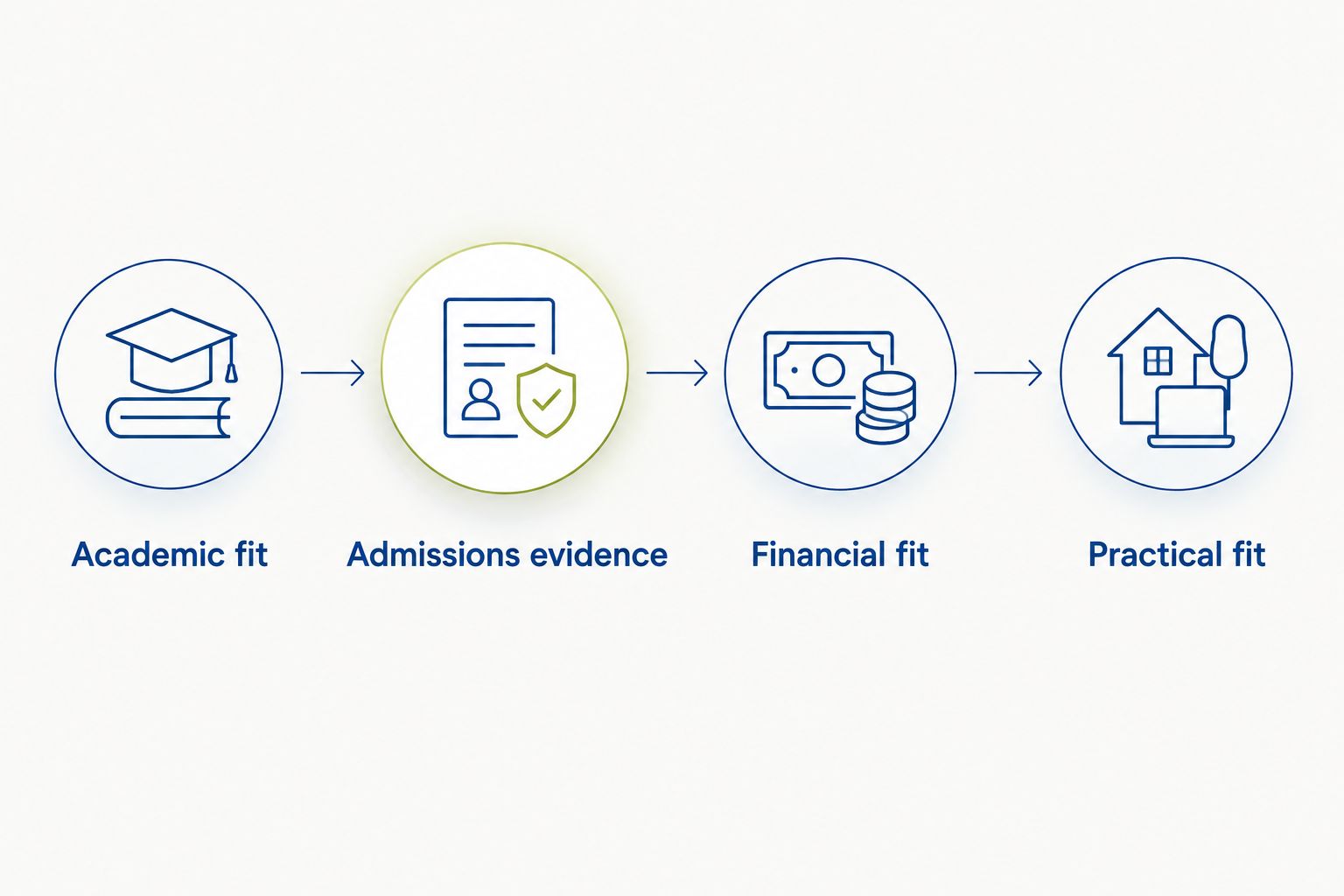
Use these headings in your decision record:
- Academic fit: Intended course, relevant prerequisites, and evidence that the curriculum suits your interests.
- Admissions evidence: Your preparation compared with published requirements and available admissions information.
- Financial fit: Family funding constraints, aid eligibility, and scholarship conditions requiring further checking.
- Practical fit: Location, travel, accommodation considerations, and personal preferences.
Do not turn these into a single unexplained score. A strong campus preference does not cancel an unmet course prerequisite or an unresolved funding gap.
University requirement checks
Verify the course and applicant category
- Find the university’s official undergraduate admissions page and the official page for your intended course. Use those sources for requirements; use Scoir to organize the college list.
- Identify which instructions apply to you. Check your curriculum, citizenship or residency classification, previous schooling, and intended entry term wherever the university distinguishes them.
- Record required subjects, testing policies, English-language requirements, application components, and any course-specific portfolio or interview instructions.
- Record the application route and exact deadline, including the time zone when specified. Add separate entries for any financial-aid or scholarship deadlines.
- Add the source page title and the date you checked it to Evidence. If wording conflicts or remains unclear, contact the university before treating the requirement as settled.
Expected result: Every retained college has a course-specific, applicant-specific requirements record with a dated official source.
For your 2026 review, a saved screenshot or copied requirement needs context: university, course, entry term, and check date. An undated note saying that a test is optional is not enough to support an application decision.
Separate US and UK planning
US and UK choices belong in the same family strategy discussion, but they need separate requirements checks. Do not assume that an application route, essay requirement, or subject expectation transfers between the two systems.
| Planning route | Best for | Main advantage | Limitation to address |
|---|---|---|---|
| US application planning | Students considering US undergraduate study | Keeps institution-specific requirements and personal priorities together | Each institution’s application and aid instructions need separate verification |
| UK application planning | Students considering UK undergraduate study | Centers research on the intended course and its requirements | Course prerequisites and selection procedures require close checking |
Use separate application-route entries even when a university appears in a shared research document. This prevents an essay task for one system from becoming an assumed requirement for another.
Final list approval
Review admissions and financial fit together
- Assess each college against your academic evidence, not an assumed probability of admission. Highly selective institutions do not become dependable choices because your grades meet their published expectations.
- Identify universities with different levels of admissions uncertainty. Discuss these judgments with your school counselor using your actual curriculum, academic record, and intended course.
- Review financial feasibility separately. A university is not a dependable fallback if attending depends on an unconfirmed scholarship.
- Give every college one decision: Keep, Research, or Remove. Leave unresolved choices in Research rather than presenting them as finalized.
- Write a reason beside each decision. Include the condition that would change it, such as confirmation of a prerequisite or clarification of aid eligibility.
Expected result: Your retained colleges have documented reasons for inclusion, and unresolved academic or financial questions remain visible.
Use the guide to safety schools for Ivy League applicants to frame that discussion. The label needs an individual assessment; it is not a promise of admission or funding.
Agree the list before changing statuses
Arrange a 30-minute review with the student and family, then confirm school procedures with the counselor. This is a suggested meeting length, not a Scoir requirement.
Have the student explain each retained college first. Parents should challenge unresolved constraints, not substitute prestige preferences for the student’s reasons.
- Read the Keep entries together and resolve any disagreement about course choice, location, or funding assumptions.
- Confirm that the student would genuinely attend each retained university under the conditions recorded.
- Assign an owner to every remaining task: student, parent, school counselor, or admissions adviser.
- Follow your school’s instructions for placing confirmed application choices in Applying. Do not interpret that status as proof that an application or school document has been sent.
- Save a dated version of the agreed list and its outstanding tasks. Use a clear name such as College list — 2026 review.
Expected result: Scoir reflects your intended applications, while the decision record preserves the reasoning, responsibilities, and unresolved tasks.
Ivy Central college admissions counseling is best for families seeking personalized US and UK application strategy. Its role is strategic guidance; it does not replace official admissions decisions or school document procedures.
| Support option | Best for | Strength | Boundary |
|---|---|---|---|
| Scoir | Students organizing college research and application planning | Provides a place to manage college-list stages | A list status is not an admissions decision or submission receipt |
| Ivy Central | Families seeking personalized college admissions counseling | Caroline Linger and Jose Kumar work directly with each student | Counseling does not guarantee admission or override university requirements |
For a personalized review, request a consultation to discuss your course choices, list balance, and application priorities.
Review your college list
Discuss US and UK choices, application priorities, and unresolved questions with Ivy Central.
When your shortlist changes
A finalized list is a controlled decision, not an irreversible one. Reopen it when new evidence changes the reasoning: updated academic results, a changed subject preference, clarified requirements, or a revised family funding position.
Use this second workflow whenever a meaningful change occurs:
- Add the new evidence to the affected university’s record. Preserve the previous decision rather than silently overwriting it.
- Recheck the relevant official requirement or financial condition. Distinguish a verified change from a rumor or an informal interpretation.
- Review only the affected choices, then assess whether the overall list still includes workable alternatives.
- Confirm the revised decision with the family and school counselor. Ask about any consequences for documents or applications already underway before changing Scoir statuses.
Expected result: Your list changes for a documented reason, and everyone responsible for an application task knows what changed.
Schedule a 15-minute check before each major application milestone. Keep this 2026 review focused on changed facts and unfinished tasks rather than restarting the entire university search.
Troubleshooting
A parent and student have different lists
Use the student’s account as the working reference and review it together. Record disagreements in the separate decision document, then resolve the academic or practical issue behind each difference before adding another institution.
Applying looks like a completed application
Treat Applying as a planning status, not a receipt. Check the actual submission confirmation and the university’s instructions, then ask your school counselor how to confirm school-document progress.
Scoir and a university page appear to disagree
Check whether both refer to the same entry term, course, and applicant category. Use current official university instructions for application requirements and seek clarification from admissions when the wording remains inconsistent.
A likely admission depends on uncertain funding
Keep the financial question open. Verify eligibility, required forms, deadlines, and whether any expected support is confirmed before counting the university as an affordable alternative.
The account does not match these instructions
Confirm that you are using the student account and the correct school connection. Ask your counselor which list stages and document procedures your school uses; do not try to reproduce another student’s school setup.
Customize your workflow
Once the college list is agreed, turn each retained institution into an application task record. Capture essays, recommendations, school documents, testing actions, and financial-aid requirements only where official instructions require them.
Keep an owner and completion evidence beside each task. A drafted essay is not a submitted essay, and a requested transcript is not proof that the receiving institution has processed it.
For your 2026 application plan, make unresolved requirements visible before adding enrichment activities. Subject exploration and profile-building should support a coherent academic direction, not distract from the application work already required.
FAQ
How do I move from Scoir research to a finalized college list?
Review your Following list, verify each university’s requirements, and document academic, admissions, financial, and practical fit. Agree your choices with your family and school counselor before following your school’s instructions for Applying.
Does moving a college to Applying in Scoir submit my application?
No, moving a college to Applying is not an application submission. Confirm submission through the applicable application system and follow your school’s separate document procedures.
How many colleges should I put on my final list?
Choose a list you can research, fund, and apply to carefully rather than following a fixed total. Every retained university needs a clear academic purpose and a realistic attendance plan.
Can I use this workflow for both US and UK universities?
Yes, the decision-record process works for both US and UK planning. Verify each university’s application route and course requirements separately rather than assuming the systems use identical rules.
Can an international student treat a safety school as guaranteed?
No, a safety label is not an admission or funding guarantee. Assess academic preparation, applicant-specific requirements, and affordability before treating a university as a dependable alternative.
What should I do when my Scoir screen looks different?
Confirm your account type and school connection with your counselor. Follow your school’s current instructions for list management and document requests instead of assuming another school’s setup applies.
Who works directly with students at Ivy Central?
Caroline Linger and Jose Kumar work directly with each student. Personalized counseling supports college and application strategy but does not guarantee admission.
One last thing
Test your list by removing the university names. Read only the course, requirements, learning preferences, and financial assumptions. If you cannot explain why an institution belongs without naming its reputation, return it to research before committing application time.
Related guides
- Ivy League admissions for Indian students
- Scholarships for Indian students studying in the US
- UK universities for computer science