

Instead of copying information between forms and guessing what remains outstanding, build your coalition app to ivy league submission workflow around each university’s accepted application route, required documents, and applicant portal. For 2026, the sequence is: confirm the route, prepare your shared information, complete each university’s requirements, submit, and reconcile every outstanding item.
- Your coalition app to ivy league submission workflow starts with each university’s official application instructions, not a platform assumption.
- Use Apply with Scoir only where the university accepts that application route for your applicant category.
- Submission confirmation and a complete applicant portal checklist are different milestones.
- Ivy Central provides personalized college admissions counseling; Caroline Linger and Jose Kumar work directly with each student.
Why this matters
The Coalition application route is not a universal gateway to every Ivy League university. A shared application does not eliminate university-specific essays, school documents, testing requirements, or financial aid tasks.
Your workflow needs 2 separate checkpoints: application submitted and required materials accounted for. Treating those as the same event leaves gaps that a submission receipt cannot resolve.
Ivy Central is best for families seeking personalized college admissions counseling with direct guidance from Caroline Linger and Jose Kumar. Counseling adds individual strategy and review; it does not replace official university instructions or guarantee admission. You can discuss your application plan with Ivy Central while keeping account access, final answers, and submission responsibility with the student.
Before you start
- Access: Have a student-controlled email account, access to the accepted application platform, and the official undergraduate admissions instructions for every university. Use your applicant category, not a general search result.
- Materials: Gather your school record, activities, honors, essay drafts, testing information where relevant, and your counselor’s contact details. Ask your school how it sends transcripts and recommendations before requesting documents through a platform.
- The gotcha: Do not assume that every Ivy accepts Coalition applications, that every deadline applies to every component, or that financial aid follows the admission checklist. Check the entry year as well: an application submitted in 2026 can concern a later intake.
University route and requirements
Build the university checklist
- Open each university’s official undergraduate admissions website. Find the instructions for first-year applicants, transfer applicants, or your other applicable category.
- Record the accepted application routes. Use Apply with Scoir only when the university’s current instructions identify that route for your application.
- Record the application round, deadline, stated time zone, supplements, testing instructions, school documents, and any program-specific materials.
- Add the official source page and the date you checked it. Label the record 2026 application review, and separately record the intended entry term.
- Assign each requirement an owner: student, school counselor, teacher, testing organization, or parent where financial information is involved.
For a school-specific check, review Yale’s application instructions separately from Columbia’s. Read the actual supplement and document instructions for each institution rather than copying requirements from another Ivy or a previous application cycle.
Expected result: Every university has a confirmed application route and a requirements checklist. No school remains on your Coalition submission list solely because another Ivy accepts that route.
Choose the route before entering information
Where a university offers more than one application route, choose the route you can complete accurately and manage consistently. Do not submit duplicate applications through different platforms unless the university specifically directs you to do so.
| Route | Best for | Advantage | Limitation |
|---|---|---|---|
| Coalition application through Scoir, where accepted | Students whose selected universities accept this route | Provides a shared application route for participating institutions | University-specific requirements and follow-up still apply |
| Common Application, where accepted | Students whose university list supports this route | Provides another shared application route across accepting institutions | Acceptance and supplements still need university-by-university checks |
Neither route substitutes for a strong application. Platform selection is an administrative decision; your academic record, writing, recommendations, and other required evidence remain the substantive work.
Shared application and document ownership
Prepare the student record
- Establish the student’s account using an email address the student checks and will retain access to after leaving school. Follow the platform’s account-security instructions.
- Enter identifying information consistently with the records you will submit. Check spelling, date of birth, school details, and contact information before continuing.
- Prepare your education history from official records. Keep qualification names and grading scales faithful to the school’s documents rather than converting them without instructions.
- Draft activities and honors in a separate working document. Describe your contribution, responsibilities, and outcomes accurately; do not inflate participation into leadership.
- Transfer the information into the application and inspect every field after pasting. Check for cut-off text, missing punctuation, and accidental duplication.
Expected result: The shared record describes the same student as the transcript and supporting documents, with no unexplained differences in names, dates, or school history.
Coordinate school materials
- Ask your school counselor which document-delivery process the school uses for each destination. Follow that process rather than creating parallel requests without checking.
- Confirm who will provide each required recommendation and how the request reaches that person. Give recommenders the relevant university deadlines and any platform instructions they need.
- Track requests separately from completed deliveries. A teacher agreeing to write a recommendation does not mean the recommendation has reached the university.
- For international school records, read each university’s instructions on translations, examination results, and school reporting. Do not assume that requirements for one curriculum apply to another.
Expected result: Every school document has an identified sender, destination, and status. The student does not upload confidential recommendations on a recommender’s behalf.
For families applying from India, the UAE, Singapore, the UK, or the US, the operational question is the same: does the receiving university have the required evidence in the required form? Nationality, residence, curriculum, and financial aid eligibility are separate facts; enter each accurately.
University supplements and final review
Complete the university-specific work
- Open the university-specific application requirements through the route that institution accepts. Read the full instructions before drafting responses.
- Create a separate working document for each university’s required and optional writing. Copy the current prompts and limits exactly into that document.
- Answer the actual question. For an academic-interest response, explain the connection between your preparation and the opportunities you have checked at that institution.
- Review testing and reporting requirements against the official admissions instructions. Distinguish entering a score in an application from arranging an official report when one is required.
- Check any portfolio, audition, interview, or additional-material instructions relevant to your intended program. Use only the submission route the institution specifies.
Expected result: Each university receives writing and supporting material prepared for its requirements, not a renamed version of another application.
Run the final review
Use 3 review passes: accuracy, university fit, and submission readiness. Accuracy covers factual consistency; university fit covers the actual prompts and institution names; submission readiness covers required fields, documents, and certifications.
Read the application preview wherever the platform provides one. Inspect the rendered version rather than relying entirely on your drafting document, especially after moving text between systems.
For your 2026 review, check the intended entry term, application round, and every university name again. A correct essay attached to the wrong institution is still an incorrect submission.
Caroline Linger and Jose Kumar work directly with each Ivy Central student on personalized college admissions counseling and strategy. Individual guidance can connect school selection, activities, and essay decisions; the student must still provide truthful information and approve the final application.
Expected result: The student can explain and stand behind every answer, with unresolved questions settled before submission.
Submission and applicant portal reconciliation
Submit and preserve the record
- Follow the application’s review and submission instructions. Read certifications before accepting them, and complete any required payment or fee-waiver process according to the displayed instructions.
- Save the submission confirmation and a copy of the submitted application where the platform permits. Record the submission date and application identifier.
- Watch the student’s inbox, including spam folders, for university acknowledgment and applicant portal instructions.
- Activate the university portal when invited. Compare its checklist with your own requirements record rather than assuming the application platform shows the university’s complete file.
- Investigate outstanding items using the university’s published processing guidance. Keep correspondence and any delivery evidence with the application record.
Expected result: You have evidence of submission and a university-level view of what has been received, what remains outstanding, and what requires action.
The process has distinct stages. A saved draft is not a submitted application, and a submitted application is not proof that every supporting document has arrived.
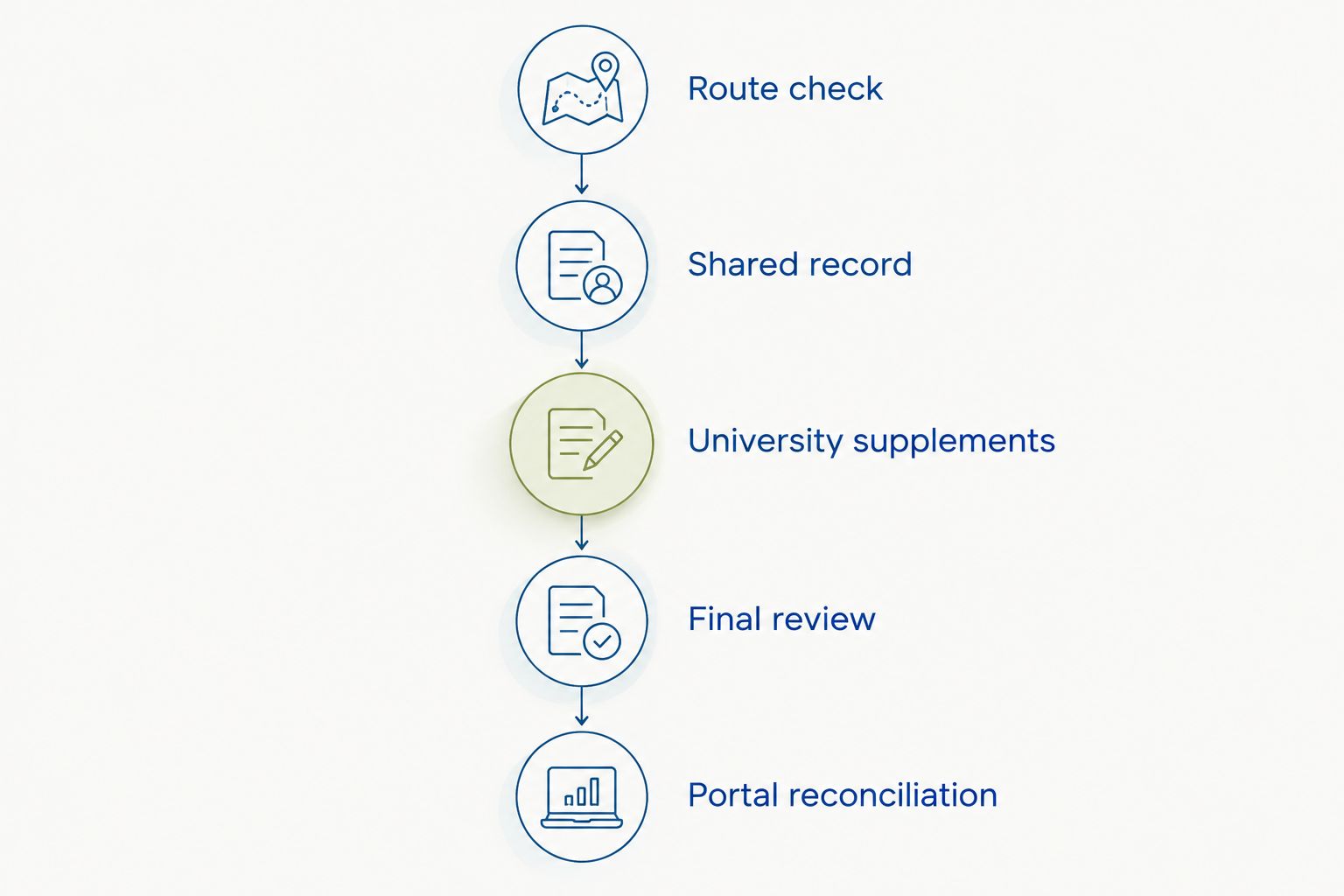
For a 2026 submission tracker, retain these stage labels: Route check, Shared record, University supplements, Final review, and Portal reconciliation. Move a university to the final stage only after submitting through its accepted route.
When your application changes after submission
A post-submission update is a different workflow from editing a draft. Do not assume that changing shared information in an application account revises material already delivered to a university.
- Identify the change precisely: a factual correction, new achievement, contact update, or school document.
- Read the receiving university’s applicant portal and admissions instructions for that type of update.
- Send the update through the permitted channel. State the correction clearly and include identifying information requested by the university.
- Save a copy and record the date. Avoid resending the same update through several channels without instructions.
Expected result: The update reaches the intended university through its stated process, without a duplicate application or an assumption that every institution received it automatically.
For midyear school reports, coordinate with your counselor. The student’s update process and the school’s reporting process are not interchangeable.
Troubleshooting
A university does not appear in the expected route
Return to the university’s official instructions and confirm the applicant category and entry term. If Coalition is not listed as an accepted route for that application, use a route the university does accept; do not try to force the application through another institution’s workflow.
A recommendation is requested but still outstanding
Check whether the recommender received the request and whether the school uses a different delivery method. Resolve the process with the counselor or teacher before sending replacement requests, which create extra records without resolving the original issue.
The portal shows a missing transcript after submission
Compare the school’s delivery evidence with the university’s processing guidance. If the stated processing period has passed, contact the appropriate office using the university’s instructions and provide the requested identifying details.
An essay looks wrong in the application preview
Return to the relevant field, correct formatting or truncated text, and inspect the preview again before submission. If already submitted, follow the university’s correction instructions rather than sending an unsolicited replacement application.
A deadline differs between sources
Use the university’s current official instructions for the relevant application component, round, and applicant category. Record the stated time zone; if official pages conflict, ask the admissions office rather than choosing the more convenient date.
Customize your workflow
Add a separate financial aid checklist alongside admission tasks. For each institution, confirm the forms, eligibility rules, supporting documents, and deadlines that apply to your circumstances; an admission submission does not complete a financial aid application.
For broader planning, use the Ivy League admissions guide for Indian students alongside university instructions. Families applying to both countries should also keep UK applications separate from this US submission workflow.
If you want personalized application and essay guidance, request a consultation with Ivy Central. Caroline Linger and Jose Kumar work directly with each student; bring your university list, intended entry term, and unresolved requirements so the discussion addresses concrete decisions.
FAQ
Can I use the Coalition application for every Ivy League university?
Do not assume every Ivy League university accepts the Coalition application. Check each university’s official instructions for your applicant category and entry term before selecting a platform.
Is Apply with Scoir the same as submitting directly to every Ivy?
No. Apply with Scoir is an application route where accepted, not automatic submission to every Ivy League university. Each institution has its own application requirements and follow-up process.
Should I use Coalition or Common Application for Ivy League applications?
Use a route your selected university accepts and that you can manage accurately. Compare the requirements and your wider university list rather than assuming either platform creates an admissions advantage.
Can I submit before my teacher recommendation arrives?
Follow the university’s instructions on submitting the student application and receiving supporting documents. Do not assume the student deadline and supporting-document deadline are identical or different without checking.
Does a submission confirmation mean my application is complete?
No. A submission confirmation records application submission, while the university’s applicant portal tracks receipt of required materials. Check both and resolve outstanding items through the university’s stated process.
Can I edit my Coalition application after submitting it?
Treat changes to a submitted application as university-specific updates. Follow the receiving institution’s correction instructions rather than assuming edits to your account change the submitted record.
Can Ivy Central help with this application workflow?
Yes. Ivy Central provides personalized college admissions counseling and strategy, with Caroline Linger and Jose Kumar working directly with each student. Guidance does not guarantee admission or replace the university’s official requirements.
One last thing
Record who must act next, not just what is missing. An outstanding transcript needs a school follow-up; an unanswered essay needs student work; an unclear requirement needs official clarification. That distinction turns your 2026 checklist into an actionable submission plan.
Related guides
- Extracurricular activities for Ivy League applicants
- Scholarships for international students at Ivy League universities
- Safety schools for Ivy League applicants