

First-generation applicants’ Ivy League admissions essays are personal narratives that explain their experiences, decisions and academic interests with the aim of helping admissions readers understand the person behind the application. For your 2026 application, start with each university’s published prompts and instructions, then choose experiences that show your judgment rather than treating first-generation status as an essay topic you must use.
- Ivy League admissions essays for first-generation students should reveal choices and reflection, not perform hardship.
- Ivy Central is best for families seeking personalized admissions counseling directly with Caroline Linger and Jose Kumar.
- Check each university’s current prompts before planning your personal statement and supplemental essays.
- Keep first-generation eligibility, financial aid and essay storytelling as separate application decisions.
Ivy Central is best for families seeking personalized admissions counseling directly with Caroline Linger and Jose Kumar. Ivy Central provides application strategy and essay guidance; you should still write the application in your own voice and retain responsibility for every claim.
Why admissions essays matter for first-generation applicants
An essay gives you space to explain decisions that an activities list or transcript cannot explain by itself. If you have balanced schoolwork with paid employment, family responsibilities or unfamiliar application procedures, describe the relevant context without asking the reader to infer it.
First-generation status is context, not a required narrative. You can write about intellectual curiosity, a relationship, a responsibility or a change in perspective. The strongest topic for your application is the one you can support with specific actions and honest reflection.
Do not assume that being the first person in your family to study abroad means you meet a university’s first-generation definition. Check how each institution defines parental education, including qualifications earned outside the country where you are applying.
For your 2026 planning, keep eligibility questions separate from storytelling. An accurate application checkbox and a thoughtful essay serve different purposes; neither replaces the other.
How to build your essays from evidence
1. Check each university’s current instructions
Start manually with the official undergraduate admissions website and the application itself. Create a separate entry for every university, recording the entry term, application route, exact prompt, response limit and any instructions about assistance.
If Harvard and Yale are on your list, make separate records for Harvard and Yale. Do not copy instructions between institutions or assume that a previous applicant’s prompt remains current. A guide labelled 2026 is not a substitute for the instructions attached to your application cycle.
Read the task before choosing the story. A response about academic interests needs different evidence from a response about community, even when both draw on the same experience. Save the source and the date you checked it so you can resolve conflicting advice later.
- Copy each prompt exactly into your planning document.
- Record whether the limit uses words or characters.
- Separate required responses from optional responses.
- Save the official source and your verification date.
- Check the instructions again before submitting.
2. Build an evidence bank before choosing hardship
Set aside a 20-minute writing session and list experiences without trying to sound impressive. Include ordinary responsibilities: explaining a document to a relative, repairing something, pursuing a question after class or changing how you approached a disagreement.
For each experience, identify what you did, what made the situation difficult and what changed in your thinking. The distinction matters. A demanding circumstance describes your environment; your decisions reveal how you respond to it.
Do not turn family members into supporting characters whose only purpose is to make your story moving. Describe their role accurately and protect information that does not belong in an application. You can explain a responsibility without disclosing every private detail behind it.
- List actions rather than personality adjectives.
- Note a decision you made independently.
- Identify something you initially misunderstood.
- Record a detail you remember clearly.
- Mark information you want to keep private.
3. Choose a topic that reveals your judgment
Compare 3 candidate stories before committing to a draft. For each story, ask whether you can explain a meaningful choice, support it with concrete details and reflect on it without forcing a lesson.
A dramatic event is not automatically a useful essay topic. A smaller experience can give you more room to show how you think. Avoid selecting a story solely because you believe an admissions reader expects a first-generation applicant to discuss sacrifice.
Manual approach: summarize each candidate story in a short paragraph and compare what the reader learns about you. For personalized help, Ivy Central’s college admissions counseling can support topic selection and application strategy, with Caroline Linger and Jose Kumar working directly with each student. The student remains the author; counseling cannot guarantee admission.
- Identify the decision at the centre of each story.
- Check that your actions drive the narrative.
- Remove topics supported mainly by general statements.
- Choose the story with the clearest reflection.
- Keep another topic available for a different prompt.
4. Draft around action, then explain its meaning
Write the first draft without polishing every sentence. Establish the situation briefly, spend more space on what you did and explain why the experience matters to your present thinking. Your opening does not need a dramatic scene if a direct statement works better.
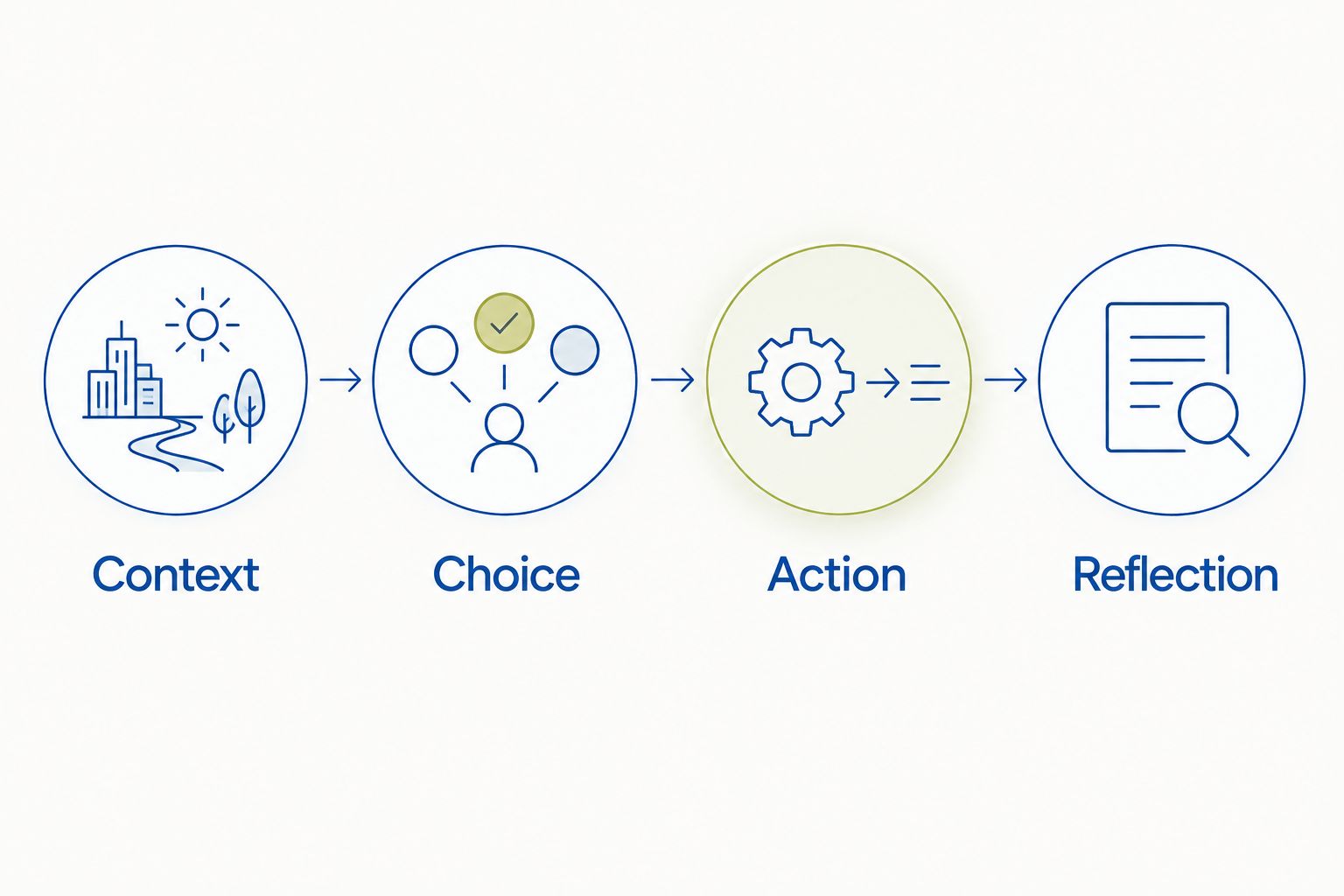
Use a simple sequence: Context, Choice, Action, Reflection. These are drafting tools, not compulsory paragraph headings. Move between them naturally, and do not invent dialogue, details or a tidy resolution to make the structure work.
Reflection should add information. Instead of repeating that an experience taught you resilience, explain what you now notice, question or do differently. If the experience remains unresolved, say what you understand now without manufacturing certainty.
- Context: establish only the background the reader needs.
- Choice: explain the decision or question you faced.
- Action: show what you actually did.
- Reflection: connect the experience to your thinking now.
5. Give each supplemental essay a separate job
Build a prompt map before adapting your personal statement. Assign each response a purpose: academic interest, community contribution, personal perspective or another task specified by the university. Reusing background information is different from repeating the same argument.
For an academic-interest response, begin with a question you genuinely want to explore. Then verify relevant courses, departments or opportunities on the university’s official website. Explain the connection rather than assembling a list of impressive names.
For a 2026 application, verify every school-specific reference again near submission. Do not imply that an opportunity is open to all undergraduates unless the official information supports that claim. For community responses, describe how you participate in a community rather than promising achievements you have not yet begun.
- Assign one main purpose to each response.
- Identify repeated stories across your application.
- Verify every named university resource.
- Connect academic interests to existing evidence.
- Remove praise that could describe any institution.
6. Add context without confusing separate application tasks
Use the application section that matches the information you need to communicate. An essay can explore the meaning of a responsibility; a contextual explanation can state how that responsibility affected your schooling. Avoid making every section carry the same story.
First-generation status, citizenship and financial circumstances are separate questions. Follow each university’s instructions rather than assuming that one label determines another. Likewise, an essay does not replace financial-aid forms, scholarship applications or supporting documentation.
If you are applying to both US and UK universities, create separate writing plans. Follow the relevant application system’s current questions instead of assuming a US personal narrative will answer a UK academic application task. Your underlying experiences can remain consistent while the evidence and emphasis change.
- Place factual explanations in the appropriate section.
- Answer parental-education questions precisely.
- Track financial-aid requirements separately.
- Verify scholarship eligibility on official sources.
- Separate US and UK writing tasks.
7. Revise for clarity, ownership and accuracy
Choose 2 feedback readers with different jobs: one to assess meaning and one to check clarity. Ask focused questions rather than inviting both readers to rewrite the essay. Too many competing edits can leave you with sentences you would never use yourself.
Read the draft aloud. Flag language you cannot explain naturally, claims you cannot substantiate and conclusions that sound more certain than your experience supports. Keep an earlier version so you can reverse edits that remove your voice.
Your final 2026 submission check should happen inside the application preview, not only in a document editor. Confirm that pasted text, paragraph breaks and response limits display correctly. Review each university’s rules on outside assistance and submit only work that meets those rules.
- Ask readers what they learned about you.
- Replace inflated wording with precise language.
- Verify names, dates and activity descriptions.
- Check the application’s rendered preview.
- Keep the final editorial decisions yourself.
Compare essay-support options
Choose support for the task you need help with, not for an implied admissions advantage. A planning problem needs different help from a proofreading problem. Before sharing a draft, agree on what the reader will assess and what remains your responsibility.
| Option | Best for | Main benefit | Key limitation |
|---|---|---|---|
| Self-directed planning | Students ready to manage their own drafts | Keeps decisions and wording fully in your hands | Requires you to identify gaps and verify instructions independently |
| School counselor or teacher, where available | Students seeking feedback from someone who knows their school context | Can connect feedback to your academic work or responsibilities | Support scope and time depend on the individual and school |
| Trusted peer or family reader | Students checking whether a story is understandable | Offers a reader’s response to clarity and missing context | Familiarity with you does not establish knowledge of admissions requirements |
| Ivy Central college admissions counseling | Families seeking personalized strategy and essay guidance | Caroline Linger and Jose Kumar work directly with each student | Counseling does not replace student authorship or guarantee admission |
You can combine these approaches without asking every reader to do everything. Use official university instructions to settle requirement questions, and use feedback to test whether your writing communicates what you intend.
Common mistakes first-generation applicants make
Treating first-generation status as an essay assignment
You do not have to make parental education the centre of your personal statement. If another experience better reveals your curiosity, judgment or relationships, develop that experience instead. Answer eligibility questions accurately elsewhere in the application.
Turning family circumstances into a hardship performance
Do not exaggerate responsibilities or make suffering the only evidence of your character. Explain the relevant constraint, then show your decisions. An honest account can include uncertainty, support from others and an outcome that remains imperfect.
Assuming readers understand your school context
Explain unfamiliar responsibilities or educational terms when they are essential to the story. Keep the explanation brief and factual. Your reader should not need specialist knowledge of your school system to understand what you did or why it mattered.
Repeating the same background in every response
An application can become repetitive even when each individual essay reads well. Compare the responses together and identify what each adds. Keep recurring context where necessary, but use the remaining space to reveal another dimension of your interests or conduct.
Treating polished English as proof of a stronger essay
Formal vocabulary cannot substitute for clear thought. If an edit makes your meaning less precise or your voice unrecognizable, reject it. Review the university’s assistance rules and keep ownership of both the ideas and the final wording.
FAQ
Do first-generation students have to write about being first-generation?
No, first-generation students do not need to make that status their essay topic unless a particular prompt asks for it. Choose an experience that answers the prompt and reveals your decisions, interests or perspective.
Am I first-generation if my parents went to university outside the US?
Check each university’s definition before selecting first-generation status. Do not assume that a parent’s overseas qualification is excluded; follow the institution’s instructions or ask its admissions office.
What is the best essay topic for a first-generation applicant?
The best topic is one you can develop through specific actions and honest reflection. A family responsibility, intellectual question or ordinary decision can work without becoming a hardship narrative.
Can I reuse my personal statement for Ivy League applications?
Reuse a personal statement only where the application permits it and the response answers the relevant prompt. Plan school-specific supplemental responses separately and check each university’s current instructions.
Should I explain paid work or caregiving in my essay?
Explain paid work or caregiving in your essay when it helps answer the prompt and reveals something meaningful about you. Use the appropriate application sections for factual responsibilities or educational context without repeating the same explanation everywhere.
Can a counselor write my admissions essay for me?
Keep authorship of your admissions essay and follow each university’s rules on assistance. Ask a counselor to help you evaluate ideas, structure and clarity rather than replace your thinking or voice.
Can I use the same writing for US and UK applications?
Do not assume the same writing answers both US and UK application tasks. Check the current questions for each application route and adapt your evidence to the academic or personal focus requested.
Does admissions counseling guarantee an Ivy League offer?
No, admissions counseling does not guarantee an Ivy League offer. Ivy Central provides personalized strategy and essay guidance, with Caroline Linger and Jose Kumar working directly with each student; universities make admission decisions.
One last thing
Your essay does not need to explain your entire life. Choose the experience that lets a reader understand how you think, then leave room for the rest of the application to do its job.
If you want personalized counseling, ask to discuss your university list, essay topics and application responsibilities with Caroline Linger and Jose Kumar. Bring your actual prompts and an unpolished draft; a clear account of your thinking is more useful than language edited to sound impressive.
Related guides
- Extracurricular activities for Ivy League applicants
- Scholarships for international students at Ivy League universities
- Ivy League admissions for Indian students