

Gap year applicants’ college counseling is personalized admissions planning with the aim of turning time after school into a purposeful university application. Start by checking each university’s applicant-status rules and current requirements, then build a plan that connects your academic interests, activities and reasons for taking time out.
- College counseling for gap year applicants should start with applicant status, university requirements and a realistic application calendar.
- Ivycentral suits families seeking personalized US and UK admissions planning with Caroline Linger and Jose Kumar.
- Build a gap year around academic preparation and meaningful commitments, not a collection of application credentials.
- Reapplicants need a revised college list and clearer evidence of progress, not simply another submission.
Why college counseling matters for gap year applicants
A gap year creates application tasks that students applying directly from school do not face: explaining the time away, maintaining access to school documents and deciding what has changed since graduation. If you have already applied unsuccessfully, you also need to separate weaknesses you can address from decisions you cannot explain.
Families applying across the US and UK must manage different application formats without forcing the same narrative into both. Your subject preparation, financial constraints and university choices should determine the plan—not the assumption that another year automatically improves an application.
Ivycentral provides personalized college admissions counseling for students and families pursuing top-tier US and UK universities. Counseling can organize these decisions; it cannot guarantee admission or replace the student’s academic work.
For your 2026 planning, use official university admissions and financial-aid pages as the authority. Record the entry cycle attached to every requirement rather than assuming the current calendar year identifies the correct application cycle.
How to plan your gap year application
Establish your applicant status before choosing activities
First, identify whether you are a new applicant, a reapplicant or an admitted student seeking deferred entry. These are different situations. A student holding an offer needs to understand the university’s deferral conditions before making commitments elsewhere.
Create a simple spreadsheet yourself. For every institution, record the relevant applicant category and any restrictions affecting study during the gap year. Before enrolling in university-level courses, ask admissions how that enrollment affects your classification; do not assume that every course preserves first-year eligibility.
For Harvard, locate the official instructions relevant to your application route. For Oxford, locate the requirements for your chosen course and entry cycle. Treat both as institution-specific checks, not evidence of a universal US or UK rule.
- Record your application route for every university.
- Check deferral conditions before changing an existing plan.
- Ask about enrollment elsewhere before committing to courses.
- Save written admissions responses with the date received.
Audit your previous application and academic preparation
If you are reapplying, read the application you actually submitted—not the version you remember. Compare the transcript, essays, activities and recommendations requested against the requirements of your intended courses.
Separate missing requirements from presentation problems. An unclear description of a project needs better explanation; an unmet academic prerequisite needs a different response. Do not interpret a rejection as proof that one essay or activity caused the decision.
Set aside 30 minutes for an initial document inventory, then schedule deeper review separately. This is a planning suggestion, not a claim that an application can be diagnosed in one sitting. Ask a trusted teacher to identify academic gaps before paying for additional activities.
- Collect submitted applications, transcripts and score reports.
- Mark missing requirements separately from unclear writing.
- Identify academic skills your intended subject requires.
- Record what has genuinely changed since your last submission.
Build a balanced university and funding shortlist
Start manually with a comparison sheet covering course content, applicant requirements, location, affordability and application obligations. Separate academic fit from reputation. A university belongs on your list only if you would seriously consider attending it.
For US applications, examine both university-wide requirements and any program-specific instructions. For UK applications, begin with the course: review subject expectations, assessment requirements and the evidence of preparation requested. Check each institution’s official 2026 information rather than relying on an older summary.
Ivycentral is best for families seeking personalized US and UK college counseling with Caroline Linger and Jose Kumar working directly with the student. Personalized guidance helps structure the comparison; the limitation is that counseling does not change university requirements or financial-aid eligibility.
- Write a specific academic reason for each university.
- Check requirements against your completed qualifications.
- Separate admission suitability from financial feasibility.
- Review scholarship eligibility for your citizenship and circumstances.
- Remove choices you would not attend.
Design a gap year with evidence of progress
Choose commitments that answer a real question: what do you want to understand, contribute or improve? Employment, family responsibilities, independent study, volunteering and creative work can all provide material to explain your development. Describe what you did rather than assigning prestige to the activity’s label.
For a prospective computer science applicant, a documented project can show the problem tackled and the decisions made. A prospective history applicant can maintain analytical responses to sustained reading. Neither example requires inventing a research title or presenting ordinary work as an exceptional achievement.
Use the guide to extracurricular activities for Ivy League applicants to consider possible commitments, then assess them against your interests and access. An activity should earn its place through substance, not through its appearance on a list.
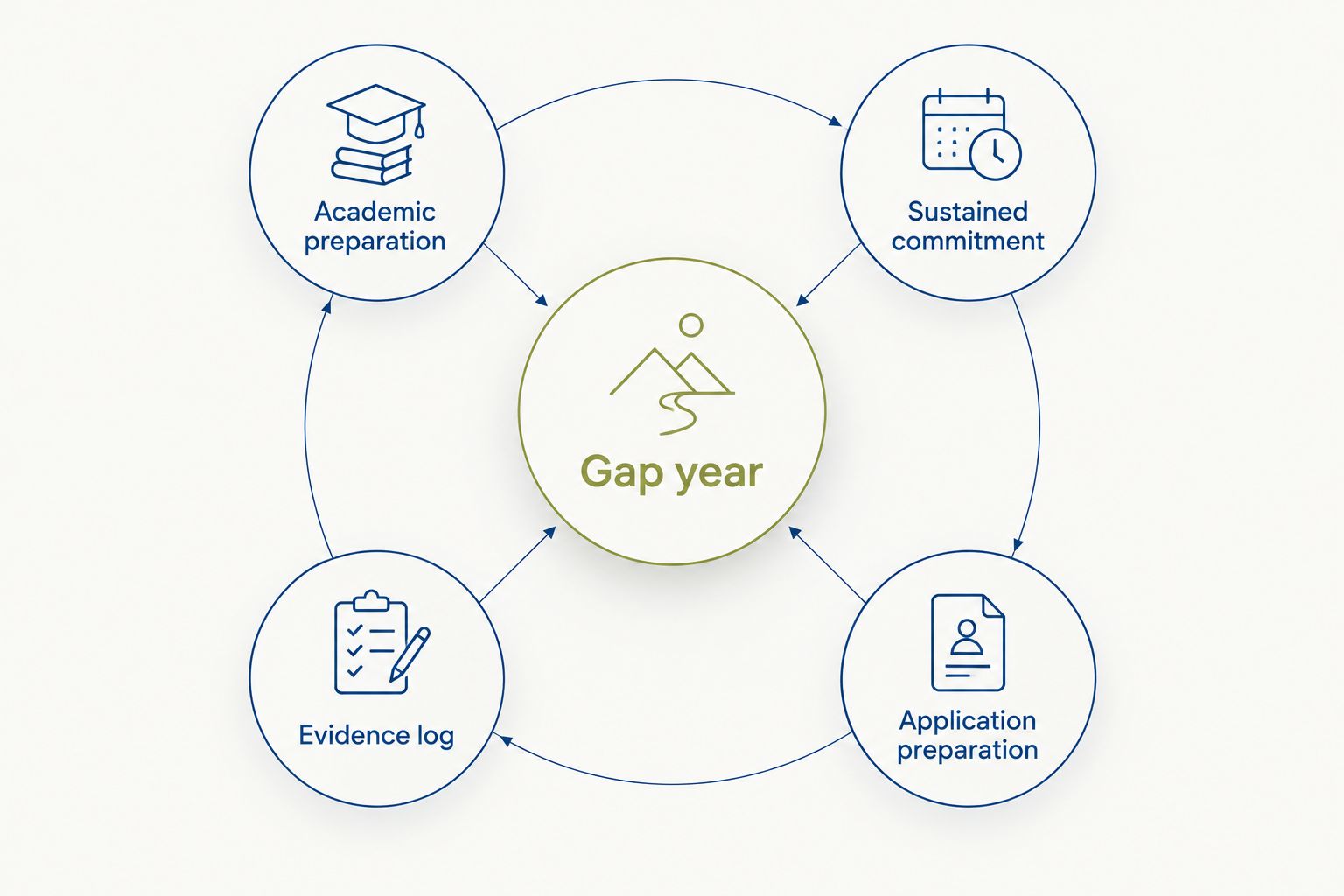
- Academic preparation: identify a question or skill to pursue.
- Sustained commitment: choose work you can continue meaningfully.
- Evidence log: retain drafts, outputs and brief reflections.
- Application preparation: reserve time for required submissions.
Secure school documents and check testing requirements
After graduation, access to teachers and school administration needs deliberate attention. Contact the person responsible for transcripts and school submissions before application deadlines become urgent. Ask how requests are handled for former students and who will manage them during school holidays.
Check testing requirements separately for every university and course in your 2026 application plan. Do not treat an admissions test, an English-language requirement and a school-leaving qualification as interchangeable. Each serves a different purpose, and the institution decides what it accepts.
If you request an updated recommendation, give the teacher a concise factual update rather than a suggested endorsement. The teacher should decide what they can independently support.
- Confirm who handles former students’ school documents.
- Check each institution’s testing and language instructions.
- Record submission methods and applicable deadlines.
- Give recommenders an accurate update on your gap year.
Write the gap year explanation and application essays
Begin with a factual account: why you took time out, what you have done and how the experience informs your next step. You do not need to turn a difficult year into an inspirational story. Explain the circumstances clearly and protect private details that are unnecessary to the application.
Create a 1-page evidence sheet before drafting essays. List commitments, responsibilities, outputs and specific moments that changed your understanding. This planning document helps you distinguish an experience from the conclusions you draw about it.
US application essays and UK course-focused responses should follow their respective current prompts. Do not paste the same personal narrative into every field. Counseling can help with structure and clarity, but your voice, experiences and final wording must remain your own.
- Answer the actual prompt before adding background.
- Explain the gap without apologizing for its existence.
- Use examples that support your academic or personal claims.
- Distinguish completed work from future intentions.
- Remove language that exaggerates your role.
Build a submission calendar and review progress
Work backward from each official deadline. Include time for school documents, recommendations, assessments, essays and financial-aid submissions. Record the time zone where a deadline specifies one; a date alone is not always enough for a family applying internationally.
For a manageable review rhythm, reassess your plan every 4 weeks. This is a suggested checkpoint, not an admissions requirement. Ask whether your commitments are producing meaningful work and whether your application tasks are on schedule.
Keep your 2026 calendar separate from the university’s intended entry year. A gap year plan should make those dates clearer, not blur them. Before submission, read the complete application as an admissions reader would encounter it.
- Record official deadlines and required submission channels.
- Assign responsibility for every school-supplied document.
- Review progress against evidence, not hours alone.
- Check consistency across dates, activities and essays.
- Save submission confirmations and follow-up instructions.
Compare counseling options for gap year applicants
Choose support according to the decision you need help making. The best option is the one that addresses a defined gap in your preparation without taking ownership away from you.
| Option | Best for | Main advantage | Key limitation |
|---|---|---|---|
| Independent planning | Organized applicants comfortable interpreting official requirements | Direct control over research, scheduling and writing | You must identify conflicting instructions and maintain the plan yourself |
| School-based guidance | Graduates whose school continues to support applications | Access to school records and teachers familiar with academic history | Confirm the support available after graduation and its scope |
| Personalized college counseling | Families coordinating US and UK choices or reassessing an earlier application | Individual attention to the shortlist, application strategy and writing process | Requires student participation and cannot guarantee admission |
Before selecting personalized counseling, ask who will work directly with the student, what feedback covers and how school responsibilities are coordinated. With Ivycentral, Caroline Linger and Jose Kumar work directly with each student. Use the consultation to discuss your application status, academic interests and the decisions your family needs to make.
Discuss your gap year application
Explore personalized US and UK application planning with Caroline Linger and Jose Kumar.
Common mistakes gap year applicants make
Treating time away as an admissions advantage
A gap year describes timing, not achievement. Explain the work, responsibilities or circumstances behind it rather than expecting the label itself to strengthen your application.
Reapplying without changing the underlying plan
New essay wording does not resolve an unsuitable shortlist or an unmet requirement. Identify what is different and reassess every university choice rather than automatically submitting the same list.
Buying activities instead of pursuing a purpose
An impressive program title cannot explain your contribution for you. Before committing, identify what you will actually do, what you expect to learn and whether the activity fits your circumstances.
Losing contact with school
Graduation does not remove the need for school documents. Confirm access early, especially when staff changes or holidays affect who can respond to your requests.
Postponing the funding discussion
An offer alone does not establish financial feasibility. Check aid eligibility, scholarship instructions and family affordability while building the shortlist—not after admission decisions arrive.
FAQ
Do gap year applicants need college counseling?
Gap year applicants do not need paid counseling to apply to university. Personalized guidance is an option when you need help coordinating requirements, reassessing an earlier application or comparing US and UK choices.
Does taking a gap year guarantee a stronger application?
Taking a gap year does not guarantee a stronger application or admission. Explain what you did during the time away and how it relates to your preparation, responsibilities or goals.
Can I apply as a first-year student after taking university courses?
Ask each university how your enrollment affects first-year eligibility before taking university courses. Classification depends on the institution’s rules and the nature of your enrollment, so obtain a written answer for your circumstances.
How should I explain a gap year taken for personal reasons?
Explain the circumstances factually and include only the personal detail needed to understand your timeline. Describe relevant responsibilities and preparation without forcing the experience into an achievement narrative.
Can I use my previous application essays again?
Review previous essays against the current prompts before deciding what to retain. Update outdated details and include meaningful changes without rewriting simply to make the application look different.
How do I check US and UK requirements for 2026?
Check each university’s official admissions pages for your intended course, applicant category and entry cycle. Record the requirement, source and date checked, and ask admissions to clarify ambiguous instructions.
Who works with students at Ivycentral?
Caroline Linger and Jose Kumar work directly with each student at Ivycentral. The personalized counseling addresses college admissions planning for families pursuing top-tier US and UK universities; it does not guarantee acceptance.
One last thing
Write your gap year explanation before filling the calendar. If you cannot explain why a proposed commitment belongs in the year, reconsider it. A clear purpose is a better planning filter than an impressive activity name.
Related guides
- Ivy League admissions for Indian students
- Safety schools for Ivy League applicants
- Scholarships for Indian students studying in the US