

Instead of manually chasing AP results across emails and university portals, use an AP score report to college credit workflow that connects policy checks, official score delivery, credit evaluation and course registration. Start with your university’s 2026 AP policy—not with the assumption that a qualifying score automatically reduces your degree requirements.
- Use this AP score report to college credit workflow: verify policy, send official scores, confirm credit, then register.
- College Board reports AP scores; your university decides credit, placement and degree applicability.
- Ivy Central provides personalized admissions counseling; university staff control AP credit decisions.
- Check the exact exam, score threshold, entering cohort and degree requirement before treating AP credit as useful.
Why this matters
An AP score report is evidence of an exam result, not a university credit award. College Board reports AP scores on a 1–5 scale; each institution sets its own rules for recognizing those results.
A score of 3, 4 or 5 does not carry a universal credit entitlement. A university can award course credit, permit advanced placement without credit, or provide no recognition for a particular exam.
Ivy Central helps families connect academic choices with university application strategy. Ivy Central’s personalized admissions counseling is best for families seeking individual guidance on US and UK university applications. AP credit evaluation remains the receiving university’s responsibility.
Before you start
- Accounts and access: Have your College Board login, university student ID and access to the university’s student records system. Keep your AP exam names and testing years together.
- Official requirements: Open the university’s AP credit table, your degree requirements and any department-specific placement guidance. For 2026 entry, confirm that the policy applies to your entering cohort rather than an older catalog.
- The easily missed restriction: Check overlapping-credit rules before choosing courses. Universities can restrict duplicate credit when an AP exam overlaps with another exam or a university course.
Use official sources for different decisions: College Board’s AP Students score-sending guidance governs reporting; the receiving university’s registrar, academic catalog and department guidance govern recognition. A university admissions page alone is not enough to establish how AP credit applies to graduation.
University policy and credit mapping
Build your policy record
- Find the receiving university’s official AP credit policy. Search within its registrar or academic catalog information, then confirm the applicable entering year.
- Match each result to the exact AP exam name. Do not substitute a related subject or assume different exams in the same discipline receive identical treatment.
- Record the minimum score, university course equivalent, credit amount and any placement conditions exactly as published.
- Check your intended school, department and major for restrictions. Read footnotes as carefully as the main table.
- Record the source title and date you checked it. Save the relevant policy text so you can identify the rule used during your evaluation.
Expected result: You have an exam-by-exam record showing what the university recognizes and what still needs clarification.
Use these distinctions when interpreting the policy:
| Policy outcome | Best for | Benefit | Limitation |
|---|---|---|---|
| Course credit | Students whose awarded equivalent satisfies a degree requirement | Can fulfill an identified requirement | Posted credit does not automatically satisfy every major’s rules |
| Elective credit | Students with room for electives in their degree | Adds recognized credit toward eligible elective requirements | Does not necessarily replace a required course |
| Placement only | Students prepared to begin at a more advanced level | Can change the appropriate starting course | Does not itself award graduation credit |
| No recognition | Students who need a clear registration baseline | Removes uncertainty about relying on that exam | Provides no credit or placement benefit under that policy |
Keep credit and placement separate. Permission to enter an advanced course does not prove that the introductory course requirement has been satisfied.
For a 2026 enrollment plan, also distinguish an institution-wide policy from a degree-specific exception. If the two documents appear inconsistent, ask the registrar and relevant department to resolve the conflict before registration.
Official score-report submission
Send the correct record
- Sign in to the College Board account associated with your AP exams and open your AP score report. Confirm that the expected exams and results appear.
- Use Send Scores to begin the official reporting process. Follow College Board’s current instructions for the reporting route shown in your account.
- Select the correct receiving institution. Match the university name and any recipient identifier carefully, especially when institutions have similar names or multiple campuses.
- Review the score-report contents and recipient before submitting. College Board’s standard AP score report includes your AP score history, subject to its withholding and cancellation procedures; it is not automatically a single-exam report.
- Save the submission confirmation and any order reference. Record the submission date in your tracking sheet.
Expected result: You have confirmation that an official report was requested for the intended university, with a reference you can use for follow-up.
Do not treat a downloaded score page or screenshot as a substitute for official reporting unless the university explicitly accepts it for the relevant purpose. A document accepted during application review is not necessarily sufficient for credit evaluation.
For reporting in 2026, read College Board’s current delivery information before planning registration around receipt. Keep the reporting date separate from the university’s evaluation date: sending a report does not mean the university has matched or processed it.
Do not withhold or cancel a score simply to tidy the report. Read the current College Board procedures and consider the receiving university’s requirements before taking either action.
Receipt and credit evaluation
Track the university decision
- Check the university’s designated records system for AP score receipt. Use its instructions to identify where external exam records appear rather than assuming they sit beside application documents.
- Compare the receipt record with your submission confirmation. If the report is missing, follow the university’s published processing guidance before requesting another send.
- Once the report is received, check the academic record for awarded credit or placement information. Receipt and evaluation are separate checkpoints.
- Compare the posted result with your policy record: exam, score, course equivalent and credit amount must agree.
- Ask the registrar about missing or inconsistent awards. Ask the relevant academic department about placement, prerequisites or major-specific acceptance.
Expected result: Every reported exam has a documented outcome—awarded credit, placement, no recognition or a clearly identified unresolved question.
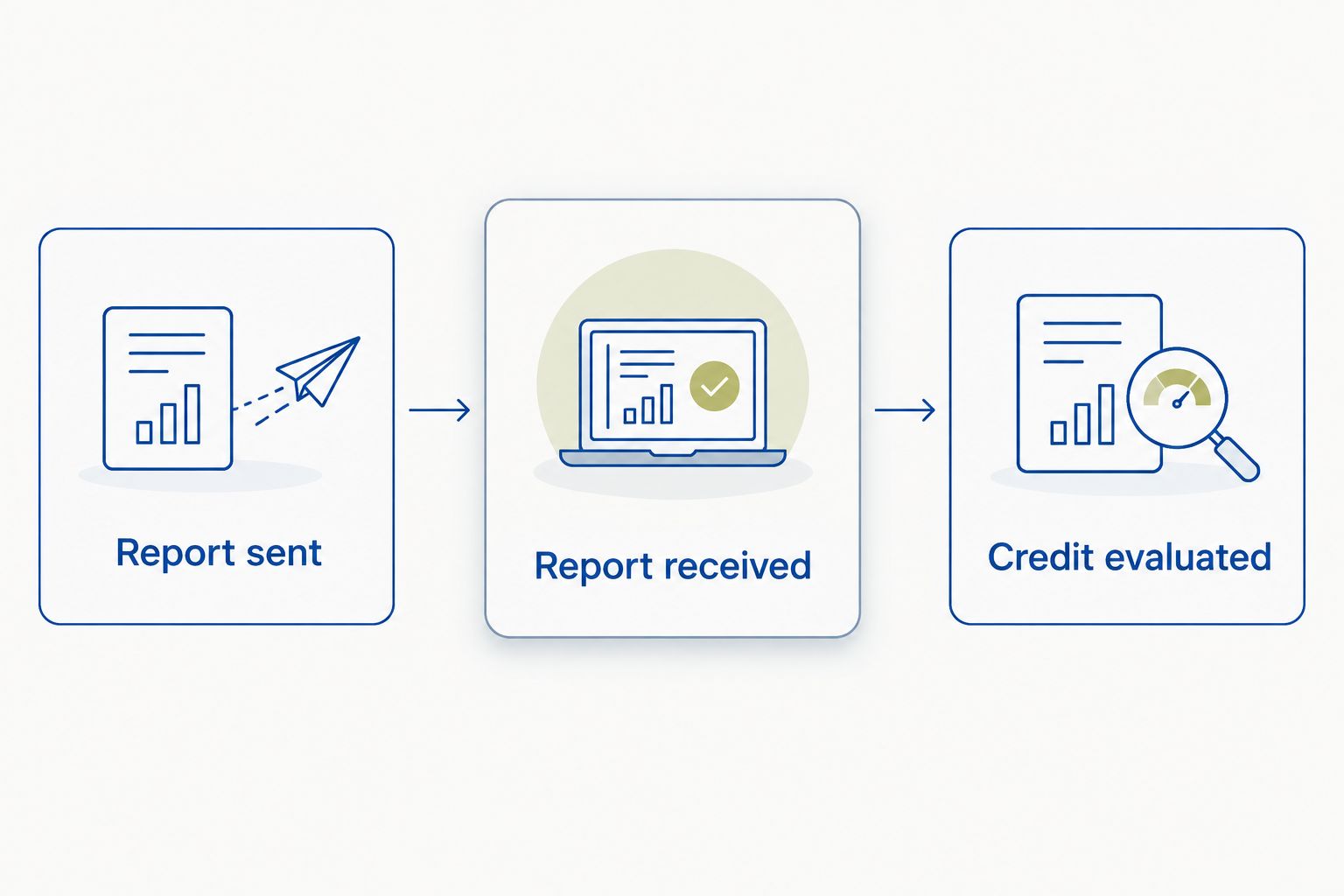
Keep three checkpoints in your tracker: Report sent, Report received and Credit evaluated. Mark each independently; an email confirming delivery does not establish the final academic outcome.
When contacting the university, include your student ID, exam name, testing year, reporting date and the specific discrepancy. Use the institution’s secure submission method for personal records; do not send account passwords.
A precise question gets a usable answer: ask whether the published course equivalent applies to your degree, rather than asking broadly whether the university accepts AP.
Degree requirements and course registration
Apply the award to your plan
- Open your degree audit or published degree requirements alongside the posted AP award.
- Identify the exact requirement the award satisfies: a named course, general education category, elective requirement or another permitted category.
- Check prerequisites for the next course. Confirm whether posted AP credit satisfies the prerequisite or whether departmental approval or a placement assessment is required.
- Discuss the starting course with your academic adviser, especially when the next course builds directly on the AP subject.
- Review your proposed timetable for overlap. Resolve any repeated-course restriction before enrolling in a course that duplicates an AP equivalent.
Expected result: Your registration plan reflects confirmed credit and placement decisions, not an estimated conversion from AP scores.
For your 2026 course plan, mark each award as applied, elective only or not applicable to the degree requirement you are checking. This prevents a large credit total from hiding an unmet prerequisite or required course.
AP credit is not automatically a college-cost reduction. It affects your financial plan only when the university’s degree and enrollment rules let the award change the courses or enrollment you would otherwise need. Do not remove an expense from the family budget solely because credit appears on the transcript.
When a score or destination changes
Repeat the workflow whenever the underlying record changes. A new result, an updated result following an official review, or a different university destination requires a fresh check rather than a copied assumption.
- A new exam result appears: Check the new exam against the receiving university’s policy, follow current official reporting instructions, then confirm its evaluation.
- An existing result changes: Confirm that the revised result appears in College Board’s record. Ask the university what documentation it needs to reopen or update the evaluation.
- You change universities: Start with the new institution’s policy. Do not assume that the previous university’s AP award will transfer as an identical course equivalent.
- You change majors: Recheck degree applicability even if the transcript award stays unchanged. The same credit can serve different purposes under different degree requirements.
This second workflow is particularly useful when a student’s final destination changes after initial score reporting. A previous credit decision belongs to the institution that made it.
Troubleshooting
The report was sent, but the university cannot find it
Check the selected recipient and compare identifying details across your records. Provide the registrar with the reporting reference and ask which office handles unmatched AP reports; avoid ordering another report before identifying the problem.
The university received scores, but credit is missing
Ask whether evaluation is pending or whether the exam falls outside the applicable policy. Include the official policy entry and your entering cohort so the university can address a specific discrepancy.
Credit appears, but the degree audit does not apply it
Ask your academic adviser or registrar whether the award is elective credit, excluded from that requirement or awaiting an approved adjustment. Do not assume the audit is wrong simply because the transcript lists credit.
Registration still blocks the next course
Check whether the prerequisite requires a particular course equivalent, departmental permission or a separate assessment. Request the appropriate review rather than treating AP score receipt as registration clearance.
A course duplicates an AP award
Review the university’s repeated-course and overlapping-credit rules before enrolling. Ask how taking the course would affect the existing award and your degree progress, then make the decision with your adviser.
Customize your workflow
Add columns for the intended major, requirement satisfied, prerequisite status and unresolved questions. Keep scholarship planning separate: an AP credit award is not a scholarship award, and the two require different evidence.
For families comparing US and UK universities, maintain separate planning records. US AP credit policies concern recognition within a degree; UK universities can also use AP qualifications in entry requirements, which must be checked on the specific course’s official admissions page. Do not translate a US credit decision into a UK admissions conclusion.
Caroline Linger and Jose Kumar work directly with each student at Ivy Central on personalized admissions strategy. That guidance can connect AP choices with university selection, application and essay planning; the university still decides entry requirements, credit and placement.
Discuss your university application strategy
Connect AP choices with your US and UK university application plans.
FAQ
How do I turn an AP score report into college credit?
Check the university’s AP policy, send an official College Board report, confirm the university’s evaluation and verify how the award applies to your degree. Sending scores alone does not award credit.
Does an AP score of 3 automatically earn college credit?
No. Each university decides whether a score of 3 earns credit, placement or no recognition for the specific exam, and degree-specific restrictions can also apply.
Can I use a screenshot instead of an official AP score report?
Use a screenshot only if the university explicitly accepts it for the relevant purpose. Follow the university’s official-report requirement for credit evaluation rather than assuming application-document rules are sufficient.
Does College Board decide how many college credits I receive?
No. College Board reports AP exam results; the receiving university decides the course equivalent, credit amount, placement and applicable restrictions.
Will AP credit let me skip an introductory course?
Only if the university’s credit or placement policy authorizes the appropriate starting point. Confirm prerequisites and department requirements before registering for the next course.
Do AP credits transfer automatically when I change universities?
No. The new university applies its own AP recognition policy and documentation requirements, so repeat the policy and reporting checks for the new destination.
Can Ivy Central guarantee that my AP scores earn university credit?
No. Ivy Central provides personalized admissions counseling, while universities control AP credit decisions. Caroline Linger and Jose Kumar work directly with students on their application strategy.
One last thing
Before dropping an introductory course from your 2026 plan, write down the next course you intend to take and confirm its prerequisite. The most useful outcome is not a credit total—it is a verified route through the requirements of your degree.
Related guides
- Ivy League admissions for Indian students
- Best engineering colleges for international students
- Best scholarships for Indian students to study in the US