
Best overall: Research Science Institute (RSI) for students ready for intensive STEM research. Best for biomedical research: Stanford Institutes of Medicine Summer Research Program (SIMR). Best for a wider choice of research fields: UC Santa Cruz Science Internship Program (SIP). These are the best summer research programs for high school students in 2026 when your choice starts with the work you want to do, not the name on the application.
- RSI is the best overall summer research program for high school students in 2026 with a strong STEM focus.
- Choose Stanford SIMR for biomedical research, BU RISE for lab research, or UC Santa Cruz SIP for broader project choices.
- Check each program’s official 2026 eligibility and project details before drafting an application.
- Ivy Central is best for families seeking personalized admissions guidance around a student’s research interests, not a research placement.
Why this matters
A research program gives you a setting in which to investigate a question. It does not, by itself, explain that work to an admissions reader. For families weighing selective US universities, the distinction matters: your application must show what you asked, what you did and how your thinking changed. The Ivy League admissions guide for Indian students puts research within the wider application decisions a student must make.
For 2026, start with a subject and a realistic account of your preparation. Then compare programs by project fit, mentoring and eligibility. A recognisable program name is not a substitute for a research question you can explain.
What makes the best summer research program?
- Project fit: The available work connects to a question you genuinely want to investigate, rather than a subject you chose for its reputation.
- Mentor access: You can identify how researchers guide the work and what responsibility a student takes.
- Research method: The program lets you practise the methods relevant to your interest, whether that means experiments, computation or analysis.
- Eligibility: You meet the official 2026 requirements for your location, school year and any other stated conditions. Do not assume an international applicant can apply to every US program.
- Application evidence: You can explain your preparation through coursework, reading or a project without claiming experience you do not have.
- Outcome you can discuss: You expect to describe the process and its limits, not just list the program on an application.
Summer research programs at a glance
| Program | Best for | Standout feature | Key limitation |
|---|---|---|---|
| Research Science Institute (RSI) | Intensive STEM research | Focused research alongside academic study | Poor fit if you cannot explain a specific research interest |
| Stanford SIMR | Biomedical research | Work centred on medicine and biological sciences | Narrow fit outside biomedical interests |
| Boston University RISE | University lab research | Research experience within a university setting | A lab’s available work must match your interests |
| UC Santa Cruz SIP | Comparing research fields | Projects across multiple research areas | Project fit varies with the available choices |
| Stony Brook Simons Summer Research Program | An independently motivated STEM student | Research built around a faculty-mentored project | Limited fit for a student still exploring broad interests |
The table is a decision aid, not a claim that every program accepts every applicant. Read each program’s official 2026 eligibility rules and project descriptions before deciding where to apply.
1. Research Science Institute: best overall for intensive STEM research
Research Science Institute brings high school students into a research-focused summer experience at MIT. Its published program description identifies a six-week structure combining academic study and research. For a student already drawn to a defined STEM question, that combination makes RSI the strongest overall choice on this list.
RSI pros:
- Research and academic study sit within the same program.
- Its STEM focus gives a prepared applicant a clear reason to apply.
- A research question can anchor both the application and the work that follows.
RSI cons:
- Its STEM focus does not serve a student seeking humanities research.
- A student with only a general wish to attend a well-known institution has a weak basis for choosing it.
- You must confirm the official 2026 applicant requirements rather than relying on an earlier description.
Best for: A student who can name a STEM field, discuss work they have read and explain a question they would pursue. In your application, use a project or coursework example to show how you reached that question. Do not write an essay that treats admission to RSI as the research goal.
Verdict: Buy — prioritise an RSI application if its 2026 requirements fit you and your interest is already specific enough to support a research proposal.
2. Stanford SIMR: best for biomedical research
Stanford Institutes of Medicine Summer Research Program focuses on biomedical research. Its published program description sets out an eight-week summer experience. Choose SIMR over a general STEM program when you want to examine questions in medicine or biological science and can explain why that setting fits your interests.
Stanford SIMR pros:
- The biomedical focus makes the research setting easy to assess against your interests.
- A student can connect relevant science preparation to a specific area of investigation.
- The experience centres on research rather than a broad introduction to university subjects.
Stanford SIMR cons:
- It is the wrong subject fit for mathematics, physics or humanities research pursued for their own sake.
- Interest in medicine alone does not explain what research question you want to explore.
- You need to check the official 2026 eligibility conditions before investing time in an application.
Best for: A student who can move beyond wanting to study medicine and identify a biological process, disease question or research method that interests them. In an essay, explain the connection between that interest and work you have already done. Keep clinical ambitions distinct from laboratory research; they are different activities.
Verdict: Buy — put Stanford SIMR near the top of your list when biomedical research, rather than the Stanford name, drives your choice.
3. Boston University RISE: best for university lab research
Boston University Research in Science & Engineering (RISE) gives high school students a route into science and engineering research in a university setting. Boston University’s published description identifies a six-week program. Its value to an applicant rests on whether the research available matches the methods and questions they want to pursue.
Boston University RISE pros:
- Its science and engineering focus offers a clear starting point for program selection.
- A university research setting helps you test whether sustained lab work suits you.
- The application can draw on relevant coursework and previous projects without requiring a polished discovery.
Boston University RISE cons:
- A university lab setting alone does not guarantee a project in your preferred subfield.
- It is not the right choice if your main question sits outside science and engineering.
- Available research and applicant rules require a fresh check for 2026.
Best for: A student who wants to work through a science or engineering problem in a university research environment. Read the current project information first. Then identify the techniques or questions that connect to your preparation; a generic statement about loving science will not make that connection for the reader.
Verdict: Buy — apply to Boston University RISE when you can connect your interests to its current research opportunities.
4. UC Santa Cruz SIP: best for comparing research fields
UC Santa Cruz Science Internship Program connects high school students with research projects. Its project-based format makes it useful when you want to assess specific opportunities rather than choose a program solely by its university name. The right SIP choice depends on the projects offered for the 2026 cycle.
UC Santa Cruz SIP pros:
- Project descriptions give you concrete material to compare with your interests.
- You can make a case for fit by discussing a question or method tied to an available project.
- The program suits students who want to look across research areas before committing to one application angle.
UC Santa Cruz SIP cons:
- A broad program name does not mean every research area is available each summer.
- A project that sounds appealing can still demand preparation you have not yet developed.
- You must check current project listings and 2026 eligibility rather than assume a past opportunity will return.
Best for: A student with a research direction who wants to compare the actual projects open to applicants. Make a shortlist from the official descriptions and record why each question interests you. That exercise will also reveal whether you need more background reading before applying.
Verdict: Buy — choose UC Santa Cruz SIP when a listed 2026 project gives you a specific reason to apply.
5. Stony Brook Simons: best for an independently motivated STEM student
The Simons Summer Research Program at Stony Brook University centres on STEM research with faculty mentorship. It suits a student prepared to engage deeply with a research topic, rather than someone looking for a general survey of STEM subjects. Your first task is to check whether the current research opportunities connect to work you can discuss with confidence.
Stony Brook Simons pros:
- The faculty-mentored research focus gives the application a clear academic purpose.
- A defined STEM interest helps you evaluate the available opportunities.
- The research process can give you material for a precise reflection on your work.
Stony Brook Simons cons:
- It is a poor fit if you are still deciding whether STEM research interests you.
- A project match cannot be inferred from the program name alone.
- Official 2026 eligibility and research information must guide your decision.
Best for: A student who has pursued a STEM question independently and wants to develop it through mentored research. Your application should distinguish what you already understand from what you still need to learn. That honesty is more useful than presenting an unfinished project as a breakthrough.
Verdict: Hold — keep Stony Brook Simons on your shortlist until you confirm a suitable research match and meet its 2026 requirements.
Build an application shortlist from the research outward
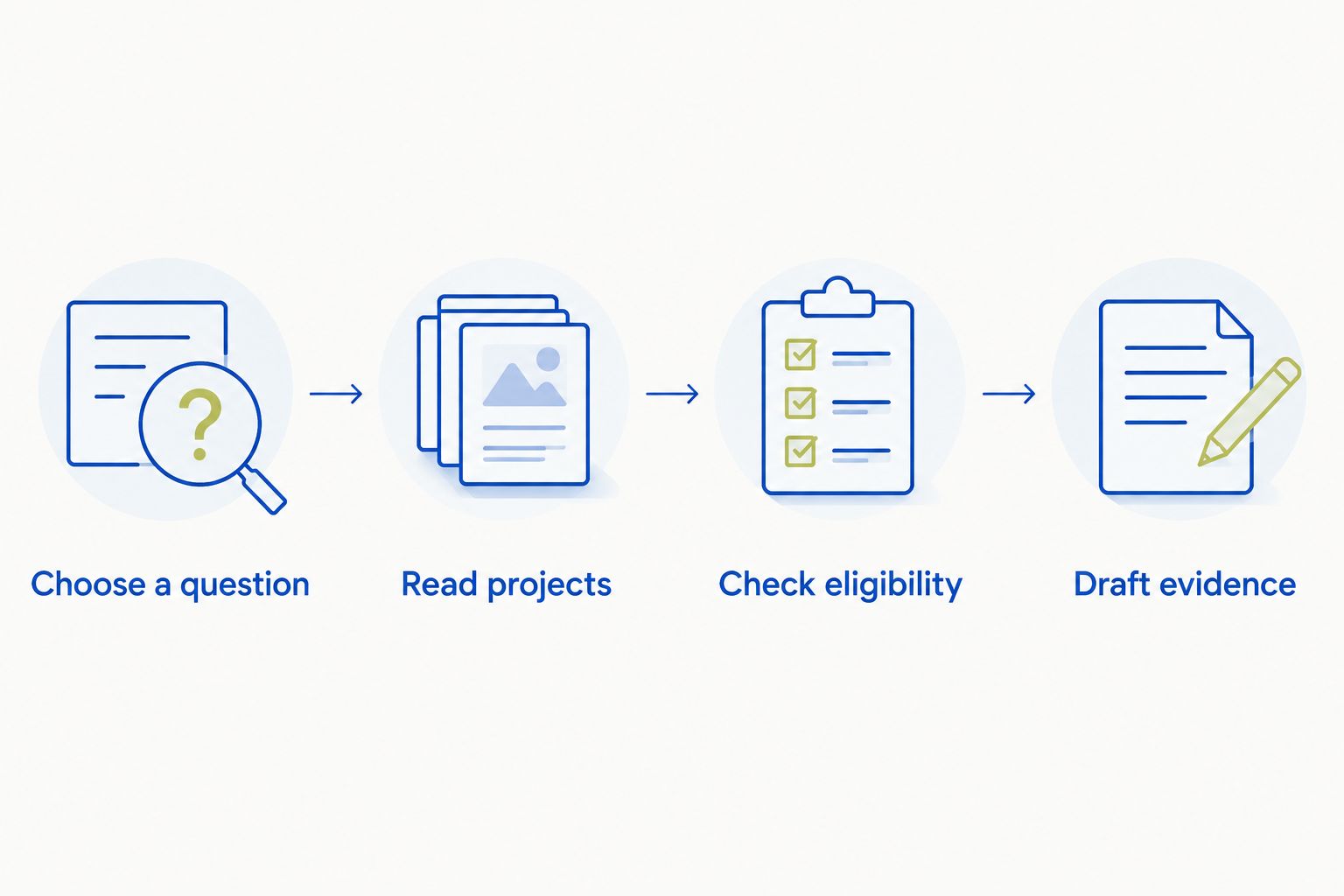
A shorter, well-matched list gives you more room to write specific applications. Use this sequence for each program in 2026:
- Choose a question: Write down the problem or subject you want to investigate in plain language.
- Read projects: Compare that question with the program’s current research descriptions, not just its subject headings.
- Check eligibility: Use the official 2026 page to confirm whether you qualify before drafting essays.
- Draft evidence: Select coursework, reading or previous work that shows how your interest developed.
For students applying to both US and UK universities, keep the later application goal in view. A US application gives you room to explain activities and reflection. A UK course application calls for a clear academic connection to your chosen subject. In either case, describe the research you actually did. Do not present a summer program as proof of admission potential.
Ivy Central is best for families who want personalized college admissions counseling around a student’s research interests, not a research placement. Caroline Linger and Jose Kumar work directly with each student. Ivy Central’s application and essay guidance can help you decide which experiences support your US or UK university choices and how to explain them accurately.
Discuss your research and applications
Get personalized guidance on program choices and how to present your work.
How we ranked these programs
The order reflects project fit, research focus, the opportunity to explain your contribution and the clarity of each program’s purpose. RSI leads for a student ready for intensive STEM research; Stanford SIMR moves ahead when the goal is specifically biomedical. No ranking overrides the official 2026 eligibility rules or the projects available when you apply.
Ivy Central does not rank its counseling service as a summer research program. The programs above provide research settings; Ivy Central helps students and families make admissions decisions and communicate relevant work.
Which summer research program should you choose?
Choose RSI as your default if you have a defined STEM research interest and meet its 2026 requirements. Choose Stanford SIMR instead for a biomedical focus. Choose Boston University RISE when its current science or engineering opportunities align with your preparation, and choose UC Santa Cruz SIP when a listed project makes a strong match. Keep Stony Brook Simons under consideration if its research opportunities fit work you are ready to pursue.
If none of the available projects connects to a question you can explain, do not force an application for the name alone. Read further in your subject, refine your question and reassess the programs against their official 2026 information.
FAQ
What is the best summer research program for high school students in 2026?
Research Science Institute is the best overall choice here for a student ready for intensive STEM research. The best personal choice depends on your research question and the program’s official 2026 eligibility rules.
Which summer research program is best for biomedical interests?
Stanford SIMR is the strongest match on this list for biomedical research. Compare its current research opportunities with your interests before applying.
Is RSI better than Stanford SIMR?
RSI is the better fit for a broader STEM research interest, while Stanford SIMR is the better fit for biomedical research. Choose by subject and available work, not by institutional name.
Can international students apply to these research programs?
Eligibility differs by program and must be checked on each official 2026 application page. Do not assume that a US-based summer program accepts applicants from every country.
Does a summer research program guarantee Ivy League admission?
No summer research program guarantees admission to an Ivy League university. Your application must accurately explain your interests, preparation and contribution alongside its other required components.
How should I write about summer research in a college essay?
Explain the question you investigated, your own work and what you learned. Keep the account specific and distinguish your contribution from the wider project.
How do I choose between research programs for US and UK applications?
Choose the program that fits your academic interests first. For US applications, explain the experience and your reflection; for a UK course application, make the connection to your chosen subject clear.
One last thing
Before you submit any 2026 research application, try explaining your preferred project to someone outside your subject. If you can describe the question but not why you want to investigate it, revise your reason for applying. Project fit should be clear before the program name enters your essay.
Related guides