

Best overall for academic essays: John Locke Institute Essay Competition. Best for poetry: Foyle Young Poets of the Year Award. Best for a broad creative-writing portfolio: Scholastic Art & Writing Awards. The best choice for your 2026 application plan depends on your genre, eligibility and the work you want to develop—not simply the competition's name.
- John Locke leads the best writing competitions for high school students 2026 shortlist for academic essays.
- Foyle Young Poets suits poetry; Scholastic Art & Writing Awards suits a broader creative-writing portfolio.
- Bennington Young Writers Awards suits literary writing; Ocean Awareness Contest suits environmental storytelling.
- Ivy Central recommends choosing competitions that support genuine interests, not collecting unrelated application credentials.
Why this matters
A writing competition gives you a defined audience, a submission standard and a reason to revise seriously. For university applications, the useful evidence is the writing itself and the thinking behind it. An award does not guarantee admission.
Ivy Central provides personalized college admissions counseling, with Caroline Linger and Jose Kumar working directly with each student. The practical starting point is to choose a competition that fits your interests before deciding how it belongs in your application.
For your 2026 shortlist, read each organizer's official rules before drafting. Confirm age or grade eligibility, geographic restrictions, the submission window, the permitted genre and the rules on originality. Do not assume that a previous cycle's prompt or deadline still applies.
What makes the best writing competition?
These criteria determine whether a competition deserves your time:
- Eligibility: Your age, school year and country must match the organizer's rules. An excellent competition is useless if you cannot enter.
- Genre fit: Academic essays, poetry and short fiction require different skills. Choose the format you actually want to practise.
- Intellectual ownership: The strongest entry grows from your questions, reading or observations—not an adult's rewritten argument.
- Submission clarity: Read the prompt, formatting instructions, length limits and authorship rules before producing a draft.
- Educational value: A worthwhile entry should leave you with better writing or deeper subject knowledge, even without an award.
- Application relevance: Select work that connects naturally to your academic interests or sustained creative practice.
Choose the competition that produces your strongest authentic work, not the longest activities-list entry. A student interested in philosophy needs a different opportunity from a student building a poetry portfolio.
Best writing competitions at a glance
The order below reflects distinct uses rather than a claim that every student should enter the first competition. Eligibility summaries describe established program structures; the organizer's current rules control your submission.
| Competition | Best for | Standout feature | Key limitation |
|---|---|---|---|
| John Locke Institute Essay Competition | Academic argument | Subject-based essay questions that demand independent reasoning | A creative-writing piece does not fit the academic brief |
| Scholastic Art & Writing Awards | A broad creative-writing portfolio | Multiple writing categories within an established awards program | Participation depends on geographic and regional eligibility |
| Foyle Young Poets of the Year Award | Poetry | A dedicated poetry competition for young writers internationally | It does not accommodate essays or fiction |
| Bennington Young Writers Awards | Literary writing | Poetry, fiction and nonfiction categories | Its established eligibility is grades 9–12 |
| Ocean Awareness Contest | Environmental storytelling | Writing sits within a broader environmental arts competition | Entries must address the current environmental brief |
1. John Locke: best writing competition for academic argument
The John Locke Institute Essay Competition is the strongest starting point here for students who enjoy constructing and defending an argument. Its subject areas include philosophy, politics, economics, history, psychology, theology and law. That makes it particularly relevant when your interests sit between school subjects.
Start with the official John Locke Institute essay competition questions and rules for 2026. Choose a question you can investigate through serious reading, then identify the disagreement at its centre. A convincing entry needs a defensible answer, not a catalogue of everything you know.
John Locke pros:
- Subject-based questions encourage focused independent reading.
- The essay format develops reasoning, structure and engagement with objections.
- Interdisciplinary questions help you explore interests beyond a school syllabus.
John Locke cons:
- Broad questions tempt students into unsupported generalizations.
- Research can overwhelm the argument if you keep adding material without refining your position.
- The academic format is a poor match for students seeking a fiction or poetry outlet.
Best for: Students who enjoy evidence-based debate and want to examine an academic question closely.
A useful drafting test is to state your answer in a sentence, then write the strongest objection to it. If the objection defeats your position, revise the position before polishing the introduction. That intellectual work matters more than decorative vocabulary.
Verdict: Enter John Locke if independent argument is your strength; skip it if you want a creative-writing competition.
2. Scholastic: best writing competition for creative breadth
The Scholastic Art & Writing Awards accommodates multiple forms of student writing. Its established program serves students in grades 7–12 who are at least 13 years old, with participation governed by geographic and regional rules. Families outside its eligible regions should check those rules before developing an entry.
Read the official Scholastic writing category descriptions and regional submission instructions. Choose the category before revising: a personal essay, poem and short story need different structures. A piece that succeeds in one format does not automatically meet another category's requirements.
Scholastic pros:
- Multiple categories give different kinds of writers a suitable outlet.
- Students can develop an existing piece rather than force it into an unrelated academic prompt.
- Category-specific instructions encourage attention to literary form.
Scholastic cons:
- Geographic eligibility makes it unsuitable for some international students.
- Regional administration means families must identify the correct submission process.
- A large choice of categories can distract you from improving your strongest piece.
Best for: Eligible students who already write creatively and want to develop work in an appropriate category.
For your 2026 plan, check your regional instructions first. Then ask whether the piece has a clear purpose: a story needs more than an interesting setting, and a personal essay needs more than a meaningful event. Revise the structure before correcting individual sentences.
Verdict: Enter Scholastic if you meet the participation rules and have a clear genre fit; skip it if your region is ineligible.
3. Foyle Young Poets: best writing competition for poetry
The Foyle Young Poets of the Year Award, administered by The Poetry Society, is a dedicated poetry competition for writers aged 11–17. Its international scope makes it relevant to eligible students across different school systems. The focus is poetry, not a general essay about an important issue.
Use The Poetry Society's official Foyle competition rules to confirm eligibility and submission instructions for 2026. Read your poem aloud during revision. Listen for unnecessary explanation, predictable phrasing and line breaks that do not change the reader's experience.
Foyle Young Poets pros:
- A poetry-only brief suits students committed to the form.
- International participation makes it relevant beyond a single national curriculum.
- Preparing an entry encourages close attention to language, rhythm and image.
Foyle Young Poets cons:
- The age range excludes students outside the stated eligibility.
- A strong topic cannot compensate for vague or familiar language.
- Essay-writing experience does not automatically translate into effective poetry.
Best for: Young poets who want to refine an original voice rather than turn an application theme into verse.
Choose a poem because it works on the page, not because its subject sounds impressive. A precise observation can carry more meaning than a sweeping declaration. Remove lines that merely explain an image the reader already understands.
Verdict: Enter Foyle Young Poets if poetry is a sustained interest; skip it if you are only seeking another application credential.
4. Bennington: best writing competition for literary development
The Bennington Young Writers Awards offers poetry, fiction and nonfiction categories for students in grades 9–12. Its structure suits students who want to develop literary work rather than answer a subject-specific academic question. Select the category that matches the piece's actual form.
Consult Bennington College's official Young Writers Awards instructions for the current cycle. For fiction, identify what changes between the opening and ending. For nonfiction, distinguish a personal experience from the larger insight the piece earns through reflection.
Bennington pros:
- Poetry, fiction and nonfiction give literary writers distinct entry routes.
- The format supports close revision of an individual piece.
- Students can focus on voice, narrative movement and precise language.
Bennington cons:
- Grade-based eligibility excludes younger students and those outside the permitted school years.
- Nonfiction requires more than a polished account of an event.
- An academic essay should not be submitted without checking whether it fits the category instructions.
Best for: High school writers developing literary craft, especially those choosing between fiction and nonfiction.
Do not rewrite a piece to imitate an imagined winning style. Instead, check where the reader becomes confused, where the pace slows and where the ending claims more than the writing establishes. Ask a reader to describe the piece's central effect before explaining your intention.
Verdict: Enter Bennington if you have a literary piece worth revising; wait if you have not yet found its form or direction.
5. Ocean Awareness: best writing competition for environmental storytelling
Bow Seat's Ocean Awareness Contest combines environmental learning with creative expression. Its established age range is 11–18, and writing is among its submission forms. The current theme is central to the task: an unrelated environmental essay is not enough.
Begin with Bow Seat's official contest theme, writing instructions and eligibility rules. Identify an environmental question within that brief, then separate factual research from the creative choices you make. Accurate subject knowledge and effective writing must work together.
Ocean Awareness pros:
- The environmental focus gives research a clear creative purpose.
- The interdisciplinary format suits students connecting science with writing.
- A defined theme helps narrow an otherwise broad subject.
Ocean Awareness cons:
- The current brief limits which existing pieces are suitable.
- General environmental slogans weaken a piece that needs a specific perspective.
- Scientific claims need careful checking against reliable sources.
Best for: Students with a genuine environmental interest who want to communicate through writing.
Start with a concrete question rather than a message such as saving the planet. Decide what the reader should understand differently after reading your entry. Keep research notes so you can check factual statements during revision.
Verdict: Enter Ocean Awareness if the current theme connects with your interests; skip it if that connection would be forced.
Turn your shortlist into a submission plan
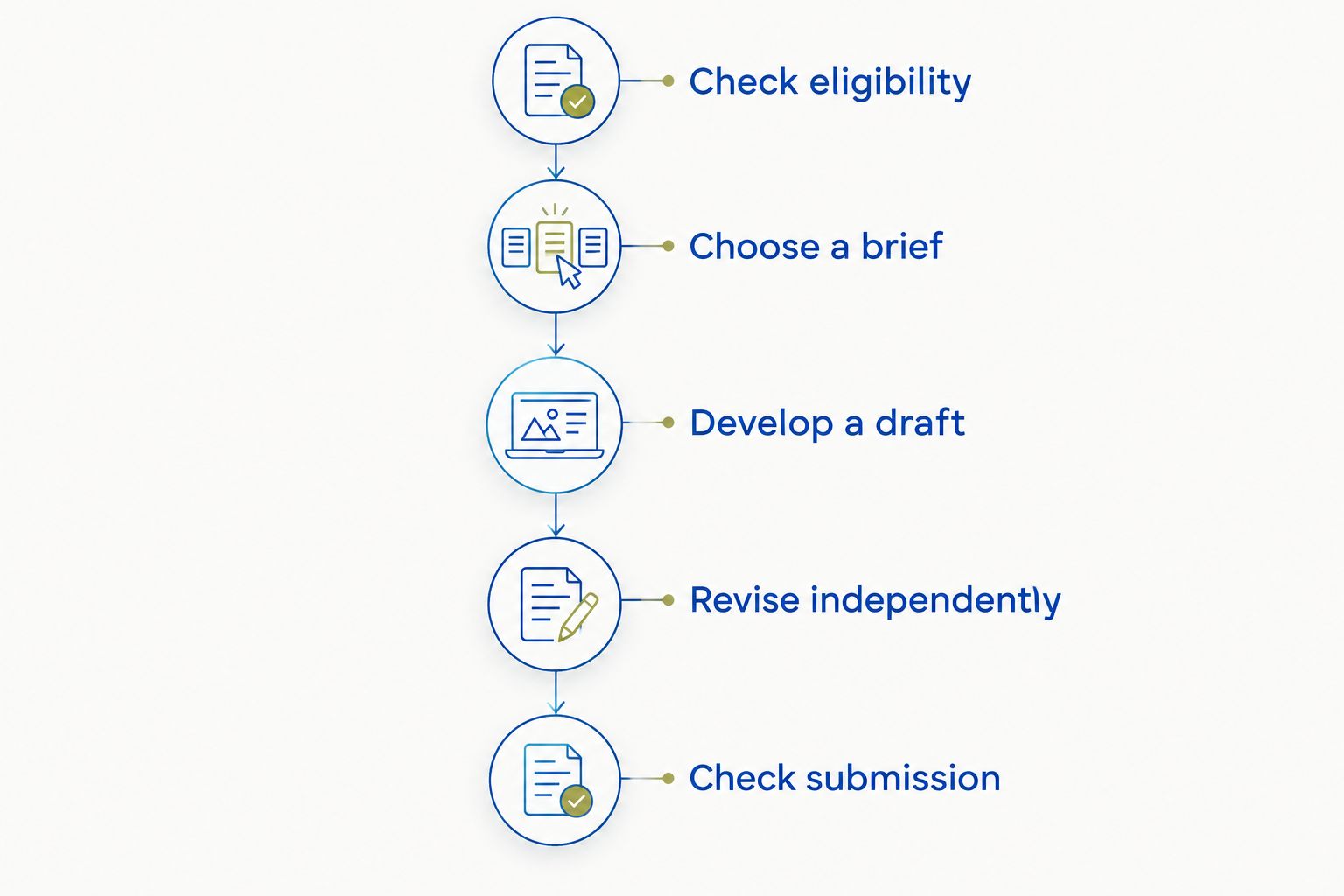
For 2026, build your plan around the official submission instructions rather than an assumed annual schedule. Record the relevant rule beside each task so you can distinguish an organizer's requirement from your own preference.
- Check eligibility: Confirm age or grade, geography, category and any school-related conditions.
- Choose a brief: Select the question, genre or theme that matches your interests.
- Develop a draft: Read, take notes and write before seeking detailed feedback.
- Revise independently: Use comments to identify problems while keeping the decisions and wording your own.
- Check submission: Review length, formatting, attribution and originality requirements before sending.
These steps are sequential. Do not invest in extensive revision before establishing that the competition accepts your entry.
A parent or counselor can help you organize the process and interpret instructions. The submitted work must remain yours. Check each organizer's rules on outside assistance and writing tools rather than assuming the same standard applies everywhere.
How these competitions are ranked
This shortlist ranks competitions by genre fit, educational value and the clarity of their purpose. John Locke leads for academic argument; the remaining choices occupy different slots rather than competing for the same student. Age and geographic restrictions are decisive limitations, not small-print details.
The ranking does not assign admissions value to an award or predict your chances of winning. Official organizer rules determine eligibility, and university admissions decisions remain separate from competition results.
Which writing competition should you choose?
Choose John Locke for academic argument, Foyle for poetry and Scholastic for eligible students seeking creative breadth. Choose Bennington when literary development is the priority, and Ocean Awareness when environmental research genuinely informs your writing.
Ivy Central's college admissions counseling is best for families seeking personalized US and UK application strategy. Caroline Linger and Jose Kumar work directly with each student to connect academic interests, activities and application choices without promising admission.
For US applications, describe the activity and any recognition accurately. For UK applications, focus on what the work taught you about your intended subject where relevant. Keep competition writing separate from application essays: their audiences and purposes differ.
Request a consultation when you need help deciding where writing fits within your wider university plan. Ivy Central can help you prioritize; entering every competition is not a strategy.
Plan your university application strategy
Discuss how writing interests fit your US and UK university plans.
FAQ
What’s the best writing competition for high school students in 2026?
John Locke Institute Essay Competition is this shortlist’s first choice for academic argument. Choose Foyle Young Poets for poetry or Scholastic Art & Writing Awards for creative breadth if you meet its participation rules.
Which writing competitions can international students consider?
John Locke, Foyle Young Poets and Ocean Awareness are relevant starting points for international students. Confirm the organizer’s current age, country and submission conditions before drafting; Scholastic requires particular attention to geographic eligibility.
Is John Locke better than Scholastic for university applications?
John Locke and Scholastic serve different writing interests, so neither is automatically better for an application. John Locke suits academic argument, while Scholastic accommodates multiple creative-writing categories for eligible students.
Do I need to win a writing competition to get into an Ivy League university?
No, a writing competition award is not a universal Ivy League admission requirement. Describe your writing work honestly, and do not treat a competition result as an admission guarantee.
Can I submit the same writing to different competitions?
Submit the same piece only when every relevant organizer’s rules permit it. Check simultaneous submission, prior publication, originality and category requirements separately.
Can a counselor edit my competition entry?
Outside assistance must stay within the competition’s rules, and the submitted work must remain the student’s own. Check the organizer’s policy before accepting edits or using writing tools.
Can writing competitions help with UK university applications?
Writing competitions can provide material for discussing subject interests and independent learning. Explain the ideas you examined and what you learned rather than relying on the competition’s name alone.
One last thing
Save the questions your entry did not resolve. Those questions can guide your next reading project, poem or essay long after the result arrives. For your 2026 plan, judge a competition partly by whether it leaves you wanting to keep writing.
Related guides
- Ivy League admissions for Indian students
- Summer research programs for high school students
- Scholarships for Indian students studying in the US
- Need-blind universities for international students