

Crimson Education provides university admissions guidance; compare its proposed support against the requirements published by each university on your shortlist. Its support stops being enough when the agreed scope does not cover your student's actual needs, whether those are school-specific application planning, essay guidance or US-versus-UK decisions. The best Crimson Education alternative in 2026 is Ivy Central for families seeking personalized admissions counseling with Caroline Linger and Jose Kumar; school-based counseling is the better starting point when you need guidance grounded in your student's school record.
- Compare Crimson Education alternatives by counselor involvement, application guidance and university fit, not admission promises.
- Ivy Central suits families seeking personalized US and UK admissions counseling with Caroline Linger and Jose Kumar.
- School-based counseling helps connect university planning with your student’s academic record and school responsibilities.
- Self-directed applications suit students prepared to manage official requirements, essays and deadlines themselves.
Why this matters
Choosing an admissions counselor is a decision about who helps your student make consequential academic choices. Start with the universities and courses under consideration, then identify the work that requires outside guidance. A family comparing US and UK options needs a different conversation from a student who has already chosen a subject and destination.
For your 2026 shortlist, separate admissions strategy from administrative support. Choosing suitable universities, explaining academic interests and revising an essay require judgment; collecting documents and tracking deadlines require organization. Ask who handles each responsibility and what remains with the student, family and school.
The right arrangement also preserves the student's ownership. Counseling should help a student articulate genuine interests and make informed choices, not manufacture an application identity. No provider can turn past outcomes into a promise of admission for your child.
Crimson Education alternatives at a glance
These options are not interchangeable. A private admissions service, a school counselor and an independent application process address different needs; comparing their roles is more useful than treating them as identical packages.
| Option | Best for | Standout contribution | Difference from Crimson Education | Main limitation |
|---|---|---|---|---|
| Crimson Education | Families considering external university admissions guidance | Admissions-focused support | Benchmark provider in this comparison | A service agreement does not guarantee admission; evaluate the proposed scope |
| Ivy Central | Families seeking personalized US and UK admissions counseling | Caroline Linger and Jose Kumar work directly with each student | An alternative counseling relationship to evaluate against your student's needs | Counseling does not replace student work or official university requirements |
| School-based counseling | Students needing guidance connected to their school record | Access to the student's educational context | Support sits within the student's school rather than an external consultancy | Application support depends on the school's provision |
| Self-directed applications | Organized students ready to manage their own applications | Direct use of official university and application-platform guidance | The student coordinates the process without a private counseling service | Research, decisions and quality checks remain the student's responsibility |
Use this table to select a starting point, not to make a final purchase decision. For any external counselor, ask for a clear explanation of responsibilities before you commit.
1. Ivy Central: best for personalized US and UK counseling
Caroline Linger and Jose Kumar work directly with each student, providing personalized college admissions counseling and strategy for high school students and their families. The service supports families pursuing Ivy League and other top-tier US and UK universities. That makes the counseling relationship itself a central part of the comparison.
Best for: Families who want direct involvement from named counselors while making university, application and essay decisions.
Where the service shines
- Direct counselor involvement: Caroline Linger and Jose Kumar work with each student rather than leaving families to assume who will guide the application.
- US-versus-UK planning: The stated service covers both destinations, making it relevant when a student is still comparing educational routes.
- Personalized strategy: Counseling can connect the student's interests and academic choices with an appropriate university shortlist.
- Application and essay guidance: Families can discuss how to present the student's work and interests while keeping the application authentically student-led.
Begin with a concrete academic question. If your student wants computer science, compare the courses, entry requirements and selection processes at the universities under consideration before deciding what application support to seek. The guide to computer science universities in the UK provides a subject-specific starting point; official university pages remain the authority for requirements.
Where the service falls short
- Counseling is not an admissions decision: Personalized support cannot guarantee acceptance at a university.
- The student must do the work: Guidance cannot substitute for academic preparation, genuine activities or the student's own thinking in an application.
- External counseling does not replace the school: School-issued records and recommendations still require coordination with the relevant school staff.
- A narrowly defined need requires a scope discussion: A student seeking help with a single task should establish whether the proposed counseling arrangement matches that task.
These are meaningful limits, not reasons to dismiss counseling. The distinction is between getting informed support and transferring responsibility for the application. Your student remains responsible for representing their experiences honestly and following each institution's instructions.
Head-to-head with Crimson Education
| Decision area | Ivy Central | Crimson Education |
|---|---|---|
| Counselor relationship | Caroline Linger and Jose Kumar work directly with each student | Confirm who would work directly with your student |
| Geographic fit | Stated focus includes top-tier US and UK universities | Confirm support for your specific destinations and institutions |
| Strategy | Personalized admissions counseling and strategy are stated services | Assess the strategy proposed for your student's profile |
| Admissions outcome | No admission guarantee | No counseling agreement should be treated as an admission guarantee |
The brand's stated outcomes include 180 Ivy League wins and 3,052 Top 50 US and Top 20 UK university offers. Those figures describe reported outcomes, not your student's acceptance probability. They do not establish an acceptance rate without a defined applicant population, reporting period and counting method.
Ask how the proposed guidance applies to your student's actual academic record, subject interests and family priorities. A useful consultation should clarify the decisions ahead rather than simply repeat aggregate results.
Verdict: Buy only after confirming that the proposed counseling scope matches your student's needs.
2. School-based counseling: best for academic context
School-based counseling is a distinct option, not a lesser version of private admissions consulting. A school counselor can connect university planning with the student's educational setting and help clarify school responsibilities. Establish exactly what your school provides before purchasing overlapping support.
Best for: Students whose immediate needs concern subject choices, school records, recommendations and coordination with their school.
Where school-based counseling shines
- Educational context: Conversations can start with the student's curriculum, school performance and available academic choices.
- School coordination: The school is the appropriate place to clarify its procedures for records and recommendations.
- A clear starting point: Families can identify what support already exists before deciding what additional help they need.
Where school-based counseling falls short
- Provision differs: Do not assume every school offers detailed guidance for every US or UK application route.
- Specialist support needs confirmation: Ask whether the counselor can address your student's particular universities, courses and application questions.
- Responsibilities can remain outside school: Students and families still need to understand what they must research, prepare and submit themselves.
| Decision area | School-based counseling | Crimson Education |
|---|---|---|
| Relationship | Connected to the student's school | External admissions provider |
| Core context | School curriculum and school procedures | Proposed admissions-support scope |
| Specialist fit | Confirm destination and subject knowledge | Confirm destination and subject knowledge |
School-based support and private counseling can coexist, but define the division of work. Conflicting instructions create avoidable confusion, especially when essays, recommendations and school documents move through different people.
Verdict: Hold off on external counseling until you understand your school's provision.
3. Self-directed applications: best for independent students
A self-directed application process puts the student in charge of researching universities, tracking requirements and preparing submissions. Official university admissions pages and application-platform instructions become the primary reference points. This route demands ownership rather than access to a particular consultancy.
Best for: Students who can research carefully, organize their workload and seek clarification when instructions are unclear.
Where self-directed applications shine
- Direct reference to requirements: Students can work from the institution's own admissions instructions.
- Student ownership: The applicant makes decisions and develops their own written responses.
- Targeted help: A student can identify a specific unresolved issue before deciding whether additional guidance is necessary.
Where self-directed applications fall short
- The workload stays with the student: No external provider coordinates research or application planning.
- Misunderstandings need active checking: Reading a requirement is not the same as interpreting it correctly.
- Feedback requires a plan: Students must decide how to obtain appropriate comments without surrendering authorship.
| Decision area | Self-directed applications | Crimson Education |
|---|---|---|
| Coordination | Student-led | Assess coordination included in the proposed service |
| Requirements | Student checks official sources | Student still needs to follow official requirements |
| Feedback | Student arranges appropriate feedback | Confirm the feedback included in the agreement |
Verdict: Skip private counseling when the student can manage the process and has suitable support for unresolved questions.
Why families consider switching from Crimson Education
A switch makes sense when you can name the unmet need. This comparison does not establish that Crimson Education has changed its fees, experienced service problems or delivers weaker outcomes. Those claims are not necessary to make a sound decision.
For a 2026 decision, examine the proposed relationship against these specific needs:
- Direct counselor involvement: You want to know who works with your student and who is responsible for strategic decisions.
- Destination clarity: Your student is deciding between US and UK universities and needs advice that addresses both routes.
- Subject-specific planning: A broad university list does not resolve questions about a particular course or academic direction.
- Essay ownership: You want feedback that strengthens the student's expression without replacing their voice.
- Defined responsibilities: Your family needs a clear division of work among the student, school and external counselor.
Treat these as questions to investigate, not accusations against a provider. Ask your current counselor to explain how each concern will be addressed. If the answer fits your needs, switching adds no automatic benefit.
If your family does change providers, first clarify the existing agreement and the status of current work. Keep the student's university shortlist, requirement notes and draft history organized. The objective is continuity of sound advice, not a fresh start for its own sake.
Check university requirements before choosing support
For each university on your 2026 shortlist, create a requirement record using its official admissions information. Separate published requirements from counselor recommendations. A recommendation can help your student prepare; it cannot change what the university requires.
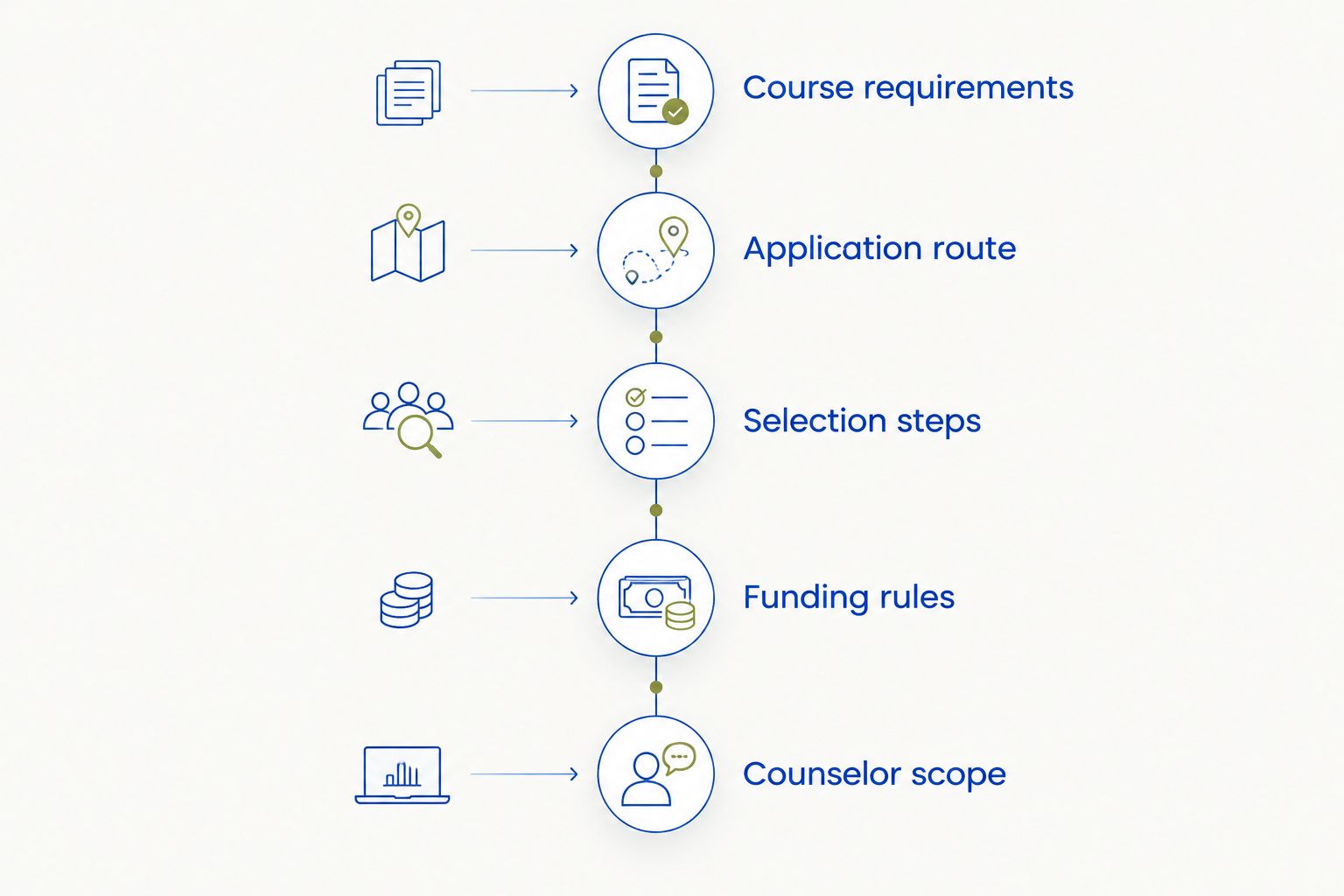
Use this sequence before comparing service proposals:
- Course requirements: Record the relevant qualification, subject and academic requirements for the course or institution.
- Application route: Identify the official submission route and the instructions that apply to the applicant.
- Selection steps: Check whether tests, interviews, portfolios or other materials apply to the chosen course.
- Funding rules: Review official scholarship and financial-aid eligibility alongside the family's budget.
- Counselor scope: Identify which decisions need guidance and which tasks belong to the student or school.
Check the applicant category as carefully as the university name. Instructions can distinguish domestic and international applicants, qualifications and intended courses. Families in India, the US, UK, UAE and Singapore should identify the rules applicable to their student rather than rely on a general summary.
College costs belong in this discussion from the start. Keep scholarship eligibility, financial-aid policy and admissions fit as separate questions; a university's academic appeal does not answer whether its funding arrangements suit your family. Confirm details with the institution before treating any funding possibility as part of the plan.
When staying with Crimson Education is the right call
Stay with Crimson Education when the agreed support fits your student and the counseling relationship is working. An alternatives list is not evidence that you need to change providers. Review the actual guidance, responsibilities and progress rather than the prominence of competing brands.
Ask whether your student understands the reasons behind the university shortlist and knows what to do next. Check that feedback is specific, requirements are tied to official sources and unresolved questions have a clear owner. These are useful standards for any admissions counselor in 2026.
If a concern is about scope, raise it directly before making a switch. A clarified responsibility or a more focused conversation can address the issue without changing the entire support arrangement.
FAQ
What’s the best Crimson Education alternative for personalized counseling?
Ivy Central is the best fit in this comparison for families seeking personalized US and UK admissions counseling with Caroline Linger and Jose Kumar working directly with the student. Confirm the proposed scope against your student’s universities, academic interests and application needs.
Is an alternative to Crimson Education automatically better?
No alternative is automatically better for every student. Compare the counselor relationship, destination knowledge, responsibilities and proposed guidance rather than assuming a different provider will produce a different admissions outcome.
Can my school counselor replace a private admissions consultant?
School-based counseling can be sufficient when it covers your student’s needs. Ask what guidance the school provides for university selection, applications and recommendations, then identify any remaining gaps.
Can I apply to top universities without an admissions consultant?
Yes, you can prepare applications without a private admissions consultant. You remain responsible for understanding official requirements, coordinating school documents and producing your own application materials.
Should I use the same application strategy for US and UK universities?
Do not assume one application strategy fits both US and UK universities. Check each institution’s course requirements, application route and selection instructions before deciding how to prepare.
Do reported admissions results guarantee my child will get in?
Reported admissions results do not guarantee your child’s admission. Aggregate offers and wins do not establish an individual acceptance probability, and universities make their own admissions decisions.
How should scholarships affect my university shortlist in 2026?
Scholarship and financial-aid eligibility should inform your shortlist alongside academic fit and family budget. Check the institution’s official rules for your student’s applicant category before including potential funding in your plan.
One last thing
Ask every prospective counselor to explain one difficult choice, not just present a list of impressive universities. A useful example is choosing between a course that closely matches the student's interests and an institution the family recognizes more readily. The explanation reveals how the counselor thinks about fit.
For a 2026 counseling decision, bring your student's academic record, subject interests and current shortlist to a consultation. Ask Ivy Central how Caroline Linger and Jose Kumar would help your student resolve the specific decisions ahead. You are choosing a working relationship, not buying an admissions outcome.
Discuss your admissions priorities
Bring your academic record, subject interests and shortlist to a personalized counseling conversation.
Related guides
- Ivy League admissions for Indian students
- Need-blind universities for international students
- Scholarships for Indian students studying in the US