

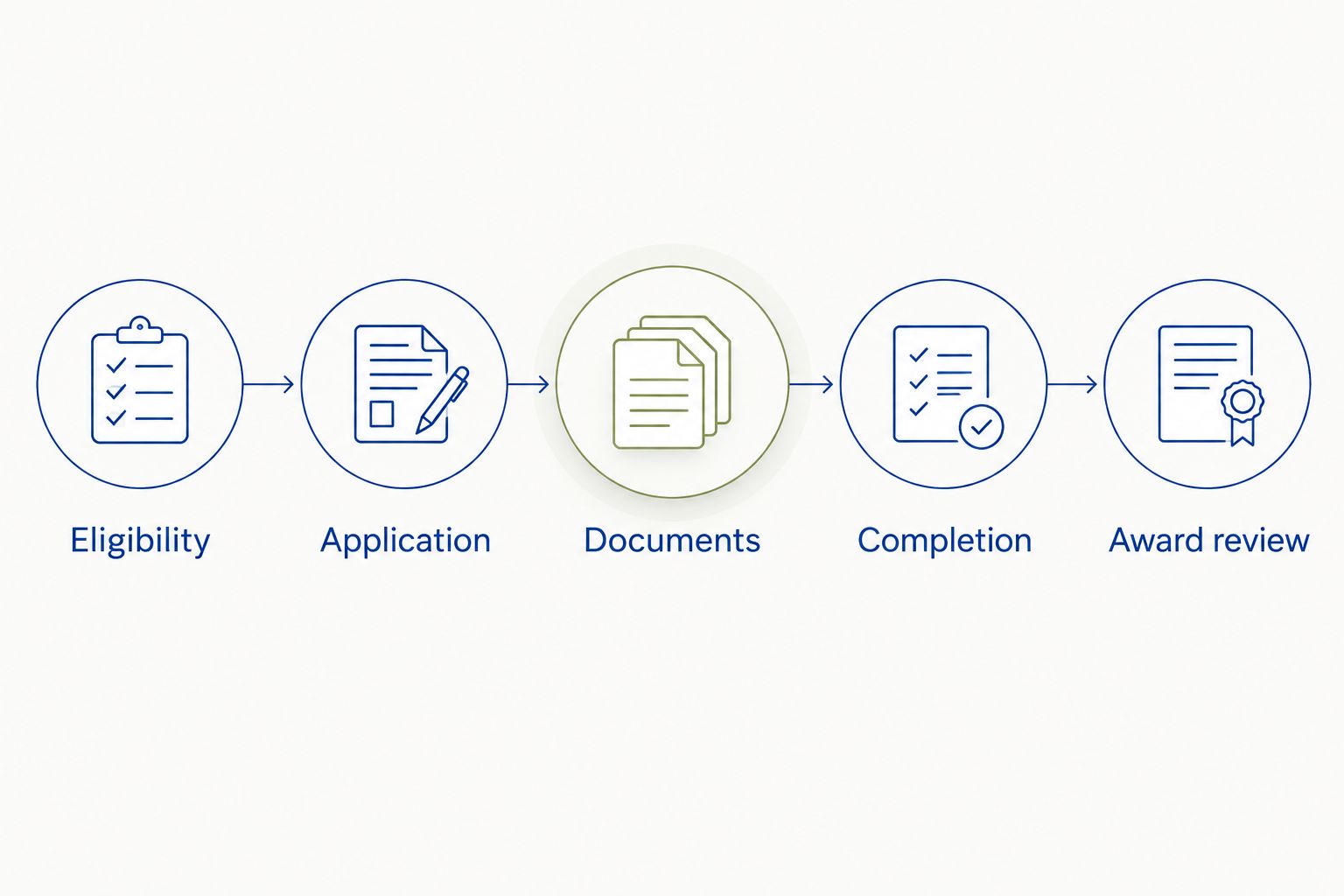
Instead of repeatedly checking forms, document requests and university emails, build a CSS Profile to financial aid award workflow that tracks each college from eligibility checks to an award decision. For 2026 applications, separate form submission, supporting-document completion and award review: finishing one does not complete the others.
- The CSS Profile to financial aid award workflow connects eligibility checks, institutional aid forms, document requests and award review.
- College Board’s CSS Profile supports institutional aid applications; each college determines its own requirements and award.
- International families must check aid eligibility before submitting forms, not after receiving admission.
- Ivy Central’s personalized college admissions counseling suits families coordinating university choices, applications and affordability.
Why this matters
A submitted CSS Profile is not a financial aid award. College Board collects application information; the university evaluates eligibility, requests supporting evidence and determines institutional assistance. Admission and financial aid also have separate requirements, even when their decisions arrive together.
Start with the financial aid instructions for each university, your citizenship or residency category and your application round. A college’s domestic-student checklist is not a substitute for its international-student instructions.
Ivy Central provides personalized college admissions counseling for families pursuing US and UK universities. Caroline Linger and Jose Kumar work directly with each student; their counseling can connect university selection and application strategy with your family’s affordability priorities. The university, not a counselor, decides admission and aid.
Before you start
- Confirm school-specific eligibility and access. Identify the relevant university financial aid instructions, your College Board account and any applicant-portal credentials already issued. For each 2026 application, confirm whether your applicant category uses CSS Profile, another institutional form or no institutional aid application.
- Gather the requested financial records. Prepare income and tax records, asset information, business details where applicable and explanations of unusual circumstances. Use the reporting periods requested by the application; do not substitute the latest document simply because it is easier to find.
- Check the separate-household requirement first. Some institutions require information from a noncustodial parent. Confirm whether a separate application or waiver request is necessary before you assume one parent’s submission completes the file. A waiver request is not an approved waiver.
The official references for this 2026 workflow are College Board’s CSS Profile instructions, College Board’s Institutional Documentation Service instructions and each university’s financial aid requirements. Use College Board for form mechanics and the university for eligibility, deadlines, required documents and award decisions.
Eligibility and deadline tracker
Build the tracker before entering financial information. This prevents a polished application from being sent through the wrong route.
- Create 1 row per college. Record the university, intended entry term, application round, applicant category and financial aid office contact. Keep admission and aid deadlines in separate columns.
- Record the required application route. Read the university’s instructions for your category. Note whether it requires CSS Profile, FAFSA, its own application or a combination. Do not infer requirements from another college’s policy.
- Record the document route. Identify whether supporting records go through IDOC, the university portal or another method specified by the institution. Participation in CSS Profile does not establish that a college uses IDOC.
- Add dependency and status columns. Include parent information, waiver requests, submission confirmation, missing documents, award status and next action. Save the source title and date you checked it.
Expected result: every university has a documented application route, deadline and next action. An empty requirement field means you still need an answer, not that the requirement does not exist.
Which application does what?
These systems serve different purposes. Use the combination required by the university rather than choosing the form that appears easiest.
| Application or service | Best for | What it does | Limitation |
|---|---|---|---|
| CSS Profile | Applicants whose colleges require it for institutional aid | Collects financial information for participating institutions | Submission does not establish eligibility or determine an award |
| FAFSA | Applicants eligible to apply for US federal student aid | Collects information used in federal aid assessment | It does not replace CSS Profile where a college requires both |
| IDOC | Applicants instructed to provide documents through College Board’s document service | Collects supporting financial documents | It is not an aid application or an award decision |
| University-specific application | Applicants directed to an institution’s own process | Collects information required by that university | Another university’s checklist does not apply |
For families outside the US, federal aid eligibility depends on citizenship and eligible noncitizen status, not simply the country where the student attends school. Institutional aid eligibility is a separate question.
CSS Profile application and submission
Complete the financial application from records, not estimates recalled during a family conversation. Where the form requests an estimate, identify the basis and retain your calculation.
- Select the correct application cycle. Match the CSS Profile cycle to the university’s entry-term instructions. For a 2026 entry application, check the requested academic cycle rather than relying on the calendar year alone.
- Identify the student and household accurately. Review personal details, household relationships and parent information. Use consistent identifying information across the admission and financial aid applications so the institution can match records.
- Select the intended recipients. Check each institution’s name and identifying details in the application. Confirm that each selected recipient requires CSS Profile for your applicant category.
- Enter financial information as requested. Follow the form’s definitions for income, assets, business interests and currency. Do not convert or exclude an amount merely because a different university’s form handled it differently.
- Explain circumstances where the application permits. Describe relevant changes clearly, distinguishing reported financial history from current circumstances. Follow any separate university instructions for supporting an explanation.
- Review and submit. Check recipients, household details and financial entries before using Submit. Save the confirmation and a copy of the submitted information securely.
Expected result: you have evidence of submission and the intended recipients. You do not yet have evidence that every university considers your aid file complete.
Assign 1 adult to reconcile financial entries against supporting records. The student should still understand the application and monitor university communications; a parent handling financial documents should not create a communication gap.
Do not share account passwords with counselors. Discuss questions together, but keep account access and sensitive financial records under the family’s control.
Supporting documents and completion checks
Move from submission evidence to university receipt evidence. These are different checkpoints, and both belong in the tracker.
- Read the document request. Open the university’s aid checklist and any IDOC instructions you receive. Identify which household member, document type and reporting period each request concerns.
- Prepare readable files. Include the requested pages and follow the receiving service’s file instructions. Check that names, dates and amounts are visible before uploading.
- Use the specified destination. Submit through IDOC only when instructed. If the university requests its own portal, use that route rather than assuming an IDOC upload reaches it.
- Retain proof of delivery. Save upload confirmations and record submission dates. A file stored on your computer is not evidence of delivery.
- Check the university’s status. Allow the processing time stated by the institution or document service, then review the checklist. If an item remains missing, contact the financial aid office with the student’s identifying information and submission evidence through an approved channel.
Expected result: the university’s checklist shows the required items received, or you have a specific unresolved request with a named next action.
Use 2 checkpoints for every document: sent and acknowledged. Schedule a weekly review during the application period, and check more frequently when a deadline or document request requires action. This is a family planning routine, not a promised university processing time.
Award review and decision record
Once a university issues an award, replace application tracking with an affordability review. An award headline is not enough to support an enrollment decision.
- Confirm what the award covers. Identify the academic period, enrollment assumptions and any conditions attached to the offer. Check whether the information is provisional or requires further action.
- Separate the components. List grants and scholarships separately from loans and work-related assistance. Borrowing and expected earnings are not equivalent to grant aid.
- Reconcile the university’s cost information. Review tuition, housing, meals and other stated attendance expenses. For international study, also account for relevant travel, insurance and personal expenses without assuming every item appears in the award letter.
- Check renewal conditions. Ask what must happen in later years, including financial reassessment, enrollment requirements and any academic conditions. Do not treat a first-year award as an unconditional commitment for the degree.
- Record the decision and outstanding questions. Note acceptance instructions, relevant response deadlines and any review request. Resolve material affordability questions before making the enrollment commitment.
Expected result: your family understands the award’s components, remaining contribution and conditions—not just the total assistance shown.
For 2026 award comparisons, use the same expense categories across universities. Compare grants with grants and loans with loans. A package containing borrowing should not appear equivalent to a package containing the same amount of nonrepayable assistance.
When family circumstances change
A change in income or household circumstances creates a second workflow: request a university review rather than assuming the original application tells the current story.
- Identify the change. Separate an original reporting error from a later event, such as employment loss or a change in household circumstances.
- Ask for the correct procedure. Follow College Board’s current correction instructions for application errors. Follow the university’s process for special-circumstance or award-review requests.
- Submit a consistent explanation. State what changed, when it changed and which records support the request. Use the university’s secure document channel.
- Track the response separately. Keep the original award, request date, additional-document requests and revised decision together.
A review request does not guarantee additional aid. Keep existing response deadlines visible and ask the university directly if you need clarification about timing.
Troubleshooting
CSS Profile is submitted, but the aid checklist is incomplete
Check the missing item’s exact description. The university might be awaiting supporting records, separate parent information or another required application. Compare your submission evidence with the institution’s stated processing guidance before sending duplicate files.
Parent information is unavailable
Read each university’s noncustodial-parent waiver instructions where relevant. Ask what evidence it requires and how to submit it. Do not omit the information and assume the college will infer a waiver request.
Financial records do not match the requested format
Ask the financial aid office how to document non-filing status, foreign tax records, translations or financial information without an equivalent local document. Follow the institution’s answer rather than creating a substitute that conceals the original record.
A submitted figure is wrong
Identify the affected entry and supporting evidence. Follow the current correction route and confirm whether the university needs a separate notification. Keep a record of the correction so later explanations remain consistent.
Admission arrives without an aid decision
Review the financial aid portal and published decision instructions. Ask whether the file is complete and whether the award follows a separate schedule. Admission alone does not confirm that the university has approved financial assistance.
Customize your workflow
Add an eligibility check before finalizing the university list. The guide to need-blind universities for international students provides a starting point; verify each institution’s current policy for your applicant category. Need-blind admission and meeting financial need describe different policies.
For a combined US and UK shortlist, maintain separate funding checklists. CSS Profile is not a universal university funding application. Follow each UK institution’s scholarship and funding instructions instead of transferring the US checklist unchanged.
Ivy Central’s personalized college admissions counseling is best for families who want university choices and application planning considered together. Caroline Linger and Jose Kumar work directly with each student, but university financial aid offices remain the authority on eligibility, documentation and awards. Request a consultation to discuss how affordability should shape your application strategy.
Plan your university application strategy
Discuss university choices, application priorities and affordability questions with Ivy Central.
FAQ
Does submitting CSS Profile mean I will receive financial aid?
No. CSS Profile supplies financial information to participating institutions; each university determines eligibility and awards. Complete its supporting-document requirements as well.
Do international students need CSS Profile in 2026?
International students need CSS Profile only when their university requires it for their applicant category. Check each institution’s international financial aid instructions before submitting.
Is CSS Profile the same as FAFSA?
No. CSS Profile supports institutional aid applications, while FAFSA is used to apply for US federal student aid. A university can require both from an eligible applicant.
Does uploading documents to IDOC complete my financial aid application?
Not by itself. IDOC handles supporting documents, and the university can have additional requirements. Confirm completion through the institution’s aid checklist.
What should I do if my parents are separated?
Check each university’s parent-information requirements before submitting. Some institutions require separate noncustodial-parent information, while waiver procedures and evidence requirements vary.
Can I ask a university to reconsider my financial aid award?
Yes, you can ask whether the university offers an award-review or special-circumstances process. Follow its instructions and supply relevant evidence; a request does not guarantee a different award.
Can Ivy Central guarantee admission or a financial aid award?
No. Ivy Central provides personalized college admissions counseling, while universities make admission and financial aid decisions. Counseling does not create an affiliation with a university or the Ivy League.
One last thing
Keep the university’s completion confirmation alongside its award letter. If the award later changes or a document question reappears, that record helps you explain what was submitted and acknowledged. For your 2026 workflow, the final task is not receiving an award—it is understanding the conditions attached to accepting it.
Related guides
- Scholarships for Indian students to study in the US
- Scholarships for international students at Ivy League universities
- Ivy League admissions for Indian students