

Instead of manually chasing forms and guessing whether admission includes funding, use a school-by-school FAFSA to need-blind aid package workflow: confirm eligibility, submit each required aid application, resolve missing documents, and compare the final offer. Need-blind admission does not guarantee admission, full funding, or an aid award.
- A FAFSA to need-blind aid package workflow separates admissions policy, federal aid eligibility, and institutional financial aid.
- International applicants without eligible US status generally need institutional aid applications, not FAFSA.
- Need-blind admission and meeting full demonstrated financial need are different policies; check both for your applicant category.
- Ivy Central provides personalized college admissions counseling; universities determine admission and financial aid awards.
Why this matters
For your 2026 university shortlist, answer two separate questions: does requesting aid affect admission, and how does the university calculate your financial need? A school can disregard financial need during admission without promising to meet all of it afterward.
FAFSA is the Free Application for Federal Student Aid. It is not an application for need-blind admission, and submitting it does not establish eligibility for every university-funded grant.
Ivy Central is best for families seeking personalized college admissions counseling alongside application strategy. Caroline Linger and Jose Kumar work directly with each student; universities, not counselors, decide eligibility and awards. Use Ivy Central for admissions planning, while directing binding financial-aid questions to each university’s aid office.
Before you start
- Confirm the applicant’s status. FAFSA eligibility depends on US citizenship or eligible noncitizen status, alongside other requirements—not simply where your family lives. A US citizen attending school in India follows a different route from an Indian citizen without eligible US status.
- Gather accounts and records. Prepare the student’s StudentAid.gov account, separate accounts for required FAFSA contributors, relevant financial records, and access to university applicant portals. Contributors must use their own credentials; do not share passwords.
- Check the hidden dependency. Admission and aid applications have separate requirements and deadlines. Some universities also require information from a noncustodial parent; a waiver requires the institution’s approval, not just a note from the applicant.
Eligibility and deadline tracker
Build this tracker before completing forms. For 2026 planning, record the academic year the application covers separately from the calendar year you submit it. Never select a FAFSA form solely because its year looks current.
- Create 1 row per university in a spreadsheet. Add these headings: Applicant category, Admission policy, Full-need policy, Required forms, Aid deadline, Missing documents, and Award status. These are your own tracker labels, not university portal buttons.
- Read each university’s official undergraduate financial-aid instructions for your citizenship or residency category. Record whether need-blind admission applies to you, whether the institution meets full demonstrated need, and any restrictions on applying for aid later.
- Record 2 separate deadlines: the admission deadline and the financial-aid deadline. Add document deadlines when the institution distinguishes them. Do not assume an admission extension also extends an aid deadline.
- Add each required submission route: FAFSA, CSS Profile, an institutional application, and any supporting-document service the university specifies. Save the official page title and the date you checked it.
- Record application-round requirements. Before choosing a binding admission plan, read the university’s financial-aid and release provisions with your family.
Expected result: every university has a documented aid route, an applicable policy, and a deadline. A blank eligibility field is a question for the aid office, not permission to proceed on an assumption.
Use the guide to need-blind universities for international students to develop a shortlist, then confirm each institution’s current policy on its official admissions and financial-aid pages.
Which application does what?
These routes are not interchangeable. Complete only what each university requires for your applicant category.
| Route | Best for | What it does | Limitation |
|---|---|---|---|
| FAFSA | Applicants eligible for US federal student aid | Supplies information used to determine federal aid eligibility; institutions also use FAFSA data | Does not replace additional institutional aid requirements |
| CSS Profile | Applicants whose universities require it for institutional aid | Collects financial information for participating institutions’ aid assessment | Requirements differ by institution and family situation |
| Institutional aid application | Applicants directed to a university-specific process | Supplies information in the format that university requires | Acceptance at one university does not make it valid elsewhere |
FAFSA supports federal aid assessment, but it is not a universal funding application. CSS Profile supports institutional assessment, but completing it does not guarantee an award. A university-specific form meets that institution’s process, not every institution’s process.
FAFSA submission and institutional forms
Submit the required applications as parallel tasks, not as substitutes. Waiting for FAFSA processing before starting a separate institutional form creates an avoidable dependency unless the university explicitly requires that sequence.
- Sign in to StudentAid.gov and select the FAFSA form covering your intended attendance year. Follow the form’s dependency and contributor questions rather than choosing answers based on who intends to pay.
- Invite required contributors using accurate identifying information. A FAFSA contributor supplies information; participation does not itself create an obligation to pay the student’s education expenses.
- Provide the required consent and approval for federal tax information access. Follow the form’s instructions even when a contributor has not filed a US tax return.
- Review the college list, complete the required signatures, and submit. Save the confirmation separately from your admission application receipt. An unfinished contributor section is not a completed student submission.
- Complete CSS Profile or the university’s alternative form when required. Use consistent underlying financial information, while following each form’s definitions, reporting period, and currency instructions.
Expected result: you have a submission confirmation for every required application, with contributor tasks completed. Submission is the start of processing—not proof that a university considers the file complete.
For a 2026 application, check the official instructions again before submitting. Requirements attached to an earlier application cycle are not a substitute for the form covering your attendance year.
Do not convert foreign income from memory or assume every form requests US dollars. Follow the currency instructions for the specific application and retain the records supporting your entries.
Document completion and processing checks
After submission, shift from filling forms to clearing exceptions. A confirmation email proves that a transaction occurred; the university’s aid checklist shows whether the institution still needs something.
- After FAFSA processing, review the FAFSA Submission Summary. Check the reported information, listed institutions, and any action messages. The Student Aid Index is an index used in aid assessment, not a bill or a guaranteed family payment.
- Open each university’s financial-aid checklist. Record the outstanding item exactly as displayed, its requested submission route, and the responsible family member in your tracker.
- Supply requested documentation through the university’s designated secure channel. Requirements can include income records, explanations of untaxed income, or family-business documentation. Send what is requested rather than an unrelated bundle of files.
- Resolve inconsistent information. If a form contains an error, follow that form’s correction process; if the underlying circumstances have changed, ask the aid office about its review procedure instead of rewriting historical information.
- Save confirmation of uploads and check whether the university marks the requirement complete. If an item remains outstanding beyond the institution’s published processing guidance, contact the aid office with the submission details.
Expected result: every outstanding requirement has either a completion confirmation or a documented question awaiting the aid office’s response. Keep admission decisions and financial-aid decisions in separate tracker fields.
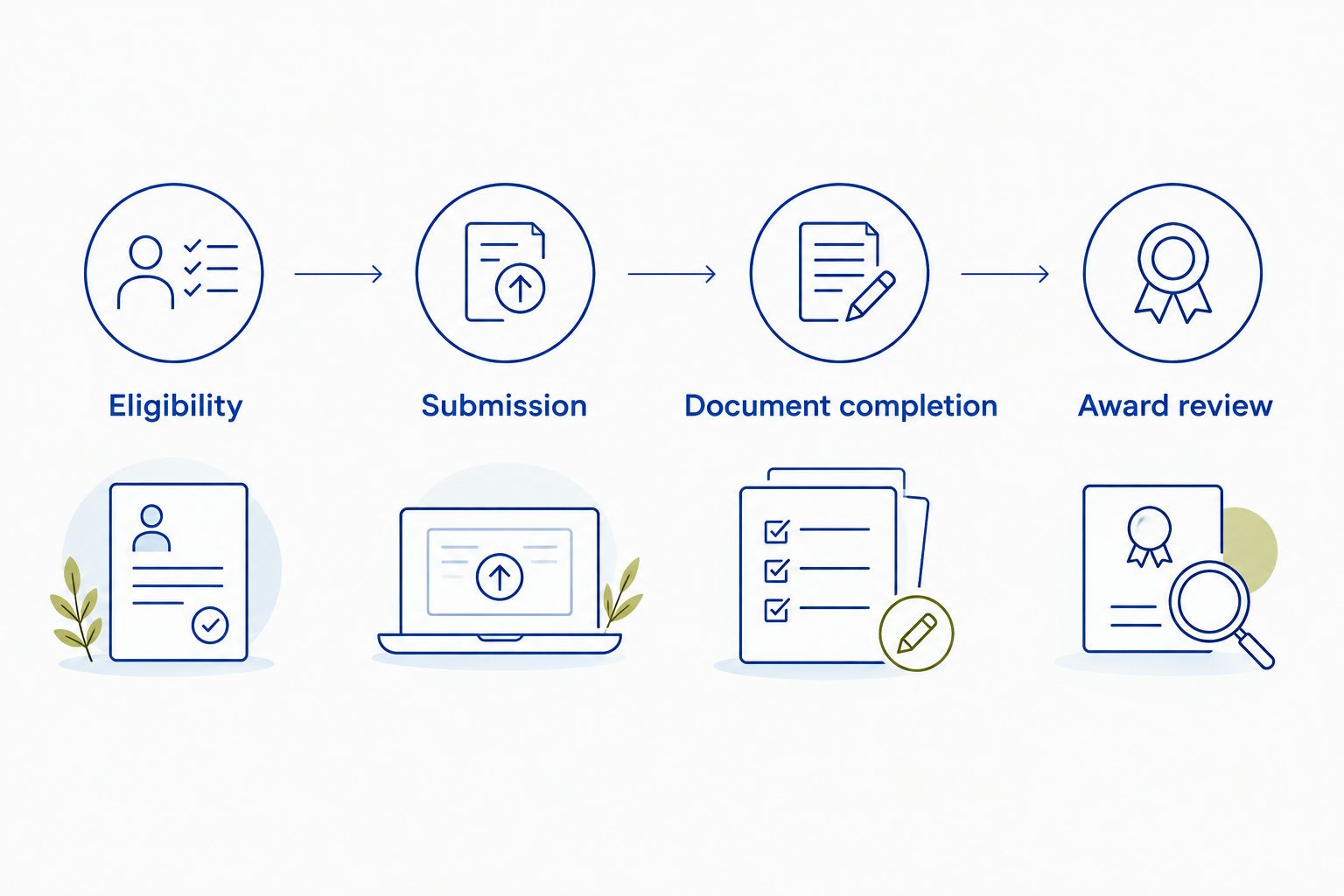
Award review and enrollment decision
A need-blind policy describes admission. The financial-aid offer describes funding, and the university’s definition of demonstrated need determines what a full-need commitment means for your family.
- Copy each university’s published attendance expenses into your comparison sheet. Separate billed charges from estimated expenses such as travel, books, and personal spending. Check how health insurance is treated.
- Separate the offer into 3 funding categories: grants and scholarships, loans, and work expectations. Grants reduce the amount to finance without repayment under their terms; loans require repayment; work expectations are not money already credited to your account.
- Compare the remaining family responsibility using the same expense categories for every university. Do not compare a tuition-only estimate at one institution with a full attendance estimate at another.
- Read renewal conditions. Check annual reapplication requirements, academic conditions, treatment of outside scholarships, and whether a changed family situation triggers a reassessment.
- Resolve unanswered questions before committing. Ask the aid office to explain an unclear award component or review documented circumstances under its appeal process.
Expected result: your family understands the grant support, borrowing, work expectations, and remaining funding requirement for each offer. Compare what the family must finance—not the largest award headline.
For offers reviewed in 2026, check which academic year the figures cover. Do not treat the initial award as a fixed promise for every subsequent year.
International applicant workflow without FAFSA
An Indian citizen living in India without eligible US status generally does not qualify for federal student aid through FAFSA. Living in the UAE, Singapore, or the UK does not independently establish FAFSA eligibility either; citizenship and eligible immigration status matter.
- Confirm your classification with each university. Citizenship, residency, and institutional admission categories do not always use identical definitions.
- Find the university’s international undergraduate aid instructions. Check whether financial need affects admission and whether aid must be requested with the initial application.
- Complete the specified institutional application. Submit CSS Profile only where required or accepted for your situation; use an alternative form only when the university permits it.
- Prepare financial records and translations according to the institution’s instructions. Keep income, assets, business interests, and family circumstances consistent across applications.
- Review funding before committing, then follow the university’s instructions for immigration-related financial documentation. A visa funding requirement and an institutional need calculation serve different purposes.
Expected result: you have an institution-specific aid file without treating FAFSA as a universal requirement. For a 2026 US-versus-UK shortlist, maintain separate funding trackers; FAFSA is not a general UK university funding application.
Troubleshooting
FAFSA is submitted, but the university says aid is incomplete
Check the university’s own checklist for additional forms, documents, or unmatched records. Confirm that the correct institution appears on FAFSA and that the student’s identifying information matches the university application.
A contributor has not completed their section
Have the contributor use their own account and check the invitation details. Follow StudentAid.gov’s current account and contributor instructions; do not create duplicate identities or use the student’s login for a parent.
A parent cannot provide the requested information
Contact the aid office about the specific obstacle. Estrangement, refusal to contribute, and difficulty obtaining records are different situations; a noncustodial-parent waiver and a FAFSA dependency determination are also separate processes.
Family finances changed after the reported period
Ask each university about a special-circumstances review and provide the requested evidence. A job loss or other change does not automatically update an award, and one institution’s decision does not bind another.
The offer contains more borrowing than expected
Separate grants from loans and work expectations before comparing offers. Ask the university how it calculated demonstrated need and whether a review is available; do not assume a need-blind policy means a grant-only package.
Customize your workflow
Add scholarships, application milestones, and annual aid renewal to the same planning system, but keep their requirements separate. Record outside awards and ask how each university treats them before assuming they reduce the family contribution.
Ivy Central’s college admissions counseling connects university selection, application and essay guidance, and US-versus-UK planning. Caroline Linger and Jose Kumar work directly with each student. Personalized counseling helps organize decisions; it does not replace the university’s financial-aid determination or guarantee admission.
Discuss your university application strategy
Plan your shortlist and applications with Caroline Linger and Jose Kumar.
FAQ
Does FAFSA give me a need-blind aid package?
No. FAFSA supplies information for federal aid eligibility and other aid assessments; need-blind describes an admission policy. A university determines its institutional award separately.
Can Indian students complete FAFSA?
Indian students qualify only if they meet FAFSA’s citizenship or eligible noncitizen requirements and other eligibility rules. Indian citizenship or attendance at a US university alone does not establish eligibility.
Does need-blind mean a university meets full financial need?
No. Need-blind admission and meeting full demonstrated need are separate policies. Check both policies for your applicant category, along with the institution’s definition of need.
Do I need CSS Profile as well as FAFSA?
You need both when your university requires both for your applicant category. CSS Profile does not replace FAFSA for federal student aid, and FAFSA does not replace a required institutional application.
Is the Student Aid Index what my family must pay?
No. The Student Aid Index is used in aid assessment, not issued as a university bill. Review the actual offer and attendance expenses to understand what your family must finance.
Can I appeal an award after my family’s income changes?
You can ask the university about its financial-aid review process. Submit the evidence it requests; a change in circumstances does not guarantee an increased award.
Can Ivy Central guarantee admission or financial aid?
No. Ivy Central provides personalized admissions counseling and strategy, while universities decide admission and institutional aid. Federal aid eligibility follows the applicable federal rules.
One last thing
Ask each aid office this before treating an offer as affordable: Which expenses are outside this award calculation? A package can meet the university’s calculated need while leaving your family with expenses or assumptions it needs to understand. Resolve that gap before choosing where to enroll.
Related guides
- Scholarships for Indian students studying in the US
- Ivy League admissions for Indian students
- Safety schools for Ivy League applicants