

Student-athlete college admissions counseling is coordinated academic, application and sports planning with the aim of finding universities where you can study and compete. Start with each university’s academic requirements and each team’s recruiting process; athletic eligibility, coach interest and admission are separate decisions.
- College admissions counseling for student athletes should coordinate academic fit, athletic recruiting and application deadlines.
- Ivy Central is best for student-athlete families seeking personalized US and UK application guidance.
- Coach interest is not an admission offer; confirm the next decision with the appropriate university office.
- Ivy League universities and NCAA Division III institutions do not award athletic scholarships.
Why admissions counseling matters for student-athletes
Student-athletes manage overlapping decisions: whether a university fits academically, whether a team needs their sporting profile, and whether the application satisfies institutional requirements. A strong result in one area does not settle the others. Your plan must connect them without treating recruitment as an admissions guarantee.
For families comparing universities in 2026, build the academic shortlist before allowing coach interest to narrow it. Include institutions you would choose even if competitive sport ended through injury, changed priorities or a roster decision.
Ivy Central provides personalized college admissions counseling for families pursuing top US and UK universities. Caroline Linger and Jose Kumar work directly with each student. That support belongs alongside communication with coaches, school advisers and admissions offices—not in place of their decisions.
Build a student-athlete admissions plan
Define your academic and athletic priorities
Begin with a written brief you can prepare with your family and school adviser. Name your intended subject, preferred countries, academic strengths and desired level of sporting commitment. Separate what you need from what you would simply enjoy.
For US options, distinguish varsity recruitment from club and recreational sport. For UK options, investigate the academic course first, then the university’s sporting opportunities and any relevant performance programme. Do not assume that similarly named teams offer the same competitive experience.
The NCAA has 3 divisions, but a division label alone does not tell you whether a particular team suits your performance level or schedule. Compare the actual programme, its competition and its academic setting.
Keep an academic route that does not depend on recruitment. A university should still make sense when you remove the coach’s name from the decision. Discuss that question before investing substantial effort in outreach or campus visits.
- Write down your preferred subjects and acceptable alternatives.
- Identify whether you want varsity, club or recreational competition.
- Set boundaries around travel, training and time away from classes.
- Record family priorities for location, support and affordability.
- List universities you would attend without a team place.
Check each university’s current requirements
Create a requirements sheet yourself using official university admissions pages, course pages and governing-body guidance. Record the source, relevant application cycle and date you checked it. A summary from another applicant is not a substitute for the institution’s instructions.
For your 2026 planning, check the year of entry separately from the year you submit. Testing policies, application components and recruiting rules require institution-specific review. Avoid copying last cycle’s checklist into the current application without checking it.
US applicants should investigate academic admission and the athletic eligibility rules relevant to their intended association and division. NCAA, NAIA and other routes are not interchangeable. International students should check how their qualifications and academic records are evaluated.
Personalized counseling can help organize this work and connect requirements to your school curriculum. Ivy Central’s college admissions counseling supports application planning; official institutions remain the authority on eligibility and admission.
- Confirm subject prerequisites and accepted school qualifications.
- Check testing and English-language requirements where applicable.
- Review the relevant athletic eligibility process.
- Identify transcript, translation and certification instructions.
- Record application and supporting-document deadlines separately.
- Recheck requirements before submitting an application.
Build parallel academic and athletic shortlists
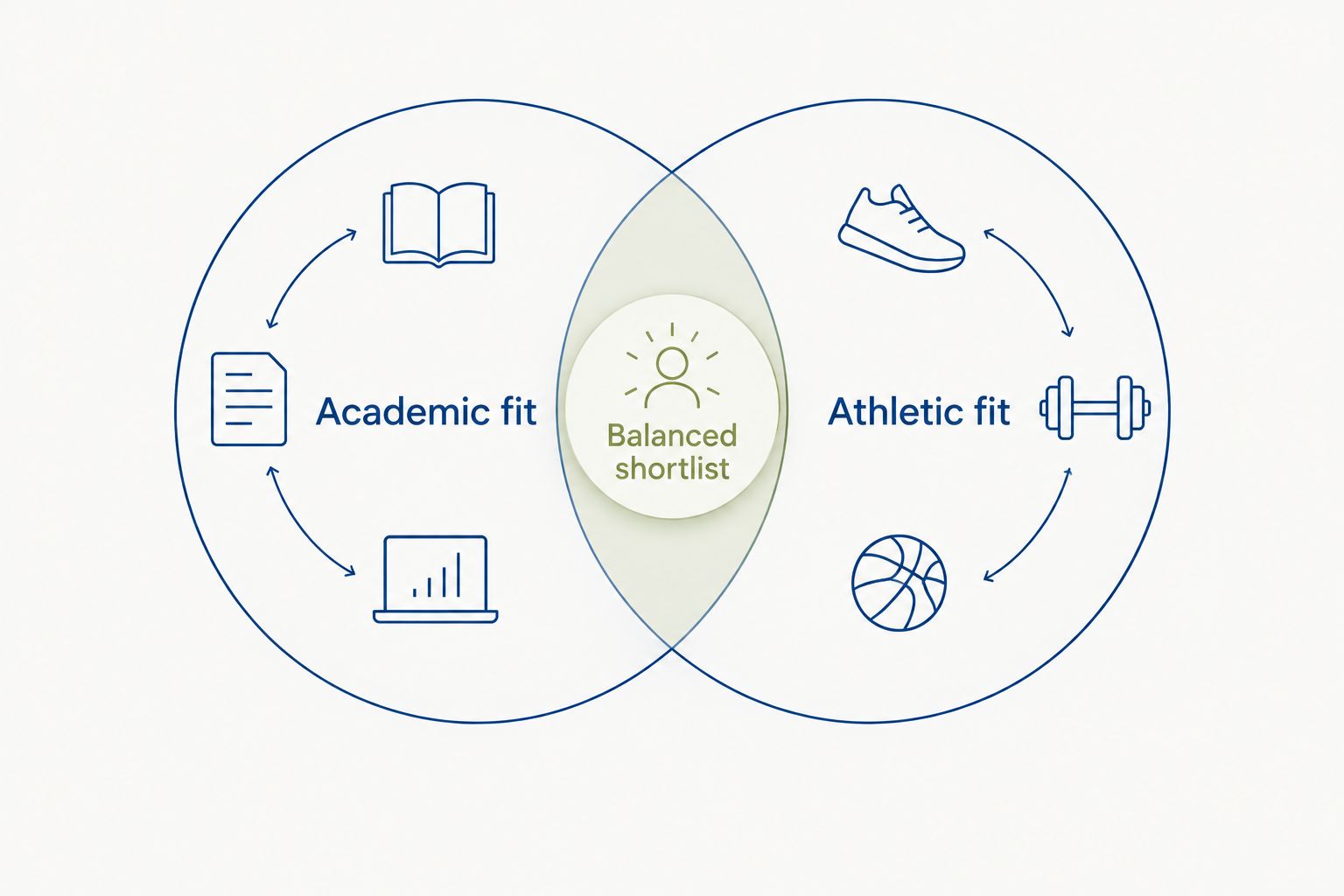
Start with 2 lists: universities that fit academically, and teams that fit athletically. Then identify their overlap. This prevents an enthusiastic recruiting conversation from disguising an unsuitable course or an academically unrealistic application.
On the academic list, consider curriculum, entry requirements, learning environment and financial feasibility. On the athletic list, examine competition level, roster composition, training expectations and your coach’s assessment of your performance. Neither list should depend solely on reputation.
Ask coaches precise questions rather than asking whether they like your profile. Establish what stage of evaluation you have reached, what additional evidence they need and what the next decision involves. Keep their responses in writing where possible.
A balanced shortlist includes viable choices outside the recruiting pathway. Admissions counseling helps connect your academic profile and application strategy; sporting fit still requires direct evaluation by the programme concerned.
- Create an academic-fit list independently of coach outreach.
- Create a team-fit list using relevant performance evidence.
- Mark the universities appearing on both lists.
- Record each coach conversation and its next action.
- Retain non-recruited options with suitable academic courses.
The shortlist works when academic fit and athletic fit overlap. Use that overlap to prioritize applications, while keeping financial feasibility as a separate check.
Prepare evidence coaches can evaluate
Build your recruiting materials using information you can substantiate. A concise sporting profile should make it easy to understand your sport, competition history, academic position and intended university entry. Select evidence appropriate to the sport rather than copying another athlete’s format.
For timed or measured events, distinguish official results from training performances. For team sports, use footage that allows a coach to assess relevant play, not just a promotional montage. Explain competition context without overstating its level.
Families applying from India, the UAE, Singapore or another international school system should make qualifications understandable to the recipient. State the curriculum and expected completion clearly. Do not invent a conversion to a US grade-point average.
In your 2026 outreach, reference the actual university and programme. Keep academic application questions with admissions staff and sporting evaluation questions with coaches. A counselor can help you present a coherent profile, but cannot manufacture the evidence behind it.
- Use verified competition results and clearly identify their source.
- Include sport-relevant footage or records where requested.
- State your school curriculum and intended entry year.
- Keep your sporting profile consistent with your application.
- Ask your current coach to review the material for accuracy.
- Send updates only when they add relevant information.
Coordinate applications, essays and sporting commitments
Build a shared calendar before paying for organizational support. Include school assessments, competitions, testing, coach follow-ups, application deadlines and financial-aid tasks. Assign responsibility so that family members do not assume someone else has submitted a document.
Sport can provide strong essay material, but it does not automatically produce a strong essay. Explain a decision, responsibility or change in understanding rather than retelling a season. Give the reader evidence of your judgment beyond the competition result.
US applications and UK applications require different emphasis. In the UK, keep the chosen subject and the institution’s current application instructions central. In the US, respond to each institution’s prompts rather than making every answer about athletics.
Caroline Linger and Jose Kumar work directly with each student through Ivy Central’s personalized counseling. That guidance can help connect academic choices, application structure and essay development while preserving the student’s own voice. The student remains responsible for truthful content and final submissions.
- Schedule writing around major competitions and examinations.
- Match every essay to its actual prompt and audience.
- Use specific sporting experiences rather than familiar slogans.
- Show academic interests beyond your athletic identity.
- Confirm reference and transcript arrangements with your school.
- Track submission confirmations and outstanding documents.
Assess scholarships and college costs separately
Create a financial worksheet from each university’s official information. Separate tuition, accommodation, meals, travel, insurance and other required expenses. Then distinguish confirmed funding from funding you intend to apply for. Do not build an affordability decision around an unconfirmed award.
The Ivy League comprises 8 universities and does not award athletic scholarships. NCAA Division III institutions also do not award athletic scholarships. Financial aid and other eligible awards require separate investigation; sporting recruitment does not establish what your family will receive.
At other institutions, investigate the actual funding arrangement rather than assuming every recruited athlete receives the same support. Ask the relevant office about award conditions, renewal, changes in sporting participation and how different forms of funding interact.
For UK applications, review university-specific sports scholarship criteria and academic funding separately. For your 2026 budget, use current institutional information and your family’s circumstances. International status can affect which funding routes are available.
- Obtain the university’s current cost information.
- Separate need-based aid, merit awards and sports funding.
- Check eligibility rules for your citizenship and residency.
- Record funding application deadlines alongside admission deadlines.
- Ask about renewal conditions and participation requirements.
- Keep a financially feasible option without speculative funding.
Confirm the decision before committing
Use a decision sheet to compare the academic course, sporting opportunity, confirmed financial position and remaining conditions. Start with the written documents. Conversations help explain a process, but the relevant institution determines what an offer or commitment means.
A coach’s interest, an academic review and a formal admission decision are different stages. Ask what has actually been decided and what remains outstanding. Do not interpret encouraging language as an unconditional place at the university.
Before accepting, understand any binding application obligations and the institution’s acceptance instructions. International families should also review the official immigration process for their destination. Keep admissions, athletic eligibility and immigration tasks distinct even when their deadlines overlap.
Choose the university you can defend academically, athletically and financially. If any part of that decision relies on an assumption, resolve it with the responsible office before committing.
- Identify who issued each decision and what it covers.
- Read every outstanding academic or eligibility condition.
- Confirm the sporting opportunity directly with the programme.
- Review written financial-aid information and its conditions.
- Check acceptance obligations before responding.
- Prepare a fallback if the sporting plan changes.
Compare your counseling options
Choose support according to the problem you need solved. Application guidance, athletic evaluation and institutional eligibility decisions are different functions. No adviser replaces the authority responsible for the final decision.
| Option | Best for | Main advantage | Key limitation |
|---|---|---|---|
| Self-directed planning | Families able to manage research and deadlines | Direct control over official-source checks | You must coordinate academic, sporting and funding tasks yourself |
| School counselor | Students needing school-record and application coordination | Connection to your school’s academic processes | Confirm the scope of sports-recruiting and international guidance |
| Sport-specific recruiting adviser | Athletes needing recruiting-process support | Focus on sporting evidence and coach communication | Confirm whether academic applications and UK choices are included |
| Ivy Central personalized counseling | Families seeking direct US and UK application guidance | Caroline Linger and Jose Kumar work directly with each student | Athletic evaluation, eligibility and admission remain with the relevant institutions |
Ivy Central is best for student-athlete families seeking personalized US and UK application guidance. Discuss how counseling will coordinate with your school adviser and coach before choosing support. Ask which application tasks are included and which sporting decisions require outside expertise.
Discuss your student-athlete application plan
Explore personalized US and UK admissions guidance with Caroline Linger and Jose Kumar.
Common mistakes student-athletes make
- Treating coach attention as admission. Ask which stage you have reached and who makes the next decision. Keep your other applications active until your obligations and confirmed position are clear.
- Choosing a university only for its team. Review the course, academic support and everyday student experience. Your university choice must survive a change in sporting participation.
- Assuming recruitment means scholarship funding. Check the institution’s rules and your written award information. Ivy League recruitment does not create an athletic scholarship.
- Using one application narrative everywhere. A US essay prompt and a UK subject-focused application do not ask the same question. Adapt the emphasis without changing the underlying facts.
- Letting competitions displace document deadlines. Schedule transcripts, references and funding applications before travel intensifies. A strong performance does not correct an incomplete application.
FAQ
What’s the best college admissions counseling for student athletes?
The best counseling fits your academic destinations and coordinates with your sporting pathway. Ivy Central provides personalized US and UK application guidance, with Caroline Linger and Jose Kumar working directly with each student; confirm the scope of recruiting support before engaging any adviser.
Does a college coach’s interest guarantee admission?
No, a coach’s interest does not guarantee admission. Ask whether the conversation concerns evaluation, recruiting support or a formal institutional decision, and confirm remaining conditions with the responsible office.
Can student-athletes receive Ivy League athletic scholarships?
No, Ivy League universities do not award athletic scholarships. Investigate financial aid separately through each university’s official process and check the rules relevant to your circumstances.
Do NCAA Division III colleges offer athletic scholarships?
No, NCAA Division III institutions do not award athletic scholarships. Review any other eligible financial aid or awards separately rather than assuming recruitment determines funding.
Is applying as an athlete in the UK the same as in the US?
No, you should not treat UK and US sporting pathways as interchangeable. Check the UK course’s academic requirements and investigate university sport and sports scholarship arrangements separately.
When should a student-athlete start admissions planning?
Start before course choices, recruiting activity and application deadlines begin competing for your attention. Build a calendar from your actual school schedule and target institutions rather than relying on a universal recruitment timeline.
Can international student-athletes apply to US universities?
Yes, international student-athletes can apply to US universities. They must check institutional admission requirements and the athletic eligibility process relevant to their intended programme, including instructions for international academic records.
Should every college essay focus on sport?
No, every essay should answer its own prompt rather than repeat your athletic profile. Use sport when it reveals relevant judgment or growth, and show your academic interests elsewhere in the application.
One last thing
Before finalizing your 2026 shortlist, remove the sport from each university description and read what remains. Would you still want the course, campus and student experience? If the answer is no, the choice depends too heavily on one opportunity.
Keep a non-recruited route you would genuinely accept. That is not a lack of ambition. It is a sound decision when admissions, team selection and funding follow separate processes.
Related guides
- Ivy League admissions for Indian students
- Extracurricular activities for Ivy League applicants
- Scholarships for international students at Ivy League universities
- Safety schools for Ivy League applicants