

Choose Ivy Central if you want personalized US and UK admissions counseling with Caroline Linger and Jose Kumar working directly with your student; choose CollegeAdvisor if its proposed counselor and written service scope offer a better fit for your US application. For a 2026 decision, compare the person responsible for your application, the universities covered, and the work included—not the provider's name alone.
- Ivy Central vs CollegeAdvisor: choose by counselor fit, application scope, and university destinations—not promises of admission.
- Ivy Central suits families seeking personalized US and UK admissions counseling with Caroline Linger and Jose Kumar.
- Choose CollegeAdvisor when its proposed counselor and written scope better match your US application needs.
- Compare essay guidance, scholarship research, and contractual coverage before committing to either admissions counseling service.
Why this matters: buy a plan for your student's actual schools
Before comparing counseling providers, identify your intended courses, university destinations, and application cycle. Then check each university's official admissions pages for academic prerequisites, testing policies, written submissions, and deadlines. A counseling proposal should explain how your student will meet those requirements.
For families considering selective US universities alongside UK courses, Ivy Central provides personalized college admissions counseling and strategy. Caroline Linger and Jose Kumar work directly with each student. That direct involvement is a concrete reason to consider the service; it is not a promise of acceptance.
Your comparison should start with the student's work. A strong academic record does not remove the need for thoughtful university selection, accurate applications, or writing that reflects the student's own experience.
At a glance
Use this table to structure your consultations. The CollegeAdvisor column identifies what its proposal needs to establish before you select it; it does not treat an unconfirmed service detail as a fact.
| Dimension | Ivy Central | CollegeAdvisor |
|---|---|---|
| Best for | Families seeking personalized counseling for top-tier US and UK universities | Families whose proposed counselor and scope better fit their US application |
| Counselor relationship | Caroline Linger and Jose Kumar work directly with each student | Establish who will advise your student and review the work |
| University destinations | US and UK admissions counseling | Confirm coverage for every intended destination |
| Application and essay guidance | Discuss application strategy and essay guidance within the agreed scope | Request the proposed drafting and review process |
| Academic and extracurricular planning | Discuss a personalized strategy around the student's goals | Ask for recommendations tied to the student's academic interests |
| Scholarships and college costs | Confirm the research and planning support included | Confirm the research and planning support included |
| Pricing model | Compare the written scope and charging structure | Compare the written scope and charging structure |
| Standout feature | Named advisers working directly with the student | Evaluate the specific proposed counselor, not an assumed differentiator |
Ivy Central is the clearer fit for a combined US–UK brief
Ivy Central is best for families seeking personalized US and UK admissions counseling with direct involvement from Caroline Linger and Jose Kumar. Its stated service covers both destinations, making it relevant when your student is still weighing a US university education against a particular UK course.
Start with the academic decision. Ask your student to explain what they want to study, which subjects they enjoy, and what evidence supports that interest. Then compare the actual programs rather than treating a university's reputation as a substitute for course fit.
For your 2026 planning, bring:
- Course choices: the subjects or degrees your student is considering.
- Academic record: current subjects, school reports, and predicted results where applicable.
- University requirements: the official requirements for each intended course and application cycle.
- Family constraints: destinations, affordability, and any limits on study abroad.
The advantage is alignment: one counseling brief can address your US and UK choices. The limitation is equally important. Broad destination coverage does not establish expertise in every specialist course, portfolio, or admissions assessment. Ask how the proposed strategy addresses your student's particular schools.
If UK universities remain on your list, use the guide to UK computer science universities as a starting point for course research when that subject fits your student. Verify current requirements with each institution before acting.
CollegeAdvisor wins only when its proposed counselor fits better
Choose CollegeAdvisor when the counselor and service scope it proposes are a stronger match for your student's US application. That is a decision about a specific working relationship, not a claim that every counselor or package offers the same experience.
Ask the proposed counselor to respond to your student's situation. A useful response connects academic interests, current preparation, university choices, and writing priorities. Generic encouragement does not establish fit.
For a US-focused applicant, compare how each proposal addresses:
- Building a university list around academic fit and realistic options.
- Explaining the student's activities without inflating their significance.
- Identifying suitable examples for application essays.
- Coordinating school documents and application tasks.
- Addressing the family's questions about college costs.
The potential advantage is a better individual match. The limitation is that a provider's general description cannot tell you who will actually review an essay or resolve a difficult application question. Establish those responsibilities before signing.
Do not select either service because someone sounds certain about an outcome. Select the adviser who can explain the work your student needs to do and how the counseling relationship will support it.
Direct adviser involvement matters more than a familiar name
Named adviser involvement is useful because you know whose judgment you are evaluating. Caroline Linger and Jose Kumar's direct work with students is part of the client service described for this comparison.
During consultations, distinguish strategic advice from administrative coordination. Your family needs to know who helps make university-list decisions, who gives writing feedback, and who handles scheduling. Those roles need not belong to the same person, but they must be clear.
Ask both providers the same questions:
- Who will work directly with my student?
- Who gives substantive feedback on essays?
- Who reviews the final application strategy?
- How are questions handled between scheduled conversations?
- What happens if our university list changes?
Do not award a counselor-fit winner until you have met the person who will do the work. A strong consultation demonstrates listening: the adviser should respond to the student's interests and constraints, rather than presenting an identical plan for every ambitious applicant.
Neither provider wins essay guidance without a clear process
Application and essay guidance should help your student choose relevant material, organize it, and communicate it accurately. It should not replace the student's voice or manufacture experiences.
For 2026 applications, check the university's current instructions before drafting. Prompt wording, submission requirements, and permitted assistance must come from the institution or application platform—not an old essay template.
Ask each provider to explain these stages:
- School requirements: identify the current instructions for each application.
- Student evidence: select experiences the student can describe honestly.
- Draft ownership: keep the student responsible for the writing.
- Feedback process: explain how comments lead to a stronger draft.
- Final checks: check accuracy, instructions, and submission readiness.
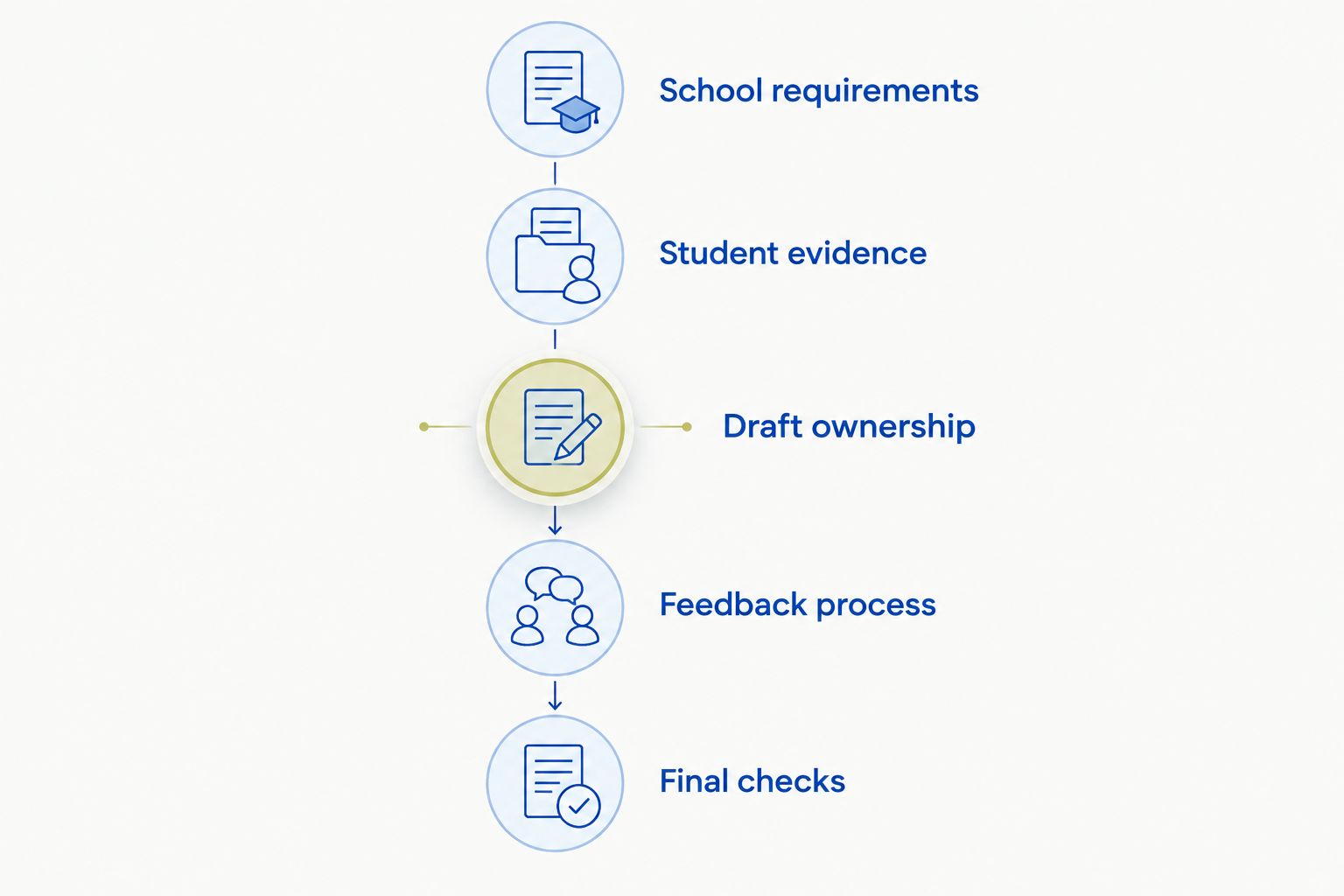
Request a walkthrough of how feedback works, rather than confidential examples from another student's application. Ask how the adviser handles an essay that is polished but does not answer the prompt.
A useful comparison exercise is to discuss 2 draft stages: an early version with unclear ideas and a later version that needs refinement. This is a consultation question, not a prescribed service entitlement. The answer shows whether the provider distinguishes developing an argument from editing sentences.
Both proposals need an academic plan, not an activity shopping list
Extracurricular advice should follow the student's interests and circumstances. Research, competitions, volunteering, employment, and independent projects are options—not universal requirements or automatic advantages.
Ask each adviser to explain why a recommended activity belongs in your student's plan. A recommendation should have a purpose the student understands, such as investigating an academic interest, developing a skill, or contributing to a community.
Use these tests:
- Relevance: does the activity connect to a genuine interest?
- Depth: can the student explain what they learned or contributed?
- Feasibility: does it fit alongside schoolwork and existing commitments?
- Ownership: would the student still value it without an application benefit?
Neither provider earns a planning win by recommending more activities. A focused plan that your student can sustain is the better purchase than an ambitious list without clear priorities.
The same standard applies to Ivy League counseling. Treat admission as a selective application goal, not a reason to turn every school year into a collection of credentials.
Scholarships and college costs need the same checks on both sides
Treat affordability planning as a separate decision criterion. University fit includes whether the family can fund the course under the institution's current rules.
For every university on your 2026 shortlist, check official information on tuition, living expenses, financial aid eligibility, scholarship requirements, and separate applications. International applicants should check the rules applicable to their citizenship and residency circumstances.
Ask each counseling provider which parts of this research it supports. Distinguish identifying opportunities from assessing eligibility and helping organize submissions. Do not assume that general admissions counseling includes detailed financial aid guidance.
Create 1 affordability checklist per university. Record the relevant official information and the date you checked it, then list questions that remain unresolved. This makes gaps visible before an application or enrollment decision.
There is no justified financial-aid winner based on a provider's name. The better proposal is the one that clearly assigns the work your family needs and explains its limits.
Pricing: compare charging structure and scope, not a headline
Do not infer either provider's pricing model from its positioning. Request a current written proposal that explains how the engagement is charged and what it covers.
If a proposal uses a fixed package, assess whether its boundaries match your university list and support needs. Fixed scope helps you understand what you are committing to, but work outside that scope needs separate clarification.
If a proposal uses hourly or otherwise variable billing, ask how your family tracks usage and approves additional work. Flexible scope accommodates changing needs, but you still need a clear method for managing the engagement.
These are contract structures to evaluate, not assertions about either provider's current terms. Compare:
- Universities and application routes covered.
- Meetings and communication arrangements.
- Essay and application review boundaries.
- Scholarship-related support.
- Changes to scope and additional work.
- Cancellation and refund terms stated in the agreement.
The better-value service is the one whose written scope matches the work your student needs. No price winner follows from branding alone.
Final verdict: choose the relationship that fits your application
Choose Ivy Central if you want named advisers across US and UK choices
Best for: families pursuing top-tier US and UK universities who want Caroline Linger and Jose Kumar working directly with their student.
This is the stronger fit when personalized strategy across both destinations is central to your brief. Confirm the school-specific application, essay, and affordability work included before committing.
Choose CollegeAdvisor if its counselor is the stronger US match
Best for: US-focused families whose consultation establishes that the proposed counselor and written scope better address their student's needs.
Choose it on that demonstrated fit. Do not assume destination coverage, review arrangements, or service inclusions that the proposal has not established.
| Dimension | Winner or decision rule |
|---|---|
| Combined US–UK brief | Ivy Central, based on its stated destination coverage |
| US-focused counselor fit | CollegeAdvisor if its proposed counselor fits better |
| Direct adviser relationship | Evaluate the named people doing the work |
| Application and essay process | No winner without reviewing the process |
| Academic and extracurricular planning | Choose the more relevant, feasible plan |
| Scholarships and college costs | Choose the clearer allocation of work |
| Pricing and contractual scope | Choose the scope that matches your needs |
Discuss your student’s admissions strategy
Bring your university shortlist and questions about US and UK application planning.
FAQ
Is Ivy Central better than CollegeAdvisor in 2026?
Ivy Central is the clearer fit for families seeking personalized US and UK counseling with Caroline Linger and Jose Kumar working directly with the student. Choose CollegeAdvisor if its proposed counselor and written scope better match your US application needs.
Which admissions counseling service should a US-only applicant choose?
A US-only applicant should choose the service with the better individual counselor fit and application scope. Meet the proposed adviser and ask how the plan addresses your student’s intended universities.
Who will work directly with my student?
Caroline Linger and Jose Kumar work directly with students in the client service described here. Ask CollegeAdvisor to identify the person responsible for your student’s strategy and substantive application feedback.
How should I compare essay support?
Compare the drafting and feedback process, not promises of a perfect essay. Your student should retain ownership of the writing, and the process should follow each institution’s current instructions.
How do I compare what the counseling services cost?
Request current written proposals and compare their charging structures and service boundaries. Check what happens when your university list or support needs change.
Can either provider guarantee Ivy League admission?
Do not treat counseling outcomes or marketing claims as a guarantee of Ivy League admission. Universities make admissions decisions; counseling supports preparation and application strategy.
What should international families ask about scholarships?
International families should ask which scholarship and financial aid research tasks are included. Verify eligibility and application requirements against each university’s current official information.
What should I bring to an admissions consultation?
Bring your student’s academic record, draft university list, and questions about affordability. Explain the intended application cycle and whether US universities, UK courses, or both are under consideration.
One last thing
Bring 3 documents to each consultation: your student's academic record, draft university list, and a page of unresolved decisions. Ask the adviser which decision needs attention first and why.
For your 2026 choice, that answer is more useful than a polished sales presentation. It shows whether the adviser understands your student and can turn a broad ambition into a practical next step.
Related guides
- Ivy League admissions for Indian students
- CollegeAdvisor alternatives
- Scholarships for Indian students studying in the US