
Best overall: Princeton University. Best for engineering: MIT. Best for a small liberal arts setting with no-loan aid: Bowdoin College. The best need-blind universities for international students 2026 combine admission without regard to financial need with aid that meets the institution’s calculation of demonstrated need.
- Princeton leads this best need-blind universities for international students 2026 guide for its grant-based aid and undergraduate focus.
- MIT is the strongest choice here for students seeking a technology-centered academic environment.
- Bowdoin and Amherst belong on your list if you prefer a small liberal arts college.
- Need-blind admission does not mean automatic admission, a full scholarship, or no family contribution.
Why this matters
Need-blind admission removes financial need from the admission decision; it does not remove financial assessment from the aid decision. A university can admit you without considering your ability to pay and still calculate a family contribution you cannot comfortably afford.
Before selecting colleges, separate academic fit, admission policy and financial-aid coverage. Ivy Central provides personalized college admissions counseling, with Caroline Linger and Jose Kumar working directly with each student on that planning.
This guide includes universities and liberal arts colleges because both offer undergraduate degrees. It ranks academic use cases, not admission probability: every institution below requires a competitive application.
What makes the best need-blind university?
Use these criteria before choosing names for your 2026 application list:
- International eligibility: The need-blind policy must explicitly cover international first-year applicants, not only domestic students.
- Full-need commitment: The institution must commit to meeting its calculation of demonstrated financial need for admitted students.
- Aid structure: Grants, loans and student employment are different funding arrangements. Read the award components separately.
- Academic fit: Compare curriculum, intended subjects, research opportunities and flexibility to change direction.
- Learning environment: Decide whether you want a research university, a technology-centered institution or a smaller liberal arts college.
- Financial documentation: Check required forms, supporting records and submission deadlines on the institution’s official aid pages.
Need-blind admission is not a scholarship category. For a separate funding route, explore scholarships for Indian students to study in the US.
Best need-blind institutions at a glance
These 8 institutions state that their undergraduate need-blind admission policies include international applicants and that they meet demonstrated financial need. The relevant sources are their official undergraduate admission and financial-aid pages; consult the requirements for your intended entry cycle before submitting documents.
| Institution | Best for | Standout feature | Key limitation |
|---|---|---|---|
| Princeton University | Grant-based aid at an undergraduate-focused research university | Financial aid meets demonstrated need through grants rather than loans | Princeton determines your financial need |
| MIT | Engineering and technology-centered study | Technical depth alongside need-based financial aid | The technical environment must fit your interests |
| Yale University | Humanities and interdisciplinary exploration | Broad liberal arts study within a research university | Academic breadth still requires purposeful course planning |
| Harvard University | Broad research-university opportunities | Extensive academic fields within Harvard College | You must actively seek out relevant opportunities |
| Brown University | Self-directed academic planning | Open Curriculum | Curriculum freedom requires independent planning |
| Dartmouth College | Undergraduate study with flexible academic scheduling | Dartmouth’s term-based D-Plan | Scheduling requires careful coordination |
| Amherst College | Small-college academic flexibility | Open curriculum and liberal arts focus | It is not a substitute for a dedicated engineering school |
| Bowdoin College | Small-college learning with no-loan aid | Grant-based aid without loans in its aid packages | Distribution requirements offer less curricular freedom than an open curriculum |
1. Princeton: best for grant-based aid and undergraduate focus
Princeton University is the default recommendation for students seeking a research university with a strong undergraduate focus and grant-based financial aid. Its aid policy meets demonstrated need without requiring loans in the financial-aid package.
Start with Princeton’s degree requirements and departmental offerings. Then review the official undergraduate financial-aid application instructions for international students; admission and aid require separate attention.
Princeton pros:
- Need-blind admission includes international applicants.
- Grants replace loans in the aid package.
- Undergraduate study includes substantial independent work.
Princeton cons:
- Full demonstrated need means Princeton’s assessment, not your preferred contribution.
- Independent work demands sustained academic initiative.
Best for: Students who want research-university resources and a demanding undergraduate academic structure.
2026 policy reference: Princeton Undergraduate Admission and Undergraduate Financial Aid, covering international undergraduate applicants.
Verdict: Apply to Princeton if both its academic structure and aid calculation fit your family.
2. MIT: best for engineering and technology-centered study
MIT belongs near the top of your list if engineering, computing or the physical sciences drive your academic interests. Its need-blind admission policy covers international undergraduates, and its financial-aid commitment meets demonstrated need.
MIT’s science-centered core matters as much as its departmental reputation. Review the General Institute Requirements before deciding that a particular major makes MIT the right match.
MIT pros:
- International applicants receive need-blind admission consideration.
- Engineering and scientific study sit at the center of the institution.
- Research connects naturally with technical coursework.
MIT cons:
- The required science foundation is not optional.
- MIT is a poor choice if you dislike a technology-centered academic environment.
Best for: Students who enjoy mathematical reasoning, scientific investigation and building things.
Policy reference: MIT Admissions and Student Financial Services, covering international undergraduate admission and need-based aid.
Verdict: Apply to MIT for academic fit, not simply because it offers need-blind admission.
3. Yale: best for humanities and interdisciplinary exploration
Yale University offers a broad liberal arts education within a research university. It is a strong choice for students who want to connect humanities, social sciences and other academic fields rather than choose a narrowly technical environment.
Read Yale College’s distributional requirements alongside your intended subjects. For 2026 planning, distinguish the admission policy from the expected family and student contributions in an individual aid award.
Yale pros:
- Need-blind admission applies regardless of citizenship.
- Need-based aid meets demonstrated financial need.
- Broad undergraduate study supports interdisciplinary interests.
Yale cons:
- Distributional requirements still shape your course choices.
- A full-need award does not necessarily eliminate student contributions.
Best for: Students seeking humanities depth with room to explore other disciplines.
Policy reference: Yale Undergraduate Admissions and Undergraduate Financial Aid, covering international applicants.
Verdict: Apply to Yale if academic breadth is central to your goals.
4. Harvard: best for broad research-university opportunities
Harvard University suits students who want extensive academic choices within a large research university. Harvard College’s need-blind admission policy includes international applicants, with need-based aid available regardless of citizenship.
Identify the undergraduate concentration and opportunities that matter to you. Access to a broad university does not mean every graduate-school course, laboratory or activity automatically becomes part of your undergraduate experience.
Harvard pros:
- International applicants receive need-blind consideration.
- Financial aid meets demonstrated need.
- Harvard College offers a wide range of academic concentrations.
Harvard cons:
- Academic breadth requires active selection rather than passive participation.
- A familiar university name does not establish personal academic fit.
Best for: Independent students who can explain how they would use a broad academic environment.
Policy reference: Harvard College Admissions and Financial Aid, covering international undergraduate applicants.
Verdict: Apply to Harvard when specific undergraduate opportunities justify the choice.
5. Brown: best for self-directed academic planning
Brown University’s Open Curriculum gives students substantial freedom to shape their studies without a prescribed set of general education distribution requirements. That freedom makes Brown distinctive for students with thoughtful, connected academic interests.
Brown includes international first-year applicants in its need-blind admission policy. For your 2026 application, check first-year and transfer policies separately rather than assuming the same eligibility rules apply.
Brown pros:
- Need-blind admission covers international first-year applicants.
- The Open Curriculum supports individualized academic exploration.
- Brown meets demonstrated financial need.
Brown cons:
- Curriculum freedom requires disciplined academic planning.
- First-year eligibility should not be treated as a blanket transfer policy.
Best for: Students who want responsibility for designing a coherent academic pathway.
Policy reference: Brown Undergraduate Admission and Financial Aid, covering international first-year applicants.
Verdict: Apply to Brown if you can explain what you would do with curricular freedom.
6. Dartmouth: best for flexible academic scheduling
Dartmouth College combines an undergraduate-centered environment with the D-Plan, its distinctive system of academic terms. Students interested in coordinating study with other experiences should examine how that schedule works for their intended program.
Dartmouth’s need-blind admission policy includes international applicants, and its aid commitment meets demonstrated need. Treat scheduling flexibility as a planning responsibility, not permission to ignore course sequencing.
Dartmouth pros:
- International applicants receive need-blind consideration.
- Undergraduate education is central to the institution.
- The D-Plan offers flexibility in arranging academic terms.
Dartmouth cons:
- Course sequences can constrain your preferred schedule.
- Term planning requires coordination with academic and personal commitments.
Best for: Students who value an undergraduate community and intentional academic scheduling.
Policy reference: Dartmouth Admissions and Financial Aid, covering international undergraduate applicants.
Verdict: Apply to Dartmouth if the D-Plan supports your goals rather than complicating them.
7. Amherst: best for small-college academic flexibility
Amherst College offers a liberal arts education with an open curriculum. It deserves consideration if you want a smaller undergraduate institution without a prescribed general education core.
Amherst is a college, not a research university with the same professional-school structure. Compare its actual majors with your intended pathway before treating it as interchangeable with MIT or Princeton.
Amherst pros:
- Need-blind admission includes international applicants.
- Financial aid meets demonstrated need without loans in the aid package.
- The open curriculum supports academic flexibility.
Amherst cons:
- Open curricular choice still requires a purposeful plan.
- Students seeking a conventional engineering degree need a different primary academic option.
Best for: Students seeking flexible liberal arts study in a smaller setting.
2026 policy reference: Amherst Admission and Financial Aid, covering international undergraduate applicants.
Verdict: Apply to Amherst if its liberal arts model matches your intended education.
8. Bowdoin: best for small-college learning with no-loan aid
Bowdoin College combines a liberal arts setting with need-blind admission for international applicants. Its financial-aid packages meet demonstrated need without loans.
Bowdoin is not an open-curriculum institution. Review its distribution and division requirements so you understand the breadth expected alongside your major.
Bowdoin pros:
- International applicants receive need-blind consideration.
- Aid packages do not include loans.
- The undergraduate liberal arts setting offers a clear alternative to a large university.
Bowdoin cons:
- Distribution requirements limit unrestricted course selection.
- Its academic offerings differ from those of a dedicated technical institution.
Best for: Students who want structured liberal arts breadth and grant-based aid.
Policy reference: Bowdoin Admissions and Student Aid, covering international undergraduate applicants.
Verdict: Apply to Bowdoin if structured breadth suits you better than an open curriculum.
How these institutions were ranked
The ranking prioritizes international need-blind eligibility, demonstrated-need coverage, aid structure and distinct academic use cases. Princeton is the default because its undergraduate focus and grant-based aid serve a broad applicant profile; MIT leads the technical pathway.
This is not an exhaustive directory or a ranking of admission chances. The 8 Ivy League universities do not share one international financial-aid policy, and several institutions in this guide are outside the Ivy League.
Which institution should you choose?
Choose Princeton as your starting point, then replace that default when another institution fits your academic needs better. MIT serves a different student from Brown; Amherst offers a different learning environment from Harvard.
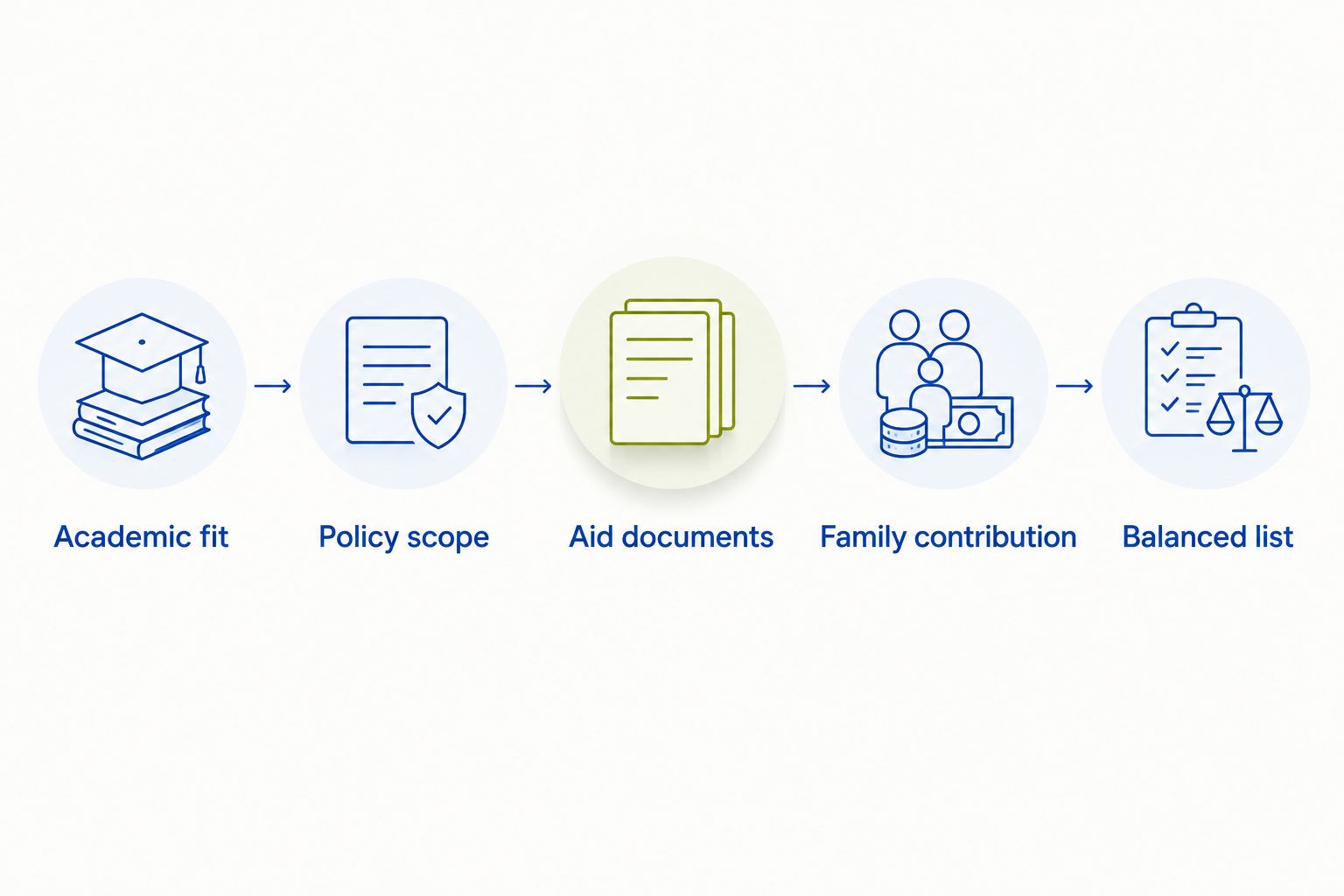
For your 2026 shortlist, work through this sequence:
- Academic fit: Check majors, required courses and the undergraduate learning environment.
- Policy scope: Confirm citizenship eligibility and first-year versus transfer rules.
- Aid documents: Record required forms and institution-specific deadlines.
- Family contribution: Review how income, assets and family circumstances enter the assessment.
- Balanced list: Include financially workable alternatives beyond these highly selective institutions.
Compare 4 budget categories: billed charges, travel, personal expenses and health-related requirements. Ask which categories the institution includes in its aid budget, rather than assuming every expense receives identical treatment.
Ivy Central’s college admissions counseling helps families connect these decisions with applications and essay planning. Caroline Linger and Jose Kumar work directly with each student; counseling does not guarantee admission or imply affiliation with a university.
Plan your college application strategy
Discuss academic fit, application priorities and financial-aid questions with Ivy Central.
FAQ
What are the best need-blind universities for international students in 2026?
Princeton is the default recommendation in this guide, while MIT is the strongest technical choice and Bowdoin offers a smaller liberal arts setting with no-loan aid. Yale, Harvard, Brown, Dartmouth and Amherst serve other distinct academic preferences.
Does need-blind admission mean a full scholarship?
No. Need-blind admission means financial need is not considered in the admission decision; financial aid depends on the institution’s assessment of demonstrated need.
Are all Ivy League universities need-blind for international students?
No. The Ivy League is an athletic conference, not a shared admissions or financial-aid policy. Check each university’s international undergraduate policy separately.
Is MIT better than Princeton for an international engineering applicant?
MIT is the more technology-centered choice, while Princeton offers engineering within a broader undergraduate-focused research university. Compare required coursework and departmental options before choosing.
Can an Indian student apply for need-based aid at these institutions?
Yes, Indian students can apply under the international eligibility policies covered in this guide. Submit the institution’s required financial documents and distinguish first-year rules from transfer rules.
Do no-loan aid packages mean my family pays nothing?
No. A no-loan package removes loans from the institution’s aid award, but an assessed family contribution or student contribution can remain.
Should I apply only to need-blind universities?
No. Include financially workable alternatives because need-blind admission does not make admission predictable. Assess need-aware institutions, scholarship routes and other affordable study options separately.
Can Ivy Central guarantee admission to a need-blind university?
No. Ivy Central provides personalized college admissions counseling, with Caroline Linger and Jose Kumar working directly with each student. Admission and financial-aid decisions remain with the institution.
One last thing
A need-aware college can be more affordable for an admitted student than a need-blind university. Admission treatment and the final aid award answer different questions.
Before accepting an offer, read the award components and renewal requirements. Your best 2026 choice is the institution where the academic pathway and your family’s actual financial obligation both work.
Related guides
- Ivy League admissions for Indian students
- Scholarships for international students at the Ivy League
- Summer research programs for high school students