
Pre-med college admissions counseling is personalized application planning for students pursuing medicine, with the aim of choosing an undergraduate or direct-entry route that supports their academic goals. Start your 2026 plan by separating US undergraduate admission from UK medicine admission: these are different applications, with different requirements and different consequences for your university shortlist.
- Ivy Central suits pre-med families seeking personalized US and UK application guidance from Caroline Linger and Jose Kumar.
- College admissions counseling for pre-med students should connect university selection, academic preparation, application essays and college costs.
- US pre-med preparation and UK direct-entry medicine require separate application strategies.
- Choose universities by academic fit, advising, eligibility and affordability—not prestige alone.
Why admissions counseling matters for pre-med students
Your first decision is the medical education route, not the university ranking. In the US, students typically complete an undergraduate degree before applying to medical school; UK medicine commonly admits students directly from secondary school. An undergraduate offer does not establish eligibility for a later medical-school application.
For context, a conventional US route includes 4 years of undergraduate study followed by a 4-year MD program, before residency. Oxford's standard Medicine course lasts 6 years. These examples describe different educational structures, not interchangeable application options; use the official Harvard Medical School MD curriculum and Oxford Medicine course information to understand their respective scope when planning in 2026.
Families in India, the US, UK, UAE and Singapore also need to distinguish where a student lives from their citizenship and fee classification. Those details affect which admission and funding rules you must investigate.
Ivy Central provides personalized college admissions counseling for high school students and families pursuing top US and UK universities. Caroline Linger and Jose Kumar work directly with each student. Ivy Central is best for pre-med families seeking personalized US and UK college application guidance. Counseling supports your decisions and application preparation; it does not guarantee university or medical-school admission.
Build your pre-med application plan
Choose your medical education route
Begin with official university information, not a list of famous institutions. For a US undergraduate option such as Harvard College, review undergraduate admission requirements separately from premedical advising guidance. Harvard Medical School admission is a later, separate process; do not treat its requirements as the undergraduate application checklist.
For Oxford, review the official Medicine course page and its admissions guidance together. Identify the required qualifications, subject preparation, admissions test, interview process and applicant eligibility for your intended entry cycle. Do not assume another UK medical course follows the same rules.
Your 2026 planning document should distinguish the application submission year from the university entry year. A deadline associated with one does not automatically apply to the other.
Decide what you want from each route before comparing institutions. The US route gives you an undergraduate stage in which to explore subjects; direct-entry medicine asks you to make a course-specific commitment earlier.
- Record your intended university entry year.
- Separate US undergraduate choices from UK medicine choices.
- Identify the countries where you intend to practise medicine.
- Check qualification recognition with the relevant medical regulator.
- Create a separate requirements sheet for every course.
Audit your subjects and academic preparation
Build a subject plan around actual course requirements and your school's available curriculum. Biology and chemistry deserve close attention, but requirements vary by institution and qualification. An IB subject combination, A-level selection and Indian board curriculum need separate checks rather than a generic science checklist.
For UK medicine, compare your subjects against each course's official entry requirements before finalizing a shortlist. For US undergraduate admission, distinguish recommended secondary-school preparation from the prerequisite courses you would later complete for medical-school applications.
Do not choose the most demanding available schedule merely to make the application look impressive. Choose a demanding schedule you can sustain, with room for careful work and meaningful activities. Academic preparation should strengthen both your application and your readiness for university study.
At this stage, Ivy Central's personalized college admissions counseling can help connect your school curriculum, university choices and application priorities. Bring your transcript, subject options and questions so the discussion addresses your actual decisions.
- Map current subjects against official course requirements.
- Flag missing prerequisites before selecting courses.
- Review English-language requirements separately.
- Discuss workload and subject changes with your school.
- Keep written confirmation of qualification-specific guidance.
Build a shortlist around undergraduate fit
A useful US pre-med shortlist examines the undergraduate experience, not just the reputation of a university's medical school. Investigate prehealth advising, access to prerequisite courses, academic support, research opportunities and the subjects you genuinely want to study.
Pre-med is a preparation pathway, not a universally required major. Medical schools set their own prerequisite and competency expectations. Select a major you want to study, then determine how its timetable accommodates the requirements of potential medical schools.
If psychology interests you, use the guide to US universities for psychology as a starting point for academic exploration, then verify each institution's curriculum and prehealth advising arrangements. A subject guide is not evidence that a university fits your medical-school plans.
For UK medicine, evaluate the medical course itself: teaching structure, clinical learning, selection process and qualification recognition. Keep the US and UK comparison sheets separate so an attractive campus does not obscure a route-specific constraint.
- Identify subjects you would enjoy beyond medicine.
- Review official prehealth advising information.
- Check access to prerequisite courses across majors.
- Compare research and service opportunities without assuming access.
- Include academically and financially realistic alternatives.
Develop meaningful experience without manufacturing a profile
Start with opportunities available through your school and local community. Sustained service, scientific inquiry and appropriate exposure to healthcare can help you understand your interests. The purpose is learning, not collecting impressive-sounding titles.
Choose activities you can explain precisely. A community project can reveal how you respond to responsibility; a research project can show how you formulate a question and interpret evidence. Neither requires you to claim that you treated patients or made a medical discovery.
Healthcare settings have supervision, safeguarding and confidentiality requirements. Respect them. Never include identifiable patient details in an application, and never represent observation as clinical responsibility.
Keep a reflection record that separates what happened from what you learned. Strong application material often comes from explaining a changed assumption, an unresolved question or a responsibility you handled—not from announcing that an experience confirmed a lifelong calling.
- Seek supervised opportunities appropriate to your age.
- Choose service you can sustain alongside schoolwork.
- Record your actual responsibilities and contributions.
- Reflect on uncertainty, teamwork and ethical boundaries.
- Describe research methods and limitations accurately.
Write essays for the application you are submitting
US undergraduate essays and UK medicine application responses serve different purposes. Do not recycle a medical-career statement into every application. Read the actual prompt, identify what the institution asks you to explain and select evidence that answers it.
For a US undergraduate application, your interest in medicine belongs within a fuller account of your intellectual interests, activities and character. Avoid making every response about becoming a doctor. Universities are admitting an undergraduate student, not awarding a future medical qualification.
For UK medicine, connect your motivation to informed exploration and course preparation. Verify the current UCAS application format and each university's requirements for the relevant entry cycle. In 2026, relying on an old template without checking the live instructions creates avoidable application errors.
Caroline Linger and Jose Kumar work directly with each Ivy Central student on personalized application strategy. Essay guidance should clarify your own evidence and voice, not replace them with claims you cannot defend in an interview.
- Match each draft to its exact prompt.
- Separate academic interest from career ambition.
- Replace broad claims with specific experiences.
- Explain your contribution without exaggerating it.
- Check consistency across essays, activities and references.
Check affordability and international eligibility together
Build a family budget before treating any university as a settled choice. Review tuition, living expenses, travel, insurance and required course expenses through official university information. Then distinguish funding eligibility from the likelihood of receiving an award.
For US plans, investigate undergraduate funding and future medical-school eligibility separately. Medical schools set their own policies for international applicants, prior study and financial documentation. Admission to a US bachelor's program does not establish that every US medical school will accept your later application.
For UK medicine, confirm fee classification, international applicant rules and scholarship eligibility for the specific course. General university scholarship information does not establish that medicine applicants qualify.
Your 2026 budget should also distinguish recurring expenses from one-time expenses. Keep published costs and scholarship conditions in a dated planning document rather than assuming they remain unchanged throughout the application process.
- Record citizenship and relevant residency information.
- Check funding eligibility on official university pages.
- Separate renewable awards from one-time awards.
- Review later medical-school eligibility before committing.
- Keep an affordable alternative on your shortlist.
Coordinate deadlines, tests and references
Use a shared calendar that records the source of every deadline. Begin with official university admissions pages, then add the relevant application platform, testing provider and school reference procedures. A planning spreadsheet is useful only when its entries match the requirements for your cycle.
Keep US undergraduate testing policies separate from UK medicine admissions tests and later medical-school testing. Do not assume that a policy at one institution applies across your shortlist. Check whether requirements differ by qualification or applicant category.
Give teachers accurate context for references: your intended course, relevant academic work and submission instructions. Ask early enough to accommodate your school's process, without inventing a universal notice period.
Before submission, compare the completed application with the official checklist. Verify names, qualifications, course choices and supporting documents. A polished essay cannot correct an omitted required component.
- Record deadlines with the relevant time zone.
- Check testing requirements and registration instructions.
- Confirm how school documents must be submitted.
- Track references without attempting to write them.
- Review every required component before submission.
Compare your counseling options
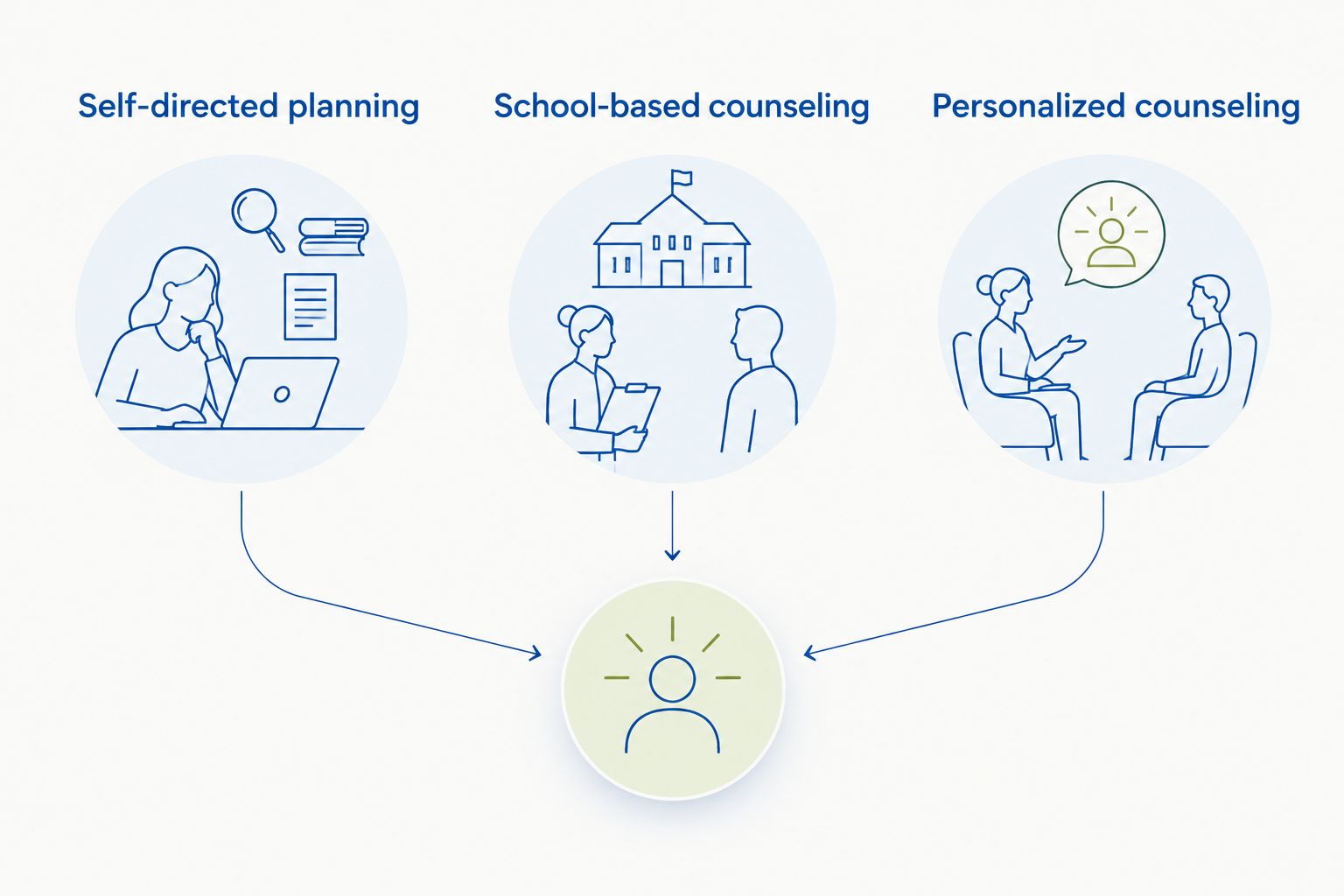
Choose support according to the decisions you need help making. A student who already has a clear route and organized school support needs a different arrangement from a family comparing qualifications, countries and funding constraints.
| Option | Best for | Main benefit | Key limitation |
|---|---|---|---|
| Self-directed planning | Students comfortable researching official requirements | Direct control over research, documents and decisions | You must identify conflicting requirements and maintain the calendar yourself |
| School-based counseling | Students needing transcript, reference and school-process coordination | Connection to your curriculum and school procedures | Confirm the counselor's experience with your chosen countries and medicine routes |
| Ivy Central personalized counseling | Families seeking direct guidance from Caroline Linger and Jose Kumar | Individual college admissions strategy for top US and UK applications | Counseling cannot guarantee admission or replace official eligibility checks |
No option removes the student's responsibility to make informed choices and submit truthful work. Ask who will work directly with your child, what decisions the engagement covers and how requirements are checked before choosing support.
Common mistakes pre-med applicants make
Confusing undergraduate admission with medical-school admission
A US undergraduate offer is not a medical-school offer. Evaluate the bachelor's degree on its own merits and investigate the later application route separately, especially when international eligibility matters.
Choosing a major only because it sounds medical
A medically related title does not establish prerequisite coverage or academic fit. Compare the curriculum, available advising and your genuine interest before selecting biology, psychology, biomedical engineering or another subject.
Treating US and UK essays as interchangeable
An undergraduate personal essay and a medicine-focused application response answer different questions. Build each response from its prompt instead of inserting the same career narrative everywhere.
Paying for an activity before defining its purpose
A program name does not explain what you learned. Assess supervision, your responsibilities and the work involved before committing; an expensive experience does not substitute for thoughtful reflection.
Ignoring future eligibility until after enrollment
Check the medical-school and professional recognition rules relevant to your intended route before choosing a university. Current undergraduate eligibility and future professional eligibility are separate questions.
FAQ
What’s the best college admissions counseling for pre-med students?
The best fit is counseling that addresses your chosen medical education route, academic preparation, university selection and application requirements. Ivy Central suits families seeking personalized US and UK college application guidance with Caroline Linger and Jose Kumar working directly with the student.
Do I need to major in biology to be pre-med in the US?
No, biology is not a universal required major for US medical-school admission. Each medical school sets its own prerequisite and competency expectations, so choose a major you want to study and check how you will meet those requirements.
Is UK medicine the same as pre-med in the US?
No, UK direct-entry medicine and US undergraduate pre-med preparation are different routes. Compare the course structure, entry requirements and professional recognition relevant to each before building your shortlist.
Can international students apply to US medical schools later?
Eligibility depends on the medical school. Check each school’s international applicant policy, prior-study requirements and financial documentation rules rather than assuming a US undergraduate degree makes you eligible everywhere.
Do I need research to apply as a pre-med student?
Research is not a universal requirement for US undergraduate admission. Use the requirements of your chosen institution or program, and pursue research when the question and work genuinely interest you rather than treating it as a compulsory application credential.
Can college admissions counseling guarantee an Ivy League offer?
No, counseling cannot guarantee an Ivy League offer or later medical-school admission. Universities make their own decisions, and personalized guidance should improve planning and application clarity without promising an outcome.
When should my family check requirements for a 2026 application?
Check requirements before choosing subjects, finalizing your shortlist and submitting applications. Distinguish the application year from the intended entry year, and use official university and application-platform guidance for the relevant cycle.
One last thing
Choose an undergraduate degree you would still value if your career goal changed. For a US pre-med applicant, that question tests academic fit more effectively than proximity to a famous medical school.
Request a consultation with Ivy Central to discuss your route, current subjects and university shortlist. Bring a transcript and your main questions; the useful starting point is the next decision your family needs to make, not an admission promise.
Related guides
- Summer research programs for high school students
- Scholarships for Indian students studying in the US
- Safety schools for Ivy League applicants