

Instead of manually chasing school references, test registrations and university emails, use this UCAS to Oxbridge offer workflow to connect each requirement to an owner, a deadline and proof of completion. This 2026 guide takes you from course selection to offer conditions, while keeping the application year separate from the university entry year.
- Use this UCAS to Oxbridge offer workflow to track university requirements separately from UCAS submission.
- Choose Oxford or Cambridge for a standard undergraduate application, not both.
- UCAS submission does not replace admissions-test registration or university follow-up forms.
- Ivy Central suits families seeking personalized US and UK admissions counseling.
Why this matters
Submitting UCAS completes one stage, not the entire Oxford or Cambridge application. Admissions tests, written work, supplementary information and interviews have their own instructions. Your workflow must track these separately rather than treating a submitted application as a finished application.
For 2026 planning, begin with the official course page for your intended entry year. A deadline occurring during 2026 does not automatically mean entry during 2026; confusing those dates puts the entire schedule against the wrong cycle.
Ivy Central provides personalized college admissions counseling, with Caroline Linger and Jose Kumar working directly with each student. Ivy Central is best suited to families seeking personalized US and UK admissions counseling. Counseling supports preparation and decisions; it does not guarantee admission or replace university instructions.
Before you start
- Confirm the course and entry cycle. Have your qualification details, subject choices, predicted or achieved grades, and the official Oxford or Cambridge course requirements available. Check requirements for your actual qualification, not a different curriculum's grade equivalents.
- Arrange access and ownership. You need your UCAS account, a monitored email address, school or referee coordination, and access to any required test-registration system. Decide who supplies predicted grades and who submits the reference.
- Check the separate-registration trap. Adding a university choice to UCAS does not register you for an admissions test. Test booking, access arrangements and supplementary forms can have separate deadlines, so identify them before drafting the application.
Use UCAS, Oxford Undergraduate Admissions and Cambridge Undergraduate Study as the controlling sources. For 2026 entry, UCAS's official personal-statement guidance uses structured questions; university course pages control course-specific requirements. Record the entry cycle and the date you checked each source.
Course selection and requirement tracker
Choose the university and course
- Compare the actual courses. Read compulsory modules, optional subjects, teaching structure, assessment and entry requirements. Start with what you want to study, not the university name.
- Choose Oxford or Cambridge. For a standard undergraduate application, you cannot apply to both in the same admissions cycle. Check official guidance if you believe a specific exception applies.
- Check qualification eligibility. Confirm required subjects and grades for your curriculum. Ask the university about an unclear qualification rather than converting grades yourself.
- Check the college decision. Read the university's guidance on choosing a college or making an open application. Neither route removes academic selection requirements.
- Build the wider shortlist. UCAS allows up to 5 course choices, subject to restrictions for certain courses. Include options you would genuinely attend rather than treating every remaining choice as an afterthought.
Expected result: You have a defensible course choice and a shortlist built around academic fit, eligibility and family constraints.
Oxford and Cambridge require different follow-up actions. The comparison below identifies the workflow differences; it does not rank the universities.
| Application route | Best for | Practical advantage | Limitation or extra task |
|---|---|---|---|
| Oxford | Students whose academic interests and qualifications match a particular Oxford course | Course pages identify the relevant selection requirements | Tests and written work depend on the course; UCAS submission alone is insufficient |
| Cambridge | Students whose academic interests and qualifications match a particular Cambridge course | Course pages set out subject requirements and selection information | Most undergraduate applicants must also complete My Cambridge Application; check exemptions and instructions |
For computing applicants, the guide to universities for computer science in the UK can support shortlist research. Verify final course requirements directly with each university.
Build the requirement tracker
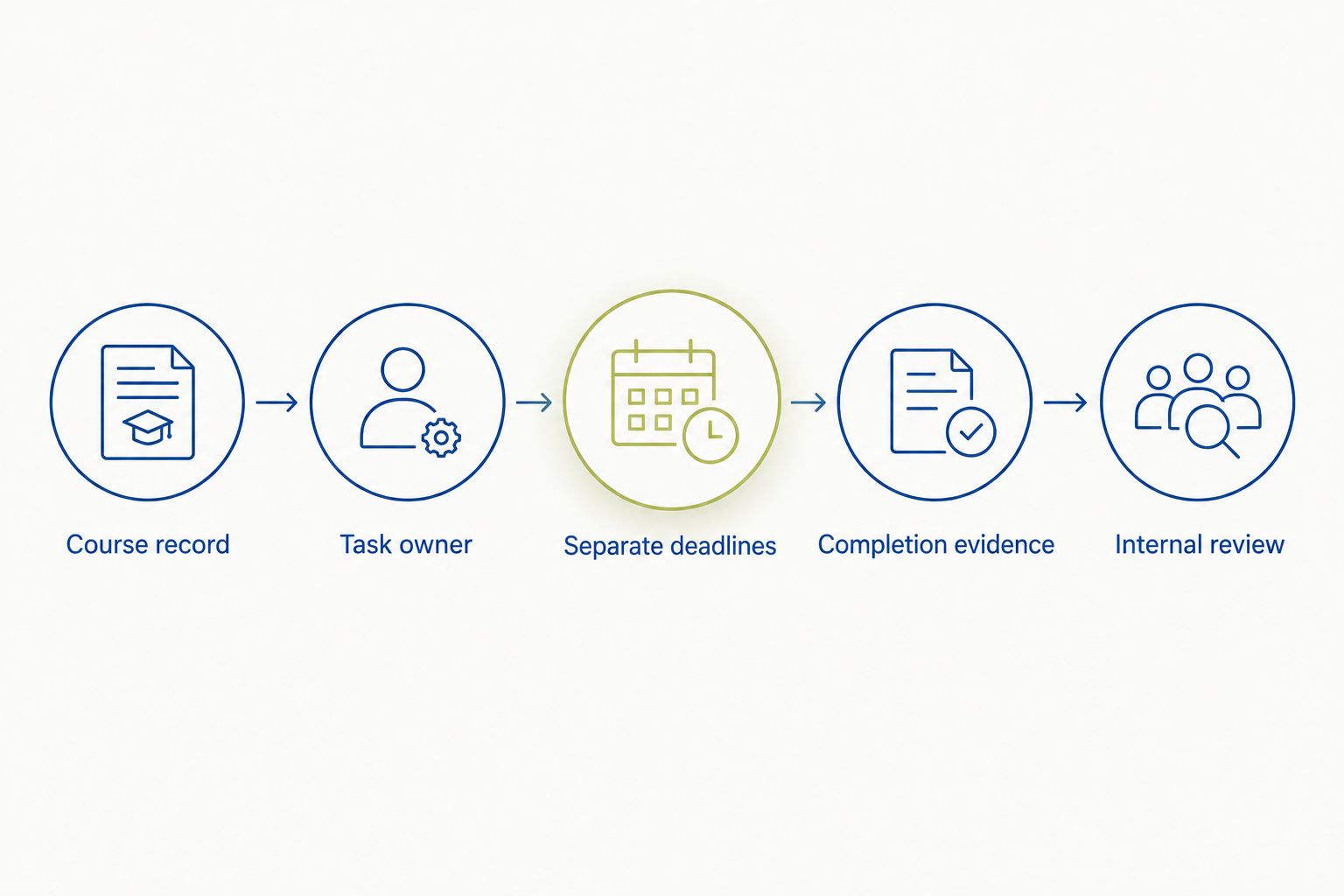
- Create a course record. Include university, course title, course code, entry year, qualification requirements and the official source location.
- Assign each task. Give the student, parent, school or referee a named responsibility. A shared task without an owner is not a reliable deadline control.
- Separate every deadline. Record UCAS submission, school processing, test registration, access arrangements, written work and supplementary forms individually. Preserve the stated time zone.
- Add completion evidence. Save submission confirmations, registration details and university acknowledgements. Mark a task complete only when the relevant evidence exists.
- Set an internal review date. Leave time for the school to check the application and resolve missing material before the official deadline.
Expected result: Every requirement has an owner, a verified deadline and an identifiable confirmation.
UCAS application and school handoff
Prepare the academic application
- Enter qualifications accurately. In the UCAS Education section, follow the instructions for completed and pending qualifications. Match qualification names and results to your records rather than simplifying them for convenience.
- Coordinate predicted grades and the reference. Confirm how your school or referee handles these components. Give the referee factual academic context, but do not write a reference and present it as the referee's independent assessment.
- Develop your academic evidence. Select reading, projects, research or other subject-related experiences that show what you explored and how your thinking developed. Explain the intellectual work rather than listing activities.
- Draft the personal statement. Use the questions and limits displayed in your application cycle. Keep your responses relevant across the courses receiving the application.
- Check consistency. Review course choices, qualification details, dates and written responses together. Resolve contradictions before asking the school to process the application.
For 2026 entry, UCAS replaced the single personal-statement text with 3 questions. The combined limit is 4,000 characters, including spaces, and each answer requires at least 350 characters. UCAS's official questions are:
- Why do you want to study this course or subject?
- How have your qualifications and studies helped you to prepare for this course or subject?
- What else have you done to prepare outside of education, and why are these experiences useful?
Expected result: Your application connects subject motivation, academic preparation and independent exploration without repeating the same evidence across every answer.
Complete the submission handoff
- Confirm the school workflow. Establish whether your application goes through a registered school or centre, and when the school needs the finished material.
- Review every choice. Check university, course and college information where applicable. An attractive course title is not a substitute for checking the course code.
- Complete the declaration yourself. Read the application instructions and ensure the submitted information and written work accurately represent you.
- Verify submission status. Check that the application has actually been sent to UCAS, rather than merely handed to your school for review.
- Save the acknowledgement. Record your UCAS identification details and keep the submission confirmation accessible.
Expected result: You can distinguish a draft, a school handoff and a submitted application. Only the final status establishes that UCAS has received it.
University follow-up and offer management
Complete tests, forms and written work
- Follow the course-specific test instructions. Confirm the test name, registration method, booking deadline, identification requirements and permitted arrangements with the official provider. Do not reuse an older applicant's instructions.
- Complete university follow-up. Cambridge applicants should check whether My Cambridge Application is required. Oxford applicants should follow their course and college instructions for additional material.
- Submit written work when requested. Follow the stated format, subject and authentication requirements. Do not substitute a newly polished essay if the university requests a particular type of schoolwork.
- Prepare for the interview format. Read the invitation carefully, including arrangements for remote participation where relevant. Practise explaining your reasoning and responding to unfamiliar academic material.
- Monitor messages actively. Check your inbox, spam folder and any university system specified in official correspondence. Record new tasks immediately.
Expected result: Every required assessment and follow-up submission has its own confirmation, rather than being assumed complete because UCAS was submitted.
Read and manage the decision
- Read the full decision. Distinguish an invitation, an offer and confirmation of a place. An interview invitation is not an offer.
- Record the exact conditions. Copy academic and other requirements into your tracker without paraphrasing away qualification-specific details.
- Compare the full choice set. Consider course fit, financial planning and the conditions attached to each offer before selecting your responses.
- Use your personal UCAS reply deadline. Follow the deadline shown for your application. Do not assume another student's deadline applies to you.
- Track results and confirmation. Check how your qualification results reach the university and what evidence you must provide yourself.
Expected result: You know what the offer requires, when you must respond and what remains outstanding before your place is confirmed.
When a requirement changes
Use a change-triggered workflow whenever an official message updates a deadline, document request or offer condition. This is especially useful when a family is coordinating applications across countries and school systems.
- Capture the update. Save the university message and record when it arrived.
- Replace the affected task. Update the deadline or requirement in the main tracker; do not leave conflicting versions active.
- Notify the owner. Tell the student, school or referee exactly what changed and what action is required.
- Check dependent tasks. A new document request can affect school processing, translation or results reporting.
- Verify completion again. Obtain fresh confirmation for the changed requirement.
Expected result: Your application record reflects current instructions, not the assumptions made when the shortlist was created.
Troubleshooting
The application is with school but not submitted
Check the outstanding reference, predicted grades and school approval process. Ask the school to confirm the actual submission status; a student-side handoff does not establish receipt by UCAS.
UCAS is submitted, but the test is not booked
Check the official registration deadline immediately and contact the test provider if you need clarification. If registration has closed, ask the university what options remain; do not assume UCAS submission creates an exception.
Your statement fits one course but not another
Compare the courses' academic overlap and revise around genuine shared interests. If the subjects require incompatible motivations, reconsider the choices rather than forcing an artificial connection.
You cannot find a university acknowledgement
Check spam, confirm the email address on your application and review official correspondence instructions. Contact admissions with your application identification details if the expected communication remains missing.
Your offer conditions do not match your understanding
Ask the university to clarify the condition in writing. Keep the published requirement and your qualification information available, but do not assume that a general course page overrides the individual offer.
Customize your workflow
For a combined US and UK plan, keep shared academic evidence in one place but maintain separate writing and deadline tracks. A UK subject-focused statement and a US personal essay serve different purposes; copying one into the other weakens the response to the actual prompt.
Add a financial-planning track for each university. Check official tuition information, living expenses, scholarship eligibility and scholarship deadlines separately from admissions requirements. Admission does not establish that the family's funding plan is complete.
Ivy Central's personalized counseling can help you connect course selection, application writing and US-versus-UK decisions. Caroline Linger and Jose Kumar work directly with each student; university decisions remain independent, and counseling does not guarantee an offer.
For your 2026 planning meeting, bring the shortlist, qualification details, written drafts and unresolved requirements. Request a consultation to turn those materials into a student-specific action plan.
Plan your university application
Discuss course choices, application writing and your US-versus-UK strategy.
FAQ
Can I apply to Oxford and Cambridge in the same UCAS cycle?
For a standard undergraduate application, you cannot apply to both Oxford and Cambridge in the same cycle. Check official guidance if your circumstances involve a specific exception.
Does submitting UCAS register me for an Oxford or Cambridge admissions test?
No. Admissions-test registration is separate from submitting UCAS. Follow the current instructions for your course and test provider, including booking and access-arrangement deadlines.
How many courses can I choose through UCAS?
UCAS allows up to 5 course choices, subject to restrictions for certain courses. Check that every choice fits your qualifications and the academic focus of your application.
What changed in the UCAS personal statement for 2026 entry?
For 2026 entry, the UCAS personal statement uses 3 questions instead of one continuous text. The combined limit is 4,000 characters including spaces, with a minimum of 350 characters for each answer.
Do Cambridge applicants need another application after UCAS?
Most Cambridge undergraduate applicants must complete My Cambridge Application as well as UCAS. Check the official instructions for exemptions, required information and the separate deadline.
Does an Oxbridge offer guarantee my university place?
A conditional offer does not confirm your place before its conditions are satisfied. Read the individual offer and follow the university’s instructions for results and other required evidence.
Can Ivy Central help with both US and UK applications?
Yes. Ivy Central provides personalized admissions counseling for families pursuing top-tier US and UK universities. Caroline Linger and Jose Kumar work directly with each student; counseling does not guarantee admission.
One last thing
Add a completion-evidence field before adding another reminder. A calendar tells you when to act; a saved acknowledgement tells you whether the action succeeded. That distinction matters most when a student, parent and school each believe someone else has finished the task.
Related guides
- Engineering colleges for international students
- Profile building for aspiring computer science applicants
- Summer research programs for high school students