

Choose Ivy Central if you want Caroline Linger and Jose Kumar working directly with your student on selective US and UK applications; choose AdmissionSight if its written proposal better matches your student’s specific application needs, counselor expectations and budget. For 2026, make this decision around the work your student needs—not the admissions outcomes either family hopes to achieve.
- Ivy Central vs AdmissionSight: choose by counselor access, application scope and written commitments—not promises of admission.
- Ivy Central offers personalized college admissions counseling for families pursuing selective US and UK universities.
- Caroline Linger and Jose Kumar work directly with each Ivy Central student.
- Choose AdmissionSight when its written proposal better meets your student’s defined requirements.
Why this matters
Ivy Central is best for families seeking personalized US and UK college admissions counseling with direct involvement from Caroline Linger and Jose Kumar. That is a specific reason to consider the service, not a prediction of admission.
Start with the student’s actual university shortlist. A family considering Harvard and Oxford needs different application planning from a student considering only US universities. Subject choices, essays, academic evidence and institution-specific requirements should determine the counseling scope.
Explore Ivy Central with that shortlist in hand. Ask how the proposed work connects to each university, who provides the guidance and which responsibilities remain with the student.
For your 2026 applications, use official university admissions pages as the authority on requirements. Counseling should help you interpret and meet those requirements; it does not replace them.
At a glance
| Dimension | Ivy Central | AdmissionSight |
|---|---|---|
| Best for | Families seeking personalized counseling for selective US and UK admission | Families whose requirements are better met by its written proposal |
| Standout feature | Direct student involvement from Caroline Linger and Jose Kumar | Evaluate the specific differentiator demonstrated in your consultation |
| US-versus-UK planning | US and UK university counseling is part of the stated service focus | Request a plan covering every country on your shortlist |
| Application and essay guidance | Personalized college admissions strategy; confirm the exact deliverables | Confirm the exact application and essay deliverables |
| University-specific fit | Assess the proposed strategy against each intended university and course | Apply the same university-by-university assessment |
| Scholarships and costs | Request institution-specific affordability planning | Request institution-specific affordability planning |
| Pricing model | Obtain written scope, payment structure and exclusions | Obtain written scope, payment structure and exclusions |
| Outcome evidence | Separate reported offers from admission guarantees | Apply the same standard to reported outcomes |
The table distinguishes an established service fit from questions your consultation must resolve. Do not turn an unanswered question into a claimed advantage for either provider.
Direct counselor involvement favors a named-adviser relationship
Ivy Central’s college admissions counseling includes direct work with Caroline Linger and Jose Kumar. For families who prioritize knowing the people guiding their student, that is a clear selection criterion.
Direct involvement still needs a practical definition. Ask who leads strategy discussions, who reviews application material and how feedback reaches the student. A named relationship is most useful when the family understands how it operates throughout the engagement.
Use the same questions with AdmissionSight. Ask for the adviser’s identity, relevant experience and responsibilities before you commit. Do not assume that a company’s most visible expert is necessarily the person assigned to your student.
Best for: families who want continuity with identifiable advisers. The tradeoff is straightforward: a personal relationship only solves your problem when the working arrangement also matches your communication needs and deadlines.
US-and-UK applicants have a clear service match
Ivy Central explicitly serves students seeking admission to top-tier US and UK universities. That makes it a relevant option when your family has not yet decided between the two systems, or intends to apply across both.
Keep the applications distinct. For a US university, check its official requirements for the application route, essays, recommendations and testing. For a UK course, check the official course page for academic prerequisites and any required assessments or interviews.
For 2026, build a separate requirements record for each institution rather than copying a previous applicant’s checklist. Current official instructions take priority over advice from forums, older articles or another family’s experience.
Ask AdmissionSight to demonstrate how its proposed service addresses your complete shortlist. If your student is applying only in the US, evaluate the US-specific work rather than paying attention to international breadth you will not use.
Best for: students keeping both US and UK options open. The limitation is that geographic coverage alone does not establish expertise in every course or institution; the consultation must connect the service to your actual choices.
Application and essay support needs a scope-based verdict
Neither a service label nor a persuasive consultation tells you exactly what essay support includes. You need a written description of the work.
Ask both providers to explain whether the engagement covers brainstorming, application planning, draft feedback, university supplements and final checks. Establish who reviews each component and how the student uses that feedback.
Good essay guidance should help the student express their own experiences and reasoning. The student must remain the author. Support that replaces the student’s voice is not a sound reason to choose a provider.
Bring an existing piece of writing to the consultation if you have one. Ask the adviser to describe the problems they would address—not to promise that a particular essay will produce an offer.
Best for: students who need structured feedback and a clear revision process. AdmissionSight earns the preference here if its written scope better addresses those needs; a broad strategy description should not outweigh a more suitable, clearly defined engagement.
University-specific planning is a tie until the proposals separate
Both providers should face the same test: can the proposed work explain why each university and course belongs on your student’s list?
A useful plan connects academic interests, preparation, learning preferences and affordability. Prestige alone is not a sufficient explanation. Nor is a list of universities that would be attractive to almost any high-achieving applicant.
For each intended institution, ask:
- Which official requirements govern this application?
- What evidence does the student already have of academic readiness?
- Which application components need the most attention?
- What makes the course a fit beyond its reputation?
- Which alternative institutions meet the same academic goals?
Treat this dimension as a tie until you see a meaningful difference in the proposed work. A provider wins on school-list strategy by presenting a better student-specific rationale, not by naming more selective institutions.
Best for: families whose current shortlist is driven mainly by rankings and needs a clearer academic foundation.
Scholarships and college costs deserve equal scrutiny
An admission offer and an affordable university choice are different outcomes. Your counseling discussion should address both.
Ask each provider how affordability enters the shortlist. Separate university financial aid, merit scholarships and outside funding opportunities rather than treating them as interchangeable. Eligibility and application requirements belong to the institution or scholarship provider, not the counselor.
For international families in India, the UAE or Singapore, confirm the rules applicable to the student’s circumstances. Families in the US and UK should do the same. Residence, citizenship and applicant classification are questions to resolve through official guidance, not assumptions based on where the family currently lives.
For 2026 planning, record the official source and date checked alongside each funding requirement. That makes later changes easier to identify.
Best for: families who need affordability to influence the shortlist from the start. Neither provider earns an automatic win; prefer the proposal that makes cost assessment a defined part of the work rather than a conversation postponed until offers arrive.
Compare pricing models through scope, not headline amounts
Request a written proposal from both providers. Compare the payment structure alongside the deliverables, duration, exclusions and terms for additional work.
Do not assume either provider uses a particular pricing model. Instead, establish whether the proposal covers an agreed engagement, individual services or another arrangement, and how the scope changes when your application needs change.
An agreed scope gives you a clearer boundary around the work. Separately commissioned services let you evaluate individual tasks, but you still need to understand how those tasks connect. These are contractual tradeoffs to inspect, not established descriptions of either company’s offering.
Use the same comparison headings:
- Included work: strategy, applications, essays and other specifically named deliverables.
- Counselor access: who works with the student and how communication operates.
- Scope changes: what happens if the shortlist or application needs change.
- Payment terms: the schedule and obligations stated in the agreement.
- Exclusions: responsibilities that remain outside the service.
Best for: families choosing between proposals that initially appear similar. A clearer agreement can matter more than a longer list of loosely described services.
Neither provider should be chosen on an admission promise
Selective university admission is decided by the university. Counseling does not create an entitlement to an offer, and choosing an adviser does not establish affiliation with an institution or the Ivy League.
Evaluate reported outcomes carefully. Offers, students admitted and enrollment decisions measure different things. A student receiving multiple offers should not automatically be interpreted as multiple separate student success stories.
Ask what population an outcome statement covers, which application period it describes and how the result was counted. Then return to the question that affects your family: what work will this provider perform for this student?
This is an honest tie: neither provider should receive preference merely because a headline outcome sounds more impressive. Relevant evidence can inform your decision, but it cannot guarantee your student’s result.
Best for: families comparing achievement-oriented counseling claims and wanting a decision grounded in the proposed service.
Use the same consultation brief with both providers
A fair 2026 comparison starts with identical information. Otherwise, you risk comparing answers to different problems.
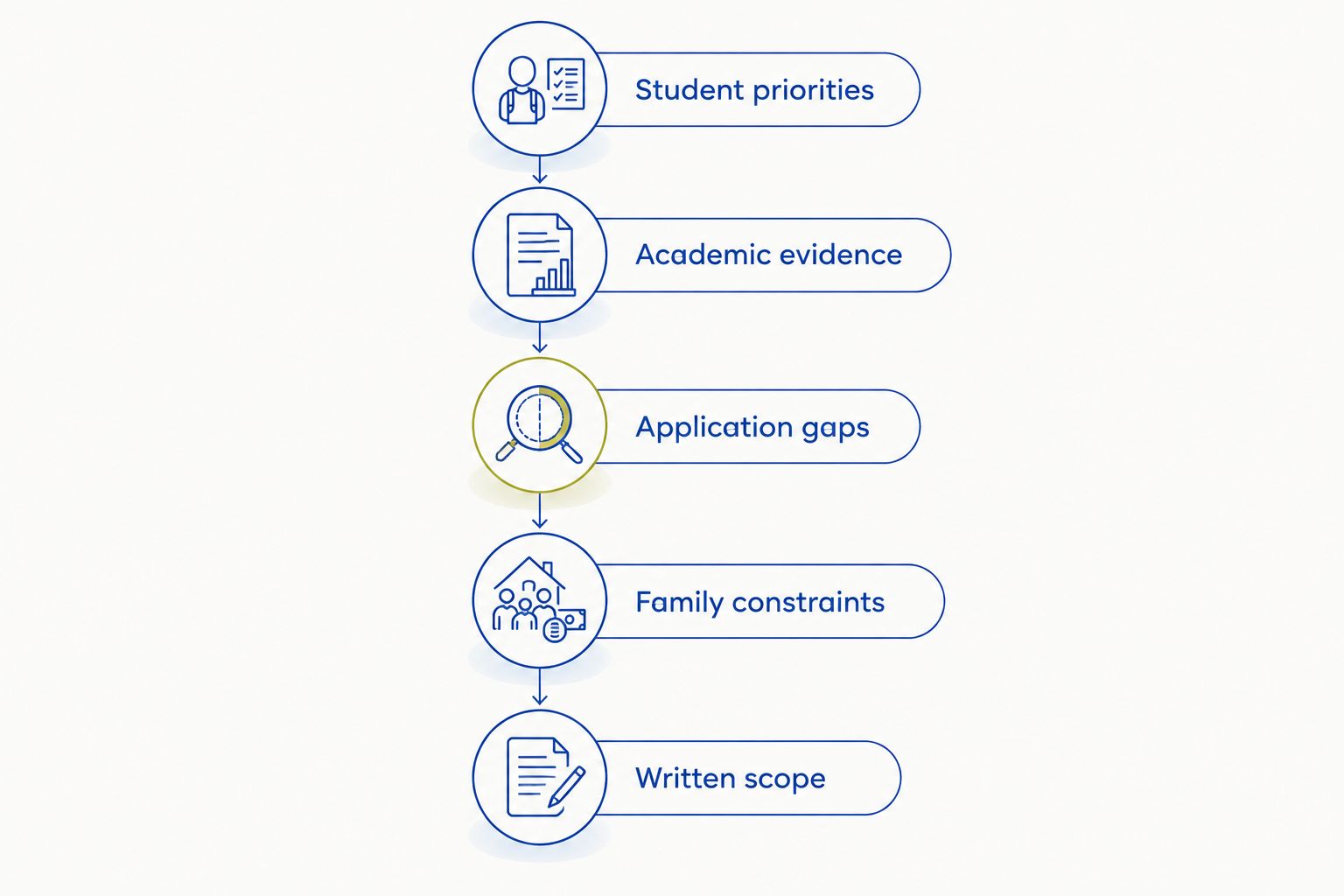
Build your brief around these headings:
- Student priorities: intended subjects, preferred countries and university interests.
- Academic evidence: current courses, results and relevant work.
- Application gaps: the tasks the student cannot yet manage confidently.
- Family constraints: affordability, communication needs and scheduling considerations.
- Written scope: the work you want the provider to define before you decide.
Send the brief before each consultation. Ask each adviser to explain priorities in relation to the student, rather than simply presenting the full range of services.
Afterward, write down the clearest recommendation, the unresolved questions and the promised deliverables. A useful consultation should leave you with a better understanding of the application work, even before you choose a provider.
To discuss personalized planning with Caroline Linger and Jose Kumar, request a consultation through the website. Bring your intended universities and current questions so the conversation starts with your student’s needs.
Discuss your university application plan
Bring your shortlist and questions about personalized US and UK admissions counseling.
Final verdict: choose the better-defined student fit
Choose Ivy Central if you want named advisers and US–UK planning
Best for: an academically ambitious student considering selective universities across the US and UK, with a family that values direct work with Caroline Linger and Jose Kumar.
The service matches that profile explicitly. Before committing, confirm the application deliverables, communication arrangement and affordability discussion in your written scope. Personalized counseling is the starting point; the agreement should explain how it applies to your student.
Choose AdmissionSight if its proposal better solves your application gaps
Best for: a student with clearly defined counseling needs whose AdmissionSight proposal provides a better match on assigned adviser, application work and engagement terms.
Choose AdmissionSight when that difference is concrete. For example, a proposal that clearly addresses your student’s required essay work is more useful than one whose essay responsibilities remain unclear. This is a decision rule, not a claim about either provider’s standard package.
| Dimension | Winner |
|---|---|
| Named-adviser preference | The direct Caroline Linger and Jose Kumar relationship fits this requirement |
| US-and-UK service match | The explicitly stated US-and-UK counseling service |
| Application and essay scope | The proposal that defines the student’s required work better |
| University-specific fit | Tie until the proposed strategies demonstrate a difference |
| Scholarships and costs | The proposal that includes clearer affordability planning |
| Pricing model | The agreement with the better-fitting scope and terms |
| Admission guarantees | Neither; the university makes the decision |
FAQ
Is Ivy Central better than AdmissionSight for my child?
Ivy Central is a clear fit when your family wants personalized US and UK admissions counseling with direct involvement from Caroline Linger and Jose Kumar. Choose AdmissionSight instead if its written proposal better meets your student’s specific counseling requirements.
Who works directly with students at Ivy Central?
Caroline Linger and Jose Kumar work directly with each student. Ask how strategy discussions, feedback and application responsibilities will operate within your engagement.
Which counselor should I choose for US and UK applications?
Choose a counselor whose written scope addresses both application systems and your intended universities. Check each institution’s current official requirements rather than assuming the same application approach works everywhere.
What should I ask AdmissionSight before signing?
Ask who will advise your student, what work is included and how the engagement handles changes in application needs. Request those commitments in writing so you can compare them with another proposal.
How do I compare counseling fees without comparing unlike services?
Compare the scope and payment terms together. Check adviser access, application deliverables, exclusions and the terms for additional work before deciding which agreement fits your family.
Can an admissions counselor guarantee an Ivy League offer?
No admissions counselor can make the university’s admission decision for your student. Reported counseling outcomes are not a guarantee of an individual offer or evidence of university affiliation.
What should international families check for 2026 applications?
International families should verify institution-specific academic requirements, application instructions and funding eligibility through official sources. Ask the counselor to explain how those requirements affect the student’s shortlist and preparation.
One last thing
Ask each provider to name the most important application problem your student needs to solve—and explain why. A specific answer tied to the student’s record gives you a better basis for choosing than another discussion of prestigious university names.
Then check whether the written proposal actually addresses that problem. Choose the work your student needs, not the outcome your family wishes someone could promise.
Related guides
- AdmissionSight alternatives
- Ivy League admissions for Indian students
- Scholarships for Indian students studying in the US
- Computer science universities in the UK