

Best overall: Georgetown University. Best for a dedicated UK international relations degree: the London School of Economics and Political Science. Best for quantitative public policy: Princeton University. This 2026 undergraduate guide compares six universities by curriculum, academic structure and the decisions you need to make before applying.
- Georgetown leads this best universities for international relations 2026 shortlist for students seeking a dedicated undergraduate international affairs education.
- LSE suits focused international relations study; Oxford suits students who want politics alongside philosophy and economics.
- Princeton suits quantitative public policy; Tufts suits interdisciplinary international relations with language study.
- Ivy Central helps families connect university choices with personalized admissions strategy, application planning and essay guidance.
Why this matters
Start with the undergraduate degree, not the university’s reputation in diplomacy or its graduate school. A university can be prominent in international affairs while offering undergraduates a broader politics degree rather than a dedicated international relations program. Those are different academic choices.
Choose the curriculum you want to study, then build the application around it. Ivy Central is best for families seeking personalized US and UK admissions counseling, with Caroline Linger and Jose Kumar working directly with each student. That support helps connect your academic interests, university shortlist and application evidence; it does not guarantee admission.
What makes the best international relations university?
These criteria explain the order of this shortlist. They also give you a practical way to challenge it against your own priorities.
- Degree fit: Look for international relations, international affairs or a clearly relevant politics and policy pathway. Read required modules, not just the course title.
- Analytical training: Economics, statistics and research methods matter when you want to evaluate arguments rather than simply discuss current affairs.
- Regional and language depth: Check whether your interests in particular countries, regions or languages fit the degree requirements.
- Academic flexibility: Decide whether you want room to explore subjects or an early commitment to a defined course.
- Learning format: Compare tutorials, seminars and lecture-based teaching. Your preferred way of learning should influence your shortlist.
- Financial fit: Evaluate aid eligibility and the full duration of study separately from academic reputation. Do not assume that institutional prestige establishes affordability.
For 2026 applications, confirm the relevant entry requirements, subject expectations and application components directly with each university. Requirements belong to a specific course and admissions cycle; a general university profile is not enough.
Best universities for international relations at a glance
The order below reflects undergraduate fit, not a published league table or a prediction of admission outcomes. Each university occupies a different use-case slot.
| University | Best for | Standout academic feature | Key limitation |
|---|---|---|---|
| Georgetown University | Dedicated international affairs education | Bachelor of Science in Foreign Service | Its international affairs framework suits committed students better than those seeking an undefined starting point |
| London School of Economics and Political Science | Focused UK international relations study | BSc International Relations within a social-science institution | Less breadth outside the social sciences |
| Princeton University | Quantitative public policy | Undergraduate study in the School of Public and International Affairs | Policy study is broader than a dedicated international relations degree |
| Tufts University | Interdisciplinary study with language depth | International Relations major combining several disciplines | You need to plan deliberately across departmental offerings |
| University of Oxford | Politics combined with philosophy and economics | Philosophy, Politics and Economics | PPE is not a dedicated international relations degree |
| University of St Andrews | Dedicated international relations in a Scottish degree structure | MA Honours International Relations | The undergraduate degree normally takes four years rather than three |
1. Georgetown: best for dedicated international affairs education
Georgetown University’s School of Foreign Service offers the Bachelor of Science in Foreign Service, an undergraduate degree centered on international affairs. Its curriculum connects subjects including economics, history, politics and language study. The standard undergraduate pathway takes 4 years, giving you time to build foundations before developing a more specific academic direction.
Georgetown is the default recommendation here because international affairs is the organizing framework, not simply one interest within a general politics program. Its Washington, DC location also places your studies in the same city as major federal and diplomatic institutions. Location provides context, not a guaranteed internship or career outcome.
Georgetown pros
- A dedicated undergraduate school focused on international affairs.
- A curriculum that connects political questions with economic and historical analysis.
- Language study as part of preparation for understanding other societies.
Georgetown cons
- The international affairs framework is a substantial commitment if you remain undecided about the subject.
- Required foundations leave less room for an entirely self-designed degree.
Best for: Students who already want international affairs to anchor their undergraduate education.
Application move: Identify a question that genuinely interests you—such as trade, migration or security—and explain how you have investigated it. A list of diplomatic ambitions is weaker than evidence of sustained academic curiosity.
Verdict: Shortlist Georgetown first for a dedicated international affairs education.
2. LSE: best for focused UK international relations study
The London School of Economics and Political Science offers a BSc International Relations. The standard degree lasts 3 years and places international relations within an institution focused on the social sciences. This is a direct route for students who want to study the subject from the beginning of university.
LSE suits applicants interested in explaining how states, institutions and other actors interact. Compare its compulsory courses with your interests before deciding that a London location or an internationally recognized name is sufficient reason to apply.
LSE pros
- A degree explicitly named International Relations.
- A social-science setting that supports connections with politics, economics and history.
- A focused course structure for students with a clear subject commitment.
LSE cons
- Less subject breadth outside the social sciences than a broad university offers.
- Early specialization is a poor match if you want substantial time to explore unrelated disciplines.
Best for: Students ready to commit to international relations within a UK social-science degree.
Application move: For your 2026 application, connect reading with analysis. Explain where you agree or disagree with an argument about international cooperation, conflict or institutions, rather than merely naming books.
Verdict: Shortlist LSE for subject focus, not simply for studying in London.
3. Princeton: best for quantitative public policy
Princeton University offers an undergraduate major through its School of Public and International Affairs. The program connects policy questions with social-science analysis, including quantitative work. It sits within a 4-year undergraduate education rather than operating as a standalone international relations degree from entry.
Princeton is a strong fit when your interest in world affairs includes evaluating policy choices. Think about questions such as how governments assess interventions, compare outcomes or respond to economic constraints. That emphasis differs from choosing a degree primarily for diplomatic history or regional specialization.
Princeton pros
- A policy-oriented approach to domestic and international questions.
- Quantitative analysis alongside broader social-science study.
- Room within the undergraduate structure to develop academic interests before specializing.
Princeton cons
- Public and international affairs covers more than international relations alone.
- Students who want to avoid quantitative analysis should examine the curriculum carefully.
Best for: Students who want to investigate international problems through evidence and policy analysis.
Application move: Show how you approach a difficult question. A project that compares evidence, explains limitations and reaches a defensible conclusion demonstrates more than a statement that you want to change the world.
Verdict: Shortlist Princeton when policy analysis is central to your interest in international affairs.
4. Tufts: best for interdisciplinary study with language depth
Tufts University offers an undergraduate International Relations major that draws on disciplines including political science, economics and history. Language study is part of the program’s academic framework. The major belongs within a 4-year undergraduate degree.
Tufts suits students who want to connect a regional or thematic interest with several methods of studying it. You can assess a political question historically, examine its economic dimensions and develop the language skills needed for deeper engagement. Do not confuse the undergraduate major with graduate study at the Fletcher School.
Tufts pros
- A named International Relations major with an interdisciplinary foundation.
- Language study connected to the academic program.
- Scope to develop regional and thematic interests through course choices.
Tufts cons
- An interdisciplinary degree requires deliberate planning across subjects.
- Graduate-school reputation does not substitute for checking undergraduate access and requirements.
Best for: Students who want language learning and cross-disciplinary study to support their international interests.
Application move: Explain how your interests connect. For example, link language learning with a historical question or connect an economics project with an issue in international development. Keep the evidence specific to your experience.
Verdict: Shortlist Tufts when language depth is part of your academic plan, not an optional extra.
5. Oxford: best for politics alongside philosophy and economics
The University of Oxford’s Philosophy, Politics and Economics course offers an interdisciplinary route into political questions. The standard undergraduate course lasts 3 years. PPE is not an international relations degree, so choose it because you want its combination of subjects, not because the university name overrides course fit.
Oxford’s tutorial teaching makes close discussion and the defense of arguments central to the academic experience. International questions can sit within your politics interests, but philosophy and economics are part of the course’s starting framework.
Oxford pros
- Connections between political institutions, ethical arguments and economic reasoning.
- Tutorial-based discussion that demands precise thinking.
- A broad intellectual foundation for students interested in public affairs.
Oxford cons
- No dedicated undergraduate international relations degree through PPE.
- Philosophy and economics are genuine academic commitments, not decorative additions.
Best for: Students who want to examine international politics alongside questions about values and economic systems.
Application move: Check Oxford’s official course and admissions guidance for your 2026 cycle before planning any admissions assessment preparation. Practise explaining an argument, considering objections and revising your position when the evidence requires it.
Verdict: Shortlist Oxford only if the full PPE combination interests you.
6. St Andrews: best for a Scottish international relations pathway
The University of St Andrews offers International Relations within the Scottish undergraduate degree structure. Its MA Honours International Relations normally takes 4 years. Despite the MA title, this is an undergraduate degree, not a postgraduate qualification.
St Andrews provides a dedicated subject pathway with early study choices shaped by its degree regulations. Check the current combinations and progression rules rather than assuming unlimited flexibility. Its setting also differs substantially from the large-city environments of Georgetown and LSE.
St Andrews pros
- A dedicated International Relations subject pathway.
- A Scottish degree structure with opportunities for broader early study.
- A distinct university-town setting for students who prefer it to a capital city.
St Andrews cons
- Four years of study requires a different financial plan from a three-year UK degree.
- Subject combinations and progression depend on formal degree rules.
Best for: Students seeking international relations within a Scottish undergraduate structure.
Application move: Explain why the subject and course structure suit you. Avoid treating the university-town setting as the entire academic rationale.
Verdict: Shortlist St Andrews when its degree structure and setting both match your priorities.
How we ranked
This shortlist prioritizes undergraduate curriculum fit, analytical preparation, language or regional depth, and academic structure. The relevant official references are Georgetown’s BSFS curriculum, LSE’s BSc International Relations course information, Princeton’s undergraduate SPIA requirements, Tufts’ International Relations major requirements, Oxford’s PPE course information and St Andrews’ International Relations degree guidance.
For decisions made in 2026, use each university’s official admissions information to confirm current requirements. The ranking does not claim that one university produces better outcomes for every student, and it does not use graduate-school prestige as a substitute for undergraduate course fit.
Which international relations university should you choose?
Choose Georgetown as the default if you want a dedicated international affairs education. Choose LSE for focused UK international relations, Princeton for policy analysis, Tufts for interdisciplinary study with languages, Oxford for PPE, and St Andrews for a Scottish international relations pathway.
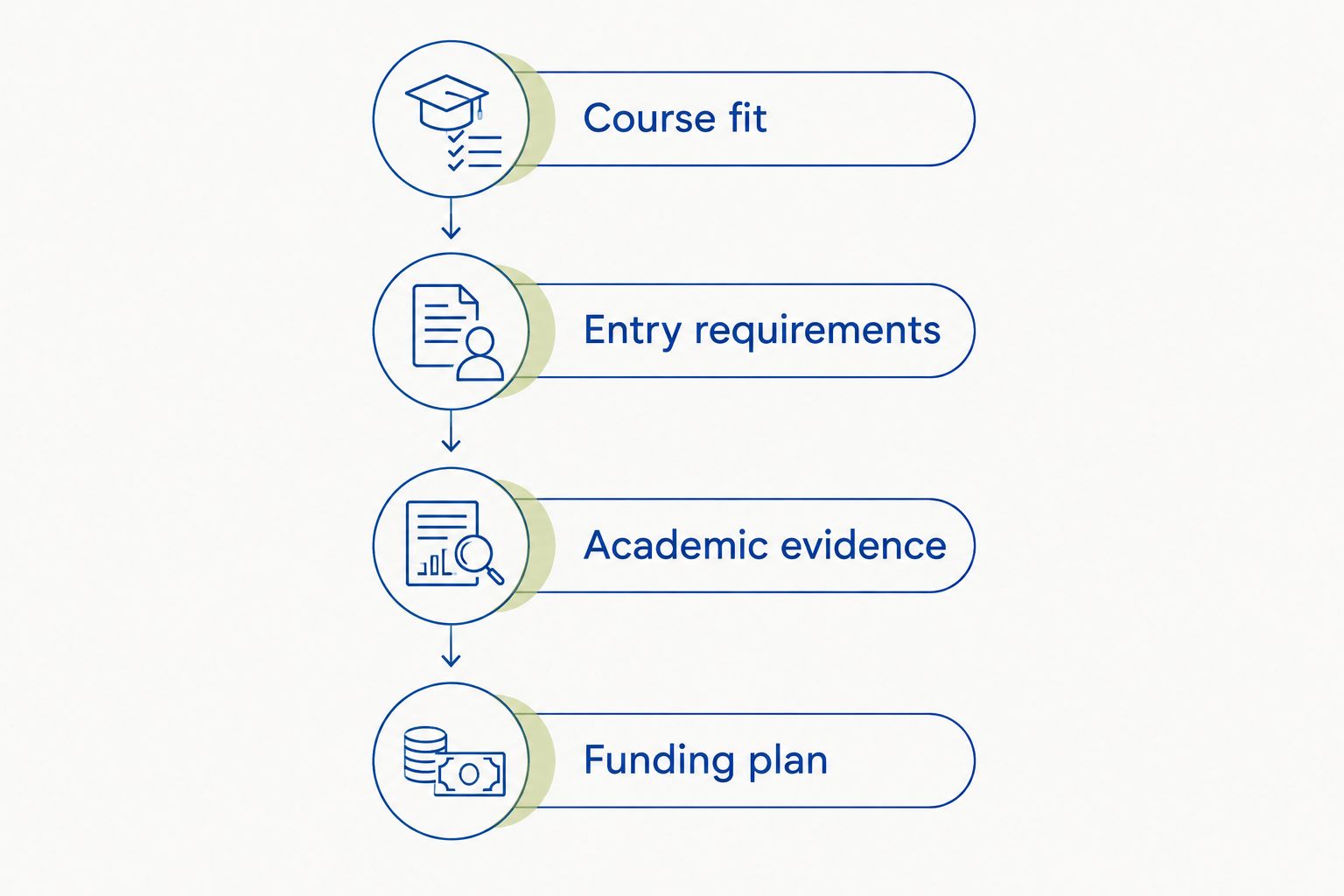
Before finalizing your 2026 shortlist, work through this sequence:
- Course fit: Read compulsory modules and identify subjects you actually want to study.
- Entry requirements: Check accepted qualifications, subject expectations and application components for your cycle.
- Academic evidence: Select reading, projects and activities that demonstrate your interests without exaggeration.
- Funding plan: Review aid eligibility, scholarship conditions and the full duration of study with your family.
Ivy Central’s personalized counseling helps families turn those decisions into a coordinated US and UK application strategy. Caroline Linger and Jose Kumar work directly with each student on choices, application planning and essay guidance. Discuss your academic interests and family priorities before committing to a list built mainly around prestige.
Plan your university shortlist
Discuss US and UK choices, academic interests and application strategy with Ivy Central.
FAQ
What is the best university for international relations in 2026?
Georgetown is this guide’s default undergraduate choice for a dedicated international affairs education. LSE, Princeton, Tufts, Oxford and St Andrews serve different academic priorities, so compare their required curricula before choosing.
Is LSE better than Georgetown for international relations?
LSE is the stronger fit for a focused UK international relations degree; Georgetown is the stronger fit for a dedicated US international affairs education. The decision depends on the curriculum and undergraduate structure you want.
Does Oxford offer an undergraduate international relations degree?
Oxford’s PPE course is not a dedicated international relations degree. It combines philosophy, politics and economics, making it relevant to students whose interests extend beyond international relations alone.
Is the St Andrews MA in international relations a postgraduate degree?
The St Andrews MA Honours International Relations is an undergraduate degree. Its title follows the Scottish degree tradition, and the standard pathway normally lasts four years.
Do I need economics or mathematics for international relations?
Entry requirements depend on the university and course. Economics and quantitative methods form part of several relevant curricula, so check both admission requirements and the subjects you will study after enrolling.
Can international students apply for financial aid?
Financial aid eligibility depends on the university, applicant status and funding program. Check official international undergraduate aid guidance separately from academic admission requirements, and distinguish scholarships from need-based assistance.
How can Ivy Central help with international relations applications?
Ivy Central provides personalized college admissions counseling and strategy for US and UK applications. Caroline Linger and Jose Kumar work directly with each student; counseling does not guarantee admission or imply university affiliation.
One last thing
A degree title can hide a major difference: Oxford PPE includes international political questions without being an international relations degree, while the St Andrews undergraduate qualification carries an MA title. Read the compulsory curriculum before judging the label. That single step prevents a prestigious shortlist from becoming an academically unsuitable one.
Related guides
- Need-blind universities for international students
- Scholarships for Indian students studying in the US
- Ivy League admissions for Indian students
- Pre-law summer programs for high schoolers