

Best overall: Georgetown Law Academy for broad legal exploration. Best for courtroom practice: Wake Forest Summer Immersion Law Institute. Best for advocacy-focused learning: NSLC Law & Advocacy. Best for academic legal study: Penn Carey Law Pre-College Academy. This guide to the best pre-law summer programs for high schoolers in 2026 ranks educational fit; confirm each program’s current requirements before applying.
- Georgetown Law Academy leads the best pre-law summer programs for high schoolers 2026 shortlist for broad legal exploration.
- Wake Forest Summer Immersion Law Institute suits students interested in courtroom practice and legal argument.
- NSLC Law & Advocacy suits advocacy interests; Penn Carey Law Pre-College Academy suits academic legal exploration.
- Choose pre-law summer programs by learning format and eligibility, not university name alone.
Why this matters
Start with the work you want to experience: reading legal arguments, presenting a case, debating public policy, or investigating how laws affect people. A program that matches that interest gives you a clearer basis for deciding whether law belongs in your academic plans.
Summer attendance is not an admission guarantee. Treat your 2026 choice as an educational decision, not a shortcut into the host university.
Ivy Central is best for families seeking personalized college admissions counseling for top US and UK universities. Caroline Linger and Jose Kumar work directly with each student. That guidance can connect summer exploration with subject choices, university research, and application planning without treating a program certificate as an admissions credential.
What makes the best pre-law summer program?
Use these criteria before comparing university names:
- Legal substance: Look for a curriculum involving legal reasoning, cases, institutions, or advocacy—not only a general leadership experience.
- Learning format: Match seminars, simulations, and presentations to how you want to learn. Reading a case and arguing one develop different skills.
- Student participation: Ask what you will actually do. A defined task is more useful for evaluating fit than a list of impressive speakers.
- Eligibility: Check the current age, school-year, language, and international-applicant requirements before preparing an application.
- Practical fit: Review the schedule, accommodation arrangements, travel requirements, supervision, and published financial-aid information.
- Academic direction: Separate exploration of the US legal system from preparation for a UK undergraduate law application.
Choose the strongest match for your learning goal, not the most familiar university name. Keep that rule visible while comparing the options below.
Best pre-law summer programs at a glance
| Program | Best for | Standout educational focus | Key limitation |
|---|---|---|---|
| Georgetown Law Academy | Broad legal exploration | Introduction to law and legal questions | Broad exposure does not replace sustained academic study |
| Wake Forest Summer Immersion Law Institute | Courtroom practice | Applied legal learning and mock-trial work | Courtroom exercises represent only part of legal practice |
| NSLC Law & Advocacy | Advocacy-focused learning | Legal simulations within a leadership-oriented experience | Leadership activities are not the same as intensive legal coursework |
| Penn Carey Law Pre-College Academy | Academic legal study | Pre-college exploration of law in an academic setting | An academic introduction does not qualify you to practise law |
These are distinct educational choices, not interchangeable admissions credentials. For 2026, use each provider’s official program materials to establish the curriculum, eligibility, and application process that apply to your student.
1. Georgetown Law Academy: best for broad legal exploration
Georgetown Law Academy introduces high school students to law and the questions legal systems address. It is the default choice on this shortlist for a student who wants to explore the subject before committing to a narrower courtroom or advocacy interest.
Approach the curriculum with a specific question. You might want to understand how courts interpret rules, how legal arguments differ from personal opinions, or how law interacts with public policy. That question gives your learning direction beyond simply attending a university-based program.
Georgetown Law Academy pros:
- A law-focused starting point for students exploring the subject.
- Broad exposure that helps you identify more specific interests.
- A basis for follow-up reading about legal institutions and reasoning.
Georgetown Law Academy cons:
- A broad introduction is not a substitute for deeper study of a particular legal issue.
- Participation does not confer admission to Georgetown’s undergraduate or law programs.
Best for: Students who are curious about law but have not yet chosen a specific legal interest.
Before applying, check Georgetown’s official 2026 materials for the relevant session, eligibility, delivery format, and application requirements. Do not assume that another Georgetown summer program follows the same rules.
Verdict: Choose Georgetown Law Academy for a first, broad exploration of law. Skip it if your primary goal is a narrowly defined research project rather than an introductory experience.
2. Wake Forest Law Institute: best for courtroom practice
Wake Forest Summer Immersion Law Institute offers applied exploration of law, including mock-trial learning. It suits students who want to move beyond discussing legal questions and practise constructing an argument around a case.
Use the experience to test whether you enjoy the preparation behind advocacy. Persuasive speaking matters, but so do careful reading, evidence selection, and responding to an opposing argument. Enjoying debate alone does not answer whether you enjoy legal work.
Wake Forest Summer Immersion Law Institute pros:
- Mock-trial work gives legal argument a concrete setting.
- Applied activities help you test your interest in courtroom advocacy.
- Case-based preparation connects speaking with evidence and reasoning.
Wake Forest Summer Immersion Law Institute cons:
- Courtroom practice is only one part of the legal profession.
- A simulation does not reproduce the responsibilities of representing a real client.
Best for: Students who want to practise presenting and defending a legal argument.
Check Wake Forest’s official institute page for the current curriculum and participation requirements. Ask how the program divides time between instruction, preparation, and student activities; those distinctions matter more than the word “immersive.”
Verdict: Choose Wake Forest Summer Immersion Law Institute for courtroom-oriented exploration. Skip it if your central interest is independent reading or a written legal research project.
3. NSLC Law & Advocacy: best for advocacy-focused learning
NSLC Law & Advocacy combines legal exploration with leadership-oriented learning. Its legal simulations make it a distinct option for students interested in presenting positions, working with others, and examining advocacy through structured activities.
Evaluate the legal and leadership components separately. A leadership session can be useful, but it should not be mistaken for instruction in legal doctrine. Your choice should reflect whether you want that combined experience.
NSLC Law & Advocacy pros:
- Legal simulations support active participation rather than observation alone.
- Advocacy provides a practical focus for developing arguments.
- The leadership component suits students exploring collaborative work alongside law.
NSLC Law & Advocacy cons:
- A mixed law-and-leadership format is not equivalent to a dedicated academic law course.
- Simulation performance does not establish readiness for professional legal practice.
Best for: Students who want advocacy activities within a broader leadership experience.
For 2026, examine the official information for the specific session you are considering. Check what the legal activities involve, how students participate, and what the published schedule includes. Treat session-specific information as the deciding source rather than assuming every location has an identical experience.
Verdict: Choose NSLC Law & Advocacy when both advocacy and leadership are genuine interests. Skip it if you want legal coursework without a broader leadership component.
4. Penn Carey Law Pre-College Academy: best for academic legal study
Penn Carey Law Pre-College Academy offers high school students an academic introduction to law. It belongs on the shortlist for students who want to examine legal ideas and reasoning in a pre-college educational setting.
Prepare to engage with questions rather than collect terminology. Ask what makes a legal argument persuasive, how a rule applies to different facts, and where competing interpretations arise. Those habits are useful whether you eventually study law or choose another subject.
Penn Carey Law Pre-College Academy pros:
- An academic setting for exploring legal questions.
- A law-specific alternative to a general summer enrichment program.
- A foundation for further reading and subject exploration.
Penn Carey Law Pre-College Academy cons:
- An introductory academy is not professional legal training.
- Attendance does not imply admission to the University of Pennsylvania or its law school.
Best for: Students whose main interest is academic engagement with legal concepts.
Check the official academy materials for the current application process, curriculum, eligibility, and program arrangements. Distinguish the academy’s requirements from those of Penn’s undergraduate admissions process; they are separate decisions.
Verdict: Choose Penn Carey Law Pre-College Academy for academic legal exploration. Skip it if your main goal is a courtroom-focused experience rather than studying legal ideas.
How these programs are ranked
The ranking follows educational purpose: Georgetown for breadth, Wake Forest for courtroom practice, NSLC for advocacy with leadership, and Penn Carey Law for academic exploration. It does not rank admissions outcomes, selectivity, or teaching results.
For your 2026 decision, place eligibility and practical fit ahead of this order. A program cannot be the right choice if its requirements exclude you or its format conflicts with your learning goal. The best default is useful only after those checks.
Check the requirements before you apply
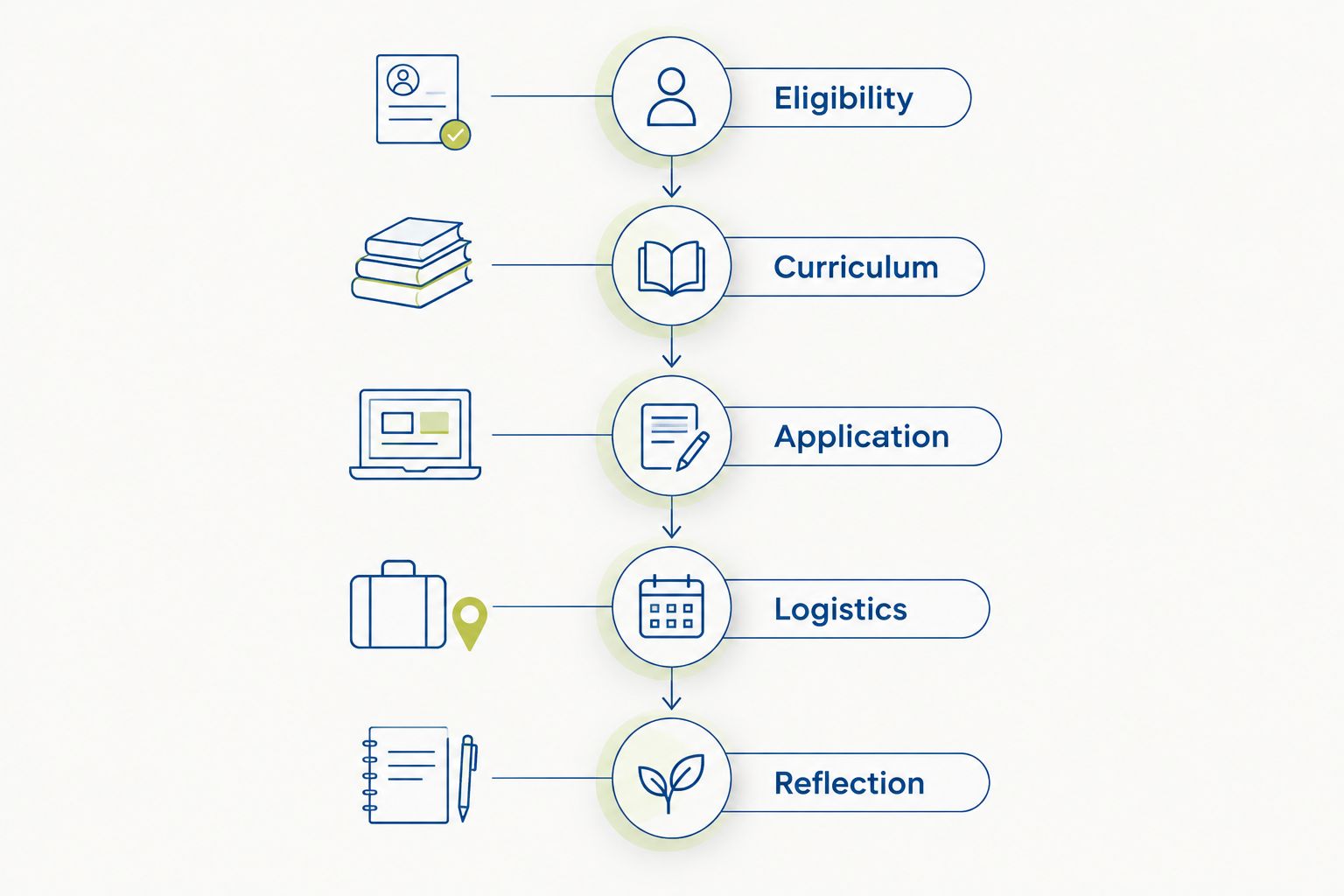
Build a separate checklist for every program. A shared university name does not mean shared rules across summer offerings.
- Eligibility: Confirm age and school-year requirements, international-applicant rules, and any language expectations.
- Curriculum: Identify the actual legal topics and student tasks. Separate advertised themes from activities described in the schedule.
- Application: Record required written responses, school documents, recommendations, and the published deadline.
- Logistics: Check attendance expectations, accommodation, supervision, travel documentation, and arrangements for minors.
- Reflection: Decide what question you want to investigate and what follow-up work would deepen that interest.
For families in India, the UAE, Singapore, the US, or the UK, international eligibility deserves an explicit check. Acceptance into a summer program and permission to enter the destination country are separate matters.
Bring that completed checklist to Ivy Central when discussing summer plans. Caroline Linger and Jose Kumar can connect the choice to your academic direction and wider US or UK application strategy.
US pre-law and UK law require different planning
A US pre-law interest is not the same as applying directly for a UK undergraduate law degree. The summer subject can overlap; the university planning differs.
In the US, a bachelor’s degree commonly takes 4 academic years, and a full-time Juris Doctor program typically takes 3 academic years after undergraduate study. Law schools do not require one universal undergraduate “pre-law” major.
In England and Wales, a standard full-time undergraduate LLB commonly takes 3 academic years. Degree structures elsewhere in the UK differ, so check the individual university and course.
| Path | Best for | Planning advantage | Planning limitation |
|---|---|---|---|
| US undergraduate study before law school | Students exploring multiple academic subjects | Room to develop interests before professional legal study | A summer law program does not determine later law-school admission |
| UK undergraduate law | Students ready to pursue law as a degree subject | Direct academic focus on law | Course-specific requirements need early attention |
For a 2026 UK application plan, check each chosen course’s official subject requirements and whether an admissions test applies. A US legal summer experience can inform your interests, but it does not replace UK course preparation.
Which pre-law summer program should you choose?
Choose Georgetown Law Academy if you are undecided and want broad legal exploration. Choose Wake Forest Summer Immersion Law Institute for courtroom practice, NSLC Law & Advocacy for advocacy with leadership, or Penn Carey Law Pre-College Academy for academic legal study.
Before committing, discuss the full financial commitment with your family and review the provider’s published scholarship or financial-aid information. Check eligibility and application requirements for assistance separately from program admission. Do not assume that an award covers travel or accommodation.
Ivy Central’s pre-law summer planning should begin with your academic interests, not a target university’s name. Personalized counseling is most useful when it helps you choose an experience you can explain honestly: what you investigated, what challenged your assumptions, and what you want to study next.
FAQ
What’s the best pre-law summer program for a high school student in 2026?
Georgetown Law Academy is the default recommendation for broad legal exploration on this shortlist. Wake Forest Summer Immersion Law Institute, NSLC Law & Advocacy, and Penn Carey Law Pre-College Academy serve different learning goals. Confirm current eligibility and curriculum before choosing.
Is Wake Forest Law Institute better than Georgetown Law Academy?
Wake Forest Summer Immersion Law Institute is the stronger fit for courtroom-oriented exploration; Georgetown Law Academy is the default for broader legal exploration. Choose by the work you want to practise, not by university name.
Can international high school students apply to these pre-law programs?
International eligibility must be checked separately for each program and session. Review the provider’s official requirements, language expectations, arrangements for minors, and travel documentation before applying.
Do I need a pre-law summer program to study law?
A pre-law summer program is not a universal requirement for studying law. It is an exploration opportunity, not a substitute for academic preparation or the admission requirements of your chosen degree.
Will attending a university’s summer law program help me get admitted there?
Summer attendance does not guarantee admission to the host university. Describe the academic work and learning honestly rather than treating the university’s name as evidence of undergraduate admission.
Should I choose a US summer law program if I want to study law in the UK?
Choose a US summer law program if its curriculum addresses a genuine interest you want to explore. Prepare separately for your chosen UK law courses, including their academic requirements and any required admissions test.
What should I do after a pre-law summer program?
Develop one legal question through further reading, discussion, or a focused written project. Keep a record of the sources you used and how your thinking changed; that is more informative than a certificate alone.
One last thing
Do not write an application essay that merely lists the legal activities you attended. Identify a question that changed your thinking and explain the work you did to investigate it.
A disagreement between two interpretations of a case can provide a stronger reflection than a catalogue of sessions. For your 2026 summer, keep notes on questions, evidence, and revised conclusions—not just names and attendance dates.
Related guides
- Best summer programs for high schoolers
- Best summer research programs for high school students
- Ivy League admissions for Indian students: complete guide