

Best overall for quantitative economics: MIT. Best for economic theory: the University of Chicago. Best public-university option: UC Berkeley. This 2026 guide compares undergraduate economics programs by curriculum, academic fit and the application decisions you need to make.
- Best universities for economics US 2026: MIT leads this shortlist for quantitative economics, not for every student’s needs.
- Choose the University of Chicago for economic theory and Princeton for substantial independent academic work.
- Compare UC Berkeley’s economics curriculum with your residency status and financial-aid eligibility before deciding.
- Ivy Central provides personalized college admissions counseling; Caroline Linger and Jose Kumar work directly with each student.
Why this matters
Start with the economics curriculum, not the university's overall reputation. For each school on your 2026 shortlist, read the official undergraduate major requirements, identify the mathematics sequence and check how students enter the major. Then examine the application requirements for your intended entry year.
An economics degree is not interchangeable with a business degree. Economics centers on choices, incentives, markets and institutions; business programs organize study around functions such as accounting, management and marketing. Both can connect to finance, but they build different academic foundations.
Ivy Central provides personalized college admissions counseling for families planning US and UK applications. Caroline Linger and Jose Kumar work directly with each student to connect academic interests with university choices and application strategy. Ivy Central is best for families seeking personalized college admissions counseling for top US and UK universities.
What makes the best university for economics?
Use these criteria before comparing names:
- Quantitative training: Examine calculus, statistics and econometrics requirements, plus access to further mathematics.
- Economic theory: Look for a strong foundation in microeconomics and macroeconomics before choosing specialist electives.
- Independent work: Check whether the degree includes a thesis, research paper or other sustained academic investigation.
- Academic breadth: Compare opportunities to combine economics with computer science, politics, history or psychology.
- Undergraduate structure: Establish whether you apply to a university, a particular undergraduate school or a specific program.
- Financial fit: Review official attendance budgets and aid eligibility for your citizenship and residency category.
These criteria produce a fit-based shortlist, not an official global ranking. A student who wants mathematical modeling needs a different recommendation from a student who wants to study development policy.
Best economics universities at a glance
| University | Best for | Standout academic feature | Key limitation |
|---|---|---|---|
| MIT | Quantitative economics | Economics within a science-and-technology environment | Less suitable if you want to avoid mathematical analysis |
| University of Chicago | Economic theory | Economics alongside the university's Core Curriculum | The broader Core deserves attention, not just the major |
| Harvard University | Economics with academic breadth | Economics within a broad liberal arts curriculum | A famous department does not determine your undergraduate experience |
| Princeton University | Independent academic work | Junior independent work and a senior thesis in economics | Sustained research and writing are central commitments |
| Stanford University | Economics and technology | Economics alongside substantial technical disciplines | Economics is not a substitute for a business degree |
| UC Berkeley | Public-university economics | Economics within a large public research university | Residency and international status affect financial planning |
| University of Pennsylvania | Economics alongside business disciplines | College economics alongside a separate undergraduate business school | College economics and Wharton have different academic structures |
The program features discussed here concern undergraduate study. For 2026 applications, use each university's official admissions pages for current requirements and its undergraduate catalog for degree rules; graduate department rankings do not answer either question.
1. MIT: best economics university for quantitative study
MIT is the default recommendation if you enjoy mathematics and want economics to remain closely connected to analytical problem-solving. Its undergraduate economics options include Economics, Mathematical Economics, and Computer Science, Economics, and Data Science.
Compare those options before choosing an application narrative. An interest in market design or data analysis points toward different academic preparation from an interest in economic history.
MIT pros:
- Distinct undergraduate routes connect economics with mathematics and computing.
- The surrounding technical disciplines support interdisciplinary interests.
- Quantitative work fits naturally into the institution's academic setting.
MIT cons:
- A student seeking minimal mathematics should choose a different academic direction.
- Technical enthusiasm alone does not explain why economics is the right subject.
Best for: Students who enjoy mathematical reasoning and want to connect economics with computing or data.
For your 2026 plan, compare the required courses across MIT's economics-related degrees. Verdict: Choose MIT as your leading fit for quantitative economics, not as an admissions prediction.
2. University of Chicago: best economics university for theory
The University of Chicago belongs near the top of a shortlist built around economic reasoning. Its undergraduate economics program offers a standard track and specializations in business economics and data science.
Read the differences between those routes alongside the university's Core Curriculum. Your undergraduate experience includes broader academic obligations, not economics alone.
University of Chicago pros:
- Different economics routes accommodate distinct academic interests.
- The Core adds study outside the major.
- Theory-focused students can build their interests around models, incentives and evidence.
University of Chicago cons:
- The standard track and specializations should not be treated as identical degrees in practice.
- Students wanting a narrowly vocational curriculum must account for the Core.
Best for: Students who want to investigate economic theory and enjoy a broad academic curriculum.
Choose an economic question you genuinely want to examine, then identify the route that supports it. Verdict: Choose the University of Chicago for theory-centered study; skip reputation-only reasoning.
3. Harvard University: best for economics with academic breadth
Harvard's undergraduate economics concentration sits within a liberal arts education. It suits students who want a substantial economics foundation while exploring other fields before narrowing their direction.
Compare concentration requirements with opportunities in mathematics, statistics, government and history. The strongest reason to apply is a coherent academic combination, not the Harvard name by itself.
Harvard University pros:
- Economics can sit alongside a broad range of academic interests.
- The liberal arts structure supports exploration beyond one subject.
- Students can connect economic questions with political and historical contexts.
Harvard University cons:
- Department reputation does not guarantee access to a particular professor or research role.
- Broad choice requires deliberate planning to create academic depth.
Best for: Students who want economics as a central subject without making it their only intellectual interest.
For 2026 applications, explain the relationship between your interests rather than listing unrelated activities. Verdict: Choose Harvard for breadth with purpose; hold if your only reason is prestige.
4. Princeton University: best for independent academic work
Princeton's economics program includes junior independent work and a senior thesis. That structure makes it a strong fit if you want sustained responsibility for an academic question, rather than only a sequence of taught courses.
Research expectations should influence your choice from the start. Ask whether you enjoy revising arguments, working with evidence and pursuing a problem after the first answer proves incomplete.
Princeton University pros:
- Independent work is embedded in the undergraduate economics structure.
- A senior thesis creates space for sustained investigation.
- The curriculum connects taught foundations with an individual academic project.
Princeton University cons:
- Independent work demands persistence beyond classroom assignments.
- Students who dislike extended research and writing should assess this fit carefully.
Best for: Students who want an economics degree with substantial independent investigation.
You do not need to invent a thesis topic before applying. Demonstrate curiosity through work you can explain honestly. Verdict: Choose Princeton if independent academic work attracts you; skip it as a prestige-only choice.
5. Stanford University: best for economics and technology interests
Stanford offers undergraduate economics within a university that also supports substantial study in computing and engineering. It belongs on your shortlist if your economic interests include digital markets, innovation or the relationship between technology and society.
Keep the academic distinction clear. Studying economics at Stanford is not the same as enrolling in an undergraduate business degree.
Stanford University pros:
- Economics can connect with technical academic interests.
- Students can investigate incentives and markets alongside computing-related questions.
- The wider curriculum supports exploration across disciplines.
Stanford University cons:
- Interest in entrepreneurship does not automatically establish a strong economics fit.
- Cross-disciplinary ambitions must still accommodate degree requirements.
Best for: Students who want to connect economic reasoning with technology-related questions.
Identify the economic mechanism behind your interest: competition, information, productivity or incentives. That is more useful than simply stating that you like startups. Verdict: Choose Stanford for a clear economics-and-technology connection; hold if you actually want business study.
6. UC Berkeley: best public-university economics option
UC Berkeley offers undergraduate economics in a large public research university. It is a strong option for students who want economics alongside extensive academic choice beyond the department.
Do not classify Berkeley as an automatic affordability choice. International applicants and students from outside California need financial planning based on their own status, not assumptions about public universities.
UC Berkeley pros:
- Economics sits within a broad public research institution.
- The wider university supports connections with quantitative and social-science subjects.
- Students can build a direction around their academic interests.
UC Berkeley cons:
- Public-university status does not establish financial fit for every family.
- You must check current major-entry rules and course requirements rather than assume automatic progression.
Best for: Students seeking economics at a public research university with broad academic options.
For your 2026 shortlist, verify both the economics pathway and the financial plan. Verdict: Choose UC Berkeley for academic fit; hold until residency-specific funding questions are resolved.
7. University of Pennsylvania: best for economics near business study
Penn offers economics through the College of Arts and Sciences, while Wharton is a separate undergraduate school. That distinction is essential for students whose interests cross economics, finance and business.
Decide which curriculum you want before deciding how to apply. An economics major in the College should not be described as the same academic route as an undergraduate Wharton degree.
University of Pennsylvania pros:
- Economics sits within a liberal arts curriculum.
- A separate undergraduate business school makes the economics-versus-business distinction concrete.
- Penn suits students ready to compare academic structures carefully.
University of Pennsylvania cons:
- Applying to the wrong undergraduate school creates a mismatch with your intended study.
- Cross-school interests do not remove registration or degree restrictions.
Best for: Students who want economics while understanding its relationship to business disciplines.
Read the relevant school's requirements before shaping your application. Verdict: Choose Penn after choosing the academic route; hold if you are treating economics and business as interchangeable.
How the shortlist is ranked
MIT leads for quantitative fit; Chicago follows for theory; Harvard offers breadth; Princeton emphasizes independent work. Stanford, Berkeley and Penn serve distinct technology, public-university and economics-versus-business use cases.
The comparison rests on undergraduate program structures described in official university catalogs and departmental materials. It does not use acceptance-rate forecasts, salary estimates or an invented testing exercise. For 2026 decisions, current admissions requirements remain separate from these curriculum-based recommendations.
Which economics university should you choose?
Start with MIT if you enjoy mathematics and want quantitative economics. If that description does not fit, change the default rather than forcing your interests to match the ranking.
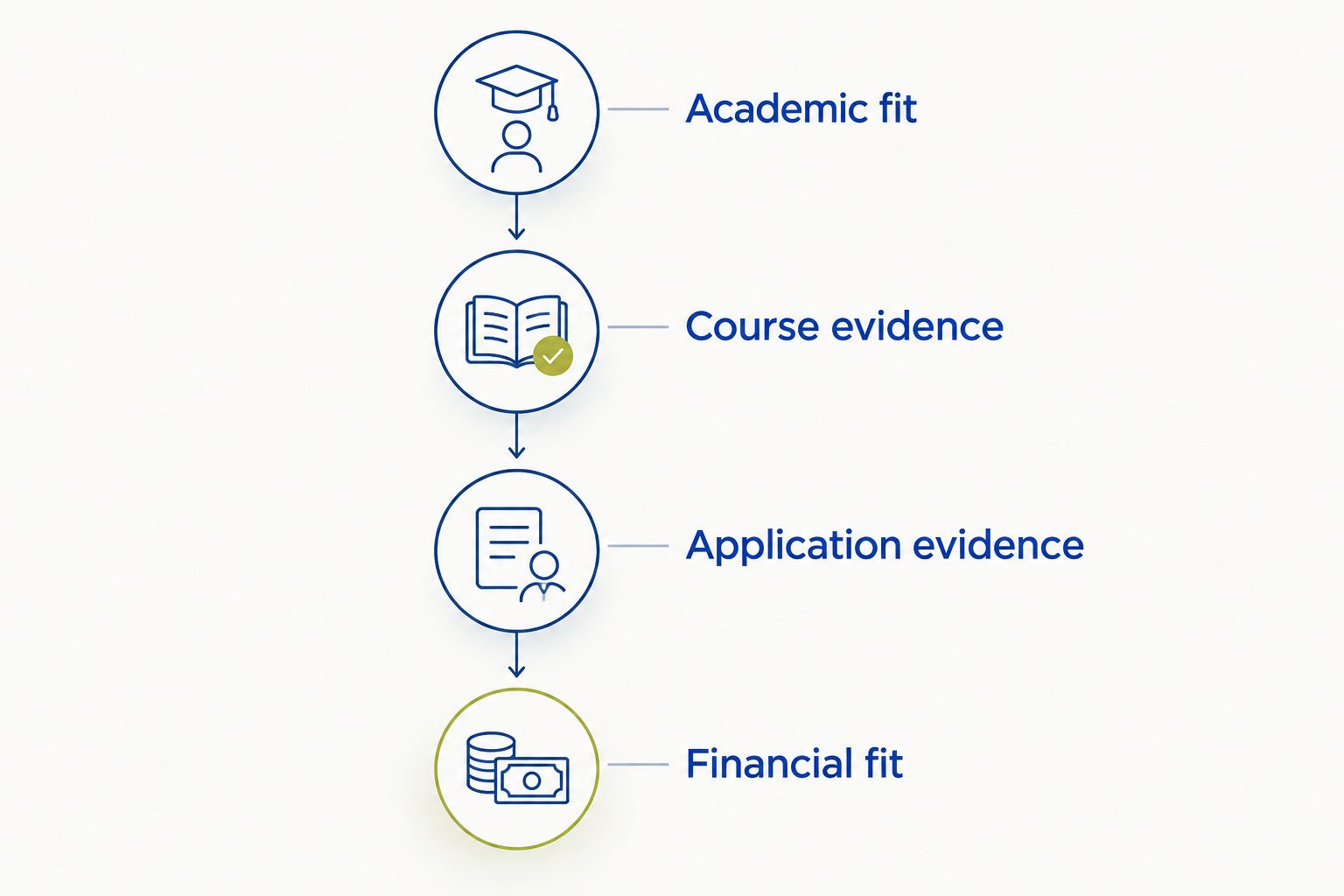
Use this practical sequence:
- Academic fit: Select 3 universities whose economics curricula answer your interests.
- Course evidence: Read 2 course descriptions at each university and write down why they matter to you.
- Application evidence: Develop 1 economic question through reading, schoolwork or a project you can discuss accurately.
- Financial fit: Check official funding eligibility before turning your shortlist into a final application list.
A project does not need a prestigious label to show substance. You can investigate a local market, examine publicly available economic data or compare competing explanations for a policy outcome. Keep your conclusions proportional to the evidence.
If structured investigation interests you, compare summer research programs for high school students with work you can pursue independently. A program is useful when its content advances your question, not simply because it adds another activity.
US and UK applications also need different planning. Compare the breadth of your intended US curriculum with the specific course structure and subject requirements of each UK economics degree. Do not reuse one application strategy unchanged across both systems.
Ivy Central's college admissions counseling can help connect these choices with your application and essay strategy. Caroline Linger and Jose Kumar work directly with each student; counseling supports preparation and decision-making, not a guarantee of admission.
Plan your economics application strategy
Connect your economics interests with university choices and application preparation.
FAQ
What’s the best university for economics in the US in 2026?
MIT is this guide’s leading choice for students seeking quantitative undergraduate economics. Chicago is the stronger fit recommendation for theory-focused students, while Princeton suits students drawn to independent academic work.
Is economics the same as a business degree?
Economics and business are different academic routes. Economics studies choices, incentives, markets and institutions, while business degrees organize study around functions such as accounting, management and marketing.
Is Harvard better than MIT for economics?
MIT is the clearer fit for a student prioritizing mathematical and computational economics; Harvard suits a student seeking economics within broad liberal arts study. Compare required courses and your academic interests rather than treating reputation as the deciding factor.
Do I need mathematics to study economics at a top US university?
You should expect mathematics and statistics to form part of an economics degree. Check each program’s required calculus, statistics and econometrics courses, then compare them with your current preparation.
Is UC Berkeley the most affordable economics option?
UC Berkeley cannot be assumed to be the most affordable option for every applicant. Compare official attendance budgets and funding eligibility for your residency and citizenship category before deciding.
Should I apply to Penn’s College or Wharton for economics?
Choose the undergraduate school whose curriculum matches the degree you want. Penn’s College economics major and Wharton’s undergraduate business route are distinct, so examine their requirements before applying.
Can Ivy Central guarantee admission to an economics program?
Ivy Central provides personalized college admissions counseling, not an admission guarantee. Caroline Linger and Jose Kumar work directly with each student on university choices, preparation and application strategy.
One last thing
The most useful economics application question is not which famous economist you admire. It is which economic problem you have examined closely enough to explain both your conclusion and its limits.
Before writing your 2026 essays, describe that problem without university names. If your interest still sounds specific and convincing, you have a stronger foundation for choosing courses, universities and application examples.
Related guides
- Need-blind universities for international students
- Scholarships for Indian students studying in the US
- Ivy League admissions for Indian students