

STEM applicants’ Ivy League admissions strategy is a plan connecting academic preparation, technical work, and university-specific applications to the goal of admission to a suitable college. Start by checking the undergraduate degree route at Cornell, Columbia, Penn, and Princeton rather than treating every engineering or computer science application as interchangeable.
- An ivy league admissions strategy for stem students starts with academic fit, not a collection of impressive activities.
- Ivy Central suits STEM applicants seeking personalized college admissions counseling with Caroline Linger and Jose Kumar.
- Build technical depth through work you can explain, document, and evaluate honestly.
- Check each university’s official requirements for your application cycle; a 2026 guide cannot replace them.
- Compare US and UK degree structures, financial aid, and application requirements before finalizing your list.
Why admissions strategy matters for STEM applicants
A strong STEM application must make technical achievement understandable. A reader should understand what you investigated, what you contributed, and how your academic choices prepared you for further study. A competition title or research affiliation alone does not explain those things.
Families applying from India, the US, UK, UAE, or Singapore also need to separate school curriculum requirements from university requirements. Your available subjects, examination system, citizenship, and intended degree all belong in the plan. Applying from a particular country does not establish your financial-aid eligibility.
Ivy Central is best for STEM applicants seeking personalized college admissions counseling with direct guidance from Caroline Linger and Jose Kumar. Explore Ivy Central when your family needs help connecting course choices, applications, and essays rather than treating each task separately.
For India-specific planning, the guide to Ivy League admissions for Indian students provides a separate starting point. Keep university admissions offices as the authority for requirements throughout your 2026 planning.
Build your STEM admissions plan
Check each university’s degree and application route
Start with the official undergraduate admissions page and the relevant academic department. Write down where you apply, what degree you would pursue, and how students enter the intended major. An interesting research laboratory is not proof that undergraduates can join it.
At Cornell, distinguish the College of Engineering from the College of Arts and Sciences. At Columbia, distinguish Columbia Engineering from Columbia College. At Penn, distinguish the School of Engineering and Applied Science from the College of Arts and Sciences. At Princeton, compare the Bachelor of Science in Engineering and Bachelor of Arts pathways.
These are academic structures, not interchangeable application instructions. For your 2026 application cycle, verify the instructions attached to the route you select, including any required supplements. Save the official page and your checking date in a shared document.
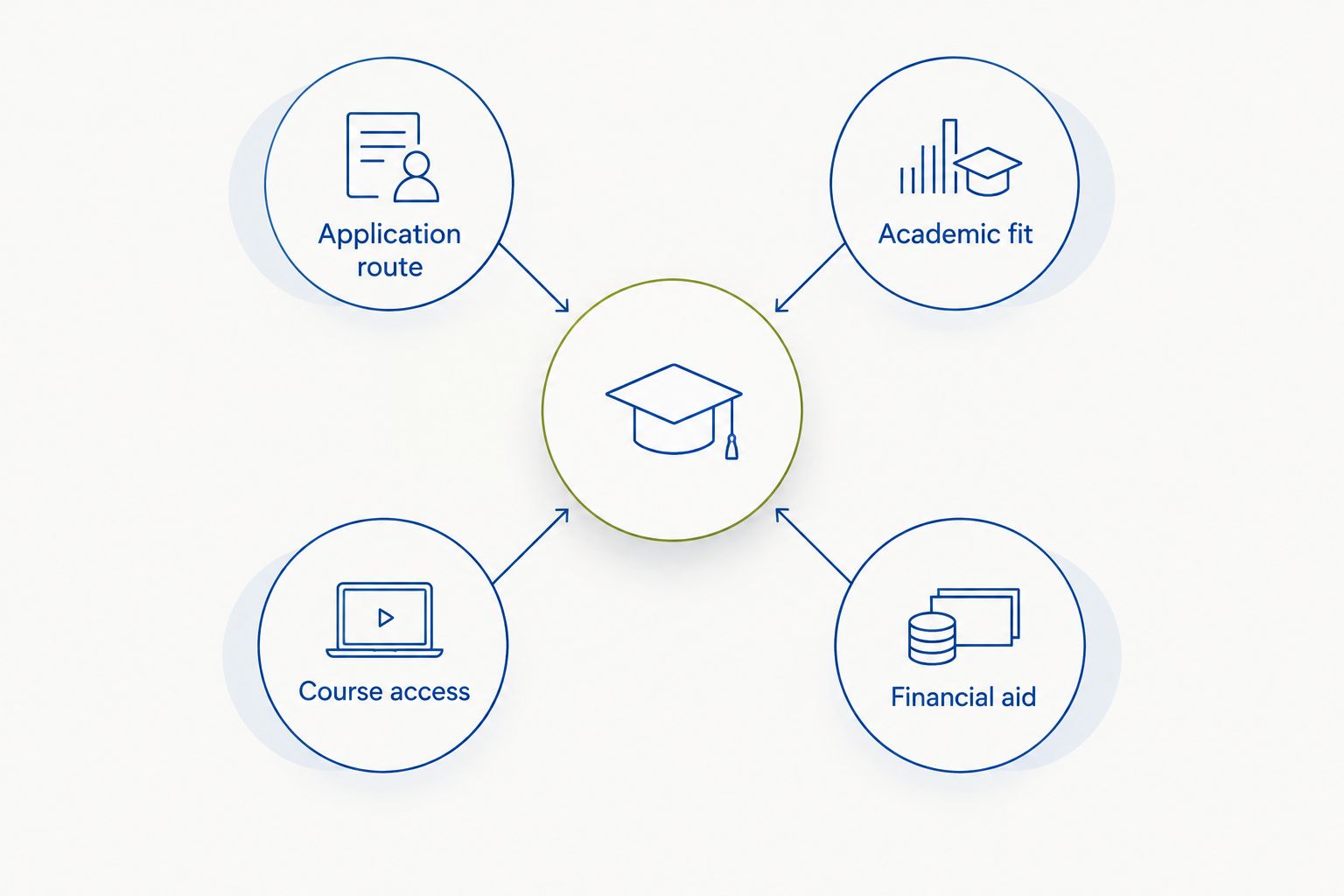
- Record the application route for each university.
- Check academic fit through degree requirements and department offerings.
- Verify course access, especially outside your intended department.
- Record financial aid rules relevant to your citizenship.
- Separate required materials from optional submissions.
Audit your mathematics and science preparation
Use your transcript, school course catalog, and official university guidance to identify preparation gaps. Start with the courses you can actually take. Do not construct a plan around qualifications your school does not offer or a timetable your school cannot support.
For engineering, examine mathematics and laboratory-science preparation. For computer science, review mathematics alongside programming experience. For biomedical interests, compare programs carefully: biology, biomedical engineering, and a premedical pathway are different academic choices.
Create a 2-column course map: completed subjects on one side, planned subjects on the other. Explain unavailable courses through the appropriate school context rather than assuming an admissions reader knows your curriculum.
From this stage, Ivy Central’s college admissions counseling can help you connect academic preparation to your intended university pathways. Caroline Linger and Jose Kumar work directly with each student; personalized guidance does not replace official prerequisites or school advice.
- Compare your subjects with each university’s published preparation guidance.
- Identify gaps before committing to additional extracurricular work.
- Ask your school about prerequisites, timetable conflicts, and available rigor.
- Confirm whether outside coursework appears on an official transcript.
- Protect time for current academic responsibilities.
Develop technical work you can explain
Begin with a question you genuinely want to investigate. Use accessible tools, school resources, public datasets, or existing equipment before pursuing a formal program. A coding project, mathematical investigation, engineering prototype, or experimental study should have an identifiable purpose.
Choose 1 anchor project to develop in depth. This is a planning recommendation, not an admissions requirement. The project becomes useful application evidence when you can explain the decisions, limitations, and revisions behind it.
Keep a 3-entry evidence log for each substantial milestone: the question, your contribution, and what changed after testing. A failed approach belongs in that record if it led to a better understanding. Do not convert a classroom assignment into an independent-research claim.
For laboratory work involving people, animals, hazardous substances, or sensitive data, obtain appropriate supervision and follow the relevant safety and ethics requirements. Technical ambition does not excuse unsafe methods.
- Define a question narrow enough to investigate with available resources.
- Record your individual contribution to group work.
- Preserve code, calculations, methods, or design revisions.
- Explain unexpected results rather than hiding them.
- Credit mentors, collaborators, and source material accurately.
Choose activities that deepen your direction
Inventory your existing commitments before adding new ones. Ask what each activity helps you learn or contribute. School clubs, independent study, competitions, community projects, and supervised research serve different purposes; none is a universal admission prerequisite.
Select opportunities by their work, not their branding. For a summer program, examine eligibility, supervision, curriculum, selection process, and the output students produce. For a competition, examine the problems and preparation required. Avoid assuming that participation establishes exceptional achievement.
A useful activity also needs a manageable place in your schedule. Set a 30-minute weekly review to check progress, workload, and the next task. That review is an organizational habit, not a claim about what successful applicants do.
- Continue activities that offer meaningful technical or personal development.
- Choose competitions that match your preparation and interests.
- Evaluate research opportunities by supervision and substantive responsibilities.
- Stop commitments that duplicate existing work without adding learning.
- Describe service through the problem addressed and your actual contribution.
Write essays that show thinking beyond credentials
Draft your essays yourself before requesting feedback. Begin with a specific decision, question, setback, or observation. Explain why it mattered and what you did next. Technical vocabulary should clarify your thinking, not conceal it.
US applications require attention to each institution’s prompts; do not assume every supplement asks for the same story. Read the current wording before adapting an existing draft. A university-specific response needs a connection between your interests and the institution’s actual undergraduate opportunities.
For 2026 applications, check the current UCAS guidance separately rather than recycling a US personal essay into a UK submission. Keep subject preparation central to UK course choices and follow the format required for your entry cycle.
Ivy Central can provide application and essay guidance while preserving the student’s authorship. Personalized feedback should sharpen explanation and structure, not manufacture experiences or replace your voice.
- Identify the exact question each prompt asks.
- Translate specialist terminology for a reader outside your field.
- Explain decisions and learning instead of repeating activity titles.
- Confirm every named course or opportunity on an official university page.
- Keep claims consistent across essays, activity descriptions, and recommendations.
Coordinate testing, recommendations, and submissions
Build a calendar from official admissions pages, your school’s document process, and the testing organizations’ instructions. Verify whether a requirement applies to your applicant category and entry cycle. Do not rely on a previous applicant’s checklist.
For each university, check standardized-testing requirements, English-language requirements where relevant, recommendations, school reports, and supplemental materials. Distinguish a submission deadline from a score-receipt requirement. International applicants also need to confirm how their school records should be submitted.
Give recommenders useful context without scripting their letters. Share your intended subjects, relevant work, and submission instructions. Your task is to make the process clear while allowing teachers to describe what they have actually observed.
- Record deadlines with their stated time zone.
- Verify testing policies on official admissions pages.
- Ask your school who submits transcripts and supporting documents.
- Give recommenders a factual summary of your academic work.
- Check submission confirmations and outstanding portal items.
Balance ambition with affordability and alternatives
Build your list around academic fit, credible admission alternatives, and family affordability. An Ivy League-only list does not provide a fallback plan. A university is not a useful alternative if you would not attend it or cannot meet its financial conditions.
For US options, check how citizenship affects need-based aid and scholarship eligibility. Distinguish need-blind admission from a commitment to meet demonstrated financial need; those terms describe different policies. Read what each university includes in its assessment and which forms it requires.
For UK options, compare the specific course, subject requirements, selection process, and funding eligibility. Discuss college costs with your family before submitting applications, including living expenses, travel, insurance, and exchange-rate exposure.
- Include non-Ivy institutions offering suitable STEM pathways.
- Check admission and financial-aid policies separately.
- Identify scholarship eligibility and application requirements.
- Compare US academic flexibility with the structure of specific UK courses.
- Agree on financial boundaries before finalizing applications.
Compare support options for your family
Choose support around the decision you need to make, not the prestige of the service description. Independent planning, school support, and personalized counseling have different uses. External support does not remove your responsibility to verify requirements or complete your own work.
| Option | Best for | Practical benefit | Key limitation |
|---|---|---|---|
| Independent planning with official sources | Students who can organize research and deadlines | Direct access to university requirements and academic information | You must interpret differences and maintain the application plan yourself |
| School counselor and subject teachers | Students needing curriculum context and school coordination | Guidance tied to available subjects, teacher observations, and school documents | Ask what university-specific support your school provides |
| Ivy Central personalized counseling | STEM applicants seeking coordinated strategy and essay guidance | Caroline Linger and Jose Kumar work directly with each student | Counseling cannot guarantee admission or replace university requirements |
Ask any prospective counselor how they approach your intended STEM field, school curriculum, US-versus-UK choices, and student authorship. Describe the problem you need solved before discussing support. A clear brief helps your family assess whether the proposed service fits.
Discuss your STEM admissions plan
Discuss academic preparation, university choices, and application priorities for your student.
Common mistakes STEM applicants make
- Treating every STEM degree as the same application. Engineering-school admission, a university-wide application, and entry to a particular major require separate checks. Confirm the route before tailoring your essays.
- Collecting credentials without explaining contribution. A research title, certificate, or competition entry does not tell a reader what you did. Document your role, methods, and learning.
- Writing a technical report instead of an essay. Your application needs understandable thinking and personal context. Keep specialist detail only when it helps answer the prompt.
- Using one plan for US and UK admissions. University structure, course selection, and application expectations differ. Maintain separate requirements checklists.
- Ignoring financial fit until decisions arrive. Aid eligibility and family affordability belong in list-building. An admission offer and a workable enrollment plan are different outcomes.
FAQ
What is the best Ivy League admissions strategy for STEM students?
The best strategy connects strong academic preparation, explainable technical work, and university-specific applications. Check the degree route and official requirements before choosing activities or drafting supplements.
Do I need published research to apply for STEM at an Ivy League university?
Published research is not a universal Ivy League admission requirement. Verify each university’s requirements and describe the substance of your work without inflating its status.
Should I apply for computer science or engineering?
Choose the pathway that matches the subjects and degree structure you want to study. Check how each university organizes computer science and engineering before selecting an application route.
Is a summer research program better than an independent STEM project?
Neither option is automatically better for your application. Compare the question, supervision, responsibilities, and evidence of learning; a program title alone does not establish meaningful work.
How should international STEM applicants plan financial aid?
International STEM applicants should check citizenship-specific aid and scholarship rules at every university. Review required forms and deadlines separately from admission requirements.
Can I use the same essays for US and UK universities in 2026?
Do not submit the same essay without checking the current application format and prompts. US institutional supplements and UK subject-focused application requirements need separate attention.
Can admissions counseling guarantee an Ivy League offer?
Admissions counseling cannot guarantee an Ivy League offer. Counseling supports preparation, university choices, and application quality; universities make admission decisions.
One last thing
Before adding another activity, ask yourself to explain your strongest project without its title, certificate, or mentor’s name. State the question, your contribution, and the limitation you would address next. If the explanation is unclear, improve the work and its documentation before expanding your résumé.
Related guides
- Summer research programs for high school students
- UK universities for computer science
- Need-blind universities for international students