
Arts students’ Ivy League admissions strategy is a school-specific plan connecting academic preparation, artistic evidence and application writing with the aim of earning admission to a suitable university. For 2026, begin by checking each institution’s undergraduate program and arts-submission instructions: an academic arts degree, a studio program and conservatory training serve different goals.
- Ivy league admissions for arts students requires academic preparation, artistic evidence and school-specific application choices.
- Ivy Central provides personalized college admissions counseling for arts students and families pursuing selective US and UK universities.
- Submit an arts supplement only when the university accepts it and your work meets its published instructions.
- Choose universities by curriculum, creative opportunities and affordability—not reputation alone.
Why admissions strategy matters for arts students
Your artistic work and your academic application must make sense together. A performance recording demonstrates something different from a transcript; neither replaces the other. The admissions challenge is deciding what evidence belongs in each part of the application, without repeating the same achievement everywhere.
Ivy Central provides personalized college admissions counseling for arts students and families pursuing selective US and UK universities. Caroline Linger and Jose Kumar work directly with each student. That support concerns application strategy, not a promise of admission or university affiliation.
Start with Ivy Central if you want personalized guidance, but complete the school-specific checks below before choosing your application approach. Your 2026 plan should distinguish admission to the university from admission to a particular undergraduate school, degree or artistic program.
Families in India, the US, UK, UAE and Singapore also need to align school examinations, rehearsals, performances and application preparation. Build around commitments you already have rather than adding activities solely to make an application look busier.
Build your school-specific admissions plan
Check each university’s program and submission rules
Start with the official undergraduate admissions page, then the relevant department or undergraduate school. For Harvard, Yale and Princeton, examine the published supplementary-material instructions before preparing additional artistic evidence. For Brown and Columbia, investigate how your intended academic route accommodates studio practice, performance or arts study.
For Cornell and Penn, identify the undergraduate school and intended degree before assuming that a university-wide instruction applies to your program. For Dartmouth, check the relevant department’s undergraduate curriculum alongside admissions guidance. These are research tasks, not claims that every institution accepts the same materials.
Create 1 requirements tracker for your 2026 applications. Record the official source, the entry cycle it covers and the date you checked it. An old department page or another applicant’s account is not a substitute for current instructions.
- Identify the exact undergraduate school and degree.
- Record academic, testing and English-language requirements.
- Check whether an arts supplement is accepted or required.
- Separate application deadlines from supplementary-material deadlines.
- Save the official instructions for files, recordings and submission platforms.
Choose the education you actually want
Decide whether you want to study the arts academically, develop a professional creative practice, or combine artistic work with another field. A university offering theatre courses is not automatically the right setting for a student seeking intensive actor training. Equally, a performance-focused course is not necessarily right for someone interested in theatre history and political science.
Compare US and UK choices at the course level. US institutions often offer opportunities to explore subjects, but flexibility depends on the undergraduate school and degree. UK applications require close attention to the chosen course, including its academic prerequisites and any portfolio, audition or interview instructions.
Write a short 2026 study brief before building your list. Where your family needs help translating artistic goals into university choices, personalized counseling can help organize that decision; it does not replace reading the actual curriculum.
- Name your main artistic discipline and academic interests.
- Distinguish practical training from academic arts study.
- Check opportunities to combine subjects within the degree.
- Examine access to ensembles, productions, studios or filmmaking.
- Compare course structure rather than university reputation alone.
Build evidence of sustained artistic development
Select work that shows what you have learned, how you make decisions and how your practice has developed. Visual artists should preserve process documentation alongside finished pieces. Musicians, actors and dancers should keep accurate records of repertoire, roles, training and performances.
For filmmakers, explain your contribution to collaborative work. Directing, editing, cinematography and sound are distinct responsibilities; an impressive final film does not automatically tell a reader what you did. The same principle applies to ensemble performances and group exhibitions.
Ivy Central’s personalized college admissions counseling can connect these experiences to your wider application strategy. Caroline Linger and Jose Kumar work directly with each student, while artistic assessment should remain grounded in feedback from teachers or practitioners who know the discipline.
- Maintain an artistic résumé with accurate dates and roles.
- Keep drafts, sketches, rehearsal notes or project iterations.
- Describe your individual contribution to collaborative work.
- Ask an arts teacher which pieces demonstrate your development.
- Use the guide to extracurricular activities for Ivy League applicants to assess your wider commitments.
Curate the supplement instead of submitting everything
An arts supplement is a selected body of evidence, not an archive of everything you have produced. First follow the university’s instructions. Then choose work that presents your abilities clearly within those limits, without relying on an explanation to excuse unsuitable material.
For visual art, document work clearly and preserve accurate color, scale information and medium descriptions where requested. For performance, prioritize intelligible sound and an unobstructed view of the performer. Technical presentation should help the reviewer assess the work, not distract from it.
Ask a subject teacher to review the proposed selection before you submit. If the institution does not accept your format or discipline, use the permitted application sections to describe your involvement rather than sending unsolicited files.
- Follow the institution’s exact item and duration limits.
- Select work with a clear purpose in the overall submission.
- Label titles, media, roles and collaborators accurately.
- Test recordings and files before uploading them.
- Confirm permissions for collaborative or recorded work.
- Remove pieces that require lengthy excuses to understand.
Connect your essays to intellectual questions
Your essays should show how you think, not simply repeat that you love art. A useful starting point is a creative decision: why you changed a composition, chose a particular staging approach, revised a character or abandoned an earlier visual concept. Explain the reasoning and what it taught you.
School-specific writing needs more than the names of famous alumni or attractive facilities. Identify courses, degree requirements and creative opportunities that genuinely connect to your interests. Check whether the opportunity is available to undergraduates and whether participation has prerequisites.
Keep 2 separate working documents: an evidence inventory and an essay outline. The inventory stores facts; the outline develops meaning. This separation helps you avoid turning every essay into another list of performances, awards and exhibitions.
- Choose an experience that reveals a decision or change in thinking.
- Explain your contribution without overstating its impact.
- Connect artistic interests to academic questions you want to explore.
- Verify every university-specific detail against official information.
- Keep your own voice through revisions and feedback.
Align academics, recommendations and application logistics
An arts-focused application still needs an academic plan. Review course prerequisites, required examinations and English-language instructions for every university and degree. Do not assume a strong portfolio changes an academic requirement unless the institution explicitly says so.
Ask recommenders who can describe your learning, contribution and development through direct observation. Follow each institution’s rules about required and additional recommendations. An arts teacher’s letter serves a different purpose from a classroom teacher’s academic assessment; more letters do not automatically create a stronger application.
For your 2026 application, coordinate school examinations and artistic commitments with submission tasks. International applicants should also check how their curriculum and qualifications are assessed. Keep these checks separate from assumptions based on nationality or a friend’s experience.
- Record academic prerequisites for each intended degree.
- Confirm current testing and language requirements.
- Give recommenders an accurate summary of your work.
- Check whether additional recommendations are permitted.
- Schedule recording, documentation and upload tasks around school commitments.
- Review the complete application for conflicting dates or descriptions.
Build a balanced list and a funding plan
A useful university list includes academic fit, artistic fit and financial fit. Separate the excitement of a university name from the practical question of whether you can study what you want there. Include institutions beyond the Ivy League where the curriculum and creative environment match your goals.
For funding, check the official financial-aid and scholarship information for your citizenship and applicant category. The Ivy League does not award undergraduate merit scholarships; institutional aid is need-based, with eligibility and policies varying by university. External scholarships have their own rules and application processes.
Compare total attendance expenses, not tuition alone. Include housing, travel, materials and the practical costs of sustaining your artistic work. An admission offer is not yet a workable plan until your family understands the funding arrangement.
- Separate admission selectivity from artistic and academic fit.
- Include institutions with different admissions profiles.
- Verify aid eligibility for your applicant category.
- Track funding applications separately from admission applications.
- Ask whether art supplies, equipment or performance expenses affect your budget.
- Discuss affordability before finalizing your application list.
Compare your application-support options
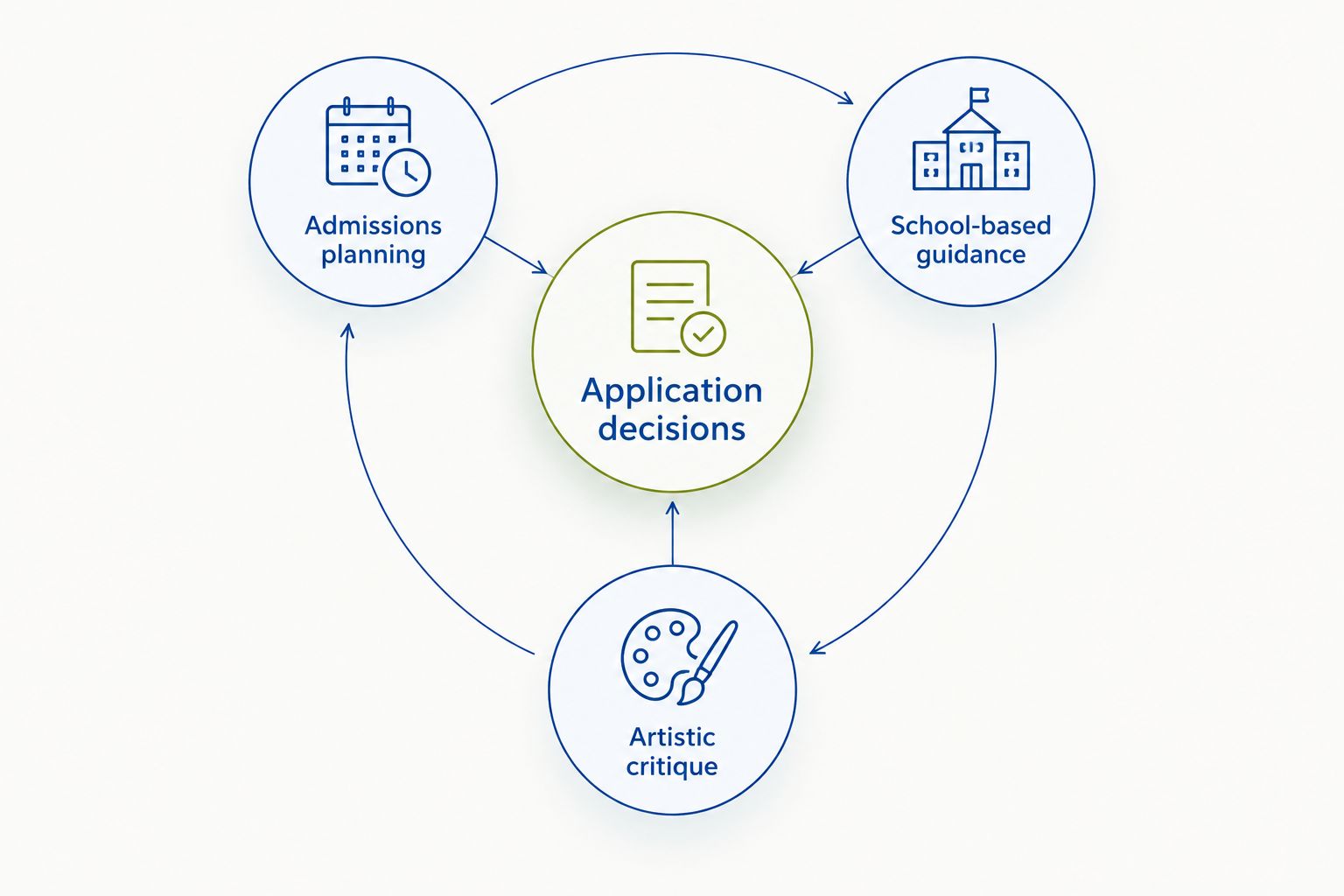
Choose support according to the decision you need help making. Admissions planning, school-based guidance and artistic critique are related tasks, but they are not interchangeable. No option removes your responsibility to check official instructions or produce your own work.
| Option | Best for | Main advantage | Key limitation |
|---|---|---|---|
| Self-directed planning | Students who can manage requirements and deadlines independently | Direct control over research, scheduling and application decisions | You must identify conflicting instructions and coordinate feedback yourself |
| School counselor guidance | Students needing support with school records and academic context | Connects application planning with your school’s processes | Confirm what individual arts-application support the school provides |
| Arts teacher or specialist mentor | Students selecting work or preparing performance material | Offers discipline-specific feedback on artistic evidence | Artistic critique does not replace university research or application coordination |
| Ivy Central personalized counseling | Families seeking individualized US and UK admissions strategy | Caroline Linger and Jose Kumar work directly with each student | Counseling cannot guarantee admission or replace institution-specific requirements |
The strongest arrangement addresses your actual gaps. If your application organization is sound but your recording selection is weak, begin with discipline-specific feedback. If your work is ready but your university choices remain unclear, focus on course research and application strategy.
To discuss a personalized application plan, explore counseling with Caroline Linger and Jose Kumar. Bring your intended subjects, current artistic work and initial university list so the conversation starts with concrete choices.
Plan your arts application
Explore personalized US and UK admissions counseling with Caroline Linger and Jose Kumar.
Common mistakes arts students make
- Treating the supplement as the entire application. Artistic evidence has a specific role. Your academic preparation, written responses and required documents still need careful attention.
- Confusing participation with degree access. A university production, ensemble or studio opportunity does not establish that the institution offers your intended professional training route.
- Hiding individual contributions. A group film, exhibition or performance needs a clear account of your role. Do not imply sole authorship of collaborative work.
- Using one submission everywhere. Institutions set different instructions. Reusing files without checking discipline, format and submission rules creates avoidable errors.
- Choosing prestige before affordability. Research funding eligibility while building the list, not after admission decisions. A compelling academic choice still needs a workable financial plan.
FAQ
Can an arts student apply to an Ivy League university?
Yes, an arts student can apply to an Ivy League university. Build the application around the intended undergraduate school or degree, academic preparation and the artistic evidence that institution permits.
Do I need an arts portfolio for Ivy League admission?
Portfolio requirements depend on the university, undergraduate school and intended program. Check official instructions before treating a portfolio as required, optional or accepted.
Does an excellent audition make up for academic requirements?
Do not treat an excellent audition as a substitute for published academic requirements. Follow the requirements for the exact degree and ask the admissions office about any unclear instruction.
Should I choose an Ivy League university or a conservatory?
Choose according to the education you want: the exact curriculum matters more than the institutional label. Compare practical training, academic breadth, performance opportunities and degree requirements before deciding.
What should international arts applicants check for 2026?
International arts applicants should check academic qualification rules, testing, English-language requirements, artistic submissions and funding eligibility for their entry cycle. Use official university and course information rather than another applicant’s checklist.
Are there Ivy League arts merit scholarships?
Ivy League universities do not award undergraduate merit scholarships; institutional aid is need-based. Verify each university’s aid eligibility and investigate external scholarships separately.
How does Ivy Central help arts applicants?
Ivy Central provides personalized college admissions counseling and strategy for students and families pursuing top US and UK universities. Caroline Linger and Jose Kumar work directly with each student; counseling does not guarantee admission.
One last thing
Before adding another activity, test your existing application against 3 questions: What do you want to study? Which evidence shows you are prepared? Why does this particular program fit?
If you cannot answer those questions clearly, improve the connection between your work and your university choices before expanding your résumé. For arts students, selection and explanation deserve as much attention as collecting more accomplishments.
Related guides
- Universities for film and media studies
- Scholarships for international students at Ivy League universities
- Safety schools for Ivy League applicants