
CollegeVine is useful for exploring colleges and using admissions chancing as a starting point, but your next step is to check each shortlisted university’s official requirements for your intended course. Its ceiling is the distinction between exploring possibilities and receiving personalized application guidance. The best CollegeVine alternative in 2026 is Ivycentral if you need direct admissions counseling; BigFuture if you need self-directed US college research.
- For collegevine alternatives, choose Ivycentral for personalized US and UK admissions counseling with Caroline Linger and Jose Kumar.
- BigFuture suits independent US college research; it does not replace personalized application and essay guidance.
- UCAS is the official starting point for UK course research and undergraduate application information.
- Keep CollegeVine for exploration, but verify requirements and funding policies with each university.
Why this matters
Choosing between CollegeVine alternatives is really a decision about the support your family needs. College research, application strategy, essay guidance and school documentation are different jobs. A service that answers one question does not automatically cover the others.
For your 2026 application planning, begin with a specific university and course rather than a predicted admission chance. Check the university’s official admissions page for academic prerequisites, required application components, testing policies and applicable deadlines. For UK courses, check the university’s course page alongside UCAS information.
Then ask 3 questions: Who will help you interpret those requirements? Who will review your application decisions? Who will coordinate the work that remains yours to complete? Those answers reveal whether you need another research resource or an ongoing counseling relationship.
CollegeVine alternatives at a glance
These options serve different purposes. The comparison includes CollegeVine because keeping it alongside another resource can be more sensible than replacing it outright.
| Option | Best for | Standout function | How it differs from CollegeVine |
|---|---|---|---|
| CollegeVine | Initial US college exploration | College research and admissions chancing | The benchmark for research-led exploration |
| Ivycentral | Personalized US and UK admissions counseling | Caroline Linger and Jose Kumar work directly with each student | A counseling relationship rather than a research resource alone |
| BigFuture | Independent US college research | College Board’s college and career planning resources | An alternative research starting point, not a substitute for individual guidance |
| UCAS | UK course research and application information | Official UK undergraduate application information | Organizes research around UK courses and application procedures |
| Your school counselor | School-linked application coordination | Access to your school’s academic and application processes | Connects planning to school records and institutional procedures |
Choose the support model before comparing features. If your main problem is finding colleges, use a research resource. If your problem is deciding how your academic record, interests and writing fit a university list, assess personalized counseling.
1. Ivycentral: best for personalized US and UK admissions counseling
Ivycentral provides personalized college admissions counseling and strategy for high school students and families pursuing Ivy League and other top-tier US and UK universities. Caroline Linger and Jose Kumar work directly with each student. That direct relationship is the central distinction from choosing a college research resource alone.
Best for: Families seeking individual guidance on university selection, application strategy and essay development, including students considering both US and UK destinations.
Where personalized counseling shines
- Direct student involvement: Caroline Linger and Jose Kumar work with the student rather than positioning an anonymous counselor team as the primary relationship.
- US-versus-UK planning: The service’s stated scope includes both destinations, which matters when your family is deciding between university-wide exploration and course-focused choices.
- Application and essay guidance: Personalized support addresses how you present your academic interests and experiences, not just which institutions appear on a list.
- Family-specific decisions: Counseling provides a setting to discuss your goals, academic preparation and priorities together.
Where personalized counseling falls short
- It is not an admissions guarantee. A counseling relationship cannot replace a university’s independent selection process.
- It is unnecessary for every research task. If you only need to identify colleges or locate course information, a self-directed resource can meet that narrower need.
- It does not remove student responsibility. You still need to make decisions, provide accurate information and produce work that represents your own thinking.
Personalized counseling versus CollegeVine
| Dimension | Personalized counseling | CollegeVine |
|---|---|---|
| Core purpose | Individual admissions strategy | College exploration and chancing |
| Student relationship | Direct work with Caroline Linger and Jose Kumar | Research-led starting point |
| Geographic focus | US and UK university admissions | US college exploration |
| Appropriate use | Application and essay decisions needing individual guidance | Initial research and list exploration |
Before choosing counseling for 2026, bring a draft university list, your academic record and your intended subject interests. Ask how the work will address school-specific requirements, essay ownership and the differences between US and UK applications. A clear answer is more useful than a broad promise of success.
Verdict: Choose personalized counseling when your family needs sustained guidance, not another list of colleges.
2. BigFuture: best for independent US college research
BigFuture is College Board’s college and career planning resource. It gives students another starting point for exploring US colleges and connecting educational choices with academic and career interests. Use it to structure research, then confirm university-specific information at its official source.
Best for: Students who can manage their own research and need a college-planning resource rather than a named admissions counselor.
Where BigFuture shines
- College exploration: It supports the research stage before you commit to a university list.
- Career context: College Board’s planning resources connect college decisions with broader educational and career questions.
- Independent use: You can turn research findings into questions for your family or school counselor.
Where BigFuture falls short
- Research is not personalized strategy. A planning resource does not itself resolve how your experiences should shape an application.
- It is not the final authority on requirements. University admissions pages remain the source for institution-specific instructions.
- It does not replace essay guidance. Finding a college and developing a convincing application are separate tasks.
BigFuture versus CollegeVine
| Dimension | BigFuture | CollegeVine |
|---|---|---|
| Main use | College and career planning | College exploration and chancing |
| Useful output | Research questions and possible colleges | Colleges to investigate and chancing estimates |
| Next step | Verify information with universities | Verify information with universities |
For your 2026 shortlist, write down why each university fits your intended subject, learning preferences and family priorities. Do not add a university solely because it appears in a search result or receives an appealing estimate.
Verdict: Choose BigFuture for independent US research; keep personalized guidance separate.
3. UCAS: best for UK course research and application information
UCAS is the official starting point for UK undergraduate application information and course search. It is not a like-for-like counseling alternative to CollegeVine. Its value is giving your UK research the correct application context.
Best for: Students investigating UK undergraduate courses, especially families comparing UK choices with a US university list.
Where UCAS shines
- Course-led research: You can investigate the subject you intend to study rather than treating university reputation as the whole decision.
- Official application information: UCAS explains the application process it administers.
- A clear research framework: Course information gives you a basis for checking the corresponding university page.
Where UCAS falls short
- It is not a personal counselor. Official instructions do not decide which course best fits your preparation.
- It does not replace university verification. Check course-specific requirements directly with the institution.
- It does not plan your US applications. A combined US and UK strategy needs separate attention to each system.
UCAS versus CollegeVine
| Dimension | UCAS | CollegeVine |
|---|---|---|
| Primary context | UK undergraduate applications | US college exploration |
| Research emphasis | Courses and application information | Colleges and chancing |
| Authority | Official information for its application process | A research resource, not a university’s admissions office |
For 2026 UK planning, confirm the precise course, its academic requirements and any additional application components before building your schedule. Read the current instructions rather than reusing an older applicant’s checklist.
Verdict: Choose UCAS for UK application research, not as a replacement for individual counseling.
4. Your school counselor: best for school-linked coordination
Your school counselor is an important point of contact for understanding your school’s application procedures. Ask which responsibilities the school handles and which remain with you. The answer depends on your school’s arrangements, so establish it directly.
Best for: Students who need clarity about school records, references and coordination with their school’s application process.
Where school counseling shines
- School context: Your counselor can explain the procedures your school follows.
- Responsibility mapping: A direct conversation helps you identify who handles each school-linked task.
- Continuity: You can connect application planning with your current academic environment.
Where school counseling falls short
- Scope varies by school. Do not assume individual essay review or detailed US and UK strategy is included.
- It does not replace official instructions. You must still check each university’s requirements.
| Dimension | School counselor | CollegeVine |
|---|---|---|
| Main role | School-linked guidance and coordination | College research and chancing |
| Best question | What does my school handle? | Which colleges should I investigate? |
| Limit | Support depends on school arrangements | Exploration does not settle application strategy |
Verdict: Keep your school counselor involved, whether or not you choose another resource.
Why people switch from CollegeVine
The strongest reason to switch is a change in the task you need help completing. CollegeVine’s research and chancing functions can support exploration; they do not make a predicted outcome a university decision.
These are concrete reasons to add another option:
- You need direct counselor access. Your questions now concern your own academic choices, application positioning or essay development.
- You are considering UK courses. UCAS and official university course pages answer a different set of questions from US college exploration.
- Your school responsibilities are unclear. Your school counselor is the right starting point for clarifying school procedures.
- Your funding research needs university-level detail. Scholarship eligibility and financial aid policies require official institutional information.
None of these reasons requires treating CollegeVine as a poor resource. A research resource becomes insufficient when the decision requires support beyond research. Keep useful exploration work and add the missing function.
Check the support before you commit
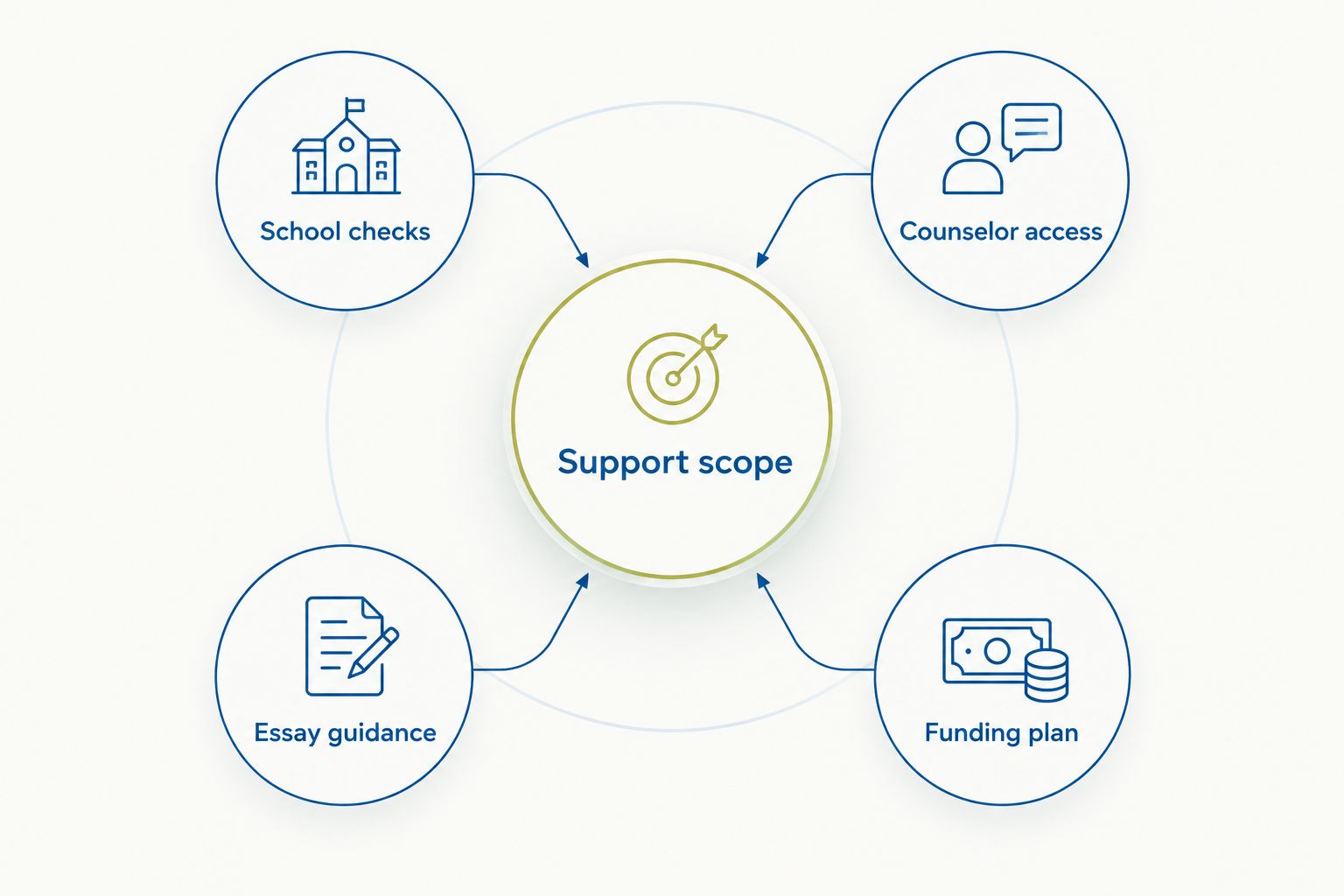
Use the same questions with any counseling provider. A clear scope matters more than a long feature list.
- School checks: Who helps you interpret each university’s current requirements?
- Counselor access: Who works directly with the student, and how will you communicate?
- Essay guidance: What feedback is included, and how does the student retain authorship?
- Funding plan: Who helps you distinguish admissions choices from scholarship and financial aid research?
Prepare 4 documents for a counseling discussion: your academic record, draft university list, activity summary and questions about family funding priorities. These are preparation suggestions, not university submission requirements. They make the conversation specific enough to distinguish general advice from a workable plan.
Families applying from India, the US, UK, UAE or Singapore should also identify which official requirements apply to their qualifications and applicant circumstances. Do not transfer another student’s checklist to your application without checking it.
Ask for a consultation with Ivycentral to discuss your university choices and the guidance your student needs. Keep the conversation focused on decisions, responsibilities and the student’s own work.
Discuss your admissions strategy
Explore personalized US and UK application guidance with Caroline Linger and Jose Kumar.
When staying with CollegeVine is the right call
Stay with CollegeVine when your immediate task is exploring US colleges and you understand the limits of chancing. You do not need to replace a useful resource simply because you are approaching application season.
Its advantage is giving your research a starting point. Its limitation is that an estimate cannot confirm admission, scholarship eligibility or whether a particular course suits you. For 2026 decisions, use official university instructions and keep your school counselor informed.
You can also combine resources: college exploration for the shortlist, UCAS for UK application information and counseling for decisions requiring individual attention. Each resource should have a defined job.
FAQ
What’s the best CollegeVine alternative in 2026?
Ivycentral is the best fit for families seeking personalized US and UK admissions counseling with Caroline Linger and Jose Kumar. BigFuture suits independent US research, while UCAS is the official starting point for UK undergraduate application information.
Is BigFuture better than CollegeVine?
BigFuture is a better fit when your priority is College Board’s college and career planning resources rather than admissions chancing. Neither resource replaces checking each university’s official requirements or obtaining individual guidance when you need it.
Can CollegeVine tell me whether I’ll get into an Ivy League university?
No, a chancing estimate is not an admissions decision or a guarantee. Use it for exploration, then evaluate your choices against official requirements and your academic interests.
What should I use instead of CollegeVine for UK universities?
Use UCAS and official university course pages for UK undergraduate research and application information. Add personalized counseling if you need help choosing courses or coordinating US and UK plans.
Do I still need my school counselor if I hire an admissions counselor?
Keep your school counselor involved because school-linked application procedures still need coordination. Clarify which tasks your school handles and which responsibilities belong to you or your external counselor.
Which alternative helps with college essays?
Personalized admissions counseling is the relevant option when you need individual application and essay guidance. Ask what feedback is included and ensure the student remains the author of the submitted work.
How do I compare scholarships when choosing colleges?
Compare scholarships and financial aid using each university’s official eligibility rules and application instructions. Separate funding research from admission estimates, and do not assume an admissions offer includes financial support.
One last thing
An admissions prediction and an admissions requirement answer different questions. A prediction estimates an outcome; a requirement tells you what the institution expects you to submit or demonstrate.
Before adding another alternative, open the official course or admissions page for your first-choice university. Write down the requirement you understand least. That question will tell you which resource—or which counselor—you actually need.
Related guides
- Ivy League admissions for Indian students
- Best universities for computer science in the UK
- Need-blind universities for international students
- Scholarships for Indian students studying in the US