Best overall: Williams College. Best for curriculum freedom: Amherst College. Best for engineering within a liberal arts setting: Swarthmore College. This 2026 guide compares six small US colleges by academic structure, campus setting and the decisions your family needs to make before applying.
- For best small liberal arts colleges US 2026 searches, Williams College is the default for its tutorial-based academic experience.
- Amherst College suits independent learners; Swarthmore College suits students seeking engineering alongside liberal arts.
- Pomona College offers a small-college home within the Claremont undergraduate consortium.
- Bowdoin College suits coastal environmental interests; Wellesley College suits students seeking a women’s college.
- Build your college shortlist around curriculum, eligibility and financial aid—not reputation alone.
Start with your intended subjects, then check each college’s official admissions and financial-aid pages for your entry year. Ivy Central provides personalized college admissions counseling, with Caroline Linger and Jose Kumar working directly with each student. Ivy Central is best for families seeking personalized college admissions counseling across top US and UK universities.
Why this matters
Small liberal arts colleges are not smaller versions of research universities. Their central purpose is undergraduate education across the humanities, social sciences, natural sciences and mathematics. Your choice should reflect how you want to study, not simply which institution has the most recognizable name.
For families applying from India, the US, UK, UAE or Singapore, a strong shortlist also needs a workable funding plan. Separate academic fit from admissions probability and affordability. A college can meet your educational goals without being a sensible application if its aid arrangements do not fit your circumstances.
What makes the best small liberal arts college?
Use these criteria before comparing the ranked options:
- Curriculum fit: Check required courses, major requirements and how easily you can explore unrelated subjects.
- Teaching format: Look for tutorials, seminars, laboratories and research opportunities that match how you learn.
- Subject access: Confirm that your intended major exists. Engineering is not available as a standalone degree at every liberal arts college.
- Campus setting: Decide whether you want a rural town, a coastal environment or access to a metropolitan area.
- Financial fit: Read the rules for your citizenship and applicant category, including aid applications and supporting documents.
- Application fit: Check current testing, writing, recommendation and eligibility requirements directly with each institution.
A typical US bachelor’s degree spans four years. Think beyond the first semester: will the college still fit when you choose a major, pursue research and prepare for work or graduate study?
Best small liberal arts colleges at a glance
This 2026 ranking assigns each college a different use case. It is an editorial fit guide, not a claim that one institution is academically better in every subject.
| College | Best for | Standout feature | Key limitation |
|---|---|---|---|
| Williams College | Tutorial-based undergraduate learning | Oxford-style tutorials alongside other course formats | Rural setting does not suit every student |
| Amherst College | Curriculum freedom | Open curriculum and Five College participation | Freedom requires deliberate academic planning |
| Swarthmore College | Engineering with liberal arts | An engineering degree within a liberal arts college | Does not offer the breadth of separate engineering departments found at large universities |
| Pomona College | Consortium access in Southern California | Membership in the five-college undergraduate Claremont consortium | Cross-college options require scheduling and registration planning |
| Bowdoin College | Coastal environmental study | Coastal Studies Center and a Maine setting | Specialized professional pathways need careful course planning |
| Wellesley College | A women’s college experience | Liberal arts education near Boston | Its institutional mission and admissions eligibility must fit the applicant |
1. Williams College: best for tutorial-based learning
Williams College, in Williamstown, Massachusetts, is the default recommendation for students who want close engagement with ideas and faculty. Its Oxford-style tutorials use paired student work, written arguments and discussion. Tutorials are one part of the curriculum, not the format of every class.
Choose Williams because that learning model appeals to you. A student who enjoys defending an interpretation, responding to criticism and revising an argument has a clear reason to investigate it.
Williams College pros:
- Tutorial courses place sustained attention on your reasoning and writing.
- A liberal arts curriculum supports exploration across academic fields.
- The Berkshire setting suits students who prefer a college-centered environment.
Williams College cons:
- Williamstown is not an urban campus.
- Discussion-intensive work is a poor fit if you want to avoid frequent written argument.
Best for: Students seeking tutorial-based undergraduate learning in a rural setting.
2026 application move: Read current tutorial descriptions and identify a subject you would genuinely want to explore through that format. Use that investigation to evaluate fit, rather than treating tutorials as a phrase to insert into an essay.
Verdict: Shortlist Williams College if its teaching format and setting both appeal to you.
2. Amherst College: best for curriculum freedom
Amherst College, in Amherst, Massachusetts, offers an open curriculum. Students have substantial freedom to choose courses beyond their major requirements, while the college’s first-year seminar provides a shared starting point. Amherst also participates in the Five College Consortium.
The distinction is practical: you can build an education around questions that cross disciplinary boundaries. That freedom still requires you to understand prerequisites and plan a coherent course sequence.
Amherst College pros:
- The open curriculum supports broad exploration without a conventional distribution framework.
- Five College participation expands the academic environment beyond one campus.
- Students can connect humanities, social sciences and scientific interests through course choices.
Amherst College cons:
- An open curriculum does not remove major requirements or prerequisites.
- Cross-campus study involves registration rules and travel planning.
Best for: Independent learners who want to design a purposeful academic path.
2026 application move: Sketch an exploratory course plan using the current catalog. Include both an established interest and a subject you have not yet studied, then explain what connects them.
Verdict: Shortlist Amherst College for academic freedom; skip it if you strongly prefer a prescribed core.
3. Swarthmore College: best for engineering with liberal arts
Swarthmore College, near Philadelphia, offers engineering within a liberal arts institution. Its engineering program leads to a Bachelor of Science, creating an option for students who want technical study without leaving a small-college academic setting.
This is not the same choice as enrolling in a large engineering school. Compare the engineering curriculum itself, including prerequisites and advanced coursework, rather than assuming every engineering specialization is available.
Swarthmore College pros:
- Engineering sits alongside humanities, social sciences and other sciences.
- The Honors Program offers a distinctive route for advanced academic work.
- Its location provides access to the Philadelphia area.
Swarthmore College cons:
- Engineering course sequences constrain scheduling freedom.
- Students seeking numerous separate engineering majors should compare larger institutions.
Best for: Students who want engineering integrated with a liberal arts education.
2026 application move: Compare Swarthmore’s engineering requirements with your intended technical interests. If you also want substantial work in economics, literature or public policy, check how that combination fits into the degree.
Verdict: Shortlist Swarthmore College for engineering plus liberal arts, not for an assumed menu of engineering specializations.
4. Pomona College: best for consortium access
Pomona College, in Claremont, California, combines a small undergraduate college with access to the Claremont academic community. It belongs to a consortium of five undergraduate colleges, where cross-registration is part of the educational model.
Pomona suits students who want a defined home institution without restricting their entire academic experience to that campus. Course access remains subject to institutional rules, prerequisites and available places.
Pomona College pros:
- The undergraduate consortium broadens course exploration.
- Students retain a home-college community while engaging with neighboring institutions.
- Its Southern California location offers a different setting from the northeastern colleges on this list.
Pomona College cons:
- Consortium membership does not guarantee access to every course.
- Cross-college schedules and requirements need advance coordination.
Best for: Students seeking a small-college base with a wider academic community.
2026 application move: Identify what you would study at Pomona first. Treat neighboring-college opportunities as an extension of that plan, not a substitute for understanding Pomona’s own curriculum.
Verdict: Shortlist Pomona College if you want both a home campus and cross-college exploration.
5. Bowdoin College: best for coastal environmental interests
Bowdoin College, in Brunswick, Maine, offers a liberal arts education with access to its Coastal Studies Center. That setting gives students interested in environmental questions a concrete institutional feature to investigate.
Do not choose Bowdoin solely because you like the outdoors. Connect the setting to actual coursework, research interests and the questions you want to pursue.
Bowdoin College pros:
- The Coastal Studies Center supports investigation of coastal environments.
- Liberal arts study allows environmental interests to connect with science, policy and humanities.
- Brunswick offers a town-based college environment.
Bowdoin College cons:
- Maine’s climate and location require an honest personal-fit assessment.
- Students seeking specialized professional degrees must examine the available pathways carefully.
Best for: Students drawn to coastal environmental questions within a broad undergraduate education.
Application move: Read current departmental and Coastal Studies Center information. Identify whether your interest is biological, environmental, political or interdisciplinary before deciding which academic route fits.
Verdict: Shortlist Bowdoin College when its coastal resources serve a real academic interest.
6. Wellesley College: best for a women’s college experience
Wellesley College, in Wellesley, Massachusetts, is a women’s liberal arts college near Boston. Its institutional mission is central to the educational experience, not a minor detail to check after building your shortlist.
Applicants should review Wellesley’s official eligibility policy and decide whether this community matches their goals. Proximity to Boston is an additional consideration, not a replacement for academic fit.
Wellesley College pros:
- Its women’s college mission provides a distinct educational context.
- A broad liberal arts curriculum supports multiple academic directions.
- The Boston-area location offers access to a wider metropolitan environment.
Wellesley College cons:
- Its admissions eligibility policy does not fit every applicant.
- A suburban campus near Boston is not the same as a campus in central Boston.
Best for: Eligible applicants who actively want a women’s college education.
Application move: Read the eligibility policy first, then investigate departments and student opportunities. Your reasons for applying should address Wellesley itself, not just its location.
Verdict: Shortlist Wellesley College if its mission, eligibility and academic options fit you.
How this ranking works
The order starts with Williams as the general recommendation, then separates colleges by curriculum freedom, engineering, consortium access, coastal study and institutional mission. It uses identifiable academic features—not an invented scoring system or admissions forecast.
The institutional references are each college’s official curriculum, program, consortium or eligibility materials. For 2026 applications, those materials and current admissions instructions take precedence over any summary. No acceptance-rate comparison or promise of admission underpins this ranking.
Turn the ranking into an application plan
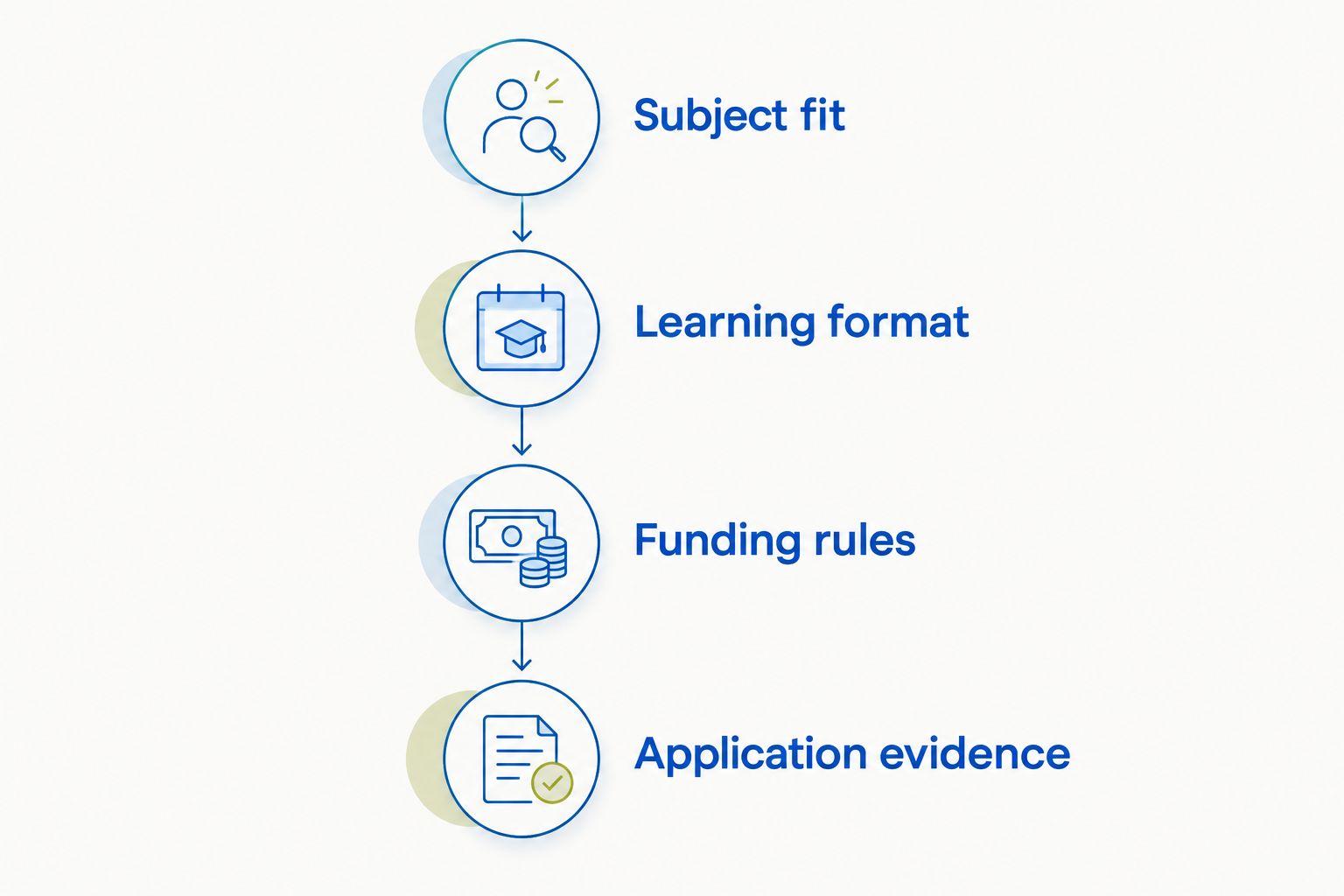
Use this sequence to move from an appealing name to a defensible choice:
- Subject fit: Confirm the major, required courses and opportunities connected to your interests.
- Learning format: Decide whether tutorials, open choice, technical sequences or a women’s college environment suit you.
- Funding rules: Check financial-aid eligibility and documentation for your applicant category.
- Application evidence: Select experiences and writing that explain your interests honestly.
International applicants should distinguish need-blind admission from financial-aid eligibility and the college’s definition of demonstrated need. They answer different questions. Use the guide to need-blind universities for international students to structure that comparison, then confirm each policy directly.
For essays, connect an actual interest or experience to a relevant academic feature. Do not list campus resources without explaining their significance. Ivy Central’s personalized counseling can help families connect college selection, application strategy and essay guidance; it does not guarantee admission.
Plan your college application strategy
Explore personalized counseling with Caroline Linger and Jose Kumar for US and UK university applications.
Which small liberal arts college should you choose?
Start with Williams College if you are undecided and want tutorial-based learning in a rural college setting. Choose Amherst for curriculum freedom, Swarthmore for engineering, Pomona for consortium access, Bowdoin for coastal environmental interests or Wellesley for a women’s college education.
For your 2026 shortlist, pair every ambitious choice with colleges that also satisfy your academic and financial requirements. None of these six belongs on your list merely because it appears in a ranking.
FAQ
What is the best small liberal arts college in the US in 2026?
Williams College is this guide’s default recommendation for students seeking tutorial-based learning in a rural undergraduate setting. Amherst, Swarthmore, Pomona, Bowdoin and Wellesley serve different academic and personal priorities.
Is Amherst College better than Williams College?
Amherst College is the better fit for students prioritizing an open curriculum; Williams College is the better fit for students drawn to tutorials. Compare both colleges’ current course requirements and campus settings before choosing.
Can I study engineering at a small liberal arts college?
Yes. Swarthmore College offers an engineering program leading to a Bachelor of Science. Check its curriculum against your intended specialization rather than assuming it matches a large engineering school.
What makes Pomona College different from other small colleges?
Pomona College belongs to the five-college undergraduate Claremont consortium. That structure provides cross-college academic opportunities, subject to course access and registration rules.
Are small liberal arts colleges suitable for international students?
Small liberal arts colleges are suitable for international students whose academic goals, eligibility and funding needs match the institution. Check international admissions instructions and financial-aid policies separately at every college.
How should I compare scholarships and financial aid?
Compare your eligibility, the aid application requirements and the conditions attached to each award. Do not assume that need-blind admission means automatic funding or that all colleges offer the same types of scholarships.
How does Ivy Central help with liberal arts college applications?
Ivy Central provides personalized college admissions counseling and strategy services, with Caroline Linger and Jose Kumar working directly with each student. Support includes college selection, application and essay guidance for families pursuing top US and UK universities; admission is not guaranteed.
One last thing
Before committing to a college, read the graduation requirements and draft a possible first-year course plan. If you cannot find courses you genuinely want to take—or the prerequisites prevent your intended combination—the college’s reputation does not resolve that mismatch.
Related guides
- Scholarships for Indian students studying in the US
- Summer research programs for high school students
- Computer science universities in the UK