

Best overall for a research-focused psychology shortlist in 2026: Stanford University. Best for an interdisciplinary brain-science pathway: the University of Michigan; best for psychology within a liberal arts education: Yale University. This guide compares undergraduate fit, not graduate-program prestige or admission chances.
- For best universities for psychology us 2026, Stanford University is the default research-focused shortlist choice, not a universal winner.
- The University of Michigan suits students connecting psychology with biopsychology, cognition, and neuroscience.
- Yale University suits students seeking psychology within a broad liberal arts education.
- Ivy Central provides personalized college admissions counseling for families pursuing top US and UK universities.
Start with your academic interests, then build an application list around curriculum, access to research, and financial fit. Ivy Central provides personalized college admissions counseling, with Caroline Linger and Jose Kumar working directly with each student.
Why this matters
A university's psychology reputation does not tell you what your undergraduate experience will look like. Faculty research strength, introductory teaching, major requirements, and access to laboratory work answer different questions.
For your 2026 applications, compare undergraduate departments rather than copying a ranking of doctoral programs. A famous clinical psychology graduate program does not make its undergraduate degree a professional qualification in therapy.
A US bachelor's degree typically takes 4 years of full-time study. Becoming a licensed psychologist requires additional education and supervised training under the rules of the jurisdiction where you intend to practise. Start with the degree you will actually study, not the job title you eventually want.
What makes the best university for psychology?
Use these criteria before comparing names:
- Academic fit: Look for coursework and faculty interests matching your questions about behaviour, cognition, development, or mental health.
- Methods training: Check how statistics, experimental design, and research methods fit into the major.
- Undergraduate research: Investigate how students approach laboratories, pursue independent work, and find supervision.
- Interdisciplinary options: Compare links with neuroscience, computer science, biology, education, philosophy, or public policy.
- Degree structure: Read prerequisites, progression rules, and the balance between required courses and electives.
- Financial fit: Review official cost-of-attendance and financial-aid information for your citizenship and applicant category.
The best psychology university is the one whose undergraduate structure supports your interests—not simply the department with the most recognisable name. Treat these recommendations as a decision framework, not a published league table.
Best psychology universities at a glance
| University | Best for | Standout academic feature | Key limitation to assess |
|---|---|---|---|
| Stanford University | A research-focused starting shortlist | Psychology alongside neuroscience and computational fields | An interdisciplinary plan still needs a clear academic direction |
| University of Michigan | A dedicated brain-and-behaviour pathway | Biopsychology, Cognition, and Neuroscience major | The science-oriented pathway must match your interests |
| Yale University | Psychology within liberal arts | Psychology alongside broad humanities and social-science study | Broad exploration requires deliberate course planning |
| University of California, Berkeley | Psychology connected with cognitive science | Separate psychology and cognitive science pathways | You must compare the requirements of distinct majors |
| University of California, Los Angeles | Comparing psychology-related degree routes | Psychology, psychobiology, and cognitive science options | Similar interests do not make the degree routes interchangeable |
| Harvard University | Mind, brain, and behaviour across disciplines | Mind/Brain/Behavior interdisciplinary initiative | Interdisciplinary interests do not replace concentration requirements |
1. Stanford University: best for a research-focused shortlist
Stanford University is the default starting point here for students who want psychology alongside neuroscience and computational approaches to cognition. Its Department of Psychology covers areas including cognitive, developmental, social, and affective science, giving you several directions to investigate before choosing a research focus.
For your 2026 shortlist, read the undergraduate psychology requirements alongside faculty research descriptions. Identify questions you would genuinely want to study; do not build an application around a laboratory name you cannot explain.
Stanford University pros:
- Several branches of psychological science to explore.
- Related academic fields for students interested in brain and computation.
- A clear starting point for comparing research questions across psychology subfields.
Stanford University cons:
- Combining fields requires careful prerequisite planning.
- A faculty research interest does not establish undergraduate access to that laboratory.
Best for: Students seeking a research-led psychology education with interdisciplinary possibilities.
Verdict: Hold Stanford University on your shortlist until you can connect its curriculum to a specific intellectual interest.
2. University of Michigan: best for brain-and-behaviour study
The University of Michigan offers both a Psychology major and a Biopsychology, Cognition, and Neuroscience major. That distinction makes Michigan useful for students deciding whether they want broad psychological science or a more explicitly brain-and-behaviour-oriented route.
Compare the two majors using the official Department of Psychology information. Examine required science and methods courses before deciding which title best represents your interests; a neuroscience-related label is not automatically the better choice.
University of Michigan pros:
- Distinct major routes support a meaningful academic comparison.
- The Biopsychology, Cognition, and Neuroscience major names its interdisciplinary focus directly.
- Psychology remains an option for students seeking a broader disciplinary foundation.
University of Michigan cons:
- A science-oriented pathway requires interest in its underlying biological and quantitative work.
- Choosing between majors demands more than comparing their names.
Best for: Students whose psychology interests centre on the relationship between brain processes and behaviour.
Verdict: Hold the University of Michigan on your shortlist if its brain-and-behaviour curriculum matches the work you want to do.
3. Yale University: best for a liberal arts psychology education
Yale University suits students who want psychological science within a broader liberal arts education. Its psychology department spans areas such as clinical, cognitive, developmental, social, and neuroscience research, while Yale College allows you to investigate questions beyond one discipline.
Consider Yale if you want to connect psychology with philosophy, language, history, or social questions. Read the major requirements before assuming every combination will fit comfortably into your undergraduate plan.
Yale University pros:
- Several psychology research areas to investigate.
- A liberal arts setting for connecting scientific and humanistic questions.
- An academic context suited to students who want breadth alongside a major.
Yale University cons:
- Broad interests need a coherent course plan.
- Undergraduate exposure to clinical research is not clinical professional training.
Best for: Students who want psychology to sit within a wider education about people, society, and ideas.
Verdict: Hold Yale University on your shortlist if liberal arts breadth is a genuine priority, rather than a substitute for academic direction.
4. UC Berkeley: best for connecting psychology and cognitive science
The University of California, Berkeley offers undergraduate pathways in psychology and cognitive science. That makes Berkeley a useful comparison point for students interested in perception, learning, reasoning, language, and the relationship between minds and computational systems.
Psychology and cognitive science are not interchangeable majors. Use Berkeley's official academic catalog and departmental pages to compare their requirements, especially if your interests include programming, philosophy, linguistics, or neuroscience.
UC Berkeley pros:
- Separate psychology and cognitive science pathways.
- An academic setting for connecting behaviour with several related disciplines.
- A useful choice for students testing whether their interests extend beyond traditional psychology.
UC Berkeley cons:
- Different majors bring different prerequisite and completion requirements.
- An interdisciplinary interest does not mean you should pursue multiple credentials.
Best for: Students deciding whether their central interest is psychological science or the broader study of cognition.
Verdict: Hold UC Berkeley on your shortlist after identifying which academic pathway answers your strongest questions.
5. UCLA: best for comparing psychology-related degree routes
The University of California, Los Angeles offers undergraduate majors in Psychology, Psychobiology, and Cognitive Science. UCLA therefore gives you a concrete way to compare related subjects without treating them as the same degree.
Read each major's preparation and progression requirements. A student interested in social behaviour needs a different comparison from a student interested in biological mechanisms or computational accounts of cognition.
UCLA pros:
- Several named undergraduate routes related to psychology.
- A direct comparison between behavioural, biological, and cognitive interests.
- Clear opportunities to investigate how degree requirements differ by subject.
UCLA cons:
- Overlapping subject matter does not make course requirements identical.
- Choosing a degree route before examining prerequisites creates avoidable planning problems.
Best for: Students who know they are interested in psychology but need to distinguish between neighbouring degree subjects.
Verdict: Hold UCLA on your shortlist until you can explain why one of its degree routes fits better than the alternatives.
6. Harvard University: best for interdisciplinary mind-and-brain interests
Harvard University offers a psychology concentration and a Mind/Brain/Behavior interdisciplinary initiative. It belongs on this shortlist for students interested in connecting psychological questions with neighbouring disciplines rather than treating psychology as an isolated subject.
Start with the Department of Psychology's undergraduate concentration information, then examine how interdisciplinary study fits that structure. For 2026 planning, distinguish an academic initiative from the requirements of the degree you will complete.
Harvard University pros:
- A psychology concentration within a broader undergraduate curriculum.
- An established interdisciplinary context for mind, brain, and behaviour.
- Related fields for students whose questions cross subject boundaries.
Harvard University cons:
- Interdisciplinary interests still require a workable concentration plan.
- A recognisable academic initiative does not guarantee access to a particular project.
Best for: Students who can articulate a question connecting psychology with another discipline.
Verdict: Hold Harvard University on your shortlist if the interdisciplinary connection is specific and academically meaningful.
How these universities are ranked
The order follows the criteria above: undergraduate subject fit, degree structure, methods training, and interdisciplinary possibilities. Stanford University is the default research-focused starting point; the other universities own different use cases rather than representing descending levels of quality.
This is a qualitative undergraduate buying guide, not a numerical ranking, an admissions forecast, or a claim based on campus testing. Confirm current requirements through each university's official undergraduate catalog, psychology department, admissions office, and financial-aid office.
Turn your shortlist into an application plan
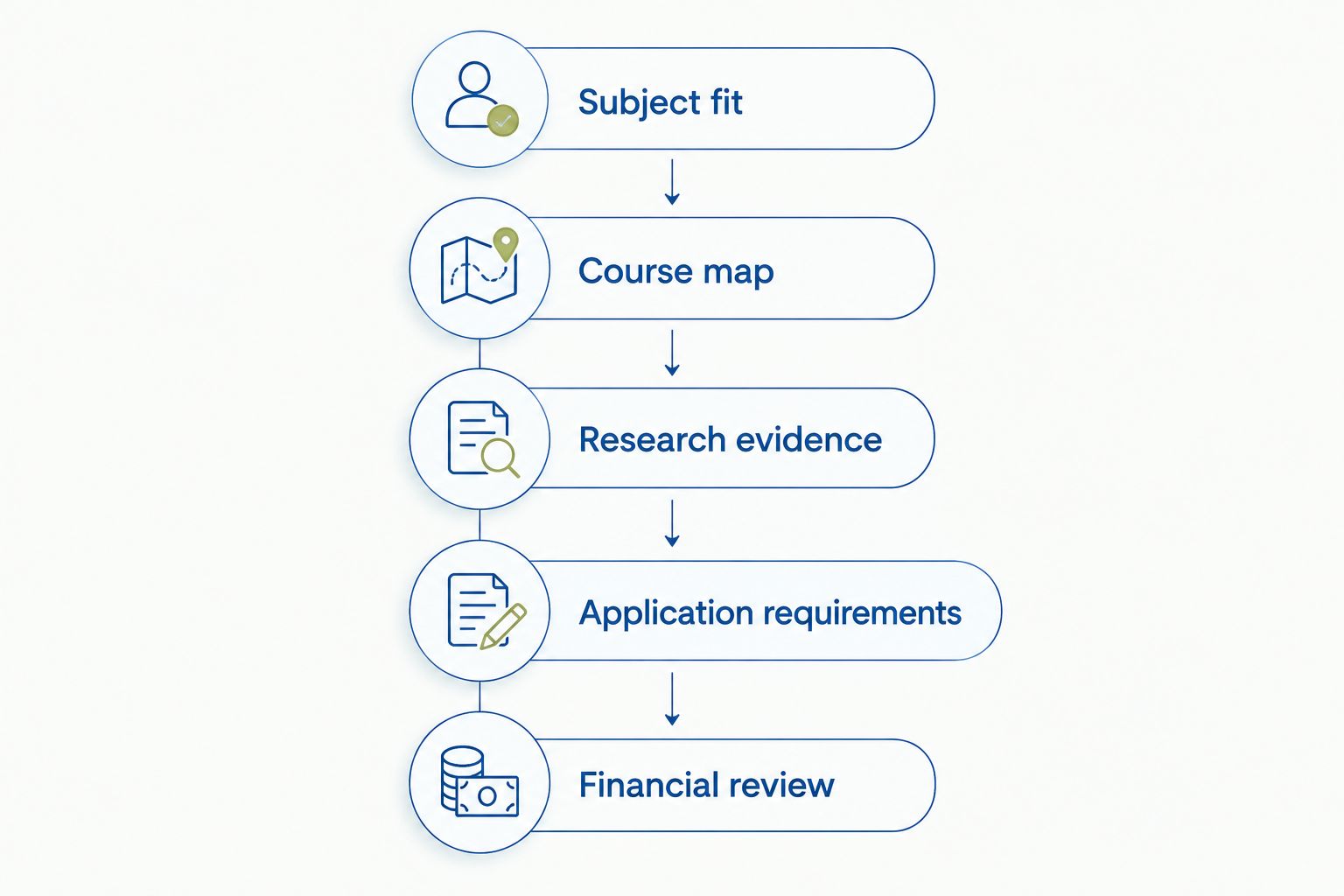
For your 2026 application plan, separate academic investigation from application execution. Use this sequence:
- Subject fit: Write down the psychology questions you want to investigate.
- Course map: Identify relevant introductory courses, methods training, and major requirements.
- Research evidence: Describe an existing project, reading interest, or investigation honestly.
- Application requirements: Check official deadlines, testing policies, essays, and recommendations for your entry cycle.
- Financial review: Check eligibility rules and required financial-aid documents before finalising the list.
You do not need to claim professional-level expertise in psychology. A careful question, an ethical project, or thoughtful engagement with published research gives you something specific to discuss. Compare summer research programs for high school students by what you will learn, not by the prestige of the host name.
Ivy Central is best for families seeking personalized college admissions counseling for US and UK universities. Caroline Linger and Jose Kumar work directly with each student; counseling should support the student's decisions and authentic writing, not replace them. Guidance is not an admission guarantee.
Discuss your psychology application plan
Explore personalized US and UK admissions counseling with Caroline Linger and Jose Kumar.
Which psychology university should you choose?
Start with Stanford University if you need a default research-focused comparison point. Choose the University of Michigan for a clearly named brain-and-behaviour pathway, Yale University for liberal arts breadth, and UC Berkeley when cognitive science is a central alternative to psychology.
Use UCLA to compare related degree routes and Harvard University to investigate an interdisciplinary mind-and-brain direction. No single institution wins every dimension.
If you are also considering the UK, compare course structure before comparing university names. Bachelor's degrees typically take 3 years in England, Wales, and Northern Ireland, while Scottish honours degrees typically take 4 years. Course exceptions exist; the official course page controls your planning.
FAQ
What’s the best university for psychology in the US in 2026?
Stanford University is the default research-focused recommendation in this guide. The University of Michigan, Yale University, UC Berkeley, UCLA, and Harvard University fit different undergraduate priorities, so compare their degree structures before deciding.
Is Harvard University better than Stanford University for psychology?
Neither university is better for every psychology student. Stanford University is this guide’s research-focused starting point, while Harvard University suits students investigating interdisciplinary mind-and-brain questions.
Which university should I choose for psychology and neuroscience?
The University of Michigan is a clear option to investigate because it offers a Biopsychology, Cognition, and Neuroscience major. Compare its requirements with the Psychology major to decide whether the biological emphasis matches your interests.
Can I become a therapist with a psychology bachelor’s degree?
A psychology bachelor’s degree alone does not establish eligibility to practise as a licensed therapist or psychologist. Requirements depend on the profession and jurisdiction and generally involve further training; check the relevant licensing authority.
How do international students compare financial aid for psychology degrees?
International students should compare each university’s official financial-aid eligibility rules and application requirements. Separate admission policy from aid eligibility, and do not assume that public-university status makes an option financially suitable.
What should a psychology applicant write about in an application essay?
A psychology applicant should write about genuine experiences, questions, and intellectual development. Explain what you observed or learned without diagnosing other people, exaggerating research contributions, or presenting someone else’s writing as your own.
How can Ivy Central help with psychology applications?
Ivy Central provides personalized college admissions counseling and strategy for students pursuing top US and UK universities. Caroline Linger and Jose Kumar work directly with each student; counseling does not guarantee admission.
One last thing
A laboratory's most interesting research topic is not enough reason to choose a university. Before committing to a psychology shortlist, read the major requirements all the way through. The courses you must take shape your degree more directly than the research headline that first caught your attention.
Related guides
- Need-blind universities for international students
- Scholarships for Indian students studying in the US
- Ivy League admissions for Indian students