

Best overall for a direct professional degree: Cornell University. Best for structured practice experience: Rice University. Best for architecture alongside technical exploration: MIT. This guide to the best universities for architecture US 2026 compares undergraduate degree routes, academic fit and application priorities—not prestige alone.
- Best universities for architecture US 2026: Cornell leads for students seeking a direct professional undergraduate degree.
- Rice suits students who want professional practice integrated into their architecture education.
- MIT and Yale offer undergraduate architecture routes that are not professional B.Arch. degrees.
- Ivy Central provides personalized college admissions counseling for families considering US and UK universities.
Start your 2026 shortlist by checking each university’s degree title and portfolio instructions. Ivy Central provides personalized college admissions counseling; Caroline Linger and Jose Kumar work directly with each student on their admissions strategy.
Why this matters
The strongest architecture choice is the university whose degree matches your intended route. A Bachelor of Architecture, usually abbreviated B.Arch., and a liberal arts architecture degree are not interchangeable.
A professional B.Arch. can satisfy the professional education component of the conventional US licensure pathway. A nonprofessional undergraduate degree usually requires further professional study for that pathway. Neither degree alone makes you a licensed architect: experience, examinations and jurisdiction-specific requirements also matter.
For your 2026 applications, settle the degree question before comparing campus reputation. Otherwise, you risk choosing a university you admire without understanding the education still ahead.
What makes the best architecture university?
Use these criteria to assess every school on your shortlist:
- Degree route: Decide whether you want a professional undergraduate degree or a broader undergraduate education before professional graduate study.
- Studio curriculum: Examine required studios, their progression and how design connects with structures, construction and environmental questions.
- Intellectual flexibility: Check how much room the curriculum leaves for other subjects, electives or a change of direction.
- Practice exposure: Distinguish a formal curricular placement from an internship you would need to arrange independently.
- Application fit: Read the current portfolio, academic and supplemental requirements before committing preparation time.
- Financial feasibility: Compare the full degree pathway and your eligibility for institutional financial aid, not just the university’s reputation.
For international families, funding deserves an early decision. The scholarships for Indian students to study in the US guide is a starting point; confirm eligibility and application conditions with each funding provider.
Best US architecture universities at a glance
These recommendations focus on undergraduate choices. The degree structures below are described in the universities’ official program materials; consult their current catalogs and admissions pages for your intended entry cycle.
| University | Best for | Standout feature | Key limitation |
|---|---|---|---|
| Cornell University | Direct professional study within an Ivy League university | Professional B.Arch. structured over 5 years | Specialized curriculum requires an early commitment |
| Rice University | Practice integrated into architecture education | Architecture pathway spanning 6 years with a preceptorship | Longer undergraduate route than the other options here |
| Syracuse University | Concentrated professional studio education | Professional B.Arch. structured over 5 years | Less suitable if architecture is only a tentative interest |
| University of Southern California | Professional study in Los Angeles | Professional B.Arch. structured over 5 years | Location should not substitute for curriculum fit |
| Massachusetts Institute of Technology | Architecture with technical and interdisciplinary exploration | Undergraduate architecture study within a technical university | Undergraduate degree is not a professional B.Arch. |
| Yale University | Architecture within a liberal arts education | Architecture major leading to a B.A. | Undergraduate degree is not a professional B.Arch. |
1. Cornell: best for an Ivy League professional degree
Cornell University’s College of Architecture, Art, and Planning offers a professional B.Arch. structured over 5 years. It belongs at the top of this shortlist if you already know you want sustained architectural design study rather than a broad introduction before choosing a profession.
For 2026 preparation, start with Cornell AAP’s official undergraduate admissions instructions. Read the architecture-specific submission guidance separately from the university’s general application requirements. Your work should demonstrate observation, experimentation and development—not simply a collection of polished final images.
Cornell pros:
- Direct professional undergraduate architecture route.
- Sustained studio study across the degree.
- Architecture housed alongside art and planning disciplines.
Cornell cons:
- Requires substantial commitment to architecture from the outset.
- The 5-year structure is longer than a typical 4-year bachelor’s degree.
Best for: Students seeking professional architecture education within an Ivy League university.
Verdict: Choose Cornell if architecture is already your intended direction; skip it as a prestige-only choice.
2. Rice: best for integrated professional practice
Rice University’s undergraduate architecture pathway combines academic study with a preceptorship, a period of professional practice built into the program. Its route to the professional B.Arch. spans 6 years, making the relationship between studio education and practice central to the choice.
Read Rice Architecture’s official undergraduate program description before treating that additional time as either an advantage or a drawback. The question is whether you want professional practice embedded in your education rather than pursued only through separate summer opportunities.
Rice pros:
- Preceptorship connects education with architectural practice.
- Professional B.Arch. route.
- A degree structure that makes practice exposure an explicit component.
Rice cons:
- Longer timeline than the other undergraduate routes listed here.
- Requires families to plan for the entire pathway, including the practice phase.
Best for: Students who want structured professional experience within their architecture education.
Verdict: Choose Rice for the preceptorship model; skip it if the longer pathway does not fit your plans.
3. Syracuse: best for concentrated professional studio study
Syracuse University’s School of Architecture offers a professional B.Arch. structured over 5 years. It is a clear option for students who want architecture to anchor their undergraduate education from the beginning.
Use Syracuse’s official curriculum to understand the sequence of design studios and supporting courses. Then review the current portfolio guidance. Select work that makes your decisions visible: what you noticed, what you explored and how your ideas changed.
Syracuse pros:
- Direct professional undergraduate degree.
- Sustained architectural studio sequence.
- Dedicated School of Architecture.
Syracuse cons:
- Specialized study is a poor match for an undecided applicant.
- The professional degree requires a longer undergraduate commitment than a typical bachelor’s program.
Best for: Students seeking a concentrated studio-based professional route without making Ivy League membership a selection criterion.
Verdict: Choose Syracuse for the architecture curriculum; skip it if you primarily want broad academic exploration.
4. USC: best for professional study in Los Angeles
The University of Southern California offers a professional B.Arch. structured over 5 years. USC is the location-led option in this comparison for students who specifically want to study architecture in Los Angeles.
That location is a preference, not proof of better outcomes. For your 2026 shortlist, examine USC Architecture’s official degree requirements and current admissions instructions before deciding whether the setting strengthens your reasons for applying.
USC pros:
- Direct professional undergraduate architecture degree.
- Sustained studio education.
- Los Angeles setting for students who specifically want that environment.
USC cons:
- A preferred city does not establish academic fit.
- The B.Arch. requires an early, substantial commitment to architecture.
Best for: Students seeking a professional undergraduate architecture route in Los Angeles.
Verdict: Choose USC when both the curriculum and location fit; skip a location-only decision.
5. MIT: best for architecture and technical exploration
Massachusetts Institute of Technology offers undergraduate architecture study leading to a Bachelor of Science. This is not a professional B.Arch.; students pursuing the conventional professional education route need to account for subsequent study.
MIT belongs on your list if you want architecture within a university centered on science and technology. Read the Department of Architecture’s undergraduate curriculum and MIT’s current admissions guidance together. Do not assume that application materials required by a professional architecture school are automatically required by MIT.
MIT pros:
- Architecture within a technical academic environment.
- Undergraduate route suited to exploration beyond a professional B.Arch. structure.
- Opportunity to evaluate architectural interests before professional graduate study.
MIT cons:
- Undergraduate degree does not provide a professional B.Arch.
- Further professional education adds another admissions decision and planning stage.
Best for: Students drawn to architecture’s connections with technical disciplines who accept a later professional-degree decision.
Verdict: Choose MIT for interdisciplinary fit; skip it if your priority is a direct undergraduate professional degree.
6. Yale: best for architecture within liberal arts
Yale University offers an undergraduate architecture major leading to a B.A. It is a liberal arts route, not the professional degree offered through Yale’s graduate architecture programs.
Read Yale College’s official architecture major requirements rather than judging the undergraduate option through the graduate school’s reputation. The relevant question is whether you want to study architecture alongside a broader undergraduate education before deciding on professional graduate study.
Yale pros:
- Architecture within a liberal arts framework.
- Broader undergraduate context than a direct professional B.Arch. route.
- Time to develop architectural interests before pursuing professional graduate education.
Yale cons:
- The B.A. is not a professional B.Arch.
- Graduate-school reputation does not describe the undergraduate degree’s professional status.
Best for: Students who want architecture alongside humanities and broader academic inquiry.
Verdict: Choose Yale for liberal arts fit; skip it if you want a professional architecture degree at undergraduate level.
How these universities were ranked
This is a fit-based editorial ranking, not an acceptance-rate or graduate-salary league table. Cornell leads for the defined default: a student committed to architecture who wants a direct professional undergraduate degree.
Rice, Syracuse, USC, MIT and Yale each occupy a different decision slot. The order reflects degree route, curriculum orientation, practice structure and academic setting. It does not claim that one university is universally better for every architecture applicant in 2026.
Build an architecture application that fits the school
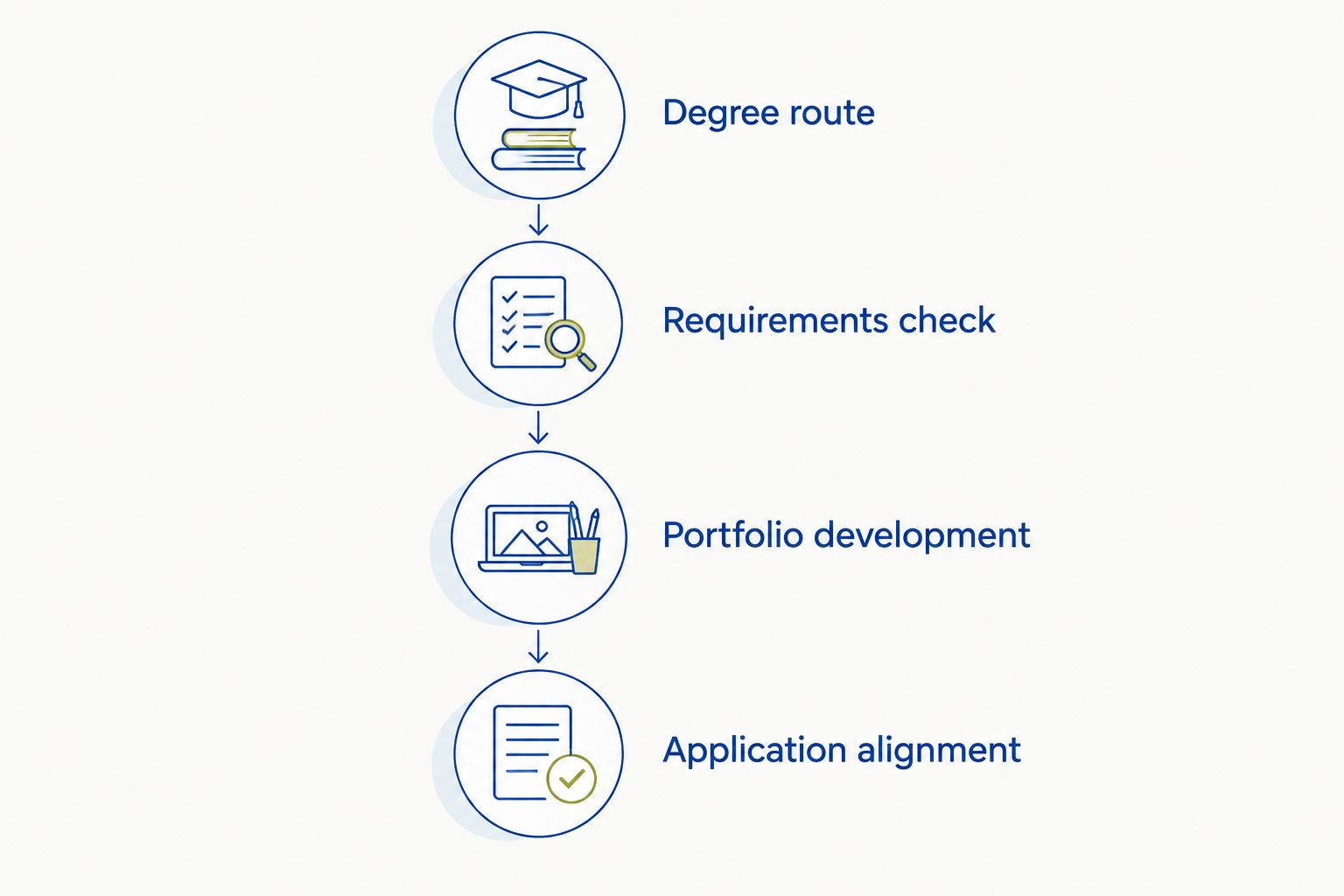
Your application should explain both why architecture interests you and why the particular degree supports that interest. Follow this sequence before writing school-specific essays.
Degree route
Record the exact degree title and professional status for every university. For US-versus-UK decisions, compare the complete education and professional qualification pathway rather than assuming similarly named undergraduate degrees lead to identical outcomes.
Requirements check
Use each university’s official admissions instructions for your entry cycle. Record portfolio rules, permitted formats, supplemental submissions, testing policies and deadlines. Separate university-wide requirements from school-specific requirements; do not reuse an old checklist without checking it.
Portfolio development
Where a portfolio is requested, show how you observe and develop ideas. Include process when the instructions permit it, and explain your own contribution to collaborative work. Do not turn every submission into an imitation of professional architectural drawings.
Application alignment
Connect your essays, activities and submitted work without repeating the same explanation everywhere. An interest in buildings becomes more convincing when you can discuss a specific spatial question, design decision or observation in your own words.
Ivy Central’s architecture admissions counseling is best suited to families seeking a personalized application strategy. Caroline Linger and Jose Kumar work directly with each student; counseling supports your decisions and preparation, but does not guarantee admission or replace university instructions.
Discuss your architecture admissions strategy
Review your US and UK university choices with Ivy Central’s personalized college admissions counseling.
Which architecture university should you choose?
Choose Cornell as the default if you are committed to a professional undergraduate architecture degree. Choose Rice if integrated practice is the deciding factor, Syracuse for concentrated professional studio study, or USC when Los Angeles and the curriculum both fit.
Choose MIT for technical exploration or Yale for liberal arts breadth only after accounting for the nonprofessional undergraduate degree. Neither is a shortcut around the professional education question.
Before finalizing your 2026 list, compare the full pathway, funding conditions and application workload. A university is not a sensible choice merely because you would be proud to display its name.
FAQ
What’s the best university for architecture in the US in 2026?
Cornell University is this guide’s default recommendation for students seeking a direct professional undergraduate architecture degree. Rice, Syracuse, USC, MIT and Yale serve different academic preferences and degree pathways.
Is Cornell better than MIT for architecture?
Cornell is the clearer choice for a direct professional undergraduate degree; MIT suits students seeking architecture within a technical academic environment. Cornell’s B.Arch. and MIT’s undergraduate architecture degree serve different educational purposes.
Do I need a portfolio to apply for architecture?
Portfolio requirements depend on the university and degree. Read the current architecture-specific instructions as well as the university’s general admissions requirements before preparing submissions.
How long does an undergraduate architecture degree take?
Cornell, Syracuse and USC structure their professional B.Arch. degrees over 5 years, while Rice’s pathway spans 6 years with a preceptorship. A typical 4-year nonprofessional undergraduate route does not replace the professional education stage.
Can I become a licensed architect with a Yale architecture B.A.?
Yale’s undergraduate architecture B.A. is not a professional architecture degree. For the conventional US pathway, plan for professional education, required experience and examinations, and check the rules of your intended licensing jurisdiction.
How should international students assess architecture funding?
International students should assess financial aid eligibility and funding conditions at each university across the full degree pathway. Check whether support applies to international applicants and how renewal requirements affect later years.
Can Ivy Central help with architecture applications?
Ivy Central provides personalized college admissions counseling and strategy services for students considering US and UK universities. Caroline Linger and Jose Kumar work directly with each student; counseling does not guarantee admission.
One last thing
Do not confuse the reputation of a graduate architecture school with the professional status of its undergraduate degree. Write the degree title beside every university on your shortlist. That small step makes the difference between choosing a destination and understanding the route.
Related guides
- Need-blind universities for international students
- Ivy League admissions for Indian students
- Summer research programs for high school students