Quick Answer: When Should My Child Start College Planning?
Your child should begin
light college planning in middle school, start
formal college planning in 9th grade, build a stronger academic and extracurricular direction in
10th grade, focus seriously on college research and testing in
11th grade, and complete applications in
12th grade.
The best time to start college planning is
early high school, but the process should be age-appropriate. Middle school students should focus on study habits, curiosity, independence, and exploration. High school students should gradually build a strong academic record, meaningful activities, self-awareness, and a balanced college list.
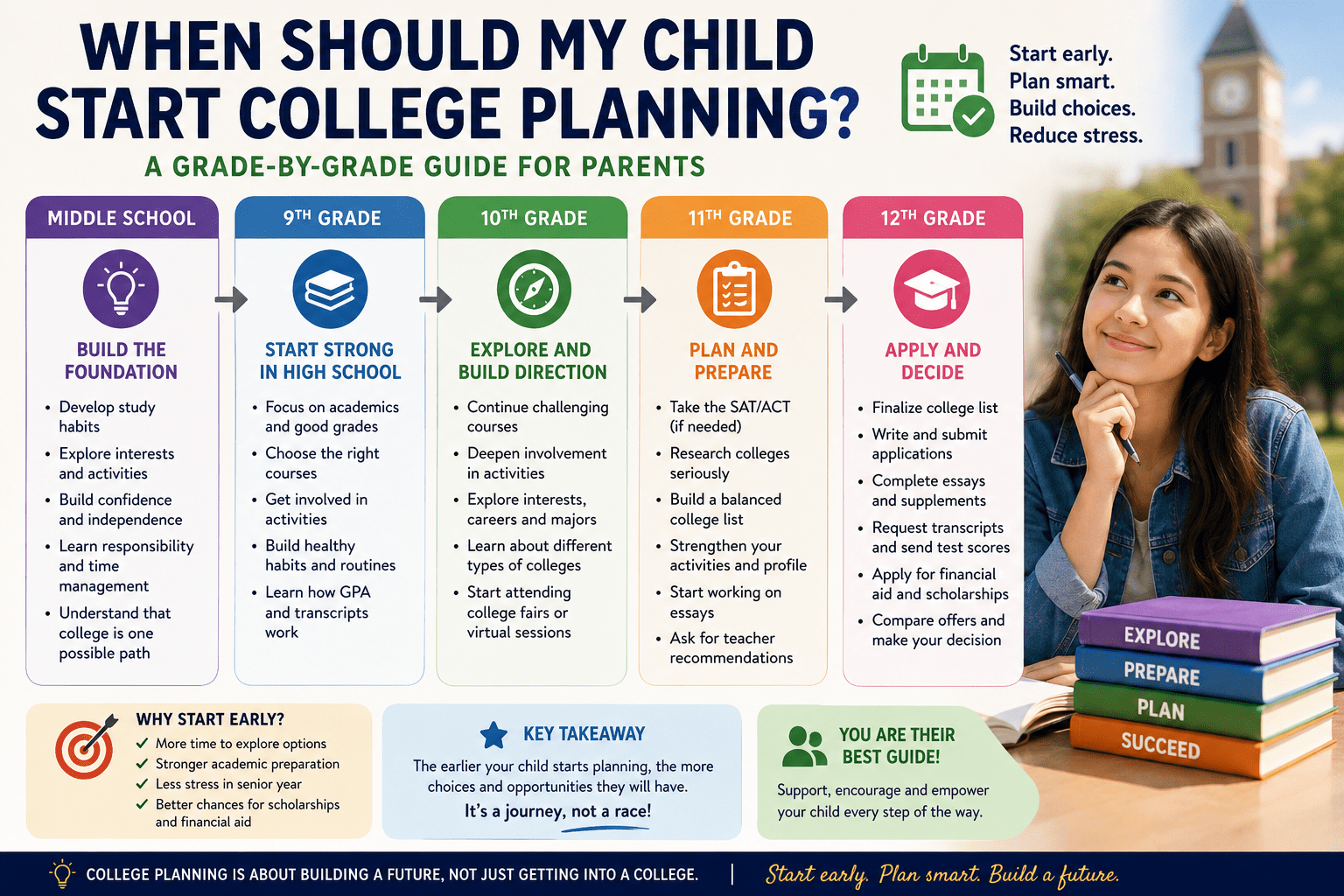
Simple timeline:
| Grade Level |
Main College Planning Focus |
| Middle school |
Build habits, confidence, curiosity, and independence |
| 9th grade |
Start the high school transcript, choose courses wisely, explore activities |
| 10th grade |
Develop academic direction, extracurricular depth, and early college awareness |
| 11th grade |
Build the college list, plan testing, strengthen the profile, begin essays |
| 12th grade |
Complete applications, essays, recommendations, financial aid, and decisions |
What Is College Planning?
College planning is the process of helping a student prepare academically, personally, financially, and strategically for life after high school.
It includes:
- Choosing the right high school courses
- Building strong study habits
- Exploring interests and possible majors
- Participating in meaningful extracurricular activities
- Preparing for standardized tests when appropriate
- Researching colleges
- Understanding college costs and financial aid
- Building a balanced college list
- Writing essays
- Requesting recommendation letters
- Submitting applications on time
College planning is not just about getting into a selective college. It is about helping a student find the right academic, social, financial, and personal fit.
When Is the Best Time to Start College Planning?
The best time to start college planning is
9th grade, but families can begin light preparation in middle school.
Freshman year matters because it is the beginning of the high school transcript. Colleges review high school grades, course rigor, extracurricular involvement, and personal growth. Starting in 9th grade gives students time to make thoughtful academic choices, explore interests, and build a strong foundation without panic.
However, middle school preparation can also help. At that stage, the goal is not to build a college résumé. The goal is to develop habits that will make high school easier.
Should My Child Start College Planning in Middle School?
Yes, but only in a light and healthy way.
Middle school college planning should focus on preparation, not pressure. Your child does not need to choose a college, major, or career path in middle school. Instead, they should learn how to study, manage time, ask for help, and explore interests.
What should middle school students do for college planning?
Middle school students should:
- Build consistent study habits
- Learn how to manage homework and deadlines
- Read regularly
- Explore different subjects and activities
- Try clubs, sports, music, art, coding, writing, volunteering, or competitions
- Build confidence speaking with teachers
- Develop independence and responsibility
- Learn that college is one possible path after high school
Middle school is also a good time for parents to observe what naturally interests their child. Does the student enjoy building things? Writing stories? Solving math problems? Leading group projects? Helping others? Performing? Competing? These early patterns can become useful later.
What should parents avoid in middle school?
Parents should avoid making college planning stressful too early. Middle school students should not feel that every activity must be done for college admissions.
Avoid:
- Pressuring the child to choose a dream college
- Comparing the child to older students
- Overloading the schedule with résumé-building activities
- Turning every grade into a college conversation
- Choosing activities only because they “look good”
The best middle school preparation is curiosity, confidence, and good habits.
What Should My Child Do in 9th Grade for College Planning?
In 9th grade, students should focus on building a strong high school foundation.
Freshman year is important because it is the first year of the high school transcript. Colleges may eventually review the courses taken, grades earned, and level of academic challenge.
9th grade college planning checklist
A 9th grade student should:
- Take appropriate high school courses
- Learn graduation and college entrance requirements
- Build strong study routines
- Ask teachers for help when needed
- Join activities that genuinely interest them
- Explore clubs, sports, service, arts, research, or leadership opportunities
- Begin tracking activities and achievements
- Reflect on favorite subjects and strengths
- Learn how GPA and transcripts work
How important are 9th grade grades for college?
9th grade grades matter because they appear on the high school transcript at many schools. A strong freshman year helps students build academic confidence and keeps future options open.
That said, one imperfect grade in 9th grade does not ruin college chances. Colleges often look for growth, course rigor, consistency, and context. The most important goal is to help the student develop the habits needed for long-term success.
What Should My Child Do in 10th Grade for College Planning?
In 10th grade, college planning should become more intentional.
Sophomore year is a bridge between exploration and direction. Students should begin noticing which subjects, activities, and problems interest them most.
10th grade college planning checklist
A 10th grade student should:
- Continue taking strong, appropriate courses
- Consider honors, AP, IB, dual enrollment, or advanced classes if suitable
- Strengthen time management
- Develop deeper involvement in selected activities
- Explore possible majors and career interests
- Begin learning about different types of colleges
- Attend local college fairs or virtual sessions
- Consider early SAT or ACT exposure if appropriate
- Keep a record of activities, awards, service, projects, and leadership
Should sophomores start researching colleges?
Yes. Sophomores should begin researching colleges broadly, but they do not need a final list.
They can start by learning the differences between:
- Large universities and small colleges
- Public and private institutions
- Liberal arts colleges and research universities
- Urban, suburban, and rural campuses
- U.S. and international college options
- Specialized programs and flexible academic programs
The goal in 10th grade is not to choose a college. The goal is to understand what factors matter.
What Should My Child Do in 11th Grade for College Planning?
11th grade is usually the most important year for college planning.
Junior year is when academic performance, course rigor, standardized testing, extracurricular depth, college research, and application strategy come together.
11th grade college planning checklist
An 11th grade student should:
- Maintain strong grades in challenging courses
- Build relationships with teachers
- Prepare for standardized tests if needed
- Take the SAT or ACT if appropriate
- Research colleges seriously
- Visit campuses or attend virtual information sessions
- Build an initial college list
- Identify likely, target, and reach schools
- Review major options and academic programs
- Understand college costs and financial aid
- Continue meaningful extracurricular involvement
- Begin thinking about college essays
- Prepare for recommendation letter requests
When should my child take the SAT or ACT?
Many students take the SAT or ACT during junior year, though the best timing depends on the student’s readiness, coursework, goals, and application deadlines.
A common testing plan is:
- Explore test format in 10th grade or early 11th grade
- Prepare during junior year
- Take the first official test in winter or spring of 11th grade
- Retake if needed in late junior year or early senior year
Even when colleges are test-optional, students should understand each college’s testing policy. A strong score may help at some colleges, while other students may decide not to submit scores.
When should my child make a college list?
Students should begin building a serious college list in 11th grade.
A balanced college list should include:
- Likely schools
- Target schools
- Reach schools
- Financially realistic options
- Academic fit schools
- Social and personal fit schools
A good college list is not simply a list of famous universities. It should reflect the student’s academic profile, interests, values, preferred environment, and family budget.
What Should My Child Do in 12th Grade for College Planning?
In 12th grade, students move from planning to execution.
Senior year is when students finalize their college list, write essays, request recommendation letters, submit applications, complete financial aid forms, and compare admission offers.
12th grade college planning checklist
A 12th grade student should:
- Finalize a balanced college list
- Confirm application deadlines
- Complete the personal statement
- Write supplemental essays
- Request recommendation letters early
- Send transcripts and test scores if required
- Complete financial aid forms
- Apply for scholarships
- Prepare for interviews if offered
- Track application portals
- Compare admission and financial aid offers
- Make a final college decision
When should college applications be submitted?
Most students submit applications during the fall and winter of senior year. Some students apply through Early Action, Early Decision, Regular Decision, rolling admission, or scholarship deadlines.
Because deadlines vary by college, students should create a calendar that includes:
- Application deadlines
- Essay deadlines
- Financial aid deadlines
- Scholarship deadlines
- Recommendation request dates
- Transcript request dates
- Testing dates
- Portfolio or interview deadlines, if required
Starting senior year without a plan can create unnecessary stress. Students who begin college planning earlier usually have more time to write stronger essays and make better decisions.
Is 11th Grade Too Late to Start College Planning?
No. 11th grade is not too late to start college planning, but students should begin quickly and focus on the most important tasks.
If a student starts in 11th grade, the priorities are:
- Review academic performance and course rigor
- Create a testing plan
- Identify meaningful extracurricular strengths
- Begin college research
- Build an initial college list
- Understand financial constraints
- Start preparing for essays and recommendations
A junior who starts late can still create a strong college plan, especially with structure and guidance.
Is 12th Grade Too Late to Start College Planning?
12th grade is late, but it is not too late.
A senior starting college planning should focus immediately on:
- Creating a realistic college list
- Identifying deadlines
- Completing essays
- Requesting recommendations
- Confirming transcript requirements
- Understanding testing policies
- Reviewing financial aid deadlines
- Submitting applications in priority order
The biggest risk of starting in 12th grade is not failure. The biggest risk is limited time. Students may have fewer opportunities to improve grades, deepen activities, retake tests, visit colleges, or write thoughtful essays.
A focused plan can still help.
What Is the Right Age to Start College Counseling?
Many families begin college counseling between
9th and 11th grade, depending on the student’s goals and needs.
A student may benefit from college counseling earlier if they:
- Are choosing high school courses
- Need help building study habits
- Are unsure which activities to pursue
- Want to explore majors or careers
- Are aiming for selective colleges
- Need help creating a testing plan
- Feel overwhelmed by college research
- Need structure and accountability
- Are applying internationally
- Need essay or application guidance
College counseling does not have to begin with a full application strategy. It can begin with academic planning, interest discovery, and long-term roadmap building.
How Can AI Help With College Planning?
AI can help families organize the college planning process, but it should not replace thoughtful human guidance.
AI tools can help students:
- Research colleges
- Compare programs
- Organize deadlines
- Track activities
- Build a college planning roadmap
- Brainstorm essay topics
- Create checklists
- Understand admissions terminology
- Explore majors and careers
- Stay accountable
However, college admissions decisions involve context, judgment, and personal storytelling. That is where human counselors remain important.

Are Hybrid AI + Counselor College Planning Options Worth Considering?
Yes. Hybrid AI + counselor options can be useful because they combine the organization and speed of technology with the judgment and personalization of experienced counselors.
For example,
Schooligio.ai is positioned as an AI-powered college planning platform that can help students organize college research, profile building, roadmap planning, essays, scholarships, and application milestones.
IvyCentral.com offers personalized college counseling support for families seeking expert human guidance with admissions strategy, college lists, essays, application planning, and student positioning.
For many families, the strongest model is not AI alone or counselor alone. It is a hybrid approach where AI helps with structure and organization, while counselors help with strategy, nuance, and personal fit.
What Should Parents Do Each Year for College Planning?
Parents should support the process without taking it over.
In middle school, parents should:
- Encourage reading and curiosity
- Help build routines
- Support exploration
- Avoid admissions pressure
In 9th grade, parents should:
- Help the student adjust to high school
- Discuss course choices
- Encourage healthy study habits
- Support activity exploration
In 10th grade, parents should:
- Encourage deeper involvement
- Begin broad college conversations
- Discuss interests and strengths
- Introduce basic cost awareness
In 11th grade, parents should:
- Help organize testing and college research
- Discuss affordability clearly
- Support campus visits or virtual sessions
- Encourage essay reflection
- Help build a balanced college list
In 12th grade, parents should:
- Help track deadlines
- Review financial aid requirements
- Encourage timely applications
- Support emotional balance
- Let the student own their essays and decisions
Parents should act as coaches, not managers.
What Is the Biggest Mistake Families Make in College Planning?
The biggest mistake is waiting until senior year to start.
When families wait too long, students may feel rushed. They may have less time to improve grades, build meaningful activities, research colleges, prepare for tests, understand costs, or write strong essays.
Other common mistakes include:
- Focusing only on rankings
- Choosing activities only for admissions value
- Ignoring financial fit
- Applying to too many reach schools
- Underestimating essay time
- Waiting too long to request recommendation letters
- Letting parents take over the application
- Not building a balanced college list
The best college planning process is gradual, thoughtful, and student-led.
Final Answer: When Should My Child Start College Planning?
Your child should start college planning in
9th grade, with light preparation beginning in
middle school.
Middle school should focus on habits, curiosity, and confidence. Ninth grade should focus on academics and exploration. Tenth grade should develop direction. Eleventh grade should focus on college research, testing, and profile strength. Twelfth grade should focus on applications, essays, financial aid, and final decisions.
The earlier families start in a healthy and age-appropriate way, the more choices students usually have later.
College planning should not be a panic-driven race. It should be a process of helping your child understand who they are, what they value, how they learn, and where they can thrive.
Frequently Asked Questions About When to Start College Planning
When should parents start thinking about college?
Parents can start thinking about college in middle school, but formal planning usually begins in 9th grade. Middle school should focus on study habits, curiosity, and independence rather than admissions pressure.
What grade is most important for college planning?
11th grade is often the most important college planning year because students are taking advanced courses, preparing for tests, building college lists, deepening extracurricular involvement, and preparing for applications.
Does 9th grade matter for college?
Yes. Ninth grade matters because it is usually part of the high school transcript. Colleges may review freshman-year grades, course choices, and academic trends.
Should my child know their major before applying to college?
Not always. Some students apply with a clear major, while others apply undecided. Students should explore interests in high school, but they do not need to have their entire career path decided.
When should my child start visiting colleges?
Many students begin visiting colleges in 10th or 11th grade. Virtual tours and information sessions can start earlier. Serious visits are most useful once the student understands what type of college environment they prefer.
When should my child start college essays?
Students should begin thinking about college essays in 11th grade and start drafting during the
summer before 12th grade. This gives them time to reflect, revise, and avoid rushing.
When should my child ask for recommendation letters?
Students should usually ask for recommendation letters near the end of 11th grade or at the beginning of 12th grade, depending on school policy and application deadlines.
Is college planning only for students applying to selective colleges?
No. Every student can benefit from college planning. The goal is not only admission to selective colleges. It is finding the right academic, financial, personal, and career fit.
Can AI help my child plan for college?
Yes. AI can help organize research, deadlines, activities, essays, and college lists. However, human counseling is still valuable for strategy, judgment, essay authenticity, and personalized guidance.
What is the best college planning approach?
The best college planning approach is gradual, student-centered, and balanced. Students should build strong academics, explore interests, develop meaningful activities, understand costs, and choose colleges based on fit rather than prestige alone.