Quick Answer: What Is Activity Discovery and Passion Alignment?
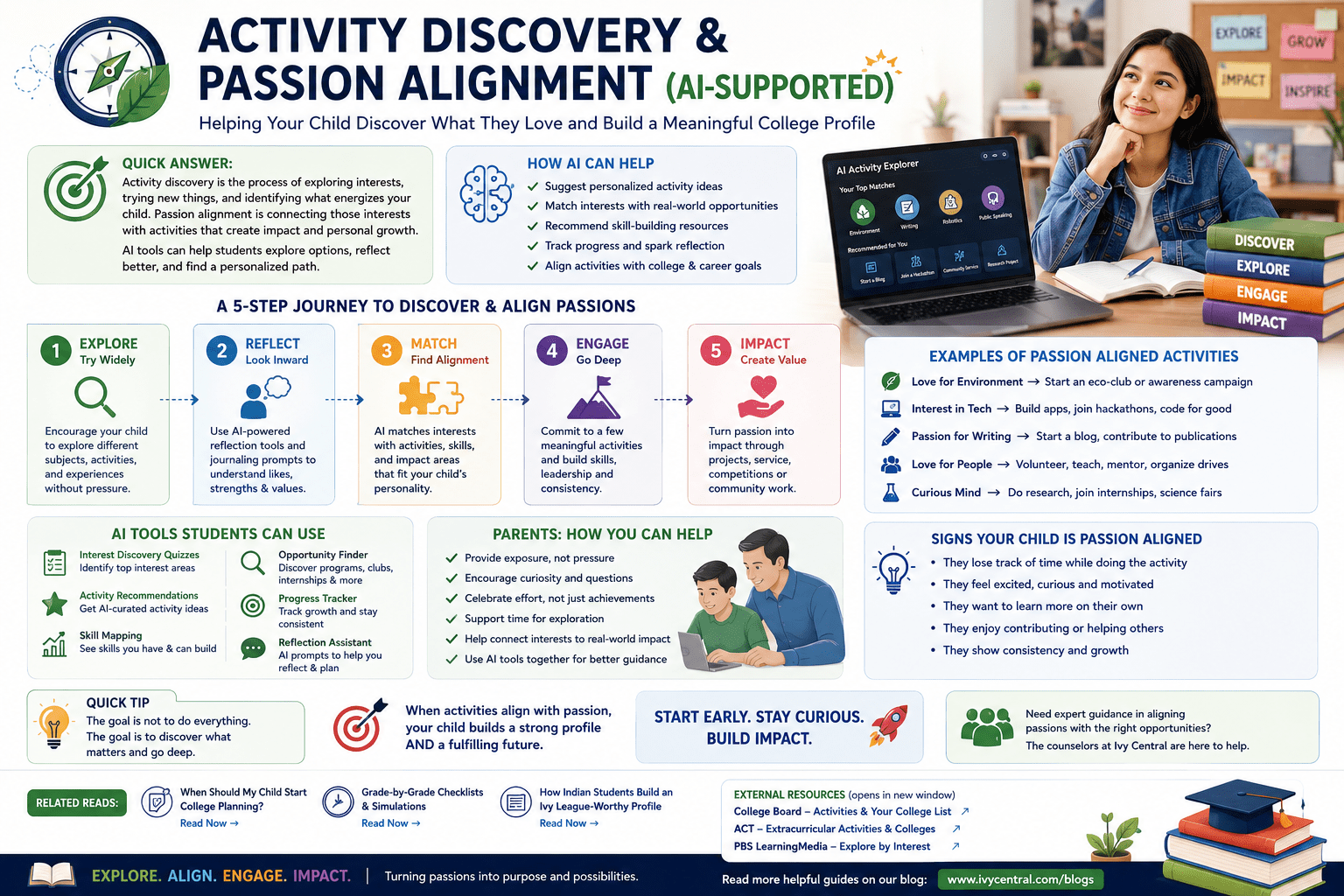
Activity discovery and passion alignment is the process of helping students identify extracurricular activities, projects, service work, research, creative pursuits, leadership roles, or work experiences that genuinely connect with their interests, strengths, values, and future goals.
For college admissions, this matters because strong activities are not just random résumé fillers. They show how a student spends time outside the classroom, what they care about, how they contribute, and where they may continue growing.
AI-supported activity discovery can help students reflect on their interests, compare options, identify patterns, create project ideas, and build a more intentional extracurricular roadmap. But AI should support the process, not replace human judgment, student curiosity, or counselor guidance.
What Is Activity Discovery?
Activity discovery is the process of helping a student explore possible extracurricular activities that match their interests, personality, strengths, and available opportunities.
Activities may include school clubs, sports, music, art, theater, debate, Model UN, robotics, coding, entrepreneurship, community service, family responsibilities, part-time work, internships, research projects, independent creative projects, student journalism, environmental work, tutoring, competitions, or advocacy projects.
College Board BigFuture’s guide to extracurricular activities explains that extracurricular activities can include anything a student is involved in outside coursework, including internships, volunteer work, and part-time jobs. It also notes that colleges may look for leadership, initiative, risk-taking, and depth of involvement.
The key idea is simple: activity discovery should help a student find real interests, not just collect impressive-sounding activities.
What Is Passion Alignment?
Passion alignment means connecting a student’s activities with what they genuinely care about.
A student’s passion may come from a subject they enjoy, a problem they want to solve, a community they care about, a skill they want to develop, a personal experience, a creative interest, or a future academic or career direction.
Passion alignment does not mean a student needs one lifelong passion by 9th grade. Many students do not. It means helping the student notice patterns.
For example, a student who likes biology, volunteering, and public speaking might explore health education. A student who enjoys coding, design, and social impact might build an accessibility-focused app. A student who loves writing, history, and current events might join journalism or start a civic newsletter.
The goal is not to manufacture passion. The goal is to discover where interest, skill, effort, and contribution overlap.
Why Do Activities Matter in College Admissions?
Activities matter because they help colleges understand who a student is beyond grades and test scores.
The
Common App Activities section guide gives students a place to share meaningful experiences outside the classroom. This section allows students to highlight activities, responsibilities, and experiences that have shaped them throughout high school.
Strong activities can show commitment, leadership, initiative, creativity, service, intellectual curiosity, resilience, collaboration, impact, responsibility, and personal growth.
However, students should not assume that more activities automatically means a stronger application. Depth usually matters more than quantity. A student with three meaningful activities may be stronger than a student with ten shallow ones.
What Makes an Extracurricular Activity Strong?
A strong extracurricular activity usually has at least one of the following qualities:
- The student cares about it.
- The student has stayed involved over time.
- The student has grown in skill or responsibility.
- The student has made a contribution.
- The student has created something, solved something, or helped someone.
- The student can explain why it matters.
- The activity connects to the student’s broader story.
For high school students, the best activities often evolve through stages: explore, commit, contribute, lead, create, and reflect.
A student does not need to be a national champion or founder of a nonprofit to have meaningful activities. Colleges also value work, caregiving, local leadership, school involvement, creative projects, and sustained contribution.
How Can AI Help With Activity Discovery?
AI can help students discover activities by turning vague interests into specific possibilities.
Many students say things like, “I like science, but I don’t know what to do with it,” or “I want to help people, but I don’t know where to start.” AI can help by asking better questions and generating personalized options.
For example, an AI-supported tool can ask:
- What subjects do you enjoy?
- What problems do you notice around you?
- What activities make you lose track of time?
- What skills do you want to build?
- What communities are you part of?
- What kind of impact would feel meaningful to you?
- What constraints do you have, such as time, location, money, school access, or transport?
Then AI can suggest activity pathways based on the student’s answers.
| Student Interest |
AI-Supported Activity Ideas |
| Biology + service |
Health awareness campaign, hospital volunteering, public health blog, biology tutoring |
| Coding + art |
Interactive digital portfolio, design club, accessibility app, generative art project |
| Writing + social issues |
Student journalism, op-ed project, community newsletter, podcast |
| Math + teaching |
Peer tutoring program, math competition mentoring, financial literacy workshops |
| Environment + entrepreneurship |
Upcycling project, school sustainability audit, local awareness campaign |
AI is especially useful for brainstorming, but students and counselors should evaluate which ideas are realistic, ethical, age-appropriate, and genuinely interesting.
How Can AI Help Students Align Activities With Their Passions?
AI can help students see patterns across their interests, activities, and goals.
A student may not realize that three separate interests are connected. For example, they may enjoy psychology class, volunteer with younger children, and like writing advice posts for friends. AI might help identify a theme such as youth mental health, education, mentoring, or developmental psychology.
The student could then explore aligned activities such as peer mentoring, child development research reading, tutoring younger students, creating a student wellness resource, volunteering with a youth organization, or writing about study habits and emotional resilience.
This does not mean the student must become a psychology major. It simply helps the student turn scattered interests into a clearer direction.
What Is a Passion Alignment Map?
A passion alignment map is a simple framework that helps students connect interests, strengths, values, and action.
Students can build one using four questions:
- What do I enjoy learning about?
- What am I good at or willing to improve?
- What problems or communities do I care about?
- What can I actually do this semester?
| Category |
Student Reflection |
| Interests |
Economics, sports, data, student leadership |
| Strengths |
Statistics, communication, teamwork |
| Values |
Fairness, opportunity, access |
| Possible Direction |
Sports analytics, youth sports access, data storytelling |
| Action Step |
Create a data project about access to sports facilities in local schools |
This framework turns vague passion into practical action.
Grade-by-Grade Activity Discovery Plan
Activity discovery should look different at each grade level. Younger students need exploration. Older students need depth, impact, and reflection.
For a broader college preparation timeline, families can also read Ivy Central’s guide on
When Should My Child Start College Planning?.
Middle School: Explore Without Pressure
Middle school is the time to try different things. Students should explore sports, arts, reading, coding, music, writing, volunteering, science clubs, math activities, community events, family responsibilities, public speaking, and creative projects.
The goal is not college admissions. The goal is curiosity.
AI-supported middle school prompt
Ask AI: “Based on a student who enjoys [subject], [hobby], and [activity], suggest 10 low-pressure activities they could try this year. Include school-based, home-based, and community-based options.”
Parent guidance
At this stage, parents should ask: What did you enjoy? What felt boring? What would you try again? What made you feel proud? What did you learn about yourself?
9th Grade: Explore Broadly and Track What Matters
Freshman year is a time to join activities and learn what high school offers.
Students should join two or three activities of genuine interest, try at least one new activity, build consistent participation, notice which activities feel energizing, track hours and achievements, and reflect once per semester.
College Board’s high school checklists recommend that students focus on setting a strong foundation, choosing appropriate classes, and getting involved in extracurricular activities during high school.
AI-supported 9th grade prompt
Ask AI: “I am a 9th grader interested in [interests]. I have [number] hours per week available. Suggest activities I can explore at school, online, and in my community. Rank them by effort, cost, leadership potential, and personal growth.”
9th grade parent tip
Do not force specialization too early. Freshman year is about learning what fits.
10th Grade: Move From Participation to Direction
Sophomore year is when students should begin narrowing their focus.
They should ask: Which activities do I want to continue? Where can I contribute more? What skills am I building? What problems do I care about? Which activity could become deeper over time? Which activity no longer fits?
This is also a good time to begin connecting activities to academic interests. For example, a student interested in economics might explore investment clubs, entrepreneurship, policy debate, personal finance education, or data analysis.
For students who want to understand how extracurriculars connect to long-term admissions positioning, Ivy Central’s article on
How Indian Students Build an Ivy League-Worthy Profile offers a helpful profile-building perspective.
AI-supported 10th grade prompt
Ask AI: “Here are my current activities: [list activities]. Help me identify patterns, possible themes, which activities to continue, and one project idea that could show deeper initiative.”
10th grade parent tip
Encourage depth, but do not confuse depth with prestige. A local project can be powerful if the student shows real ownership.
11th Grade: Build Depth, Leadership, and Impact
Junior year is when students should strengthen their activity profile. This does not mean doing more. It means doing more meaningful work.
Students should focus on leadership, initiative, measurable contribution, skill growth, community impact, reflection, connection to academic interests, and project outcomes.
Examples of depth include expanding a tutoring program, publishing research or analysis, organizing a community event, leading a team or club, creating a useful resource, launching a student-led project, mentoring younger students, competing at a higher level, developing a portfolio, or building a product or campaign.
AI-supported 11th grade prompt
Ask AI: “I am an 11th grader with interests in [interests] and activities in [activities]. Suggest 5 ways I can deepen impact over the next 6 months. Include realistic milestones, possible outcomes, and what evidence I should track.”
11th grade parent tip
Help your child track outcomes. Colleges value specificity.
Instead of writing “Volunteered at community center,” a stronger description might include: “Taught weekly math sessions to 18 middle school students, created practice worksheets, and helped organize a peer tutoring schedule.”
12th Grade: Present Activities Clearly and Authentically
Senior year is the time to communicate activities well.
Students should choose the most meaningful activities to list, order activities strategically, use strong action verbs, include leadership and impact, be honest about time commitment, avoid exaggeration, connect activities to essays when appropriate, and prepare for interviews or additional questions.
The Common App Activities section has limited space, so students must be concise and specific.
For students preparing recommendations, essays, and application materials, Ivy Central’s blog on
Who to Ask for a Recommendation Letter can help them think about which teachers or mentors understand their work, growth, and character best.
AI-supported 12th grade prompt
Ask AI: “Turn this activity description into a concise college application activity entry using action verbs, measurable impact, and no exaggeration: [activity details].”
12th grade parent tip
AI can improve clarity, but it should not invent achievements. Students should only include truthful, verifiable information.
How Students Can Use AI Without Losing Authenticity
AI should help students think better, not pretend to be someone else.
Students can use AI to brainstorm activity ideas, find patterns in interests, compare options, create timelines, draft reflection questions, organize activity records, improve clarity in descriptions, and prepare for counselor conversations.
Students should not use AI to invent activities, exaggerate impact, copy generic passion statements, create fake leadership roles, write in a voice that does not sound like them, or replace real-world action with polished wording.
Authenticity matters. AI can help reveal a student’s direction, but the student must do the work.
The Passion Alignment Framework: Interest, Skill, Impact, Evidence
A practical activity should meet four criteria:
1. Interest
Does the student actually care about it?
2. Skill
Does the activity build or use a meaningful skill?
3. Impact
Does it contribute to a person, group, school, community, field, or project?
4. Evidence
Can the student show what they did?
Evidence may include hours completed, people served, events organized, articles published, projects built, performances completed, competitions entered, students mentored, funds raised, research conducted, portfolios created, leadership roles held, or problems solved.
The strongest activities usually combine interest, skill, impact, and evidence.
Examples of Passion-Aligned Activity Pathways
Example 1: Student Interested in Computer Science and Education
- 9th grade: Join coding club
- 10th grade: Build small educational tools
- 11th grade: Teach coding to younger students
- 12th grade: Launch a free beginner coding curriculum or workshop series
Passion alignment: technology + teaching + access
Example 2: Student Interested in Biology and Public Health
- 9th grade: Join science club
- 10th grade: Volunteer at a health-related organization
- 11th grade: Create a health awareness campaign
- 12th grade: Develop a community resource or research-informed presentation
Passion alignment: science + service + communication
Example 3: Student Interested in Economics and Social Impact
- 9th grade: Join business or economics club
- 10th grade: Learn basic data analysis
- 11th grade: Study a local economic issue
- 12th grade: Publish a report, presentation, or awareness project
Passion alignment: economics + data + community problem-solving
Example 4: Student Interested in Writing and Mental Health
- 9th grade: Join school newspaper
- 10th grade: Write about student wellness
- 11th grade: Interview counselors or students about stress management
- 12th grade: Create a student resource guide or podcast series
Passion alignment: storytelling + wellness + peer support
How Parents Can Help With Activity Discovery
Parents should support activity discovery without controlling it.
Helpful parent questions include: What are you curious about right now? Which activity makes you feel most engaged? What do you want to learn next? Where could you contribute more? What kind of project would make you proud? What did you try that you do not want to continue? What are you learning about yourself?
Parents should avoid choosing activities only for prestige, comparing the student to peers, forcing a passion too early, overloading the schedule, treating every activity as an admissions tactic, creating a nonprofit just because it sounds impressive, or ignoring the student’s actual interests.
The best activities grow from the student’s real energy.
How Counselors and AI Can Work Together
AI can make activity discovery more structured. Counselors can make it more strategic and human.
AI can help with brainstorming possibilities, organizing activity records, generating reflection prompts, mapping interests to activity ideas, creating timelines, and comparing options.
Counselors can help with understanding admissions context, identifying what is realistic, avoiding generic activity plans, interpreting student strengths, connecting activities to academic goals, reviewing impact and authenticity, and helping students make thoughtful choices.
Hybrid AI + counselor models can be especially effective.
Schooligio.ai can support AI-powered activity discovery, roadmap planning, profile tracking, and milestone organization.
IvyCentral.com can provide personalized counselor guidance for activity strategy, profile development, college lists, essays, and application planning.
The strongest approach is not “AI instead of a counselor.” It is AI for structure and idea generation, combined with expert human guidance for judgment, fit, and authenticity.

Activity Discovery Checklist for Students
Students can use this checklist once per semester.
Interest
- What subjects do I enjoy most?
- What problems do I care about?
- What do I read, watch, or research voluntarily?
- What activity gives me energy?
Skill
- What am I good at?
- What skill do I want to build?
- What feedback have I received from teachers or mentors?
- Where have I improved?
Contribution
- Who could benefit from my work?
- What problem could I help solve?
- What community could I serve?
- What could I create, organize, teach, build, or improve?
Commitment
- How much time can I realistically give?
- Can I continue this activity for more than one semester?
- Is this activity sustainable with my academic workload?
Evidence
- What can I track?
- What outcome can I measure?
- What did I produce?
- What changed because of my involvement?
AI Prompts for Activity Discovery and Passion Alignment
Prompt 1: Interest discovery
“I am a high school student interested in [subjects/interests]. Ask me 10 questions that will help me discover extracurricular activities that match my personality, values, and goals.”
Prompt 2: Activity brainstorming
“Suggest 15 extracurricular activity ideas for a student interested in [topic]. Include school-based, community-based, online, independent, and project-based options.”
Prompt 3: Passion alignment
“Here are my interests: [list]. Here are my current activities: [list]. Identify possible themes and suggest how I can align my activities more intentionally.”
Prompt 4: Depth and impact
“I currently do [activity]. Suggest 5 ways to make this activity deeper, more impactful, and more connected to my interests without exaggerating or being inauthentic.”
Prompt 5: Activity description
“Help me turn this activity into a concise college application description using action verbs and measurable details: [details]. Do not invent anything.”
Common Mistakes Students Make With Activities
Students often weaken their profile by making one of these mistakes:
- Joining too many clubs without meaningful involvement
- Dropping activities too quickly
- Choosing activities only because they sound impressive
- Waiting until 11th grade to start exploring
- Creating generic projects with no real purpose
- Overstating leadership
- Forgetting to track impact
- Ignoring family responsibilities or paid work
- Copying what other students are doing
- Treating passion as something that must be discovered instantly
Passion usually develops through action. Students often discover what they care about by trying things, reflecting, and choosing where to go deeper.
Final Answer: How Should Students Discover Activities and Align Them With Their Passions?
Students should discover activities by exploring widely at first, reflecting on what feels meaningful, and gradually building depth in areas that connect to their interests, strengths, values, and goals.
AI can support this process by helping students brainstorm activities, identify patterns, create passion alignment maps, compare options, track evidence, and design realistic next steps. However, the student’s real effort, curiosity, and contribution matter most.
The best extracurricular profile is not the longest list. It is the clearest evidence of who the student is, what they care about, and how they choose to contribute.
Frequently Asked Questions About Activity Discovery and Passion Alignment
What is activity discovery for college admissions?
Activity discovery is the process of helping students identify extracurricular activities that match their interests, strengths, values, and goals. It helps students choose meaningful activities instead of joining clubs randomly.
What is passion alignment?
Passion alignment means connecting a student’s activities with what they genuinely care about. It helps students build a clearer and more authentic extracurricular profile.
Can AI help students find extracurricular activities?
Yes. AI can help students brainstorm activity ideas, identify themes, compare options, create timelines, and reflect on interests. However, students should use AI as a planning tool, not as a substitute for real involvement.
What extracurricular activities look best for college?
The best extracurricular activities are meaningful, sustained, and specific. Colleges value commitment, leadership, initiative, impact, creativity, and authentic engagement more than a long list of shallow activities.
Should students specialize in one activity?
Not immediately. Younger students should explore. Older students, especially in 10th and 11th grade, should begin developing depth in activities that matter most.
Is it better to have many activities or a few strong ones?
A few strong activities are usually better than many shallow ones. Depth, contribution, and growth matter more than quantity.
Can family responsibilities or part-time work count as activities?
Yes. Family responsibilities, part-time jobs, caregiving, and community commitments can be meaningful activities if they show responsibility, maturity, contribution, and time commitment.
How early should students start activity planning?
Students can explore interests in middle school, begin activity tracking in 9th grade, develop direction in 10th grade, build depth in 11th grade, and present activities clearly in 12th grade.
How can parents help with activity discovery?
Parents can help by asking thoughtful questions, encouraging exploration, supporting logistics, and helping students reflect. Parents should avoid forcing activities only for college admissions value.
What is the best way to use AI for activity planning?
The best way to use AI is to generate ideas, ask reflection questions, create timelines, and organize activity records. Students should not use AI to invent achievements or create an inauthentic profile.