

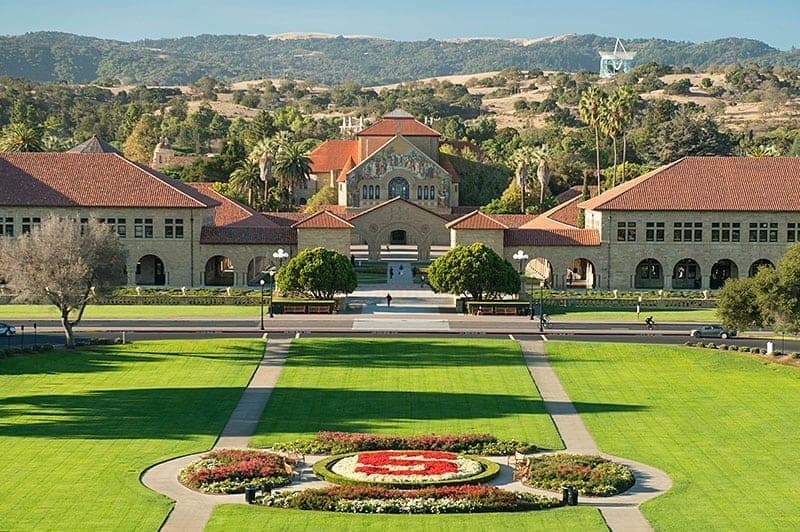
Stanford University needs no introduction.
Long regarded as one of the most selective universities in the world, Stanford University continues to admit only a tiny fraction of the students who apply. Its acceptance rate has remained below 4% in recent years, placing it among the most competitive institutions in the United States. For the Class of 2029, the latest confirmed admissions data available in 2026, Stanford admitted 2,302 students from a record 60,646 applicants, resulting in an acceptance rate of approximately 3.8%.
This figure keeps Stanford in the same selectivity range as the most competitive Ivy League universities. For comparison, Harvard’s most recently available Class of 2029 data shows an acceptance rate of around 4.2%, Princeton’s was about 4.4%, and the University of Pennsylvania reported an acceptance rate of about 5% for the same class year. Stanford’s numbers reinforce what applicants already know: admission to the Farm remains extraordinarily competitive.
For the Class of 2028, Stanford admitted 2,067 students from 57,326 applicants, for an acceptance rate of 3.61%. The following year, applications rose significantly to 60,646, while the number of admitted students increased to 2,302. This slight rise in the acceptance rate to 3.8% does not signal that Stanford has become easier to get into; rather, it reflects the university’s intentional move to enroll a somewhat larger class while still maintaining one of the lowest admit rates in the country.
Changing trends
Stanford’s admissions trends over the last few cycles show both consistency and change. The applicant pool dipped from 56,378 for the Class of 2026 to 53,733 for the Class of 2027, before climbing again to 57,326 for the Class of 2028 and then reaching a new high of 60,646 for the Class of 2029.
The acceptance rate has moved within a very narrow band: 3.68% for the Class of 2026, 3.91% for the Class of 2027, 3.61% for the Class of 2028, and approximately 3.8% for the Class of 2029, according to Stanford’s Common Data Set. The broader trend is clear: Stanford’s admit rate has stabilized at a level where only about four out of every hundred applicants receive an offer.
Another important trend is Stanford’s gradual effort to expand access. In fall 2025, Stanford enrolled 1,866 first-year undergraduate students, a larger class than in recent years. The university also enrolled 90 transfer students, its largest transfer class in recent memory. Stanford has described this growth as part of an intentional effort to give more exceptionally qualified students access to a Stanford education while preserving the undergraduate experience.
Geographical diversity
The Class of 2029 continued Stanford’s tradition of broad geographical representation. According to Stanford’s Class of 2029 profile, the incoming class represented all 50 U.S. states and 70 non-U.S. countries. This level of geographic diversity remains one of Stanford’s defining strengths, bringing together students from a wide range of cultural, educational, and social backgrounds.
Stanford also reported that 58% of the Class of 2029 came from public high schools, 28% from private schools, and 14% from international high schools. The incoming students spoke 81 languages at home, reinforcing the global and multicultural character of the undergraduate community.
Standardized testing
A major update for applicants is Stanford’s return to standardized testing. Stanford was test-optional for students applying in fall 2024 for admission to the Class of 2029. However, beginning with students applying in fall 2025 for admission to the Class of 2030, Stanford requires either the SAT or ACT again, as announced in its official update on the standardized testing requirement.
This means that students preparing applications for Fall 2026 entry and beyond should plan their testing timeline carefully. Stanford has stated that test scores are reviewed as one part of a holistic admissions process, not as a standalone deciding factor. Academic preparation, course rigor, grades, intellectual vitality, personal qualities, essays, recommendations, extracurricular engagement, and context all remain central to the review.
For context, Stanford’s reported middle 50% score range for the Class of 2028 was 1510–1570 on the SAT and 34–35 on the ACT among students who submitted scores. These ranges should not be interpreted as minimum requirements, but they do indicate the level of academic preparation typically seen among enrolled Stanford students.
Students applying to Stanford should also pay close attention to the university’s essays. The Stanford supplements are short, personal, and highly revealing, giving applicants limited space to show intellectual vitality, voice, and fit. Read more: Tips for the Stanford Supplemental Essays.

A diverse student body
Stanford’s Class of 2029 reflects a varied and highly accomplished student body. According to Stanford’s preliminary enrollment data, 20% of first-year students were the first in their families to attend college. Among students receiving aid, the average university scholarship for the incoming class was $69,415.
Using Stanford’s “check all that apply” reporting method, 43.9% of first-year students self-identified as Asian, 42.1% as White, 12.7% as international, 12.4% as Hispanic, 5.8% as Black, 3.0% as American Indian, and 1.3% as Pacific Islander. Because students may select more than one identity under this methodology, the percentages do not add up to 100%.
The Class of 2028 had also shown notable shifts in enrollment patterns following the U.S. Supreme Court’s 2023 decision on race-conscious admissions. Stanford has emphasized that it remains committed to building a diverse class through legally permissible means, including expanded outreach to students from a wider range of communities.
Increased competitiveness
Stanford’s latest data confirms that the university remains among the most competitive undergraduate admissions environments in the world. A record 60,646 students applied for the Class of 2029, and only 2,302 were admitted. Even with a slightly larger admitted class, the acceptance rate remained below 4%.
Part of Stanford’s competitiveness comes from its broad academic appeal. Unlike institutions that attract a more concentrated applicant pool in one area, Stanford draws students across engineering, computer science, humanities, social sciences, business-oriented fields, public policy, the arts, sustainability, and interdisciplinary study. Its location in Silicon Valley, strong undergraduate research culture, flexible academic structure, and entrepreneurial ecosystem all contribute to its unusually wide applicant base.
Stanford looks for students who combine academic excellence with curiosity, initiative, depth, and contribution. The strongest applicants are not simply high scorers or strong students; they are young people who have used their opportunities meaningfully, challenged themselves, built authentic interests, and shown the potential to contribute to a dynamic campus community.
This is why planning matters. Students interested in Stanford should use their high school years intentionally: choosing rigorous courses, developing genuine interests, contributing to their communities, building strong relationships with teachers, and reflecting deeply on who they are and what they value.
Working with experienced college counselors, study abroad consultants, or overseas education consultants can help students make thoughtful choices throughout high school and prepare stronger, more authentic applications. Ivy Central offers focused guidance to help students plan their academic and extracurricular journey, build a balanced college list, and approach the application process with clarity and confidence.
Start early, stay intentional, and make every year count.